Shopify AI: How Artificial Intelligence Is Transforming Ecommerce (2026)


Shopify AI is an umbrella term covering built-in tools like Shopify Magic and Sidekick, plus a growing ecosystem of third-party apps and developer frameworks.
Shopify has been quietly embedding AI into every layer of the merchant experience - from store creation and product content to customer support and analytics.
This guide covers the full Shopify AI landscape: native features, third-party tools, developer capabilities, and practical use cases organized by merchant workflow. Whether you are a new merchant or an experienced developer, you will find actionable insights here.
What Is Shopify AI? A Quick Overview
"Shopify AI" is not a single product. It is the full collection of artificial intelligence features, developer frameworks, and third-party apps that power the Shopify ecosystem. Understanding this distinction matters because merchants often search for "Shopify AI" expecting one tool, when in reality they are looking at a layered platform.
Shopify's AI journey accelerated noticeably in recent years. The company introduced Shopify Magic as its first broadly available AI feature set, followed by Sidekick as a conversational commerce assistant, then the AI Store Builder for rapid store creation, and most recently the AI Toolkit and Model Context Protocol (MCP) for developers building AI-powered apps.
The core idea is straightforward: Shopify is building AI into every layer of the merchant experience, from the first moment a seller describes their business idea to the daily tasks of managing orders, writing product copy, and responding to customers.

Shopify's Native AI Features
In this section I will cover the AI capabilities that come directly from Shopify, without needing to install any third-party app.
1. Shopify Magic: AI-Powered Content and Productivity Assistant
Shopify Magic is Shopify's free, built-in suite of AI-powered features embedded throughout the Shopify admin. According to Shopify's official documentation, it is available to all merchants regardless of plan.
The key capabilities span several areas of store management. For product listings, Shopify Magic generates SEO-friendly descriptions based on keywords, tone preferences, and product details you provide. Inside Shopify Email, it produces subject lines and body copy to speed up campaign creation. It can also generate blog outlines and draft content to support your content marketing efforts.
On the visual side, AI-powered background removal and image generation help merchants create cleaner product photos without relying on external editing tools. Within Shopify Inbox, Magic suggests responses to customer messages based on conversation context, helping support teams reply faster and more consistently.
To access Shopify Magic, navigate to the relevant section of your Shopify admin, such as the product editor, email builder, or Inbox, and look for the AI assist button or prompt field. It is embedded directly into the workflow rather than sitting in a separate menu.

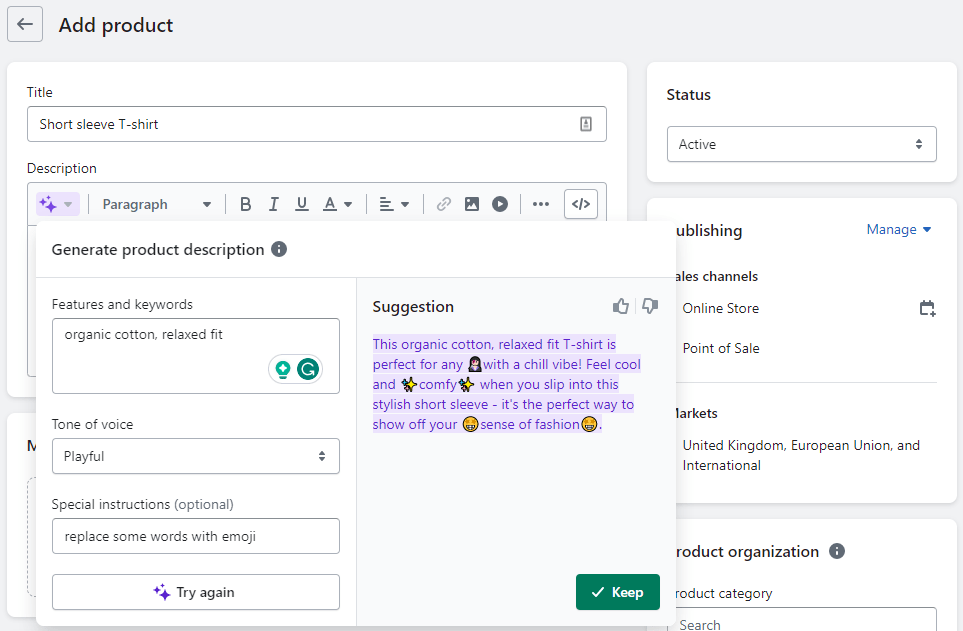
My honest assessment: the output quality is genuinely useful as a starting point, but most merchants will need to review and edit AI-generated content before publishing. Language support is improving but not yet comprehensive across all languages. Think of Shopify Magic as a first-draft assistant rather than a finished-content generator.
2. Sidekick: Shopify's AI Commerce Assistant
Sidekick is Shopify's conversational AI assistant, built directly into the Shopify admin. It is designed to help merchants run their stores through natural language, meaning you type a question or request in plain language and Sidekick responds or takes action for you.
What Sidekick can do goes beyond simple question-and-answer. It can help with store setup tasks like adding products, configuring discounts, and adjusting shipping settings. Moreover, it can answer questions about store performance and pull relevant data. It also provides guidance on Shopify features and best practices without requiring merchants to search through help documentation.
At this point, you might be a little confused between Sidekick and Shopify Magic.
So here’s the thing: Shopify Magic is a set of content generation tools embedded in specific admin workflows such as the product editor. While Sidekick is a conversational assistant that spans the entire admin experience and can take actions on your behalf based on natural language prompts.
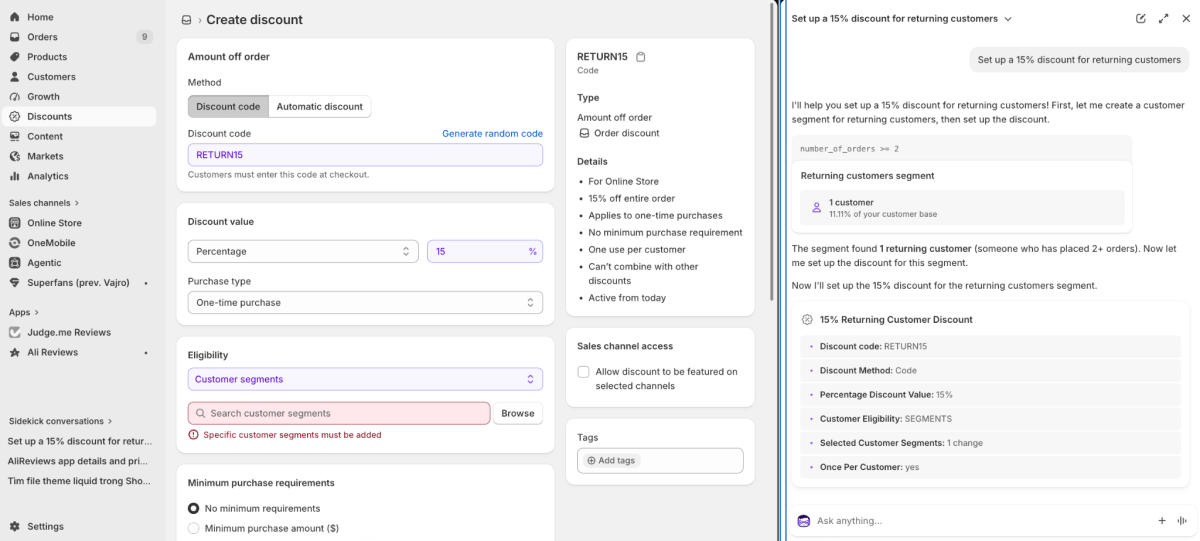
Practical prompts you can try with sidekick include: "Set up a 15% discount for returning customers," "Show me which products have the lowest inventory," or "Help me write a shipping policy." Sidekick interprets these requests and either executes them or guides you through the steps.
3. Shopify AI Store Builder
The AI Store Builder allows anyone to describe their business in a few sentences and receive a complete, functional Shopify store in return. The process involves describing your business, after which the AI generates a store layout, branding direction, sample products, and supporting pages.
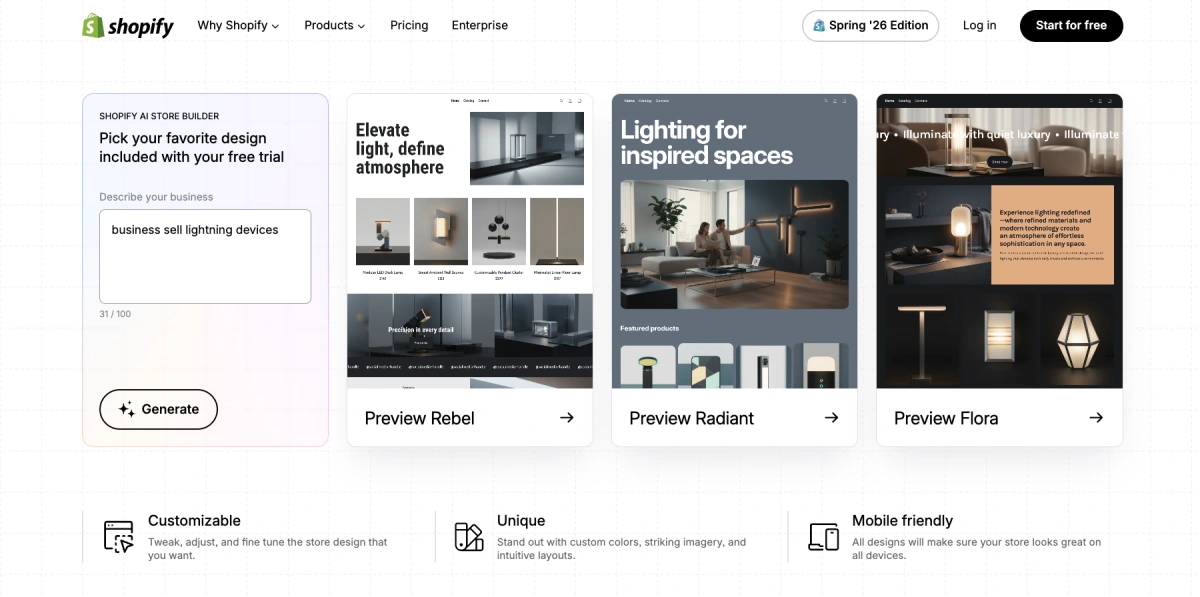
This tool is best suited for entrepreneurs validating a new idea quickly or beginners who need a structured starting point rather than a blank canvas. It genuinely lowers the barrier to launching a Shopify store.
The important caveat: the generated store is a starting point, not a finished product. Sample products, placeholder content, and generated branding all need to be replaced with real assets before the store is ready for customers. Treat it as a scaffold, not a finished build.
Best Third-Party AI Tools and Apps for Shopify
Beyond Shopify's native features, the Shopify App Store hosts a large and growing ecosystem of AI-powered tools built by third-party developers. The categories below cover the most impactful areas for merchant workflows.
If you don’t want to read the whole paragraph, here’s a quick comparison of some of the best AI tools for Shopify, along with the use cases I recommend for each.
1. AI Tools for Product Content and SEO
Several third-party apps extend well beyond what Shopify Magic offers for product content. Tools such as Jasper, Copy.ai integrations, and dedicated Shopify SEO apps can generate bulk product descriptions, optimize meta titles and descriptions, and suggest keyword improvements at scale.
Once your product descriptions are generated in bulk, running them through a tool like Clever AI Humanizer can help remove the robotic tone and make the copy sound more natural before publishing
These are particularly useful for merchants managing large catalogs who need to produce consistent, optimized content efficiently.
2. AI Tools for Customer Support and Chat
AI chatbots built for Shopify storefronts can handle order tracking inquiries, answer common FAQs, and upsell or cross-sell products through conversational flows.
Apps like Tidio and Gorgias with AI features allow merchants to offer around-the-clock support without adding headcount, making them especially valuable for stores with high support volume.
3. AI Tools for Marketing and Advertising
AI also takes the repetitive grind off your marketing team's plate. Need ad creatives fast? Tools like Zeely AI turn a product URL into a video or static ad in minutes while AdScale goes a step further and manages the bidding and targeting on Google and Meta too, so you're testing more angles without burning hours on manual builds.
Email is the same story. Klaviyo's AI layer optimizes send times, subject lines, and segments based on actual engagement data, not guesswork. If you want something closer to zero-setup, Wiz builds and writes your core flows (welcome, abandoned checkout, winback) automatically so you're only reviewing copy, not writing it from scratch.
Pricing is the one merchants sleep on. Apps like Intelis and Prisync track competitor prices and stock in real time and reprice within the guardrails you set, so you're not manually checking what everyone else charges every morning. For simpler catalog-wide changes like schedule a sale, let it auto-revert then Pricing.AI handles that without touching AI-driven demand modeling at all.
None of this replaces your judgment on strategy or brand voice. It just means the busywork runs while you focus on the decisions that actually move the margin.
4. AI Tools for Analytics and Profit Tracking
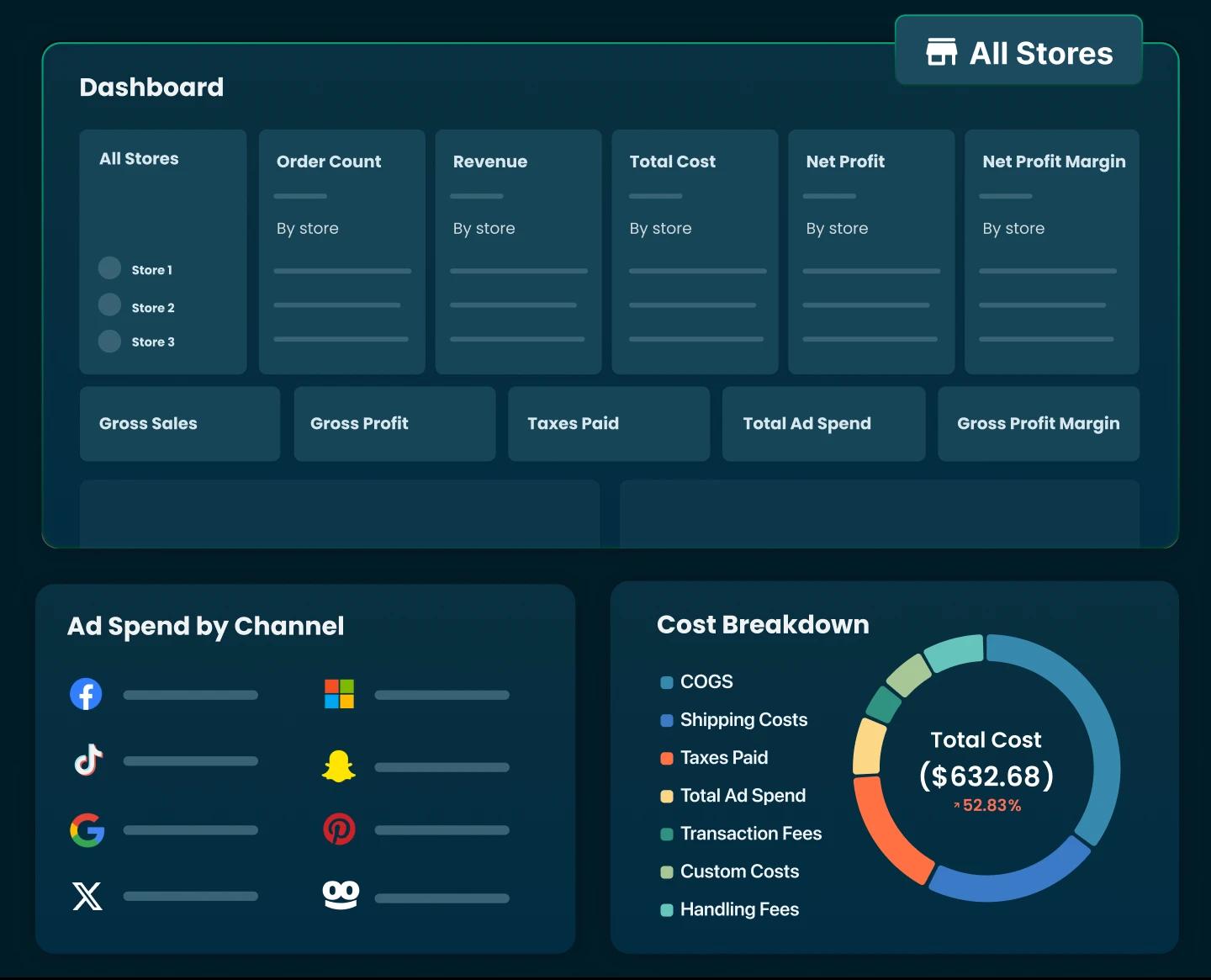
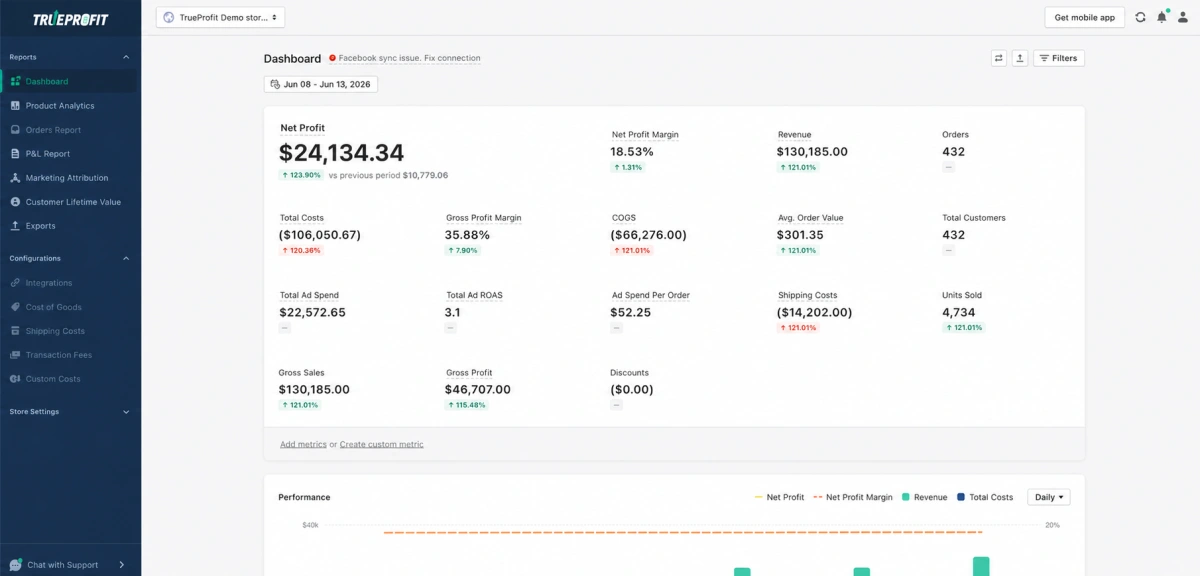
This is where AI creates some of the most tangible business value for Shopify merchants. Raw traffic and revenue numbers are useful, but net profit, after ad spend, COGS, shipping, and platform fees, is what actually drives better decisions.
Tools like TrueProfit connect directly to your Shopify store and consolidate all revenue and cost data into a real-time net profit focused dashboard. It also connects via MCP, so you can ask AI directly ("why did profit drop last Tuesday?") and get an answer from your real numbers, plus build custom dashboards around whatever metric matters that week. That's what turns a random traffic spike into an actual answer: is it profitable, or just noise?
Combine that with AI-generated content and AI-driven ad campaigns, and you can see whether your AI efforts are moving the bottom line, not just the top line.
5. AI Tools for Store Design and Visual Content
AI image generators and integrations like Adobe Firefly handle the visual grunt work: cleaning up product photography, generating lifestyle shots without a photoshoot, and putting together banners in minutes instead of a Canva session.
Before publishing or accepting visual assets from outside contributors, merchants can also use an AI image detector to assess whether an image may have been created or significantly altered using artificial intelligence.
For store design, native AI Store Builder gets you a working layout fast, but it's generic by design. Third-party builders like DropMagic and Atlas go further, generating unique color schemes, typography, and full page structures from a product link, so your store doesn't look like every other AI-built one.
If you already have a store and just want more design control, Shogun or GemPages give you drag-and-drop customization Shopify's native editor doesn't offer, no developer needed.
Some Limitations You Should Keep In Mind
AI can speed up almost every part of running a Shopify store, but it's worth being honest about what it's actually good at right now, and what still needs a human.
What Shopify AI Does Well
Shopify AI genuinely lowers the barrier to entry. Writing product descriptions, setting up a store, handling basic customer replies, all meaningfully faster with AI in the loop. If you don't have copywriting or design skills, this is a real equalizer. Weeks of work compressed into hours.
Where It Falls Short
Nothing Shopify Magic or the AI Store Builder produces is production-ready out of the box. Review it before it goes live. An AI-generated store still needs your actual branding, actual products, actual content; the AI gives you a draft, not a finished brand.
And if you want profit-level analytics (net margin, not just revenue), that's not something Shopify's native AI does yet. Some Sidekick features are also still rolling out gradually, so what you see depends on your region and plan.
AI Won't Replace Strategy
AI speeds up execution. It doesn't understand your market, your customers, or your unit economics for you. The merchants getting the most out of Shopify AI aren't the ones automating everything, they're the ones using it to save time on the busywork while staying focused on whether the business is actually profitable.

The Future of Shopify AI: What Is Coming?
Based on Shopify Editions announcements and public statements from Shopify's leadership, the direction is clear: more autonomous AI agents, deeper personalization across the storefront experience, and an AI-native app ecosystem built on the MCP framework.
Shopify has also been referenced in developer discussions in connection with Anthropic's Claude AI model as a potential underlying technology for some of its AI features. The "Shopify AI Claude" connection reflects Shopify's broader approach of partnering with leading AI model providers rather than building foundation models from scratch.
The longer-term vision of Shopify as the AI shopping layer of the internet suggests that future Shopify storefronts may be accessible not just through browsers but through AI agents operating across the web on behalf of shoppers. For merchants, this means the platform's capabilities will continue to expand well beyond what is available today.
Final Thoughts
Shopify AI is not a single feature. It is an ecosystem. From the free content tools inside Shopify Magic to the conversational intelligence of Sidekick, from third-party AI apps to a developer platform built for the next generation of AI-powered commerce, Shopify has made a clear commitment to making artificial intelligence central to how merchants build and run their stores.
The merchants who benefit most are not those who adopt every AI tool available. They are the ones who use AI strategically to save time on execution, improve content quality, and serve customers better, while keeping a clear eye on true profitability. Every AI-powered ad campaign, product description, and customer interaction should ultimately be measured against one question: is it making the business more profitable?
That is where a tool like TrueProfit becomes essential. Understanding your real net profit, not just revenue, is the foundation that makes every AI tool more effective and every business decision more confident.


Harry Chu is the Founder of TrueProfit, a net profit tracking solution designed to help Shopify merchants gain real-time insights into their actual profits. With 11+ years of experience in eCommerce and technology, his expertise in profit analytics, cost tracking, and data-driven decision-making has made him a trusted voice for thousands of Shopify merchants.