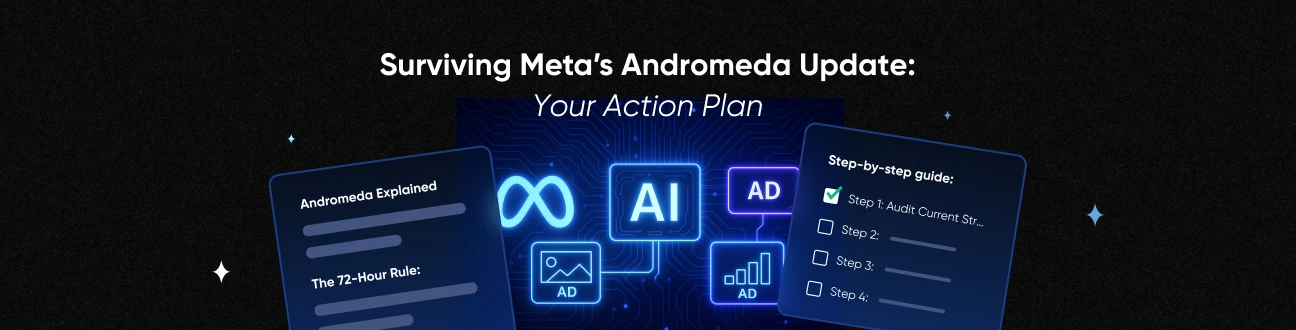
Surviving Meta’s Andromeda Update: Your Action Plan
Meta’s new ad engine, Andromeda, is already shaking things up.
And if your CPMs or CPAs have been acting weird lately, this update could be the reason.
Andromeda changes how Meta’s system selects and delivers ads — shifting more control to machine learning and less to manual targeting.
In short, the old playbook doesn’t hit the same anymore.
Ahead: The deep insights + action plan you need to survive and thrive in this new era.
Andromeda Explained
First, What Is Andromeda?
Andromeda is Meta's new ad delivery engine.
Think of it as the brain that decides which ad to show to which person.
The old brain followed strict rules. The new brain plays the odds—it's constantly learning, adapting, and testing at massive scale.
What Actually Changed
The algorithm went from deterministic (rule-based) to probabilistic (best-guess).
Old way (Deterministic):
- Followed fixed targeting rules based on demographics and interests
- Same targeting parameters = same ad shown every time
- Manual, rigid, predictable
New way (Probabilistic):
- AI analyzes thousands of real-time signals (behavior, context, timing, past interactions)
- Predicts which ad has the highest probability of converting for each user
- Two identical users can see completely different ads
Why this matters:
Your job isn't to find "the one winning ad" anymore:
- The old game: Find one winner, show it to everyone.
- The new game: Give the system 5-10 different winners so it can match the right ad to each person
Why Your Old Playbook Died
What's Dead:
- Manual targeting with layered audiences
- Finding one winner and riding it with minor tweaks
- Manual bid optimization without strategic framework
- Auction that favored one dominant winner
What Works Now:
- Multiple conceptually different angles per product (minimum 5)
- Visual diversity that's obvious in the first 3 seconds
- Weekly creative refreshes, not monthly
- Letting the algorithm choose who sees what & when
The shift is simple: The old system rewarded you for finding one perfect ad. The new system rewards you for giving it multiple strong options.
One winner worked when the machine was simple. Now the machine is smart, and it's hungry for choices.
What Most Advertisers Got Wrong
When Andromeda dropped, we watched the same mistake play out everywhere.
The narrative went: "The algorithm is smarter now, so just launch 100 ads and let it figure it out."
Sounds logical, right? It's not.
Think of it like this: If we gave you 100 white t-shirts with slightly different neck cuts, you still just have... a bunch of white t-shirts. But if we gave you 5 completely different outfits—a suit, gym gear, casual streetwear, beachwear, and formal attire—now you've got real options for different occasions.
That's the difference between creative volume and creative diversity.
Here's what actually happens when you dump 100 similar ads into an account:
- Each ad becomes its own tiny data pool, needing impressions, clicks, and conversions for the algo to learn. But with limited budget, most ads never get enough data.
- The machine defaults to showing ads with existing signals, meaning your new ads just compete with each other.
You didn't give the algorithm diverse options. You gave it 100 versions of the same thing and asked it to pick.
Meta doesn't need more ads.
It needs more different ads—ones that target different personas, address different pain points, and are visually distinct.
Your Action Plan
STEP 1: Audit Your Current Structure
Before you change anything, you need to know what you're working with.
What to Review
Pull up your Meta Ads Manager and answer these questions:
- How many campaigns are running? (If it's more than 5, you're probably over-fragmented)
- How many ad sets per campaign?
- How many ads per ad set?
- What's your oldest active ad? (Proven winners should be running for 60+ days minimum)
Identify Your Winners
Now dig into performance. Which 3-6 ads have been consistently delivering over the last 30+ days?
Ask yourself:
- What formats work best? (Video, static, carousel)
- What messages actually resonate? (Problem-focused, social proof, features-driven, etc.)
- Are these ads genuinely different from each other, or are they variations of the same concept?
Calculate Your Baseline
You need numbers to measure against:
- 7-Day Average ROAS
- CPM trends by ad format
- CTR by creative type
- Landing page conversion rate
STEP 2: Restructure for Consolidation
Alright, you've audited. You know what's broken. Now let's fix it.
The goal here is simple: Give the algorithm clean, concentrated data instead of fragmented garbage.
Account Structure
There are a few ways to restructure this depending on your budget and experience, but here's the setup we recommend for most:
├── Main Campaign
├── Ad Set 1: Proven Winners (80-90% budget)
│ ├── Winner Ad 1
│ ├── Winner Ad 2
│ ├── Winner Ad 3
│ ├── Winner Ad 4
│ └── Winner Ad 5
│
└── Ad Set 2: Testing (10-20% budget)
├── New Test Concept 1
├── New Test Concept 2
└── New Test Concept 3
Ad Set 1: Proven Winners
This ad set contains 3-6 ads maximum.
These are your proven, diverse concepts—the ones that actually work:
- All have 50+ conversions (they've exited the learning phase)
- Diverse formats (video, static, carousel, etc.)
- Complementary messaging (testimonial, demo, features, etc.)
- Run continuously and never touched unless performance actually degrades
Budget allocation: 80-90% budget
This is your revenue engine. It's predictable & scalable.
Ad Set 2: Testing
This ad set contains 3-15 new concepts you're actively testing.
Kill protocol:
- If CPA is 2x your target after 48 hours → Kill it
- If an ad proves itself after 72 hours → Graduate it to Proven Winners
Budget allocation: 10-20% of your total spend.
This ad set exists to find improvements for your weakest link in the Winners ad set.
Budget Tier Adaptations
How you organize your Testing ad set also depends on how much you're spending:
- High Budget (£50k+/week total = £5k+/week for Testing): Split your Testing budget into separate ad sets for each big concept you want to test.
- Mid Budget (£10-50k/week total = £1-5k/week for Testing): Keep one Testing ad set, but organize your tests in batches by persona. For example: Week 1-2: test 8-15 creatives aimed at busy parents. Week 3-4: test 8-15 creatives aimed at young professionals. One ad set, but focused testing windows.
- Low Budget (<£10k/week total = <£1k/week for Testing): One Testing ad set with 3-10 creatives maximum, all running together for 10-14 days. Everything tests side-by-side. Let the algorithm surface winners from the consolidated pool.
More budget = more room to isolate variables. Less budget = keep everything tighter.
Targeting
Keep it stupid simple. Here's what your targeting should look like:
- Age. Gender. Location. That's it.
- No interest targeting. You're just restricting the algorithm from finding high-intent users outside your assumptions.
- No lookalike audiences. Broad already includes them and performs better at scale.
- No detailed exclusions. If someone wants to buy again, why would you stop them?
In short: Let your creative do the targeting.
STEP 3: Test Strategically
You've got the structure. Now let's talk about what actually goes inside it.
Like we said, Andromeda doesn't just want more ads. It wants different ads.
And there's a specific way to create "different" that the algorithm actually recognizes.
The 3-Second Rule (This Is Critical For Video Ads)
Meta considers video ads "the same" if the first 3 seconds look similar—even if your copy, CTA, and messaging are completely different.
Let me say that again: You can change every word in your video, but if the opening visual looks the same, Meta groups them as identical and throttles delivery.
What Meta flags as "similar":
- Same creator + same setting = identical
- Same background + different text overlay = identical
- Same product shot + different hook = identical
What Meta sees as "different":
- Different visual environments (office vs. gym vs. home)
- Different creators/talent
- Different production styles (UGC vs. polished vs. static)
If someone scrolled past your ad on mute, would they think they'd seen it before? If yes—it's too similar.
The Persona-First Framework
Instead of making 20 versions of the same message, identify 4-5 distinct customer types who buy for different reasons.
Example: For a skincare product, you might have: One cares about speed (fast results). One cares about price (affordable solution). One wants proof it works (testimonials/science). One needs natural ingredients (clean beauty).
Create ads that speak to each motivation—with visually different settings and messaging that feels tailored to that specific audience.
Same product. Different reasons to buy.
What to Test (In Order of Impact)
1. Visual diversity (Biggest lever)
- Video: Different hooks, creators, styles, etc.
- Static: Different compositions, backgrounds, styles
- Carousel: Different structures and themes
2. Angles: Different pain points or benefits (speed vs. cost vs. results)
3. Formats: Video vs. static vs. carousel—different people consume differently
4. Offers: "BOGO" vs. "50% off" vs. "Free shipping"
5. Messaging variations: Headlines, body copy, CTAs
Start at the top & test ONE thing at a time.
STEP 4: Scale & Optimize
You've restructured. You're testing diverse concepts. Now comes the hard part: Not touching anything.
Let me walk you through the actual timeline.
Days 1-3: Launch & Monitor
You're only checking for technical issues:
- Delivery status = "Active"
- Ads are spending
- No policy rejections
That's it. Don't look at CPA. Don't look at ROAS. The algorithm is still figuring things out.
Days 4-7: Initial Health Check
Now you can start looking at early signals.
Key metrics:
Outbound CTR (oCTR): Should be ≥ 0.8%
- Below 0.8% = weak scroll-stopping power
CPM vs. account average: Should be ≤ 1.5x your baseline
- Way higher = creative isn't resonating in the auction
Frequency: Should be < 2.0
- Above 2.0 this early = you're already showing the same ad too many times
Kill protocol (only if BOTH are true):
- oCTR < 0.8% AND CPM > 150% of your average
Days 8-14: Performance Evaluation
Now you can judge based on actual conversions.
What you're looking for:
- Minimum 10 conversions before you make any decisions
- CPA at or below target = keep it running
- CPA 2x target after 48 hours = kill it
- ROAS above target = graduate to Proven Winners
Don't kill ads with low spend if they have good efficiency. The algorithm might be holding them for specific micro-audiences.
Kill ads with high impressions but terrible CTR. Those are confirmed duds.
Day 15+: Time to Scale
Your ads are validated. Performance is stable. Now you can pour gas on the fire.
Standard Scaling Protocol:
If ROAS is at or above target:
- Increase budget by 20% every 3 days
- Monitor: CPM, CTR, conversion rate, frequency
- If all metrics stay stable, keep scaling
Aggressive Scaling (Under $1k/day spend):
When you're spending less than $1k daily, the dollar risk is minimal.
- Increase budget by 50% every 2 days
- Watch for red flags: CPM spike >30%, CTR drop >25%, conversion rate decrease >20%
- If you hit any threshold, pause scaling and stabilize for 48 hours
When to STOP Scaling:
Hit the brakes immediately if you see:
- Impression share declining while spend increases (you've maxed out your audience)
- CPM rising but CTR staying flat (creative fatigue)
- Add-to-cart rate dropping >15% week-over-week
- ROAS declining >20% from baseline
These signals mean you've hit your campaign's ceiling. Don't force it.
Maintain current spend and focus on creative refresh instead.
Final Thoughts
Meta will change again. It always does.
And here's what we've noticed after a long time in this game: The tactics change. The principle doesn't.
Brands that thrive long-term aren't the ones who panic and chase every new playbook.
They're the ones who understand their numbers, build adaptable systems, and stay calm when everyone else panics.
Remember, you're not in this alone. We'll keep breaking down what actually matters, so you can focus on what works.

Content Marketer at TrueProfit & eCommerce Operator
I’m part of the TrueProfit content team, but before that, I’m an eCom nerd with 3 years of hands-on experience. I’ve done a bit of everything, but running high-performing ads and making sense of the numbers? That’s my thing. If it’s written here, it’s because I’ve lived it.
 Top Reads