8 Best AI Analytics Platforms for Shopify in 2026 (Compared by Features, Pricing & Use Case)


I've run and scaled Shopify stores long enough to tell you the truth: the brands that win aren't the ones with the prettiest dashboard, they're the ones who actually know their numbers. And Shopify's built-in analytics, as handy as it is for the basics, just won't get you there once you're spending real money on ads.
That's where AI-powered platforms come in, layering on attribution modeling, predictive insights, and real-time profit visibility that native reporting can't match. The problem? "AI-powered" gets slapped on everything now. Some tools run serious machine learning; others are a chatbot in a trench coat.
So in this guide I'm cutting through it. Here are the best AI analytics platforms for Shopify brands in 2026, what each one is genuinely good at, what it costs, and which one fits your brand's stage and goals.
How I Evaluated These Platforms
I didn't just pick these off a leaderboard. Every platform here got scored against the same six criteria, so you're getting a real apples-to-apples comparison, not recycled marketing claims.
Here are the six factors I looked at:
- Shopify integration depth: How well the tool connects with Shopify, including native app availability, data syncing reliability, and how easy the setup process is.
- AI capabilities: Whether the platform uses real AI capabilities such as machine learning, prediction, and natural language processing, rather than simply presenting basic reports or dashboards.
- Attribution and ad spend tracking: How accurately it tracks performance across paid channels like Meta, Google, TikTok, and other advertising platforms.
- Profit and unit economics visibility: Whether merchants can track the metrics that actually impact profitability, including COGS, shipping costs, fees, and net profit, instead of focusing only on revenue.
- Pricing and value: The overall value for money, including free plans, pricing at different business sizes, cost scalability, and pricing transparency.
- Community feedback and merchant reviews: Real-world user experiences based on Shopify App Store ratings, trusted review platforms, and feedback from actual merchants.

8 Best AI Analytics Platforms for Shopify Brands in 2026
Alright, here's the main event. These eight platforms are leading the Shopify AI analytics game in 2026, and each one is built for a different job. Here's the quick-scan version, then I'll break down every single one below.
1. TrueProfit: The #1 real-time net profit analytics for Shopify Merchants
Best for: Shopify brands that want to move past revenue metrics and see real net profit at every level of the business.
This one's close to my heart because it answers the question that actually matters: how much money are you keeping, not just how much you're making?
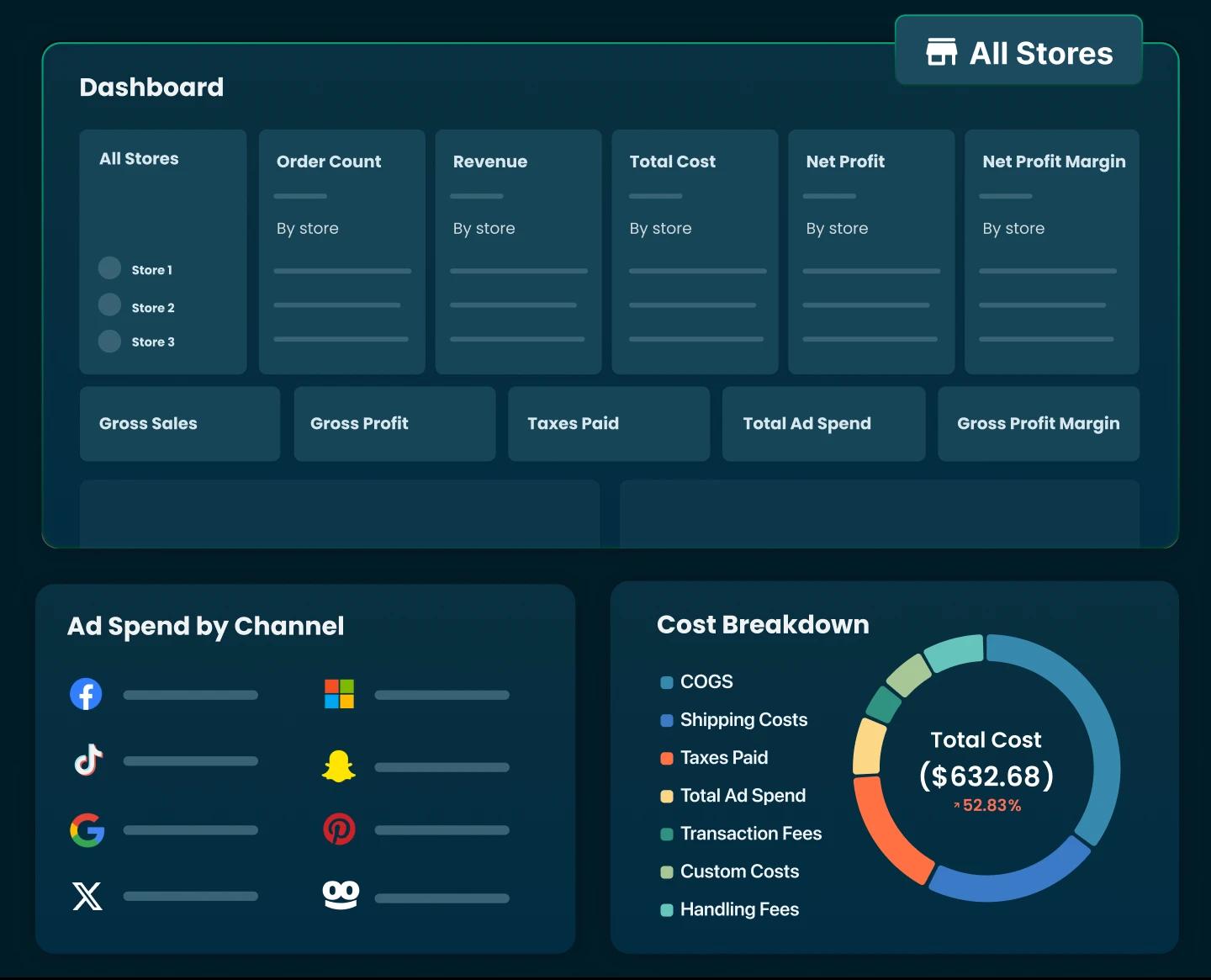
Unlike traditional analytics or spreadsheets with outdated data and manual work, TrueProfit calculates real-time net profit by automatically tracking every key cost like COGS, shipping, transaction fees, ad spend, and custom expenses that impacts your bottom line.

What the AI actually does
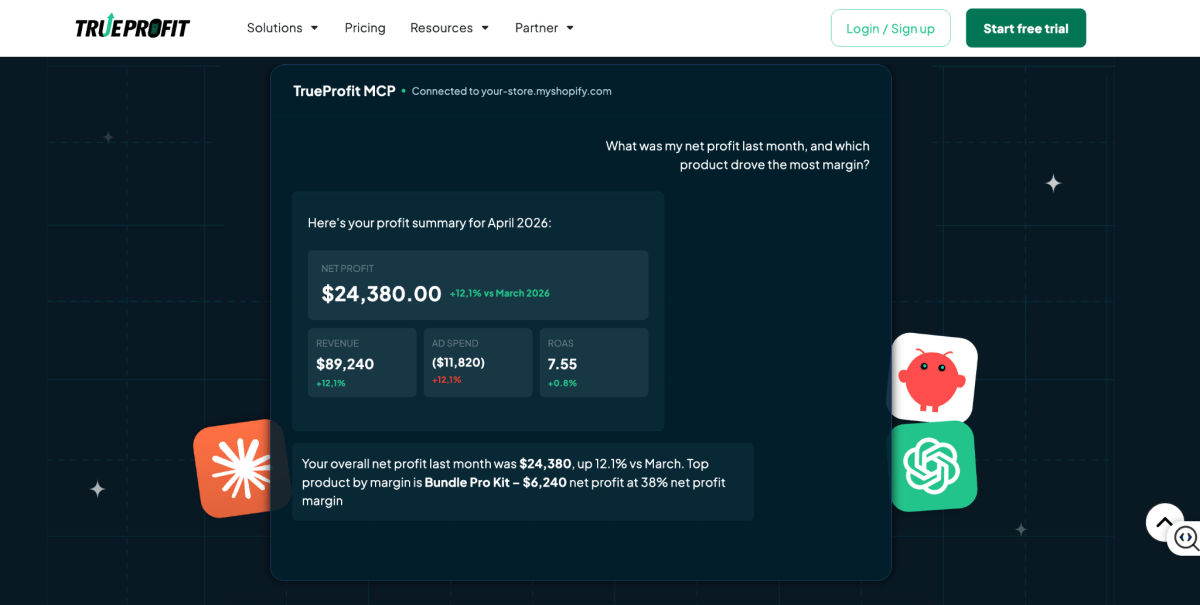
Now, with TrueProfit MCP, AI assistants like Claude and ChatGPT can securely access your store's profit data. Instead of digging through dashboards, you can analyze profit, costs, and business performance simply by asking questions.
- Connects TrueProfit data to AI assistants through Model Context Protocol (MCP)
- Connects AI assistants to real-time store data, enabling answers based on actual revenue, costs, ROAS, and profit metrics, such as:
- "Which products generated the highest net profit last month?"
- "Why did my profit margin drop this week?"
- "Which Meta campaigns are profitable after shipping and fees?"
- Generates on-demand reports, tailored to specific business questions and performance needs.
- Detects anomalies in key metrics, including sales, ad spend, and ROAS, to surface unusual patterns quickly.
- Turns data into insights and recommendations, helping merchants take faster, more informed actions.
Key analytics capabilities
- Real-time net profit dashboard with revenue, expenses, and profit in one view
- Net profit analysis by product, order, customer, marketing channel, and location
- Automatic cost tracking for COGS, shipping, transaction fees, ad spend, refunds, and custom expenses
- Ad spend sync from Meta, Google Ads, TikTok Ads, Microsoft Ads (Bing), Snapchat, Pinterest, X (Twitter), and more
- Automated payment fee syncing from Shopify Payments, PayPal, Stripe, and other supported gateways
- Profit & Loss (P&L) reporting with flexible date ranges and detailed expense breakdowns
- Customer Lifetime Value (LTV) and customer profitability analytics
- AI-powered analytics with TrueProfit MCP, allowing ChatGPT and Claude to answer questions using your live store data
- Multi-store dashboard for managing multiple Shopify stores in one place
Why Shopify brands choose TrueProfit
Here's the wake-up call a lot of us get: you track revenue and ROAS, everything looks great, and then you realize your best-selling product is actually losing money once shipping, returns, and fees hit.
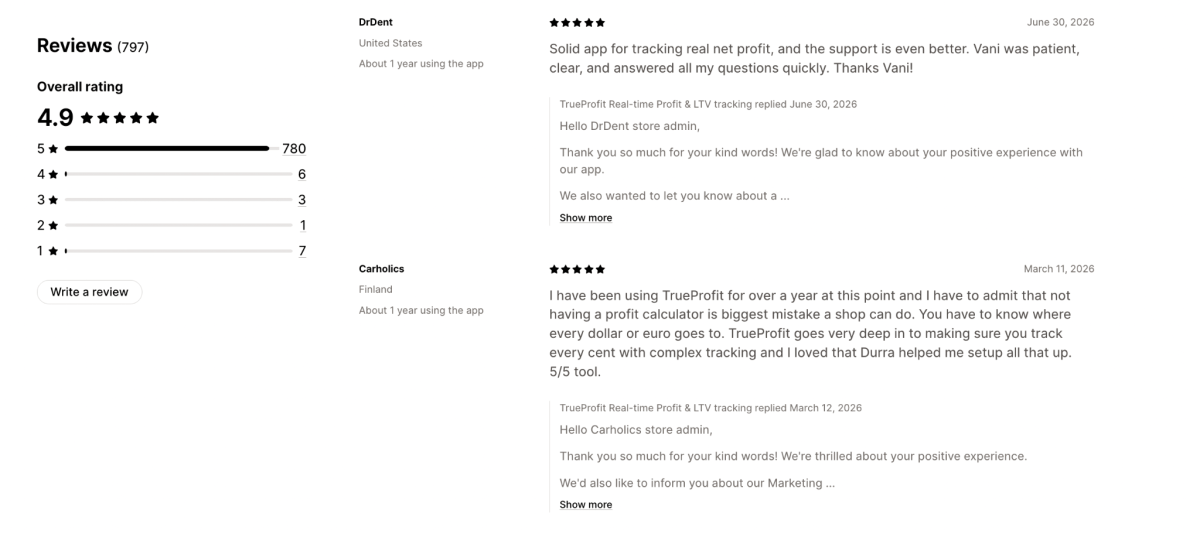
That's what makes TrueProfit so popular among Shopify merchants. By automatically tracking every cost, it replaces spreadsheets with accurate, real-time profit analytics, helping merchants make faster and more confident decisions.
Limitations
TrueProfit is built specifically for profit analytics, not enterprise BI or advanced attribution. And if you run multiple stores, check the pricing model to understand how multiple stores are billed.
Pricing
There's a 14-day free trial. Paid plans start low, with reported entry pricing around $35/mo, scaling by monthly order volume up to roughly $200/mo on the higher tiers.
2. Polar Analytics: Best all-in-one AI analytics platform for growing DTC brands
Best for: Shopify brands that want a unified view of sales, marketing, and customer data with AI-powered reporting.
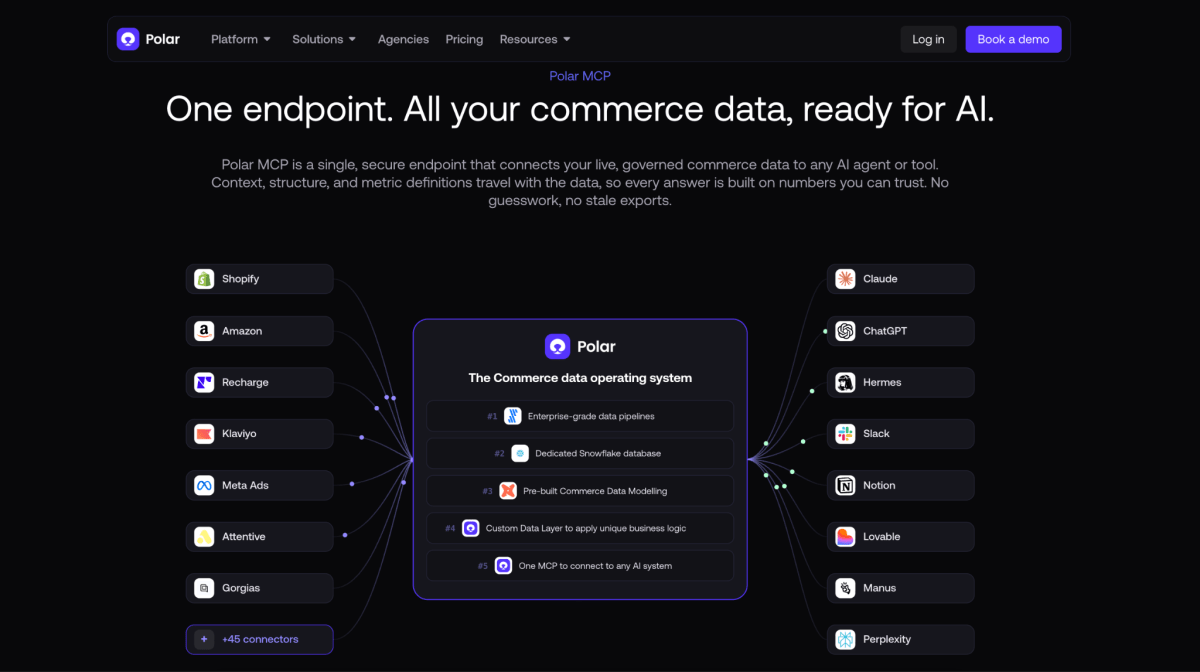
If your team is sick of bouncing between Shopify, Meta Ads, Google Analytics, Klaviyo, and a graveyard of spreadsheets, Polar Analytics pulls all of it into one dashboard. It's built for growing DTC brands that need centralized reporting but don't want to stand up a custom BI stack.
Under the hood, Polar unifies Shopify, your ad accounts, email, and 40+ other sources into a dedicated warehouse, then layers the reporting on top.
What the AI actually does
Polar's AI focuses on making analytics easier to explore rather than manually building reports. Using AI Answers, you can ask questions in plain English, such as:
- Which products generated the highest profit last month?
- Why did ROAS decline this week?
- How did email revenue compare with paid social?
Key analytics capabilities
- Unified dashboard across Shopify, Meta, Google Ads, TikTok, Klaviyo, Amazon, and 100+ sources
- AI-powered natural language queries
- Marketing attribution and channel performance reporting
- Customer and revenue analytics
- Automated executive reports, KPI dashboards, and smart alerts
- Custom metrics and multi-store reporting
- Dedicated Snowflake warehouse with data-ownership rights on higher tiers
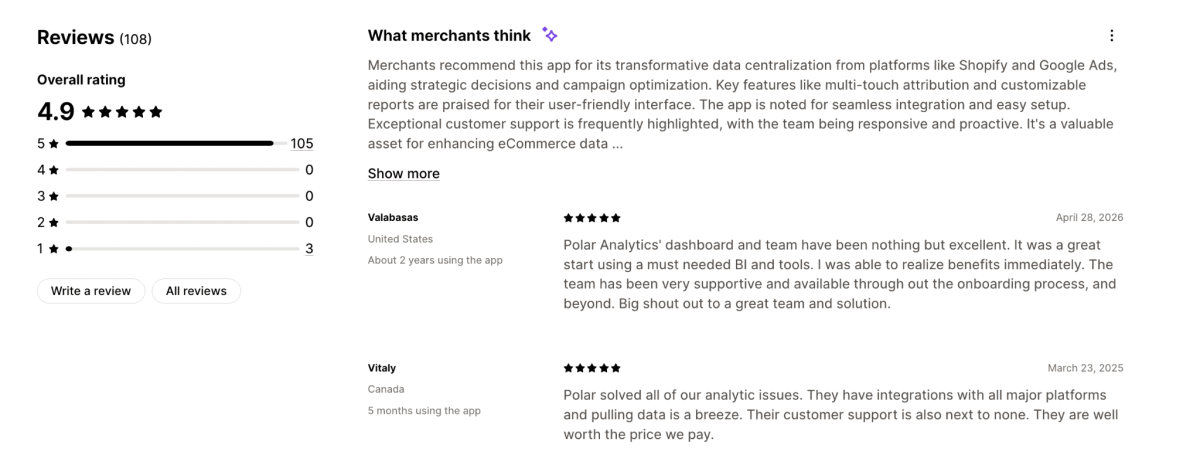
Why Shopify brands choose Polar Analytics
People go with Polar because it becomes the single source of truth for everything.
Limitations
Polar is built for reporting and BI, not for telling you what to do next. The AI surfaces insights, but it won't automatically suggest actions or optimize your campaigns the way some AI assistants do.
Some merchants also notice its attribution numbers don't perfectly match the ad platforms, which comes down to different attribution models. And heads up: pricing climbs as your GMV grows, so it can turn into a real line item at scale.
Pricing
There's a free trial to test it. Paid pricing is tied to GMV, and honestly the public numbers are all over the place, ranging from around $300/mo up to $720/mo or more depending on the bundle and whether you want the dedicated warehouse.
3. Triple Whale: Best for ad spend attribution and creative analytics
Best for: Shopify brands spending heavily on paid media that need granular, cross-channel attribution and creative-level insights.
If you're spending serious money on paid social, Triple Whale is probably already on your radar, and for good reason. The whole thing revolves around Triple Pixel, a first-party pixel that tracks customer journeys independently of Meta or Google's native tracking.
In a post-iOS 14 world where the platform-reported numbers are basically fiction, that independence is a big deal.
What the AI actually does
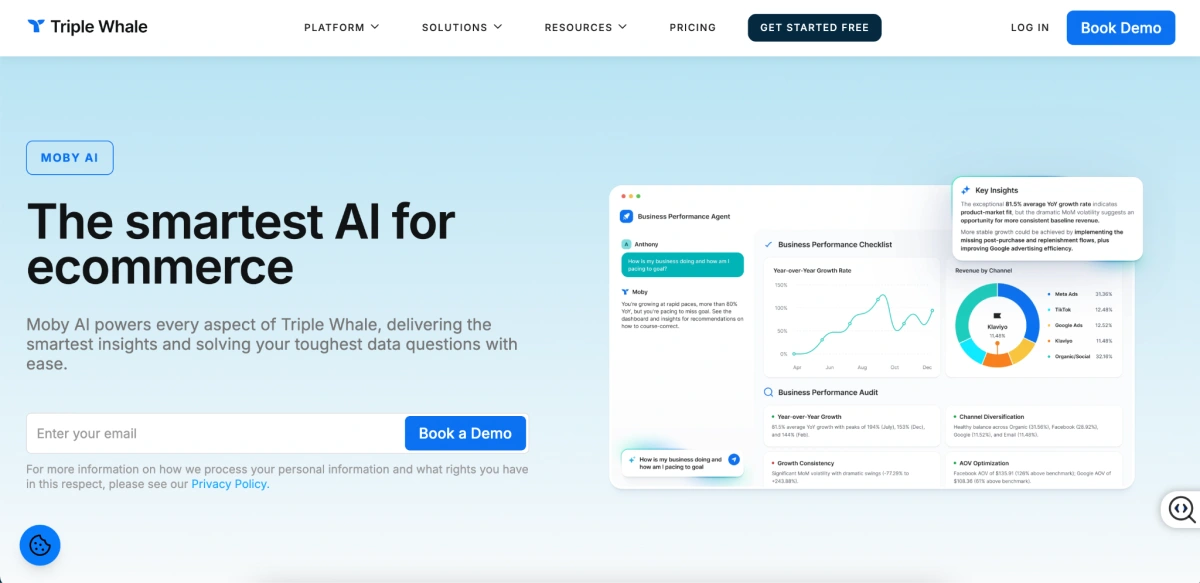
Moby is Triple Whale's AI operator, built to answer questions and take action on your live data. You can chat with it like a teammate to handle things such as:
- What was our blended ROAS across Meta and Google yesterday?
- Which ad creatives are driving the most profitable purchases?
- Build a dashboard tracking new-customer CAC by channel.
Key analytics capabilities
- Triple Pixel first-party attribution across Meta, Google, TikTok, and 60+ integrations
- Multi-touch attribution models
- Creative analytics broken down by individual ad
- Product and cohort analytics
- Post-purchase surveys
- BI tools including dashboards, segmentation, and SQL (higher tiers)
- Multi-store reporting
- Marketing mix modeling and GeoLift incrementality via Compass (Enterprise)
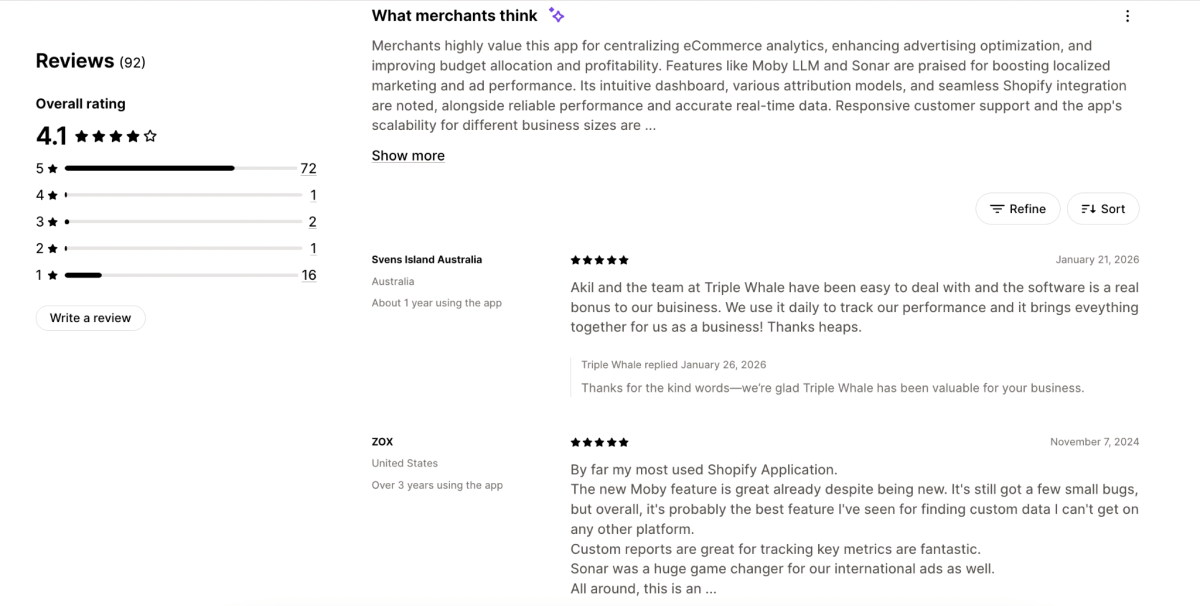
Why Shopify brands choose Triple Whale
That pixel is widely considered one of the most reliable attribution solutions out there, and the creative breakdowns make it dead simple to decide what to scale and what to kill.
Limitations
The knock on Triple Whale is price, and you'll hear it a lot from smaller brands. Because it's GMV-based, a high-revenue but thin-margin store can end up paying more than it really needs to.
Pixel setup takes a bit of technical care, some users report data lagging by a day, and it's Shopify-only, so keep that in mind if you sell elsewhere.
Pricing
There's a free plan (the Founders Dash) to get started. Paid pricing is GMV-based and the entry figures vary depending on who you ask, usually around $129 to $149/mo for the lowest paid tier at smaller GMV, a higher tier around $219/mo, and Compass on a custom quote.
4. Lifetimely (by AMP): Best for customer lifetime value and cohort analysis
Best for: Subscription and repeat-purchase DTC brands that make decisions on LTV, cohort retention, and CAC payback rather than daily revenue alone.
Lifetimely is all about the long game, figuring out what a customer is actually worth over time. While most tools obsess over that first purchase, Lifetimely zooms out, which is exactly what you want if you're in retention, subscriptions, or any repeat-purchase category.
What the AI actually does
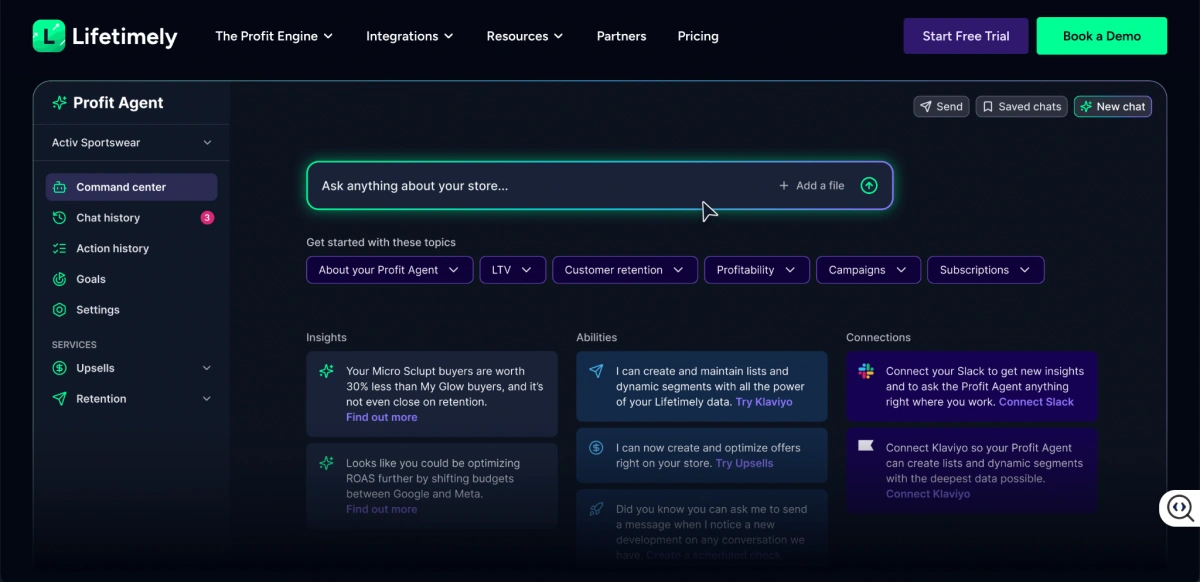
Lifetimely's Profit Agent works like an always-on analyst focused on long-term customer value. It monitors your data around the clock and helps you:
- Forecast future customer value by cohort with predictive LTV modeling.
- Catch opportunities and risks in your P&L, LTV, and attribution, with its reasoning attached.
- Ask natural-language questions about your store and get computed answers.
You approve the actions it suggests, and it can also connect to Claude via MCP so your profit and LTV data feed external AI analysis.
Key analytics capabilities
- Predictive LTV modeling by cohort
- Best-in-class cohort analysis (by first purchase, first product, acquisition channel, geography, and discount code)
- Real-time P&L reporting
- CAC payback and retention curves
- Repurchase-rate reporting
- Industry benchmarking against comparable stores
- Marketing attribution
- Sales forecasting
- Integrations across Meta, Google, Klaviyo, TikTok, QuickBooks, and Amazon
Why Shopify brands choose Lifetimely
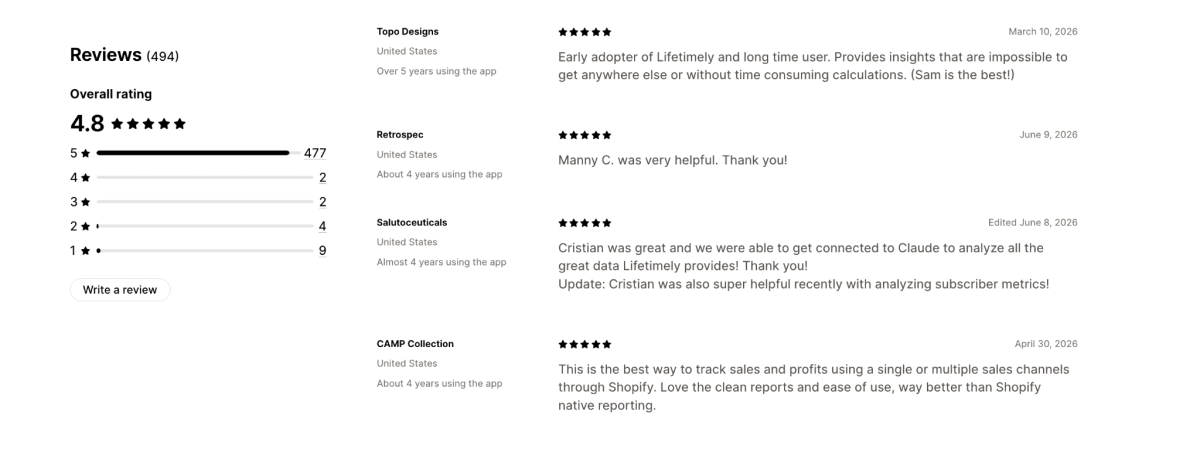
Its cohort analysis gets called the best on the Shopify App Store, and the industry benchmarking feature is close to one-of-a-kind.
Limitations
Data refreshes every few hours instead of in real time, so if you need intraday profit visibility, look at TrueProfit instead. It's also less useful in the early acquisition-heavy grind, its attribution is lighter than the dedicated attribution tools.
Pricing
This one's priced on order volume, not revenue. Free plan if you're under 50 orders/mo. From there the paid plans are widely reported as S at $79/mo (up to 500 orders), M at $149/mo (up to 3,000), L at $299/mo (up to 7,000), XL at $499/mo (up to 15,000), XXL at $749/mo (up to 25,000), and Unlimited at $999/mo.
5. Northbeam: Best for enterprise multi-touch attribution
Best for: Larger brands spending heavily on paid media that need statistically rigorous, independent attribution.
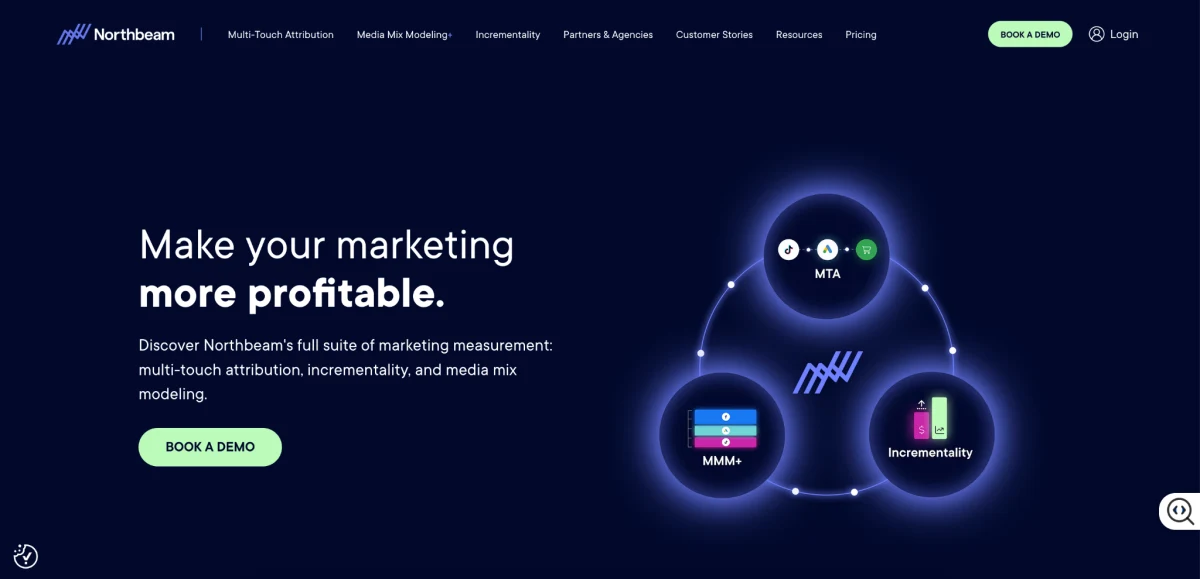
Northbeam plays at the sophisticated end of the market. It combines machine learning attribution with incrementality testing and media mix modeling to give big advertisers a genuinely rigorous read on what their ad spend is driving, and it works across Shopify and non-Shopify platforms alike.
What the AI actually does
Northbeam's machine learning is built for attribution rigor rather than plain-English chat. Its models are designed to:
- Assign fractional credit across the full customer journey instead of using last-click rules.
- Keep credited orders from ever exceeding the real orders in your store.
- Triangulate each channel's true, independent contribution using incrementality testing and media mix modeling.
Key analytics capabilities
- Machine learning multi-touch attribution with six models
- Incrementality testing
- Media mix modeling
- New-customer metrics like nCPA
- Creative analytics (higher tiers)
- Extended attribution windows
- 4x daily (or optional hourly) data refresh
- Export API access
- Support for headless Shopify, BigCommerce, WooCommerce, Magento, and custom builds
Why Shopify brands choose Northbeam
When you're spending big, even tiny allocation improvements move real dollars, so that attribution precision pays for itself in smarter budget decisions.
Limitations
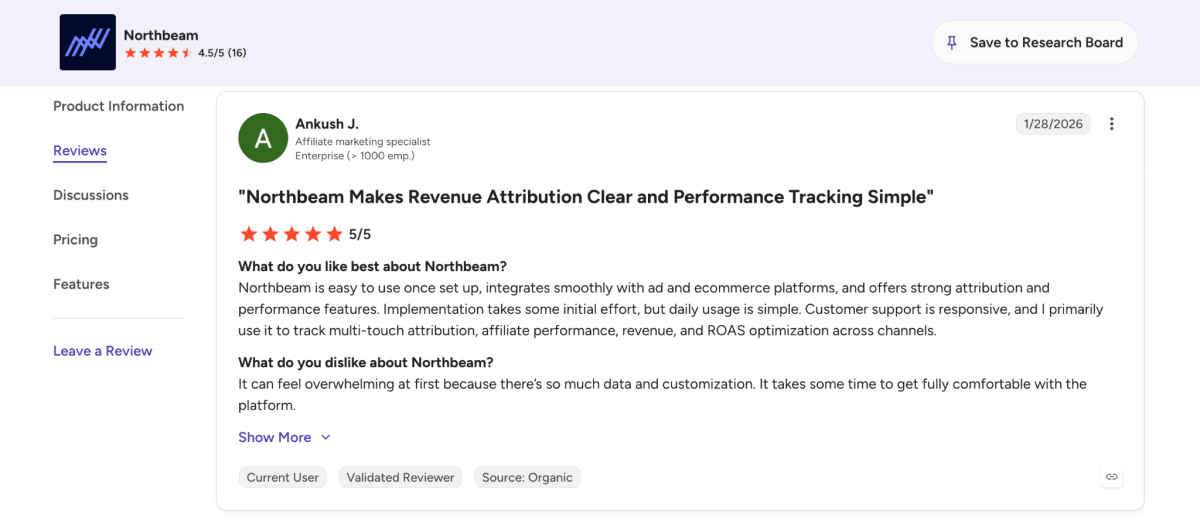
Let's be honest: it's expensive, it takes 2 to 4 weeks of calibration before the models are trustworthy, and it really needs a dedicated media buyer actually using it. Below enterprise scale, it's overkill. Its core model also doesn't follow in-platform attribution logic, which creates reconciliation friction, and raw export is locked behind the higher tiers.
Pricing
No free plan here. Public sources put the Starter tier around $1,000 to $1,500/mo, Professional around $2,500/mo, and Enterprise on a custom quote. It generally makes sense for brands spending roughly $50K+/mo (often $1M+/year) on paid media. Numbers vary by source and spend volume, so confirm current pricing with Northbeam directly.
6. Daasity: Best for data warehousing and custom analytics
Best for: Data-mature brands with an analyst or BI team that want warehouse-level analytics without building the pipeline from scratch.
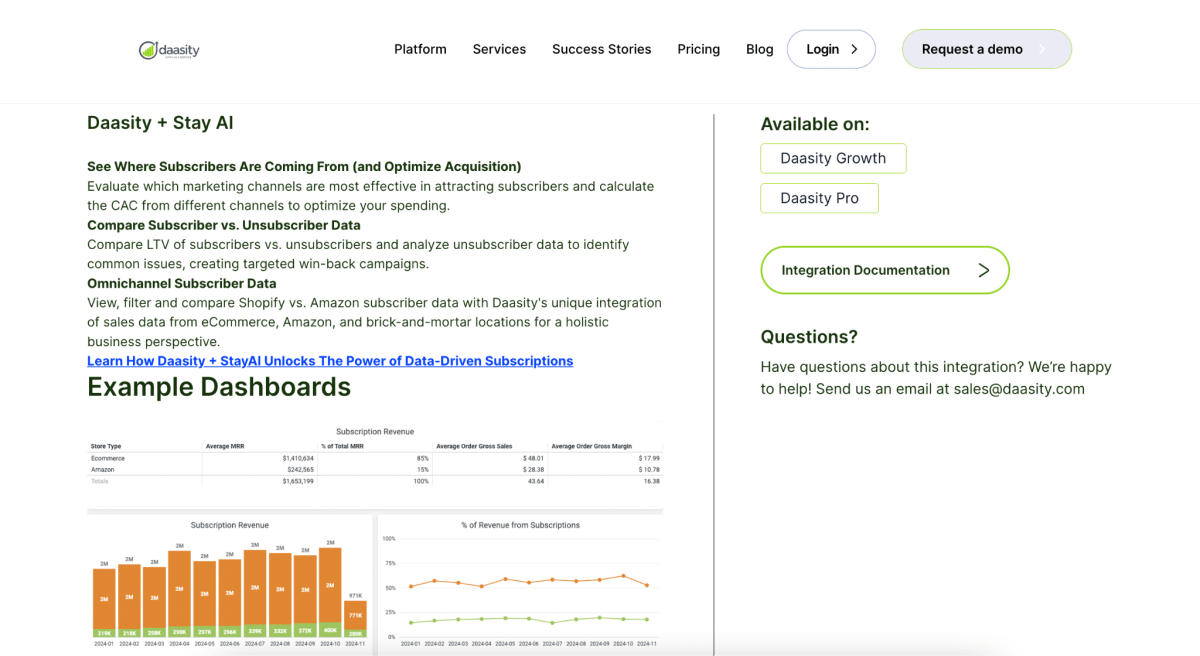
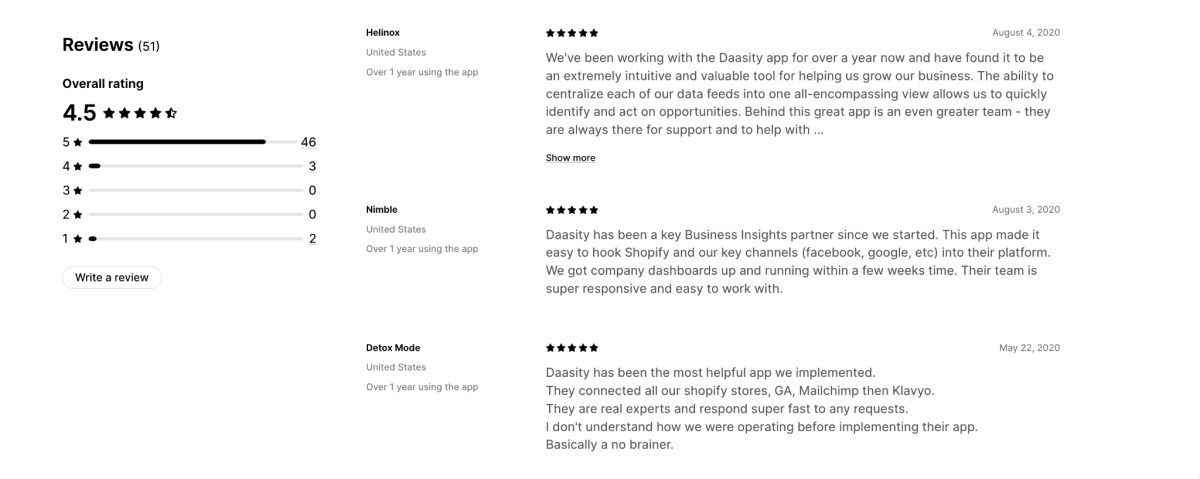
Daasity takes a totally different route from the fixed-dashboard crowd. It works as a centralized data layer that extracts, transforms, and loads your Shopify, ad, and other data into a warehouse (Snowflake or BigQuery), and then you build your own highly customized analytics on top of clean, unified data.
What the AI actually does
Daasity's value is less a conversational AI layer and more the clean, governed data foundation that advanced analytics depend on. It centralizes and standardizes your data so your team can:
- Build custom models and LTV analyses on unified, warehouse-level data.
- Report in the BI tools you already use, such as Looker, Tableau, or Power BI.
- Avoid maintaining data pipelines and ELT engineering in-house.
Key analytics capabilities
- Managed ETL into Snowflake or BigQuery
- A centralized, standardized data layer
- Strong LTV analytics
- Multi-channel and multi-brand consolidation (Shopify plus Amazon and wholesale)
- Custom dashboards in your preferred BI tool
- Flexible, warehouse-level data quality for finance-grade reporting
Why Shopify brands choose Daasity
Daasity hands your data team a clean foundation to answer questions no off-the-shelf dashboard can touch, with full control over your metrics and models.
Limitations
This isn't plug-and-play. It takes more setup and technical chops than a simple dashboard, and if you don't have a data or BI person, it's going to feel like way more infrastructure than you need. Custom pricing can get steep, and it assumes you've got a team to build and maintain the reporting layer.
Pricing
Custom pricing based on your data volume and setup. No public flat-rate tier here, so you'll need to request a quote from Daasity directly.
7. Peel Insights: Best for automated retention and cohort metrics
Best for: Brands focused on retention marketing and repeat-purchase optimization that want insights delivered automatically.
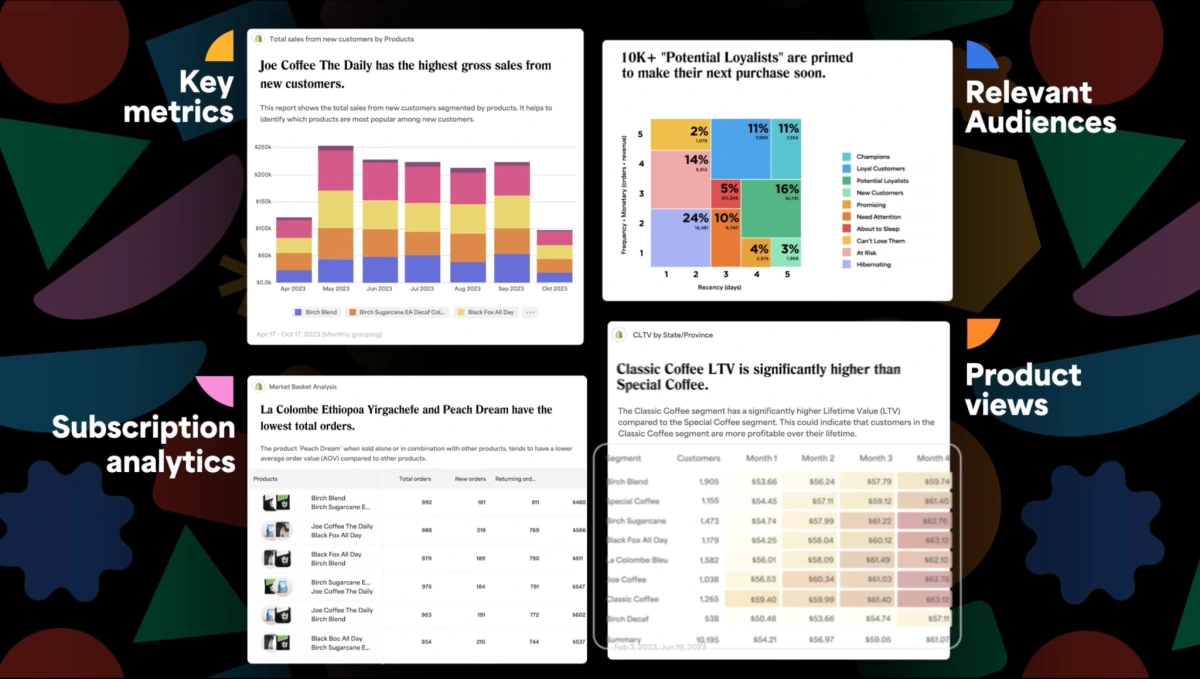
Peel Insights basically puts your retention analytics on autopilot. Instead of making you log in and build reports, it drops daily insight reports covering cohort performance, RFM (recency, frequency, monetary) segmentation, and repeat purchase metrics straight into your inbox.
What the AI actually does
Peel's intelligence is built for hands-off retention reporting, surfacing what changed without you having to query it. Its automated daily insights help you:
- Spot shifts in cohort behavior and repeat purchase rates as they happen.
- Track retention and RFM segments without logging in to build reports.
- Stay aligned as a team on the metrics that drive repeat revenue.
Key analytics capabilities
- Automated daily insight reports
- Cohort analysis
- RFM segmentation
- Repeat purchase and retention metrics
- Customer behavior reporting
- Native Shopify integration with minimal setup
Why Shopify brands choose Peel Insights
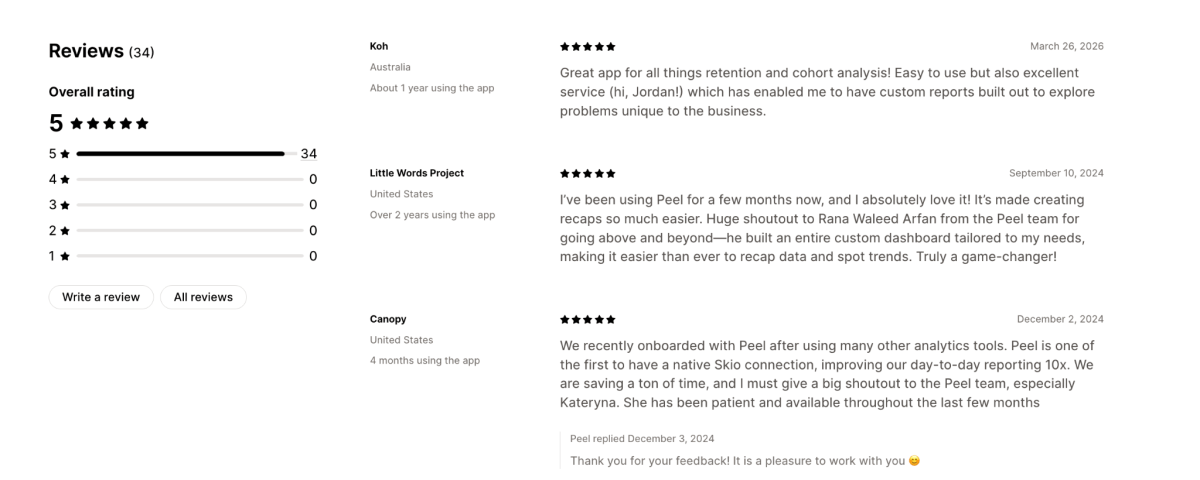
Peel automated daily summaries save real time and keep the whole team locked in on the metrics that actually drive repeat revenue.
Limitations
It's light on attribution and acquisition-side analytics, and the scope is narrower than the all-in-one platforms, so most brands run it alongside an attribution or profit tool rather than leaning on it alone.
Pricing
Peel Insights starts at $499/month ($449/month with annual billing), making it one of the more expensive analytics platforms for Shopify brands.
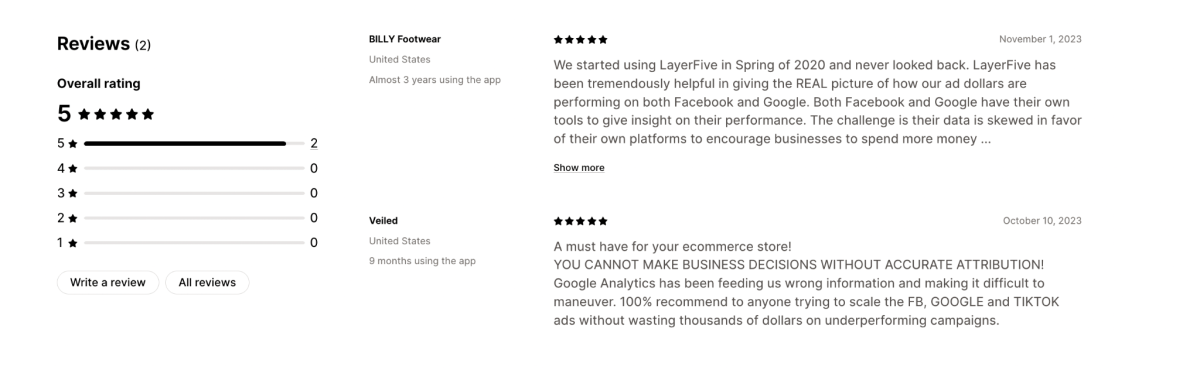
8. LayerFive: Best for privacy-first customer journey analytics
Best for: Brands prioritizing first-party data strategies and cookieless attribution as third-party tracking declines.
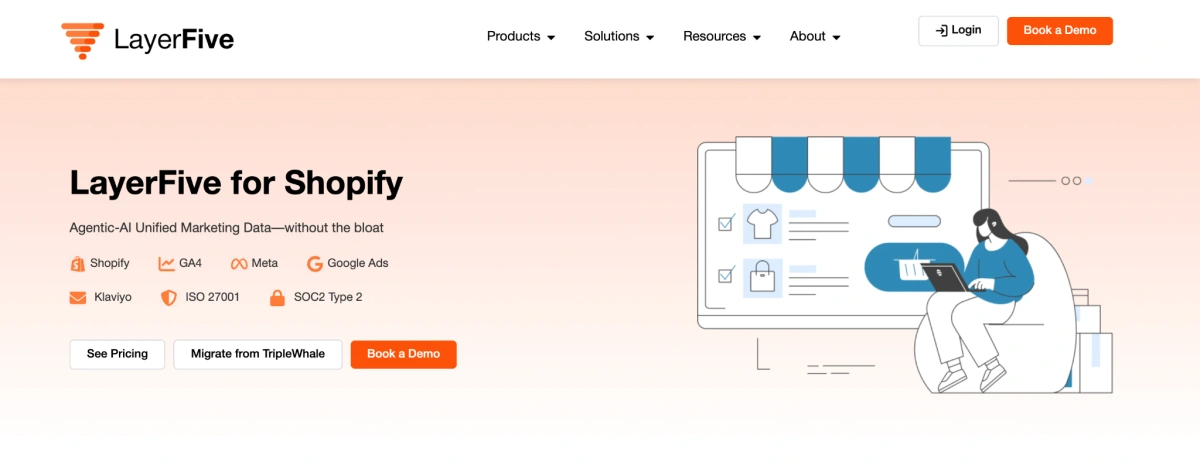
LayerFive is built for a problem that's coming for all of us: what happens to attribution and journey tracking as third-party cookies die off and privacy rules tighten? Its answer is first-party data collection and identity resolution, tracking journeys across devices without leaning on third-party tracking infrastructure.
What the AI actually does
LayerFive's AI is designed to act on first-party data, not just chart it. Across its products, it can:
- Proactively monitor performance and trigger actions through Navigator, its agentic AI.
- Build predictive audiences and LTV scores from resolved first-party identities with Edge.
- Push clean, identity-resolved data into activation across ad platforms, email, and SMS.
Key analytics capabilities
- First-party data collection via the L5 pixel and server-side CAPI
- Identity resolution and cross-device matching
- Multi-touch and profit-aware attribution
- Unified reporting across Shopify, Meta, Google, TikTok, and Klaviyo (Axis)
- Funnel and journey analytics (Signal)
- Predictive audiences and activation (Edge)
- Agentic AI monitoring (Navigator)
- Privacy compliance with GDPR, CCPA, and CPRA, plus SOC 2 and ISO 27001 controls
Why Shopify brands choose LayerFive
If you're worried about data compliance and whether your analytics will even survive a cookieless world, LayerFive lets you consolidate a messy stack onto a first-party foundation.
Limitations
It's less established in the Shopify world than a Polar or a TrueProfit, and a lot of the material out there is LayerFive's own, so independent third-party validation is thinner. Its full power also spreads across multiple products, which can mean a bigger commitment than a single-purpose tool.
Pricing
Free plan available. Reported entry pricing kicks off around $29/mo and scales with revenue, with enterprise setups custom-quoted. Since most of those figures come from LayerFive's own materials, confirm current pricing directly with them.
Why Shopify Brands Need AI Analytics in 2026
Here's the thing about AI analytics: it hands Shopify brands the attribution, profit, and predictive insights that native reporting just can't give you. Once you start scaling, "how much did I sell" stops being the question that matters. What you really need to know is which campaign drove profitable customers, and which products actually make you money.
What Shopify's built-in analytics can do
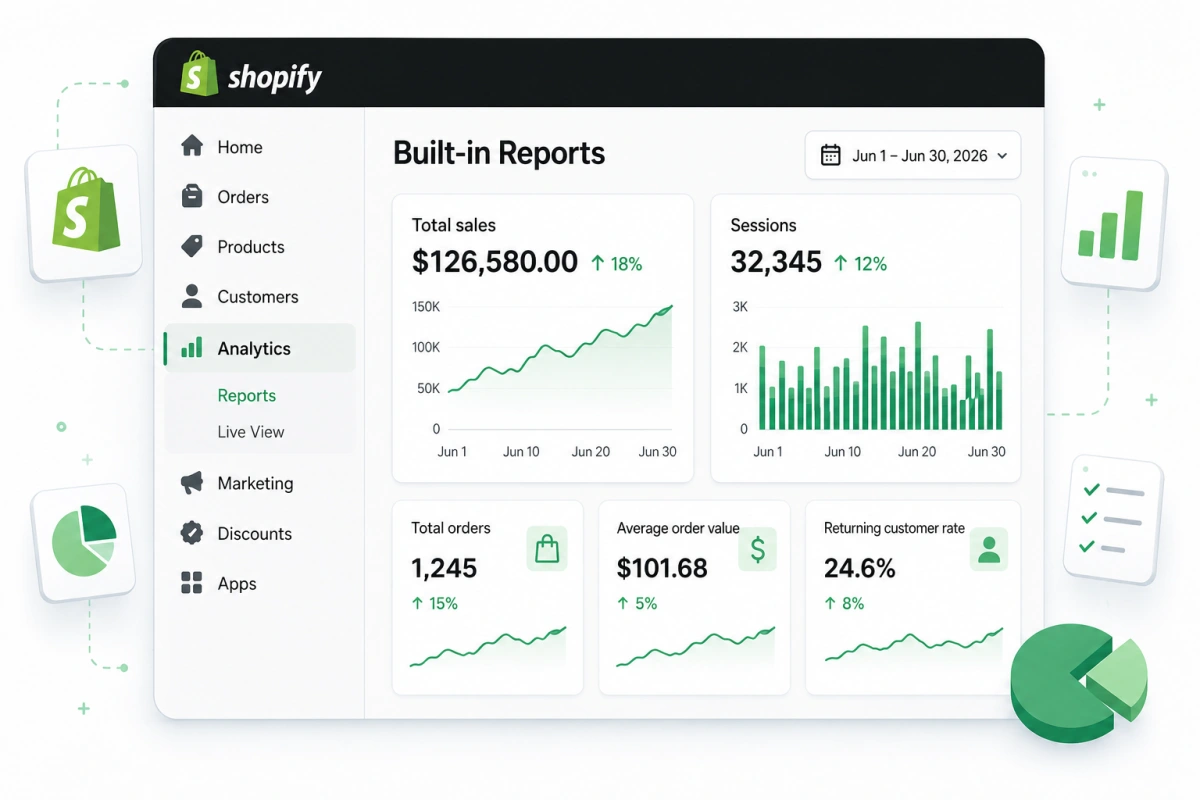
I'll give Shopify credit here: the native dashboard is a solid starting point. It tracks total sales, sessions, conversion rate, top products, and basic traffic sources. If you're in your first few months, that's honestly enough to answer the simple questions.
And it's free with any plan, zero setup. So if you're an early-stage founder, you can watch daily revenue and your top sellers without installing a single app.
What Shopify's built-in analytics cannot do
But here's where it falls apart. Native reporting can't connect ad spend to net profit, and it can't credit conversions across channels. It tells you what happened in your store, but never why it happened or what's coming next.
The gaps that bite you: no multi-touch attribution across ad channels, no link between ad spend and net profit, no predictive lifetime value modeling, no anomaly detection or alerts, and no cross-channel view in one place.
This is exactly why so many of us go looking for third-party tools. If you scroll through Shopify community threads, you'll see the same gripe over and over: data delays and limited customization make native analytics feel like staring in the rearview mirror instead of watching the road ahead.
What "AI-powered" actually means in analytics
Real AI analytics does at least one thing a static dashboard never could: it models, predicts, or answers questions straight from your data. The problem is marketing teams love to stretch that word, so let me tell you what to actually look for.
You want machine learning attribution that spreads credit across the full customer journey instead of dumb last-click rules. You want predictive lifetime value that forecasts spend from behavioral patterns. Natural language querying so you can just ask a question in plain English and get an answer. Anomaly detection that flags weird swings in conversion rate, ROAS, or refunds. And automated insights that surface the patterns you never thought to check.
If a platform only shows you bar charts and pre-built reports, that's a traditional BI tool wearing an AI costume. And this matters, because you're paying every month for actionable intelligence, not just pretty pictures. Keep in mind Shopify DTC net margins usually sit somewhere in that 10 to 20 percent range, so tracking revenue alone completely hides whether your growth is actually profitable. That right there is the gap AI-driven profit analytics is built to close.
3 Mistakes to Avoid When Choosing an AI Analytics Platform
I've watched people burn money on the same three mistakes over and over: picking on feature count, chasing revenue over profit, and underestimating integrations. Every one of them leads to wasted spend and a subscription you eventually cancel.
1. Choosing based on features you will never use
A platform with 40 dashboard views looks impressive in the demo, but if your team checks three metrics a day, you're just paying for noise. Match the tool to how you actually make decisions, not to a feature checklist.
2. Ignoring profit metrics in favor of revenue metrics
A big revenue month with a low-margin product mix and rising ad costs can hide a serious profitability problem. Revenue may be climbing, but net profit is what determines whether your store is actually becoming healthier, and the two numbers can move in opposite directions.
Another common mistake every merchant makes is optimizing ROAS without looking at net profit. This can literally lead you to scale campaigns that lose money on every order. because a strong ROAS on a thin-margin product can still land below breakeven once shipping and fees hit.
Understanding the gap between what your store earns and what it keeps is one of the most important shifts you'll ever make as you grow
3. Underestimating integration requirements
Before you commit, make sure the platform connects cleanly with your ad accounts, your email tool like Klaviyo, and your Shopify store, with no manual exports or custom dev work.

Final Thoughts
So where does that leave you? My honest advice: don't go shopping for the "best" platform. Go shopping for the answer to your single biggest unanswered question right now.
If you can't confidently say whether you're profitable, start with profit tracking. If you're pouring money into ads but flying blind on what's working, start with attribution. If your growth depends on customers coming back, start with LTV and retention. Nail one, then layer on the next.
That's how the sharpest brands build their stack, one deliberate piece at a time, never paying for complexity before they're ready to use it.

Irene Le is the Content Manager at TrueProfit, specializing in crafting insightful, data-driven content to help eCommerce merchants scale profitably. With over 5 years of experience in content creation and growth strategy for the eCommerce industry, she is dedicated to producing high-value, actionable content that empowers merchants to make informed financial decisions.