14 Best AI Tools for Growing Ecommerce Stores in 2026 (Full Review & Breakdown)


Table of Contents
- 1. Why Ecommerce Stores Need AI Tools in 2026
- 2. The Best AI Tools for Growing Ecommerce Stores in 2026
- 3. AI Tools for Ecommerce Profit Tracking & Optimization
- 4. AI Tools for Product Descriptions and Content Creation
- 5. AI Tools for Customer Support and Chat
- 6. AI Marketing Tools for Ecommerce
- 7. AI Image Optimization Tools for Ecommerce
- 8. AI Tools for Inventory Management and Demand Forecasting
- 9. AI Tools to Improve Personalization and Conversions
- 10. AI Ecommerce Website Builders
- 11. How to Choose the Right AI Tool for Your Store
- 12. Final Thoughts
- 13. AI Tools For Ecommerce FAQs
AI is no longer just a “nice-to-have” for ecommerce stores. In 2026, it has become a core part of how stores operate day to day, from writing product listings and running ads to tracking performance and understanding profit.
In this guide, I’ve pulled together the best AI tools for ecommerce and broken them down in a simple, practical way. You’ll see what each tool actually does, how much it costs, where it performs well, and where it doesn’t. The goal is to help you quickly figure out what is genuinely worth using in a real store setup, not just what sounds good on paper.
In this blog:
- 1. Why Ecommerce Stores Need AI Tools in 2026
- 2. The Best AI Tools for Growing Ecommerce Stores in 2026
- 3. AI Tools for Ecommerce Profit Tracking & Optimization
- 4. AI Tools for Product Descriptions and Content Creation
- 5. AI Tools for Customer Support and Chat
- 6. AI Marketing Tools for Ecommerce
- 7. AI Image Optimization Tools for Ecommerce
- 8. AI Tools for Inventory Management and Demand Forecasting
- 9. AI Tools to Improve Personalization and Conversions
- 10. AI Ecommerce Website Builders
- 11. How to Choose the Right AI Tool for Your Store
- 12. Final Thoughts
- 13. AI Tools For Ecommerce FAQs
Why Ecommerce Stores Need AI Tools in 2026
The core challenges in ecommerce, especially for small stores, rarely change: writing product descriptions at scale, handling repetitive customer support, diagnosing ad performance drops, deciding when to reorder inventory and analyzing business’s health.
What I’ve noticed is that these problems are not about a lack of effort, but about how time-consuming they are when everything is done manually. And AI tools are now used to handle many of these tasks more directly:
- Content tools can generate product listings in minutes, which helps stores keep up with large catalogs.
- Support bots take care of common customer questions around the clock, so teams don’t have to answer the same issues again and again.
- Analytics tools help surface patterns in profit and performance that would normally require manual reporting or someone dedicated to data analysis.
A solo founder or a small ecommerce team can now operate with a level of output that used to require a much larger team.

The Best AI Tools for Growing Ecommerce Stores in 2026
Not every AI tool is worth your subscription. This list breaks down the ones that actually help ecommerce stores save time, improve margins, and scale faster in 2026.
AI Tools for Ecommerce Profit Tracking & Optimization
From profit tracking to pricing optimization, these tools help improve ecommerce margins through better data.
1. TrueProfit AI (MCP): Best for AI-Powered Profit Analysis Using Real Store Data
TrueProfit is a net profit analytics platform built specifically for Shopify merchants who need a clear, real-time view of what their business is actually earning. By automatically tracking revenue, costs, ad spend, and net profit in one place, TrueProfit helps store owners make faster decisions based on accurate numbers - not guesswork.
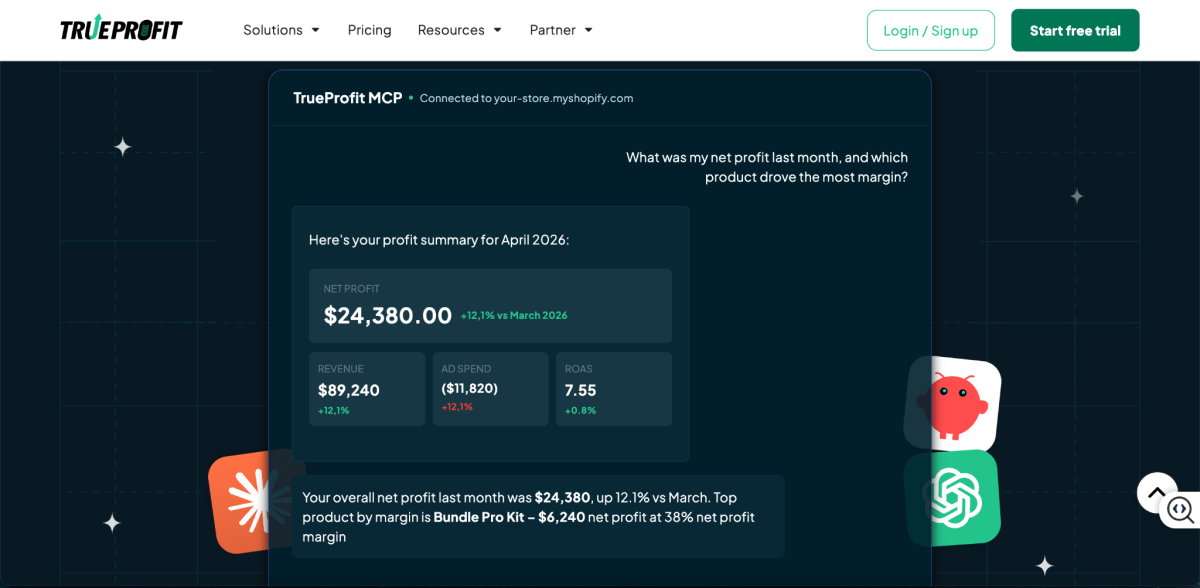
Now, with TrueProfit AI, powered by Model Context Protocol (MCP), AI assistants like Claude can access your store's profit data directly from TrueProfit. Instead of manually digging through reports and trying to understand what’s going on inside your business, you can ask natural-language questions to AI and get answers based on your actual numbers like revenue, costs, ROAS, and net profit.

Core AI Features
- Connects TrueProfit data to AI assistants through Model Context Protocol (MCP)
- Connects AI assistants to real-time store data, enabling answers based on actual revenue, costs, ROAS, and profit metrics, such as:
- "Which products generated the highest net profit last month?"
- "Why did my profit margin drop this week?"
- "Which Meta campaigns are profitable after shipping and fees?"
- Generates on-demand reports, tailored to specific business questions and performance needs.
- Detects anomalies in key metrics, including sales, ad spend, and ROAS, to surface unusual patterns quickly.
- Turns data into insights and recommendations, helping merchants take faster, more informed actions.
What it solves: Most AI assistants can only analyze data you manually provide. Exporting reports every time you need answers is slow and often results in outdated insights. TrueProfit MCP gives AI direct access to real profit data, enabling faster and more accurate ecommerce analysis.
Why it matters:
- Ask complex business questions in seconds instead of building reports manually
- Identify profit trends, margin declines, and top-performing products using conversational AI
- Reduce time spent exporting, cleaning, and organizing data before analysis
- Make faster decisions with AI powered by live business metrics instead of static spreadsheets
Best for: Shopify merchants already using TrueProfit who want to use AI for deeper profit analysis, performance reporting, and faster decision-making.
Pricing: Included with eligible TrueProfit plans. Check current availability on the TrueProfit website.
AI Tools for Product Descriptions and Content Creation
Good AI content tools should be able to do three things: cut the time it takes to write product copy, generate SEO-ready blog drafts, and keep your brand voice consistent even across a large catalog.
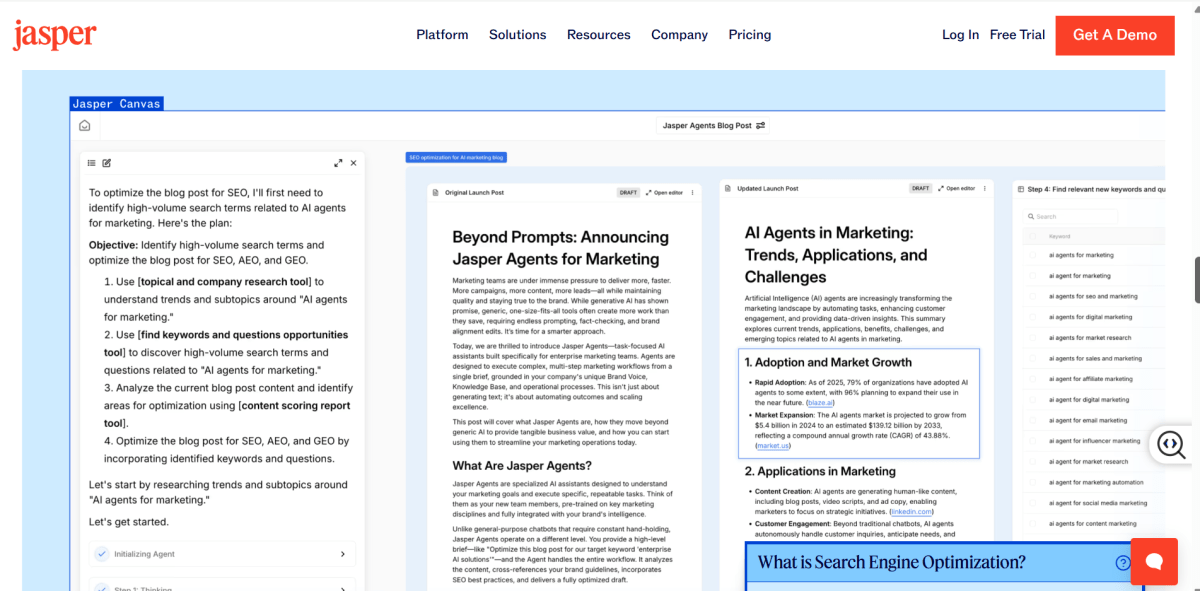
2. Jasper AI: Best for Product Page Copy at Scale
Jasper is the only AI writing platform built specifically around ecommerce and marketing workflows. The thing that sets it apart is brand voice memory, it locks in your tone and vocabulary so you are not re-training it from scratch every session.
Core Features
- Ecommerce product description templates with SEO keyword integration
- Brand Voice that holds your tone, style, and vocabulary across all outputs
- AI-powered campaign briefs that generate ad copy, email subject lines, and landing page text from a single brief
- Team workspace so multiple users share the same brand settings
What it solves: A catalog expansion that would take a copywriter two weeks can be done in a day using Jasper's batch workflow.
Why it matters:
- Stores with large catalogs report cutting product description time by 70–80% per SKU
- Consistent brand voice across thousands of SKUs means less cleanup editing afterward
- Faster publishing on new product launches means less revenue sitting unlisted
Best for: Stores with 50 or more SKUs.
Pricing: Starts at $59/month/seat (yearly paid). No permanent free tier, but a 7-day trial is available.
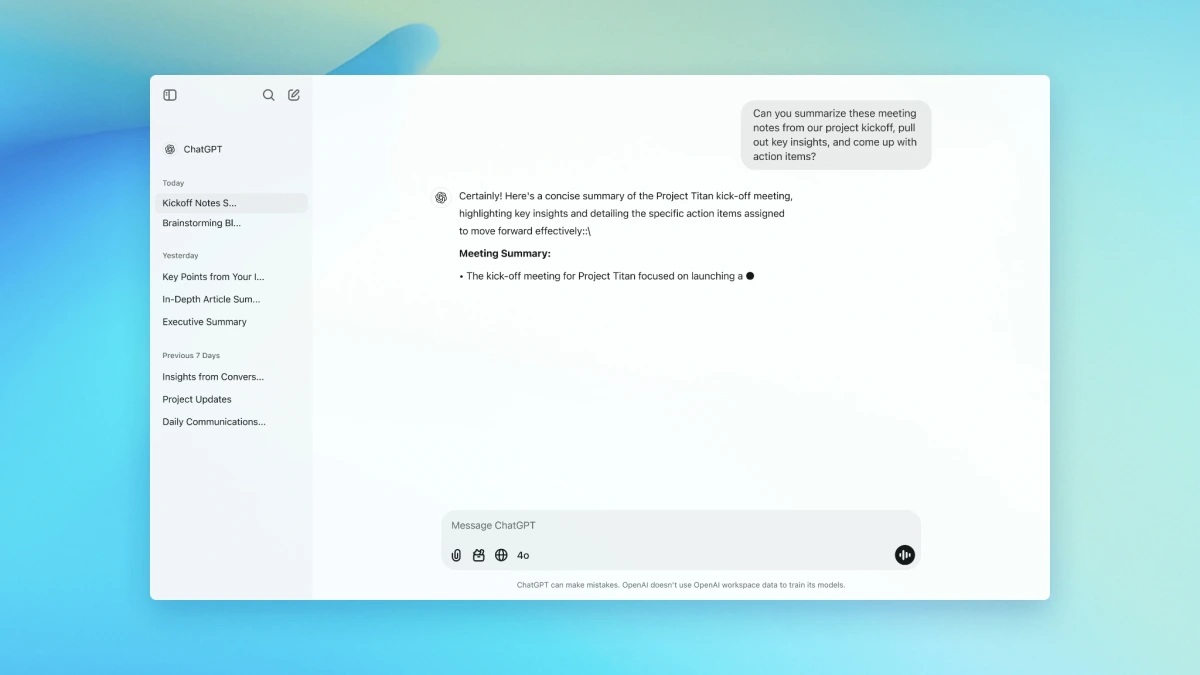
3. ChatGPT Plus: Best Option for Blog and SEO Content
The most flexible AI writing tool out there, with a genuinely useful free tier. If you are a solo founder who needs content help but does not want to commit to a paid tool yet, this is where you start.
Core Features
- GPT-5 model (on Plus) for higher-quality content, reasoning, and longer-form outputs
- Custom Instructions that persist your brand tone, target audience, and formatting preferences across sessions
- File and image uploads for analyzing competitors, existing copy, or product specs
- Zapier integrations for connecting ChatGPT into Shopify workflows
What it solves: Paying a freelance copywriter $50–$150 per blog post or $5–$20 per product description. ChatGPT handles first drafts of blog articles, FAQ sections, email campaigns, and meta descriptions in minutes.
Why it matters:
- Free tier eliminates content creation costs entirely for stores under $5K/month
- Blog content that previously took 4–6 hours to research and write can be drafted in under 30 minutes
- Meta description and FAQ generation at scale cuts on-page SEO setup time considerably
Best for: Solo dropshippers, early-stage stores, and any founder who needs a general-purpose writing assistant.
Pricing: Plus plan starts at $20/month.

AI Tools for Customer Support and Chat
AI support tools reduce ticket volume by handling the repetitive stuff automatically like returns, order status, product questions without adding headcount.
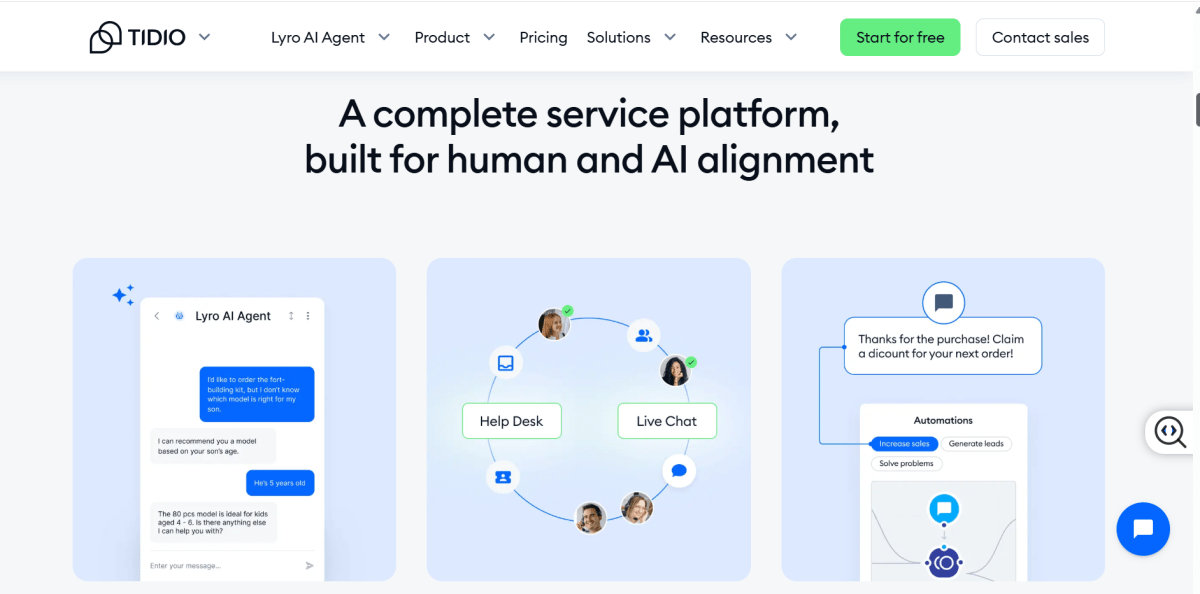
4. Tidio: Best AI Chatbot for Small Stores
Tidio's Lyro AI resolves 67% of customer questions on its own and takes under an hour to set up without any developer help. If you are currently handling support manually, that is a meaningful amount of time back.
Core Features
- Lyro AI handles returns, order status, product questions, and shipping queries using natural language
- No-code visual flow builder for building conversation paths
- Automatic handoff to a human agent when AI confidence is low
- Sentiment detection that flags frustrated customers for priority escalation
What it solves: Answering the same 10–15 questions dozens of times per week. For a solo founder doing support manually, Tidio reclaims 5–10 hours per week on average.
Why it matters:
- Lyro AI resolves up to 70% of tier-one tickets automatically, per Tidio's published benchmarks
- Average first response time drops from hours to seconds
- Support coverage extends to 24/7 without additional staffing cost
Best for: Solo founders and small teams on Shopify or WooCommerce receiving repetitive support tickets. Ideal for stores doing $5K–$50K/month.
Pricing: Free plan available. Paid plans start at $29/month.
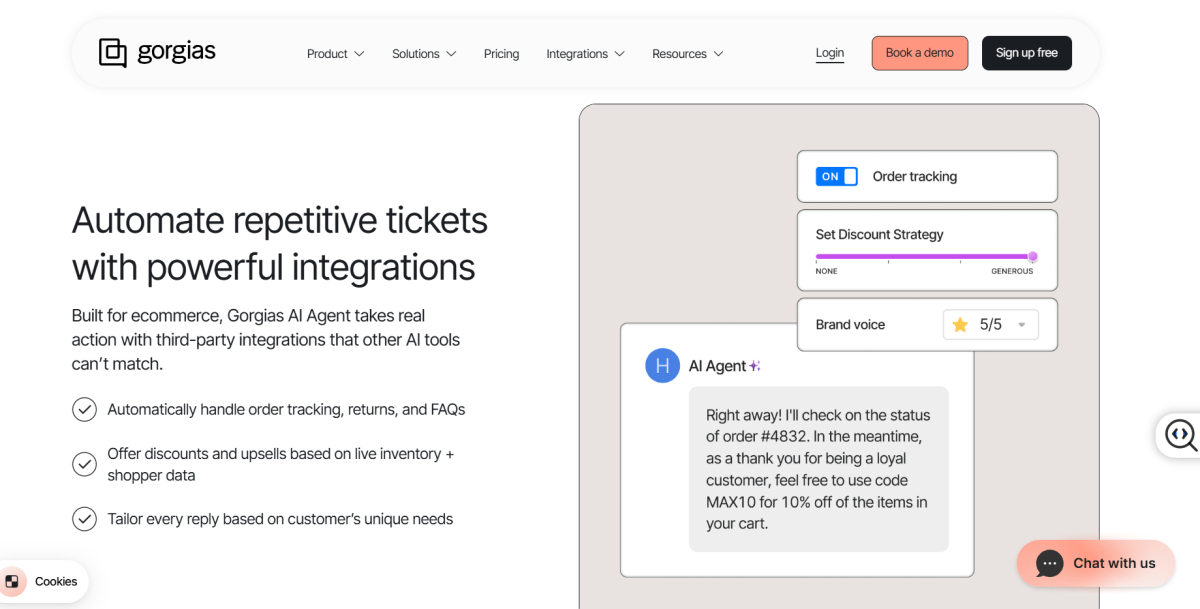
5. Gorgias: Best for Multichannel Support on Shopify
Gorgias pulls live Shopify order data directly into every support ticket, so agents and AI responses always have full customer context, no tab-switching required.
Core Features
- AI-suggested responses based on ticket content and order history
- Auto-close for tickets where AI detects the issue is resolved
- Intent detection that routes tickets by topic (returns, shipping, product questions) automatically
- Macros powered by dynamic Shopify data variables (order number, status, tracking link)
What it solves: Support agents spending 2–3 minutes per ticket hunting for order information across multiple tabs. Gorgias surfaces that data automatically, cutting average handle time significantly.
Why it matters:
- Average handle time per ticket drops by 30–40% when agents have instant order context
- Auto-close on resolved tickets cuts manual follow-up work
- Unified inbox across email, chat, Instagram, and Facebook means fewer messages slipping through the cracks
Best for: Shopify stores managing support across two or more channels. Most valuable for stores doing $20K+/month with consistent daily ticket volume.
Pricing: Starts at $10/month for up to 50 tickets, scaling with volume.
AI Marketing Tools for Ecommerce
AI marketing tools take the repetitive work off your plate: email segmentation, ad creative production, campaign optimization tasks that used to require a specialist or a lot of manual effort.
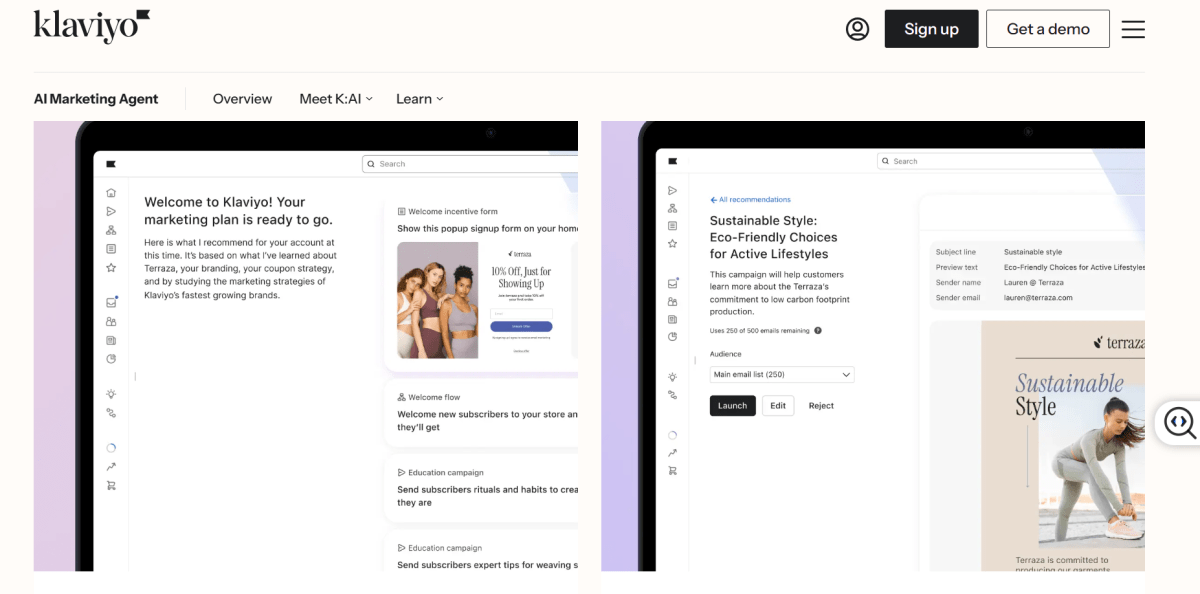
6. Klaviyo AI: Best for AI-Powered Email Campaigns
Klaviyo has the most comprehensive Shopify data integration in email marketing, combined with AI that predicts which customers are about to churn, what they are likely to buy next, and when to send for the best open rates.
Core Features
- Predictive Customer Lifetime Value (CLV) scoring per contact
- Churn risk prediction that flags at-risk customers before they go quiet
- AI subject line generation with built-in A/B testing
- Smart send-time optimization based on individual recipient behavior
- Pre-built flows for abandoned cart, post-purchase, and win-back
- Go from idea to launch-ready campaign with just a prompt
What it solves: Manually segmenting email lists and guessing the right message and timing for each group. Klaviyo's AI handles both automatically.
Why it matters:
- Predictive CLV helps merchants identify high-value customers so they can prioritize retention efforts and allocate marketing budgets more effectively.
- AI-powered send-time optimization increases the likelihood that emails reach customers when they're most likely to engage, helping improve overall campaign performance.
- Automated predictions reduce the need for manual audience segmentation, allowing marketers to launch more personalized campaigns with less effort.
Best for: Any ecommerce store with an email list. The free tier covers solo founders with up to 250 contacts; paid tiers suit SMBs at $10K+/month who want to scale email as a revenue channel.
Pricing: Free up to 250 contacts. Paid plans start at $20/month.
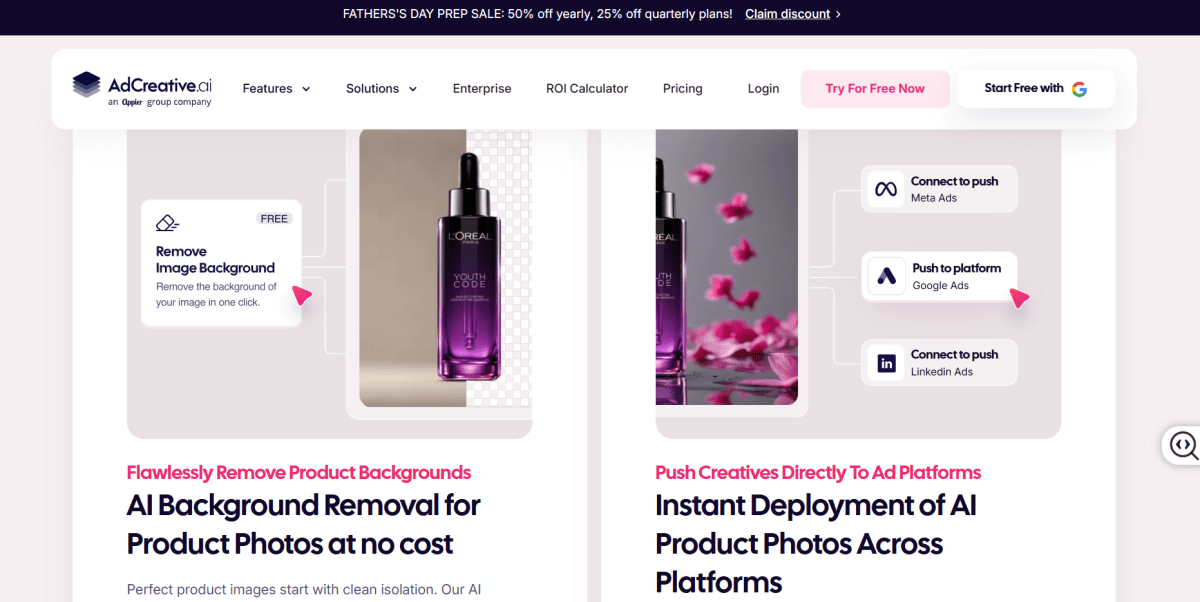
7. AdCreative.ai: Best for AI-Generated Ad Creatives
AdCreative.ai generates conversion-scored ad creatives before you spend a dollar, so you are testing AI-ranked winners instead of random designs.
Core Features
- AI creative scoring that predicts conversion performance before publishing
- Automatic generation of multiple size variations (Facebook, Instagram, Google Display) from one brief
- Direct integration with Meta Ads and Google Ads for performance feedback loops
- Competitor creative analysis to identify what is working in your niche
- Unified workspace for ad creative generation, product photoshoots, creative scoring, etc.
What it solves: Paying a designer $50–$200 per ad creative or waiting days for turnaround. AdCreative.ai produces a full set of sized ad variations in minutes.
Why it matters:
- Reduces reliance on designers by automating ad creative production from idea to ready-to-run assets.
- Speeds up testing cycles by enabling fast creation of multiple creative variations for each campaign.
- Helps ecommerce owners continuously improve ad performance through structured creative feedback and optimization signals.
- Removes creative production bottlenecks so teams can focus more on scaling campaigns rather than asset creation.
Best for: Small stores and SMBs running paid social on Meta or Google without an in-house designer. Not necessary if you are not running paid ads yet.
Pricing: Starts at $20/month. No permanent free plan, but a free trial is available.
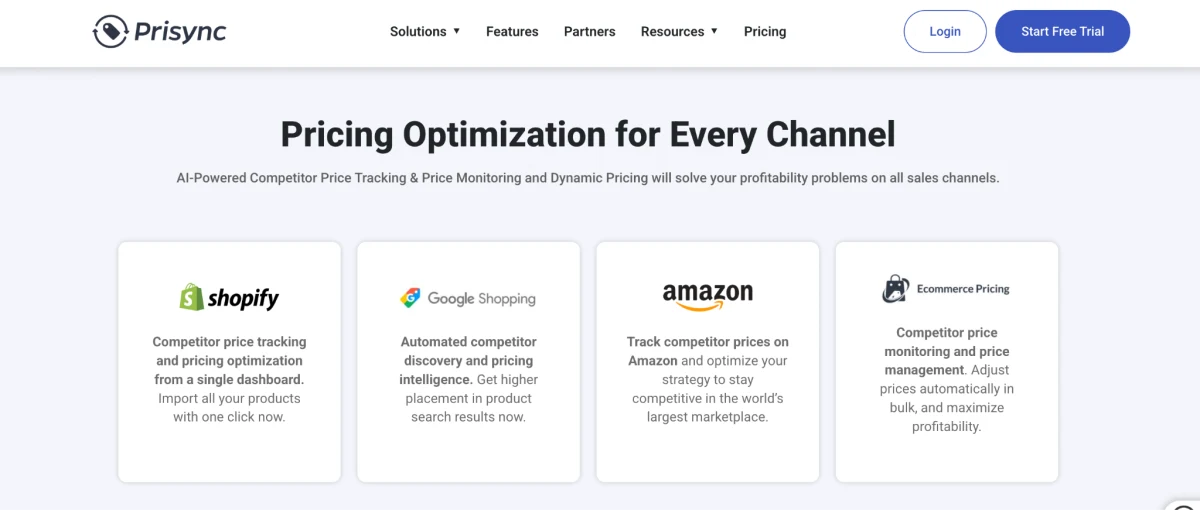
8. Prisync: Best for Dynamic Pricing and Competitor Monitoring
Prisync monitors competitor prices across the web in real time and lets you set automated pricing rules that protect your margin without losing the sale on price, all without any manual research.
Core Features
- Automated competitor price scraping across any ecommerce website
- Dynamic pricing rules engine that adjusts your prices based on competitor data
- Price change alerts when a competitor undercuts your price by a defined threshold
- Historical price trend tracking to identify seasonal pricing patterns
What it solves: Manually checking competitor prices, a task that takes 2–4 hours per week for stores in competitive categories and is nearly impossible to do at scale across a large catalog.
Why it matters:
- Helps ecommerce stores stay competitive by automatically adjusting prices based on real-time market conditions.
- Reduces manual effort in tracking competitor pricing, especially for stores with large product catalogs.
- Protects profit margins by enforcing pricing rules instead of reacting manually to price changes.
- Improves responsiveness in price-sensitive niches where even small price differences impact conversion.
Best for: SMBs in competitive, price-sensitive niches where pricing directly affects conversion rate. Less relevant for stores selling unique, handmade, or hard-to-compare products.
Pricing: Starts at $99/month with a 14-day free trial.
AI Image Optimization Tools for Ecommerce
Product visuals directly affect conversion rate. AI image tools make professional-quality photography accessible without a studio budget.
9. Pebblely: Best for AI Product Photo Generation
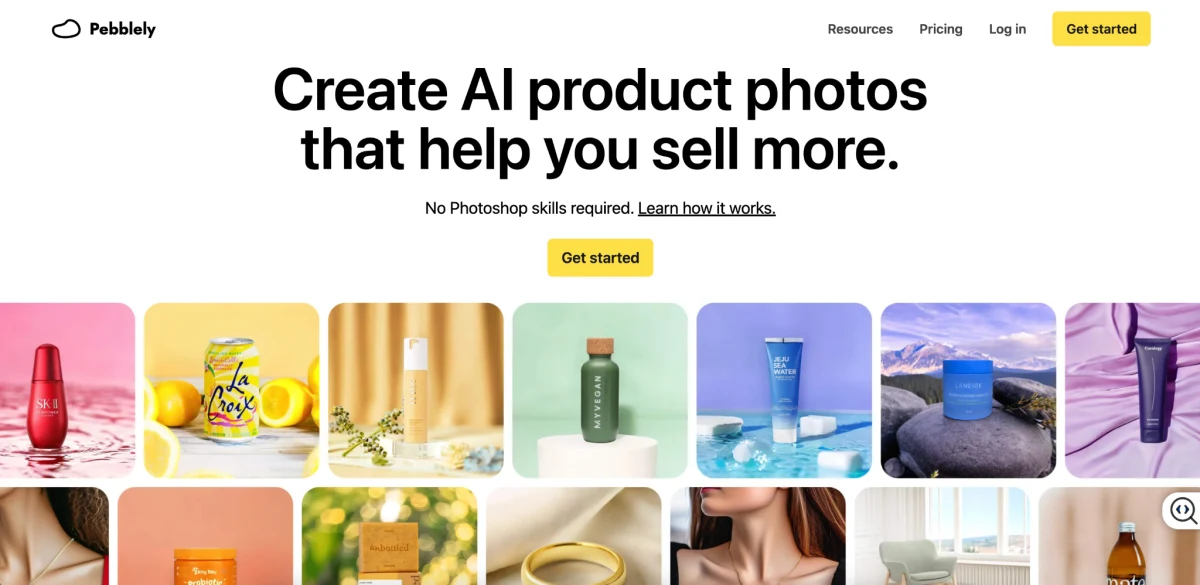
With Pebblely, you upload a product image, pick a background theme, and get studio-quality output in under two minutes. For standard product imagery, it effectively removes the need for a photo shoot.
Core Features
- AI background generation across 100+ style themes: minimal, lifestyle, seasonal, and custom
- Automatic background removal and product isolation before applying new environments
- Batch processing for generating multiple product images simultaneously
- Custom background prompts for stores that need settings beyond preset themes
What it solves: The cost and logistics of professional product photography, typically $500–$2,000 per shoot for a small catalog.
Why it matters:
- Enables ecommerce brands to create high-quality product visuals without the cost and complexity of traditional photo shoots.
- Makes it easy to produce consistent product imagery across a full catalog, even without design or photography resources.
- Allows stores to quickly refresh visuals for campaigns, seasons, or promotions without reshooting products.
- Improves perceived product quality by turning simple product photos into polished, lifestyle-style imagery.
Best for: Solo dropshippers and small stores selling physical products who cannot afford regular photography sessions. Particularly valuable for print-on-demand brands needing lifestyle imagery across large SKU catalogs.
Pricing: Free plan includes 40 images per month. Paid plans start at $9/month.
10. Canva AI: Best Budget Option for Visual Content
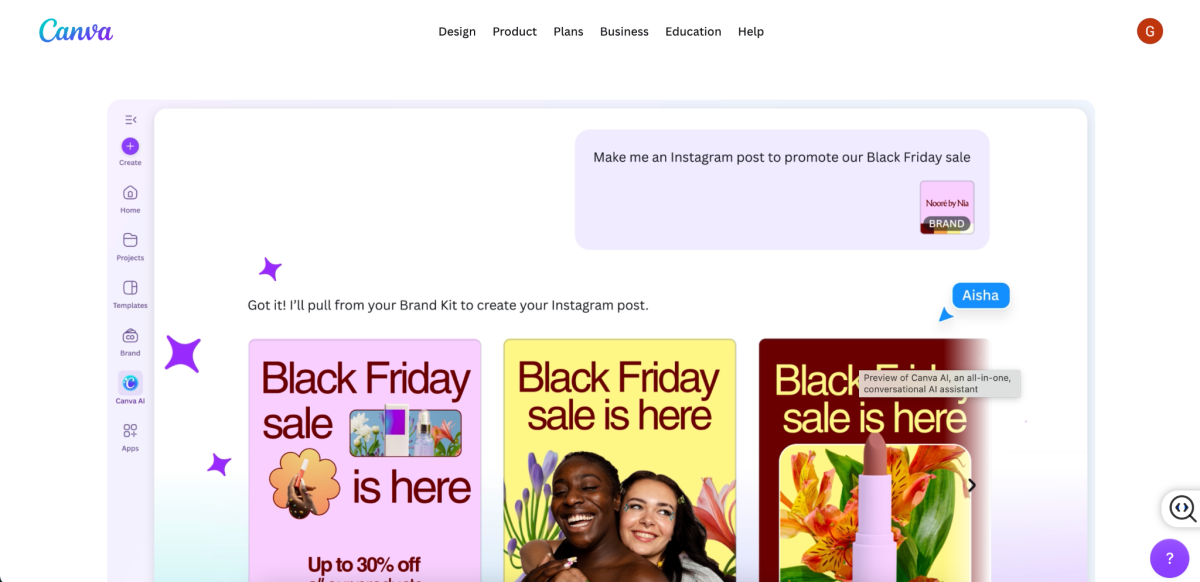
Canva AI is the only free tool that handles product banners, social ads, email graphics, and promotional overlays from one platform, and you do not need any design experience to use it effectively.
Core Features
- Magic Design: generates complete layout designs from a text prompt
- Magic Eraser and background removal for product photo editing
- Text-to-image AI for generating custom illustrations and graphics
- AI-powered resize that adapts designs to any format automatically (Instagram Story, Facebook Ad, email banner)
What it solves: Paying a freelance designer $30–$80 for a single ad banner or social graphic. Canva AI handles the full visual content workload for a small store without design skills.
Why it matters:
- Reduces design costs by enabling ecommerce stores to create banners, ads, and promotional visuals without hiring designers.
- Speeds up content production by turning one design into multiple formats for different channels automatically.
- Helps maintain consistent branding across ads, emails, and social content through a single design system.
- Makes it easier for small teams to produce high-volume visual content without design expertise.
Best for: Solo founders and small teams across all platforms who need a versatile, no-design-skills-required visual content tool. Best for stores not yet ready to invest in specialized tools like AdCreative.ai or Pebblely.
Pricing: Free tier available with broad functionality. Pro plan at $18/month/person.
AI Tools for Inventory Management and Demand Forecasting
This tool uses real-time and historical data to help ecommerce brands predict demand and keep inventory levels optimized.
11. Inventory Planner: Best for Preventing Stockouts and Overstock
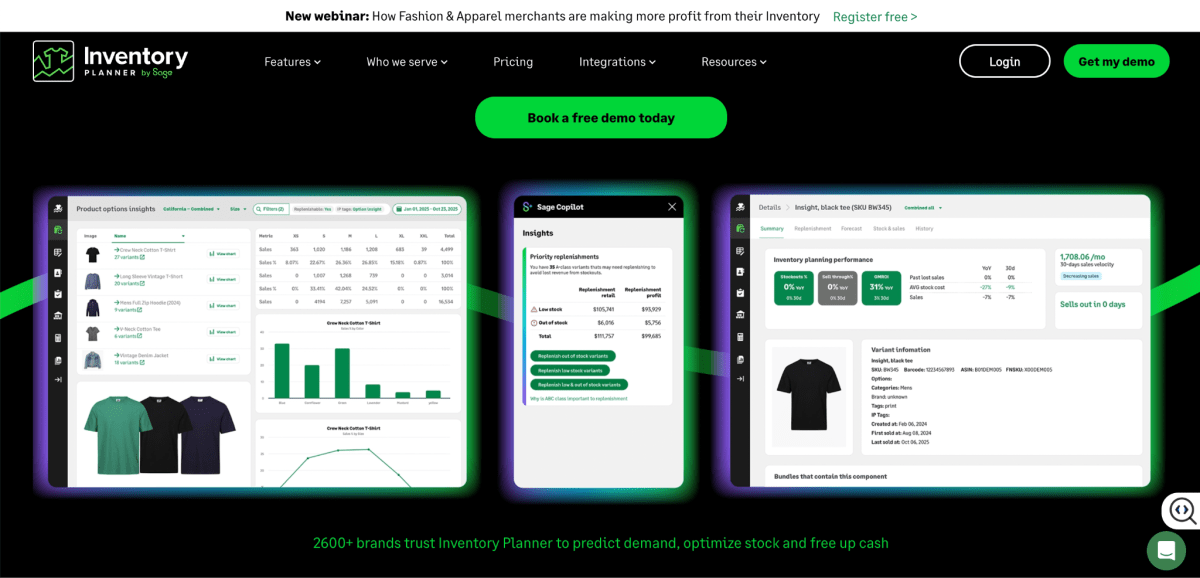
Inventory Planner uses your historical sales data and AI demand forecasting to tell you when to reorder and how much to buy, taking the guesswork out of the two most expensive inventory mistakes a small store makes.
Core Features
- AI demand forecasting based on historical sales velocity, seasonality, and trends
- Reorder point calculation that accounts for supplier lead times
- Overstock detection that flags slow-moving inventory before it ties up cash
- Integration with Shopify and WooCommerce sales data and supplier purchase orders
What it solves: Guessing reorder quantities. Stockouts cost you revenue when customers buy elsewhere and rarely come back. Overstock ties up working capital and creates storage costs. Inventory Planner addresses both through data-driven forecasting.
Why it matters:
- Reduces lost sales by helping ecommerce stores avoid stockouts through more accurate demand forecasting and reorder planning.
- Prevents cash flow issues caused by overstocked inventory sitting too long in storage.
- Improves purchasing decisions by using historical sales data instead of manual guesswork.
- Helps store owners manage larger SKU catalogs more efficiently without increasing operational complexity.
Best for: SMBs with more than 30 SKUs that have experienced at least one stockout or overstock event in the past 12 months.
Pricing: Free trial available, with custom pricing for higher-tier plans upon request.
AI Tools to Improve Personalization and Conversions
AI enables ecommerce brands to improve conversions by tailoring onsite experiences and optimizing engagement across the funnel.
12. LimeSpot: Best for On-Site Product Recommendations
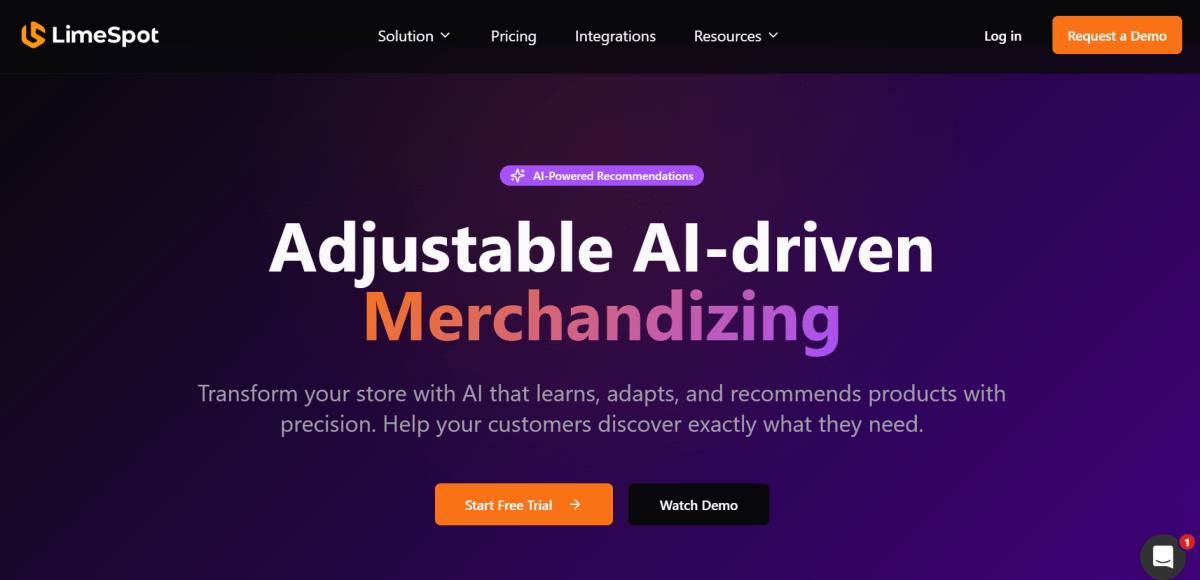
LimeSpot analyzes real-time visitor behavior and purchase history to surface personalized product recommendations that increase average order value without spending more on ads to get there.
Core Features
- Behavioral AI that tracks individual visitor patterns and purchase history in real time
- Personalized recommendation widgets for product pages, cart, checkout, and post-purchase pages
- A/B testing for recommendation placement and logic
- Upsell and cross-sell rules customizable by product category or customer segment
What it solves: Leaving cross-sell and upsell revenue on the table because your recommendations are static ("Customers also bought") rather than personalized to the individual visitor.
Why it matters:
- Increases average order value by showing relevant product recommendations throughout the shopping journey.
- Helps monetize existing traffic by turning product views into additional cross-sell and upsell opportunities.
- Improves product discovery for customers, especially in stores with larger catalogs.
- Replaces static recommendation blocks with dynamic, behavior-based personalization.
Best for: Solo founders and SMBs on Shopify with a catalog of 20 or more products where natural cross-sell and upsell opportunities exist.
Pricing: Free 15-day plan available on Shopify. Paid plans are based on your store’s revenue.
13. Wisepops: Best for AI-Powered Popups and Lead Capture
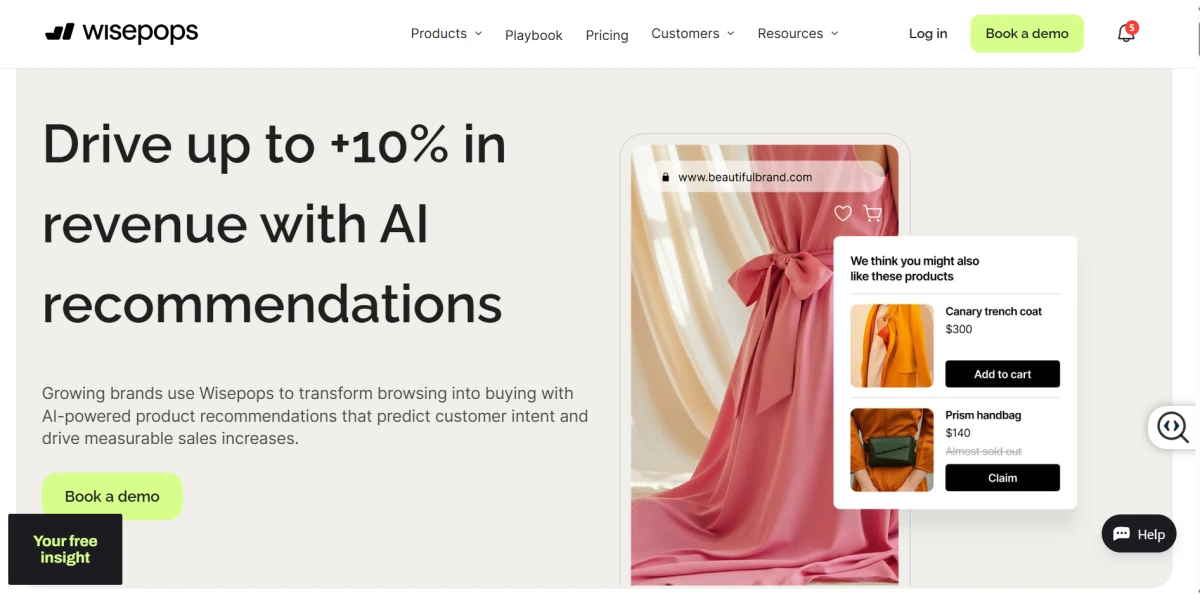
Wisepops uses behavioral AI to show the right popup to the right visitor at the right moment, so you stop annoying everyone with a generic discount on page load and actually improve email capture and cart recovery rates.
Core Features
- Behavioral targeting that triggers popups based on scroll depth, time on page, exit intent, and traffic source
- AI-driven audience segmentation that distinguishes new visitors from returning customers and shows different messages accordingly
- Campaign performance analytics with AI-suggested optimizations
- A/B testing for popup timing, copy, and offer
What it solves: Showing the same generic discount popup to every visitor the moment they land, which damages brand perception and produces low opt-in rates. Wisepops shows targeted messages at the right behavioral moment instead.
Why it matters:
- Improves lead capture by showing more relevant popups based on visitor behavior instead of generic, one-size-fits-all messaging.
- Reduces user friction by triggering offers at the right moment in the browsing journey rather than immediately on page load.
- Helps ecommerce stores segment new vs. returning visitors to deliver more relevant incentives and messaging.
- Increases efficiency of conversion efforts by focusing on intent-driven interactions instead of broad, untargeted popups.
Best for: SMBs focused on list building and reducing cart abandonment. Most valuable for stores with existing traffic (1,000+ monthly sessions) where conversion optimization has measurable ROI.
Pricing: Pricing is available upon request. Book a demo to receive a custom quote.
AI Ecommerce Website Builders
Building an ecommerce store no longer requires design or coding skills thanks to AI-powered website builders.
14. Shopify Magic: Best Built-In AI for Launching and Running a Store
Shopify Magic is the only AI store tool with zero added cost, it is built directly into Shopify and handles product descriptions, FAQs, email subject lines, and layout suggestions without leaving the admin.
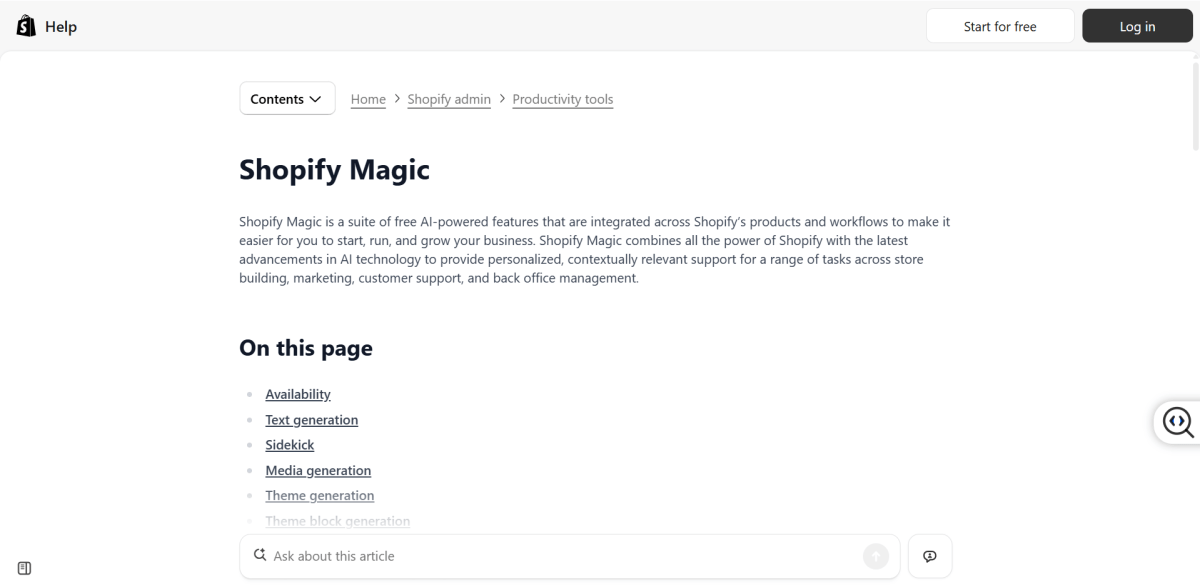
Core AI Features
- AI product description generation directly inside the Shopify product editor
- FAQ generation for product and policy pages
- AI email subject line suggestions inside Shopify Email
- AI-assisted store setup guidance for new merchants
- Blog post drafting assistance within Shopify's native blog editor
What it solves: The blank page problem. New store owners who are not natural writers spend hours on product descriptions and FAQ pages that end up converting poorly. Shopify Magic produces a solid first draft in seconds.
Why it matters:
- New stores can go from product upload to fully described catalog in hours instead of days
- AI-generated FAQs reduce post-purchase support tickets by preemptively answering common questions
- Email subject line suggestions improve open rates for stores using Shopify Email without a dedicated copywriter
Best for: Any store launching on Shopify, and established Shopify stores that want AI writing assistance without adding a paid tool.
Pricing: Included with all Shopify plans.
How to Choose the Right AI Tool for Your Store
Choosing the right AI tool isn’t about having more options, it’s about solving the right problem in the right order. I’ll walk you through a simple way to approach this.
1. Identify your single biggest bottleneck: You should start by figuring out what’s actually slowing you down the most. Maybe it’s content creation, maybe it’s customer support overload, or even ad performance or inventory chaos.
2. Pick one tool that solves that bottleneck directly: You don’t need a stack of tools right away. What you really need is one solid tool that directly fixes the core issue. In most cases, one well-used tool will outperform three half-used ones every time.
3. Set a specific 30-day success metric before you start: Before you even start using it, you should already know what “success” looks like. Maybe it’s faster response times, higher conversion rates, or just fewer hours spent on manual work.
4. Check integration with your current stack: If it doesn’t connect smoothly with Shopify, email tools, or ad platforms, you’ll end up doing more manual work than before, and that defeats the whole point.
5. Add the next tool only after the first is working: Only then should you think about adding another tool. Stack-building works best when it’s sequential, not simultaneous. That’s usually what separates messy setups from scalable systems
Final Thoughts
The best AI tools for small ecommerce stores in 2026 aren’t the biggest or the most expensive, they’re the ones that directly remove friction from your specific bottleneck while protecting your margins.
In most cases, a focused stack of three to five well-chosen tools will consistently outperform a bloated setup of ten overlapping subscriptions. Complexity rarely scales with clarity; it usually just adds cost and confusion.

Lila Le is the Marketing Manager at TrueProfit, with a deep understanding of the Shopify ecosystem and a proven track record in dropshipping. She combines hands-on selling experience with marketing expertise to help Shopify merchants scale smarter, through clear positioning, profit-first strategies, and high-converting campaigns.