Should You Choose Print on Demand or Dropshipping in 2026?



Print on demand vs dropshipping is a common choice for ecom beginners. Both models keep upfront inventory costs low, but they come with different trade-offs around margins, branding, product selection, and competition.
So, which one gives you the better path to a profitable store? Let’s compare them side by side.
What Is Print on Demand?
If you want to sell custom-designed products without buying or holding inventory upfront, print on demand (POD) is one of the simplest models to start with.
Here's how it works: you create a design, choose a product, and list it in your store. When a customer places an order, your POD supplier prints the product, packs it, and ships it directly to the customer.


You don't need to buy 100 T-shirts upfront or rent a warehouse to store them. You pay for the product when you actually make a sale.
Sounds pretty convenient, right? And that's exactly why POD has become popular with merchants who want to test product ideas without taking on a lot of inventory risk.
So, what are you really getting with POD?
The upside are:
- Low upfront investment: You don't have to purchase inventory in bulk.
- Easy product testing: Launch different designs without committing to large quantities.
- Simpler operations: Your supplier handles production and fulfillment.
- Strong branding potential: Custom designs make it easier to build around a specific niche.
The trade-offs are:
- Lower margins: Per-unit costs are generally higher than buying products in bulk.
- Less control: You rely on your supplier for product quality and fulfillment.
- Shipping can vary: Costs and delivery times depend on the supplier and destination.
- Designs drive demand: Having a POD store doesn't mean customers will automatically want the products.

What Is Dropshipping?
Now, let's look at the other side of the equation: dropshipping.
Like print on demand, dropshipping lets you sell products without buying and storing inventory upfront. The difference is that you're usually selling ready-made products from a supplier, rather than adding your own designs to them.
Here's how it works: you find a product from a dropshipping supplier, list it in your store, and set your own retail price. When a customer places an order, you purchase the product from your supplier, and they ship it directly to the customer.

So, you don't have to keep products in your garage, rent a warehouse, or handle fulfillment yourself.
The upside are:
- Low startup costs: You don't need to invest heavily in inventory.
- Huge product selection: You can test products across different categories and niches.
- Easy to test and scale: Winning products can be expanded without holding more stock.
- Flexible business model: You can change your product catalog as demand changes.
The trade-offs are:
- High competition: Popular products are often sold by many merchants.
- Less product differentiation: You're often selling products that other stores can access too.
- Supplier dependency: Product quality, stock availability, and fulfillment are largely outside your control.
- Margins can be tight: Ads, shipping, payment fees, refunds, and other costs can quickly eat into your profit.
So, while both models let you sell without holding inventory, dropshipping gives you more freedom in what you sell, while POD gives you more control over how you differentiate the product.
And that's where the comparison gets interesting.
Print on Demand vs Dropshipping: What are the Differences?
At first glance, the 2 models look pretty similar. In both, you can sell products without buying inventory upfront, while a third-party supplier handles fulfillment.
But once you actually run the store, the differences start to matter.
Here’s the quick comparison table before we break everything down in details for you:
Now, let's look at what each difference actually means for your business.
Product Selection
This is probably the most obvious difference.
Dropshipping gives you a much wider product selection. You can sell products across categories such as beauty, home, electronics, accessories, pet products, and more.
POD is more focused on products that can be customized, such as T-shirts, hoodies, mugs, posters, tote bags, and other accessories.
So if your strategy is to test lots of different product types, dropshipping gives you more flexibility. If you already know your niche and want to build around original designs, POD may make more sense.
Startup Costs
Both models have a relatively low barrier to entry because you don't need to purchase inventory in bulk.
With POD, your initial costs may come from creating designs, ordering samples, setting up your store, and marketing. With dropshipping, you'll typically spend more on product research, samples, store setup, and customer acquisition.
The important point is that low startup cost doesn't mean low operating cost. Once you start getting orders, product costs, shipping, payment processing, advertising, refunds, and other expenses all affect your actual profitability.
Profit Margins
This one needs a little more nuance.
POD products often have higher per-unit costs because you're paying for both the base product and the printing or customization. That can put pressure on margins.
Dropshipping can offer more flexibility in sourcing and pricing, so some products may have stronger margins. But that doesn't mean every dropshipping product is more profitable.
And this is where I'd avoid looking at markup alone.
Branding & Product Control
This is where POD has a clear advantage.
With POD, your designs give you a built-in way to differentiate your products. You can create collections around a niche, develop a recognizable visual identity, and build products that feel more specific to your audience.
With dropshipping, you often start with a product that other merchants can access too. You can still build a strong brand through your positioning, creative, packaging, customer experience, and offers, but you typically have less control over the underlying product.
Competition
Dropshipping can be highly competitive, particularly when many merchants are selling the same trending products.
POD has competition too, but the competitive advantage often comes from the design, niche, and brand positioning rather than the physical product itself.
So I wouldn't say one model is simply “less competitive.”
The better question is: Where can you create enough differentiation that customers have a reason to buy from you?
Shipping & Fulfillment
In both models, the supplier handles fulfillment, which means you don't need to build your own warehouse operation.
The difference is that POD requires the product to be printed or customized before it's shipped. That additional production step can affect fulfillment times and costs.
For dropshipping, fulfillment speed depends largely on the supplier's inventory location, processing time, and shipping network.
Either way, don't assume that “supplier fulfillment” automatically means fast shipping. Check actual processing and delivery times before scaling a product.
Product Quality
You don't have complete control over product quality in either model.
With dropshipping, you're primarily relying on your supplier to maintain consistent product quality.
With POD, there are two things to evaluate: the quality of the base product and the quality of the printing or customization.
That's why ordering samples is worth doing before you start spending heavily on ads. You want to know exactly what your customer is going to receive.
Scalability
Both models can scale without requiring you to hold large amounts of inventory yourself.
With dropshipping, you can scale by increasing sales of winning products, expanding your catalog, or working with suppliers that can support higher order volumes.
With POD, you can scale by expanding your design library, introducing new products, and growing within a profitable niche.
Which Model Gives You More Room to Make Money?
If you're choosing between POD and dropshipping, this is probably the question you care about most: which model actually gives you more profit?
The honest answer is that neither model is automatically more profitable. What matters is where your competitive advantage comes from, how much it costs to acquire each customer, and how much profit you keep after every expense.
Before I break down the strengths of each model, it helps to look at what sellers actually earn. Across our analysis of 1,200+ dropshipping stores, monthly income typically ranges from under $2,000 for beginners to $50,000+ for advanced operators, with most sellers landing between $20,000 and $120,000 per year.
POD tends to start slower: many sellers earn under $100 a month in the beginning, a smaller group reaches $1,000–$3,000 monthly with consistent effort, and experienced sellers can pull $10,000 or more.
In both models, the ceiling is high, but the median is modest, and the gap between the two comes down to how you compete.
POD: Lower Margins, but More Room to Build Value
POD products often come with higher per-unit costs because you're paying for both the base product and customization. That shows up in the numbers, POD net margins average around 20%, which is why most sellers start with modest monthly income before their brand gains traction.
On paper, that can make dropshipping look more attractive. But there's another side to the equation: POD gives you more opportunities to create perceived value.
If your designs target a specific niche and your brand resonates with that audience, you may be able to charge a premium, increase AOV through bundles, and generate repeat purchases.
And here's an interesting part: a winning design can keep working for you.
One successful design can become a T-shirt, hoodie, mug, tote bag, poster, or an entire collection. You're not starting from zero every time you launch another SKU.
So POD tends to reward merchants who are good at building demand around a brand, niche, or creative concept.
Dropshipping: Better Product Economics, but More Competition
Dropshipping gives you more freedom to source products at different price points, test new products, and optimize your product economics. That flexibility shows up in the income data, dropshipping stores tend to hit 65–70% gross margins and 15–25% net, and the top tier scales into $10,000–$50,000+ per month once they find products that work.
Find a product with strong perceived value, reasonable supplier costs, and a reliable fulfillment setup, and you can potentially build healthy margins.
The challenge is differentiation.
If other merchants can access the same product, you're often competing through your creative, offer, pricing, landing page, and customer acquisition strategy.
That means a product with a great markup isn't necessarily a profitable product. If CAC rises or competitors start bidding up ad costs, your margin can disappear quickly. This is also why only about 1–5% of dropshippers ever reach consistent profitability, the earning potential is real, but most never make it past the testing phase.
Dropshipping tends to reward merchants who are strong at product research, marketing, testing, and optimization.

How to Choose the Right Model for You?
Still not sure which one fits your store? Don't overthink it. Start with how you want to build your competitive advantage, because that's what will matter long after you've launched your first few products.
Go With Print on Demand If You Want to Build a Brand and You Love Design
POD is a strong fit if you already have a niche, design direction, or audience you want to build around.
You might choose POD if you:
- Want to sell products aroundoriginal designs or a specific niche
- Care about building a recognizable brand
- Want to test products without committing to inventory
- Plan to expand winning designs into multiple products
- Are comfortable investing more time in creative and branding
The key here is that the product itself isn't your only selling point. Your design, positioning, and brand give customers a reason to choose you.
Go With Dropshipping If You Want More Product Flexibility
Dropshipping makes more sense if you're more interested in finding and marketing products than creating them yourself.
It's worth considering if you:
- Want a much wider product selection
- Enjoy researching and testing new products
- Are comfortable running and optimizing paid ads
- Want to quickly replace products that don't perform
- Prefer testing demand before investing heavily in branding
Here, your advantage usually comes from product selection, offers, creative, and marketing execution.
Final Thoughts
So, which one should you choose?
If you ask me, don't choose based on which model sounds easier. Choose based on where you have an advantage.
If you can create designs people care about and turn them into a brand, POD gives you a strong foundation. If you're better at spotting winning products and turning them into profitable offers, dropshipping gives you more flexibility.
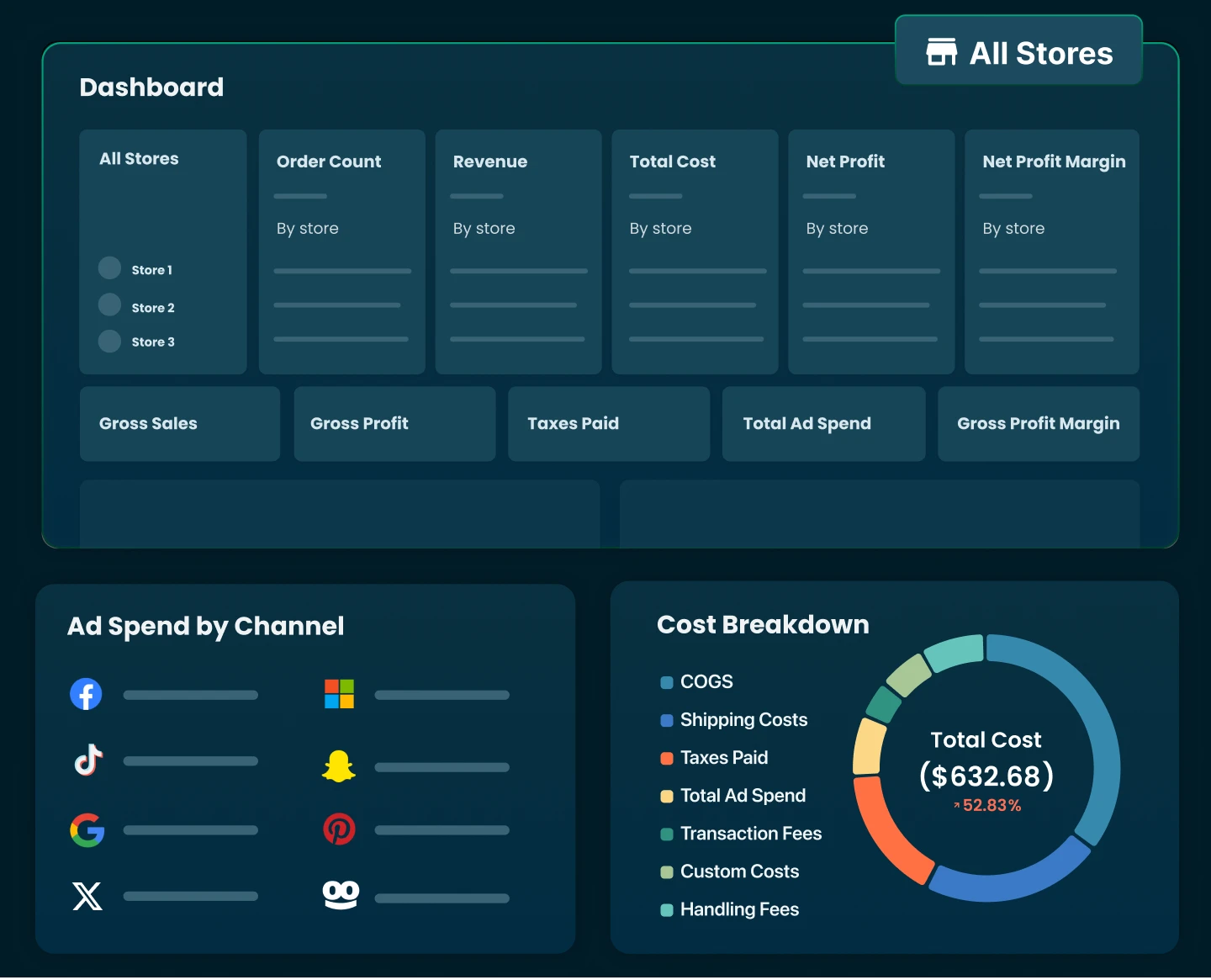
And once you’ve picked your model, get your numbers right from day one. Every sale comes with costs, and if you’re not tracking them all, the “profit” you see on your dashboard may not be the profit you actually keep.
Product costs, shipping, ad spend, transaction fees, refunds, and other expenses all add up. The sooner you track them accurately, the sooner you know which products are actually worth scaling.
That’s where TrueProfit stands out from other analytics apps. As the #1 net profit analytics platform for Shopify in real time, TrueProfit brings all your ins and outs into one place, so you can stop piecing together data from different tools and see what your store is actually keeping.

Harry Chu is the Founder of TrueProfit, a net profit tracking solution designed to help Shopify merchants gain real-time insights into their actual profits. With 11+ years of experience in eCommerce and technology, his expertise in profit analytics, cost tracking, and data-driven decision-making has made him a trusted voice for thousands of Shopify merchants.