The Practical Guide to AI Marketing for Shopify + 11 Tools Worth Trying


Table of Contents
- 1. Why AI Marketing Matters for Shopify Merchants
- 2. How AI Is Changing Shopify Marketing in 2026
- 3. Top AI Marketing Tools & Apps for Shopify in 2026
- 4. Step-by-Step: How to Implement AI Marketing in Your Shopify Store
- 5. Best Practices & Common Pitfalls to Avoid
- 6. Final Thoughts
- 7. FAQs About AI Marketing For Shopify
AI is everywhere in Shopify marketing right now. But using more AI doesn't automatically mean better marketing.
The real opportunity is using it to take repetitive work off your plate while helping you make better decisions.
So let's look at what AI can actually do for your store in 2026, and which tools are worth your attention.
In this blog:
- 1. Why AI Marketing Matters for Shopify Merchants
- 2. How AI Is Changing Shopify Marketing in 2026
- 3. Top AI Marketing Tools & Apps for Shopify in 2026
- 4. Step-by-Step: How to Implement AI Marketing in Your Shopify Store
- 5. Best Practices & Common Pitfalls to Avoid
- 6. Final Thoughts
- 7. FAQs About AI Marketing For Shopify
Why AI Marketing Matters for Shopify Merchants
AI marketing for Shopify means using AI to handle, improve, or speed up different parts of your marketing, from creating content and analyzing campaigns to personalizing the customer experience.
The biggest value of AI marketing isn't simply doing more with AI. It's being able to move faster without adding the same amount of manual work.
So, there are a few practical areas where AI can make a difference:
- Save time: Handle repetitive tasks like content drafts, variations, summaries, and basic analysis.
- Personalize marketing: Use customer and behavioral data to make messages, offers, and recommendations more relevant.
- Optimize faster: Analyze performance data and help identify what may need to change.
The important part is that AI isn't going to fix a bad offer, poor targeting, or a product page that doesn't convert. Creating more content won't solve the wrong problem.
I'd look at AI as a multiplier for your existing marketing, not a replacement for it. Give it a clear goal, accurate data, and enough context about your store, and it can take a lot of the repetitive work off your hands while you stay in control of the decisions.

How AI Is Changing Shopify Marketing in 2026
The key is not to use AI everywhere just because you can. It's to use it where it can remove repetitive work or help you make better marketing decisions.
- Create product content faster: AI can help draft product descriptions, SEO titles, meta descriptions, ad copy, emails, and social posts. Shopify Magic is one example, with AI features built into Shopify.
- Understand customers and personalize marketing: AI can analyze purchase history, product interactions, and campaign data to find useful patterns and build more relevant segments, recommendations, and offers.
- Automate email, SMS, and ad campaigns: AI can help create content variations, personalize messages, and improve segmentation. Ad platforms also use AI for creative generation, targeting, bidding, and budget optimization. The strategy still needs to come from you.
- Improve the shopping experience: AI chatbots and shopping assistants can answer product questions, recommend products, and help shoppers decide what to buy. Repeated customer questions can also show where your product pages need clearer information.
- Make marketing decisions faster: AI can summarize performance, flag unusual changes, and surface patterns across your marketing data, so you spend less time jumping between reports and more time acting on what matters.
Top AI Marketing Tools & Apps for Shopify in 2026
Here are the tools worth looking at in 2026, based on the marketing job they are built to handle.
1. Shopify Magic: Best AI Content Creation
Shopify Magic is the easiest place to start because it's already built into Shopify. It can generate product descriptions, blog content, email subject lines, and suggested replies, while also helping with image generation and other store-building tasks.

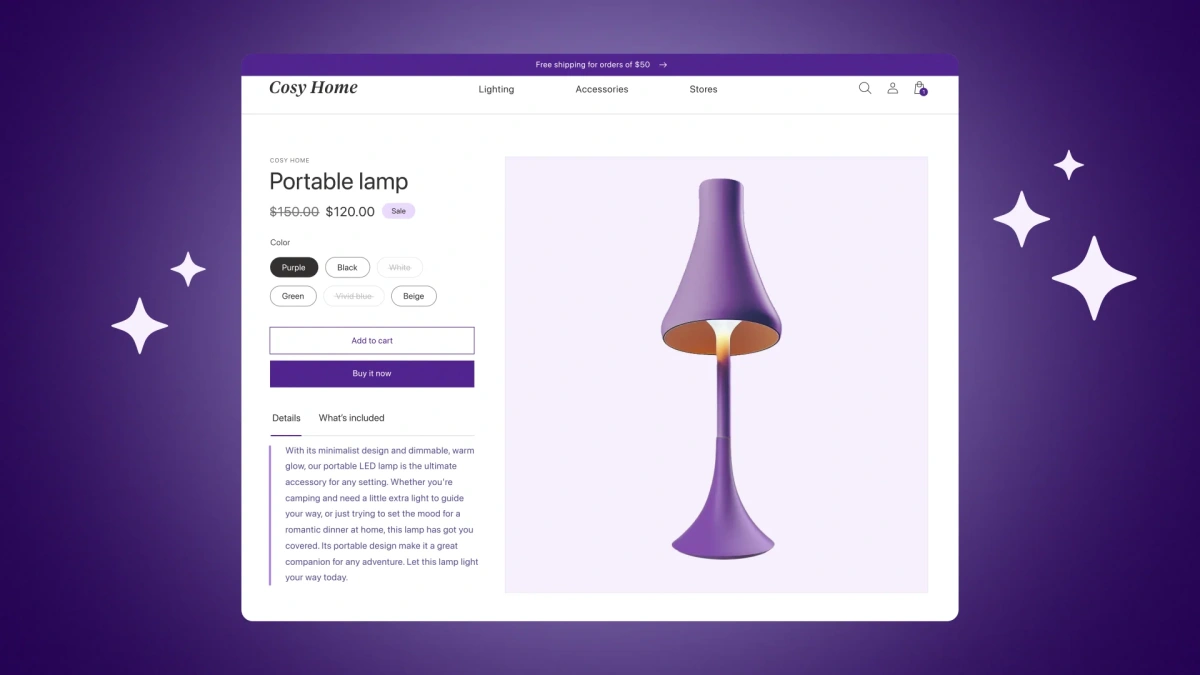
For merchants with a large catalog, the biggest benefit is simple: you don't have to start every piece of content from scratch. Give it the product information and a clear direction, then use the output as a first draft.
Pros
- Built directly into Shopify
- Free AI features across Shopify workflows
- Useful for repetitive copy and content tasks
Cons
- Less specialized than dedicated marketing apps
- Generated content still needs review
- Not designed to replace a complete marketing stack
Best fit: Merchants who want to reduce repetitive content work without adding another app.
2. Shopify Sidekick: Best Native AI Store Assistant
Sidekick is worth separating from Shopify Magic because it does much more than generate copy.
It's designed as a conversational AI assistant inside Shopify. You can use it to analyze reports, create customer segments, edit products and discounts, generate marketing content, build Shopify Flow workflows, and get help with SEO. It can also work with supported third-party apps.
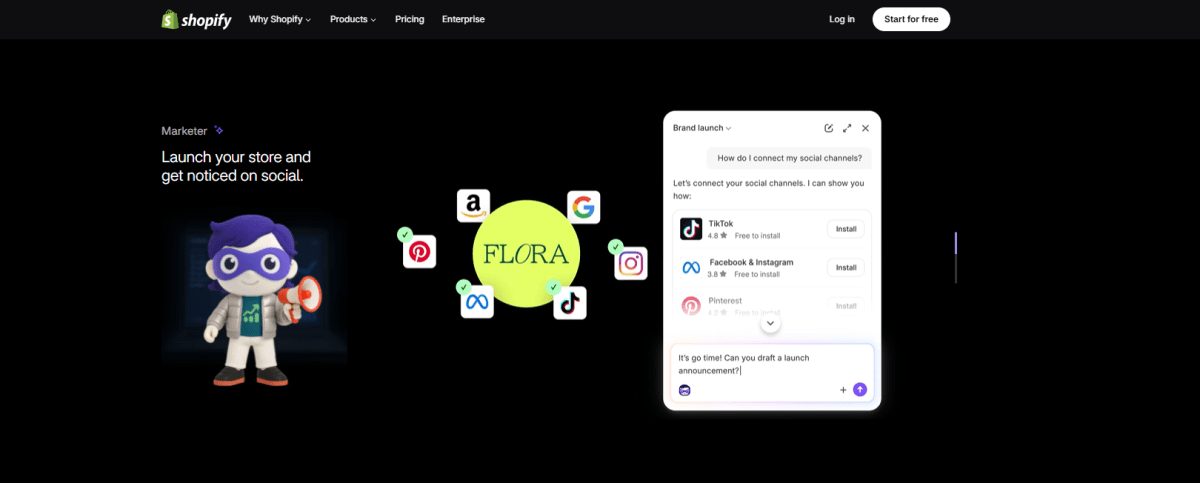
That's where Sidekick becomes useful for merchants: instead of asking AI to write something, you can ask it to help you get something done in your store.
Pros
- Works directly inside Shopify Admin
- Can handle both analysis and execution
- Connects marketing tasks with your Shopify store data
Cons
- Not a replacement for specialized marketing platforms
- Some features have plan or usage limitations
- Important changes still need merchant review
Best fit: Merchants who want an AI co-pilot for running and analyzing their Shopify store, not just generating content.
3. Campaign Autopilot: Best AI Campaign Automation
Campaign Autopilot is designed for merchants who want AI to take more of the repetitive work out of campaign management.
Instead of manually setting up and monitoring every campaign, the platform can help automate campaign creation, audience targeting, creative variations, and optimization based on performance data.
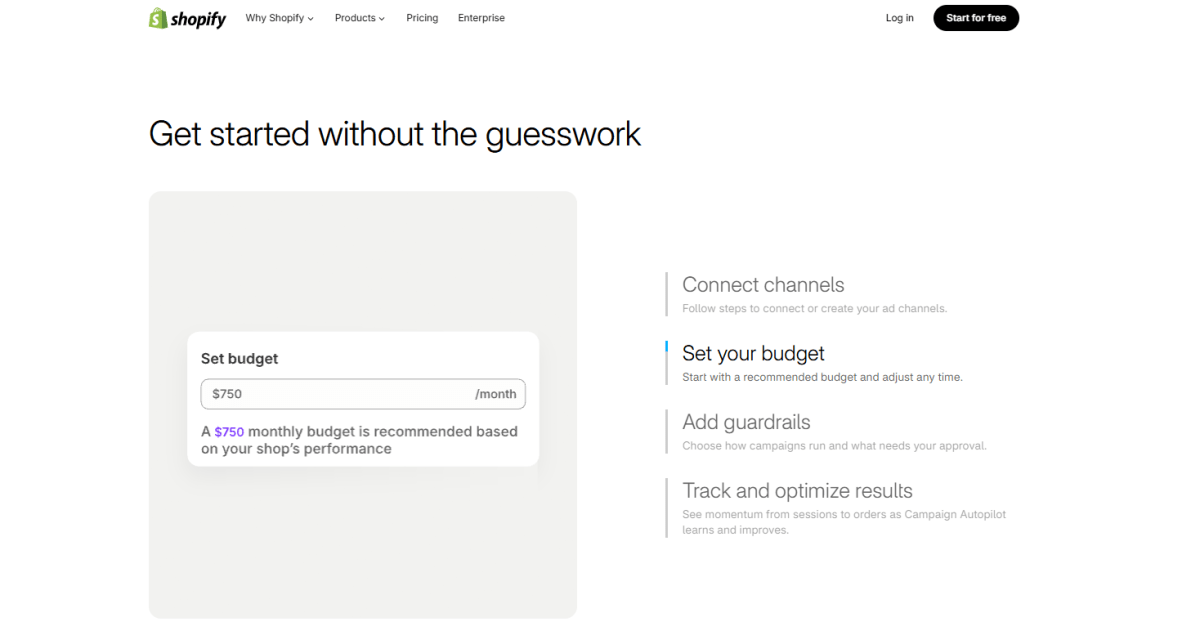
The appeal is less about generating one piece of content and more about creating a workflow that can keep campaigns moving with less manual input.
Pros
- Reduces repetitive campaign management
- Can help test and optimize campaigns faster
- Useful when you're managing multiple campaigns at once
Cons
- Less control than fully manual campaign management
- Automated decisions still need monitoring
- Results depend on the quality of your campaign data and setup
Best fit: Merchants running enough paid or promotional campaigns that manual optimization is becoming time-consuming.
4. Shopify Inbox: Best Native Shopify Chat
Shopify Inbox is Shopify's built-in messaging tool for talking with shoppers directly from your store.
It's particularly useful for answering pre-purchase questions while customers are still browsing. Shopify's AI features can help suggest replies and provide product recommendations during conversations, so merchants can respond faster without turning every chat into a manual support task.
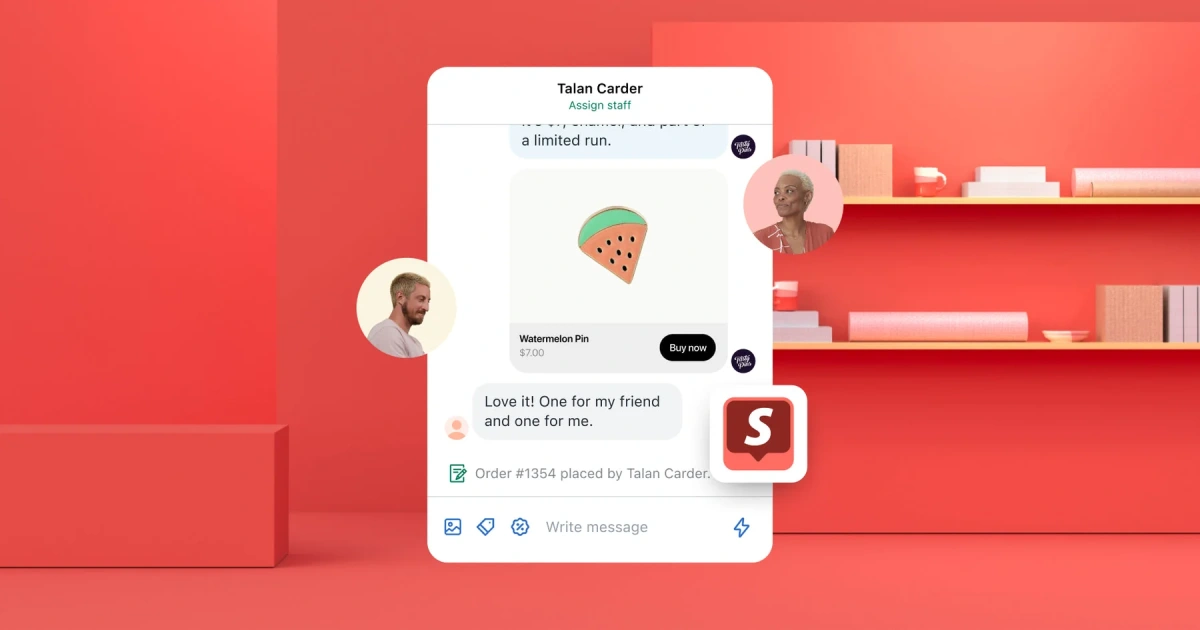
The advantage here is simplicity. You don't need to introduce a separate customer-support platform if your main need is basic storefront messaging.
Pros
- Built directly into Shopify
- Easy way to add live chat to a store
- Can support product discovery and pre-purchase conversations
- No separate helpdesk required for basic use
Cons
- Less comprehensive than dedicated platforms such as Tidio or Gorgias
- Better suited to lightweight chat than complex support operations
- AI assistance doesn't eliminate the need for human responses in more complicated conversations
Best fit: Small and growing stores that want to add AI-assisted chat without adopting a full customer-service platform.
5. Klaviyo: Best AI Email & SMS Marketing
Klaviyo makes the most sense when you want AI to work with your customer data, rather than simply generate marketing copy.
Its Shopify integration combines segmentation, automated flows, predictive analytics, personalization, email, and SMS. Its AI features can help with areas such as predictive insights, content generation, and send-time optimization.
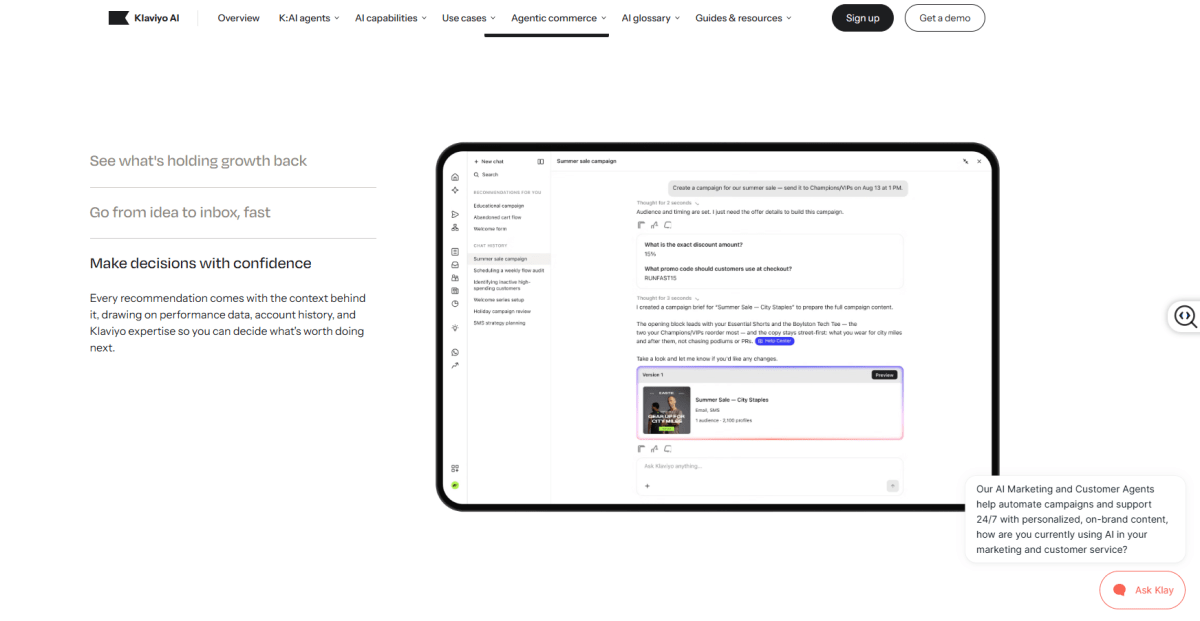
The important trade-off is complexity. Klaviyo can support sophisticated lifecycle marketing, but you'll get much more from it once you have enough customer and behavioral data to build meaningful segments.
Pros
- Strong segmentation and personalization
- Advanced email and SMS automation
- AI works alongside customer behavior data
Cons
- More complex to set up than basic email tools
- Costs increase as your customer list grows
- Requires a solid lifecycle marketing strategy to get the most from it
Best fit: Growing stores that want to automate retention and personalize email and SMS at scale.
6. Rebuy Personalization Engine: Best AI Upselling & Merchandising
Rebuy is focused on a very specific problem: what should you show a shopper next?
It uses personalization to power product recommendations, upsells, cross-sells, bundles, Smart Cart experiences, and post-purchase offers. That makes it particularly relevant if you're already getting traffic and orders but want to increase AOV or revenue per shopper.
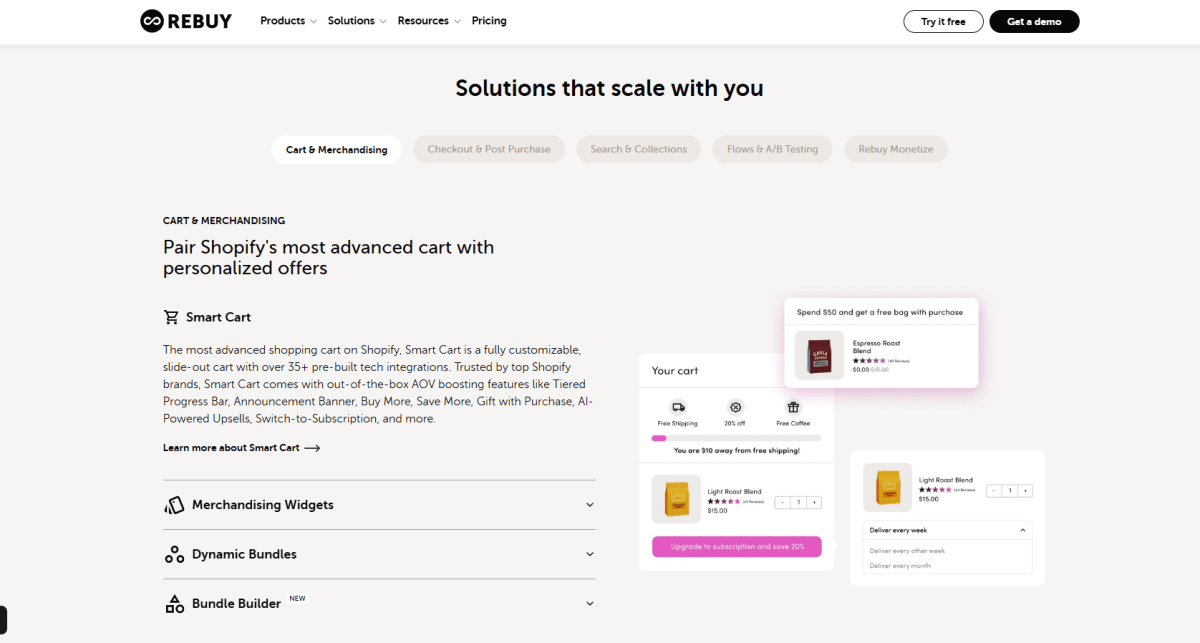
The main thing to watch is app compatibility. Because Rebuy can sit across important parts of the buying journey, you'll want to make sure its cart and offer logic works cleanly with your existing discount, subscription, and checkout setup.
Pros
- Strong personalization and recommendation features
- Covers upsells, cross-sells, bundles, and post-purchase offers
- Useful for increasing AOV without simply acquiring more traffic
Cons
- More relevant once your store has enough traffic and order data
- Can overlap with other upsell or cart apps
- Requires testing to make sure recommendations actually improve the customer journey
Best fit: Established stores that want to monetize existing traffic more effectively through personalized offers.
7. Octane AI: Best Zero-Party Data & Product Recommendations
Octane AI takes a different approach to personalization. Instead of guessing what a shopper wants from browsing behavior alone, you can ask them directly through an interactive quiz.
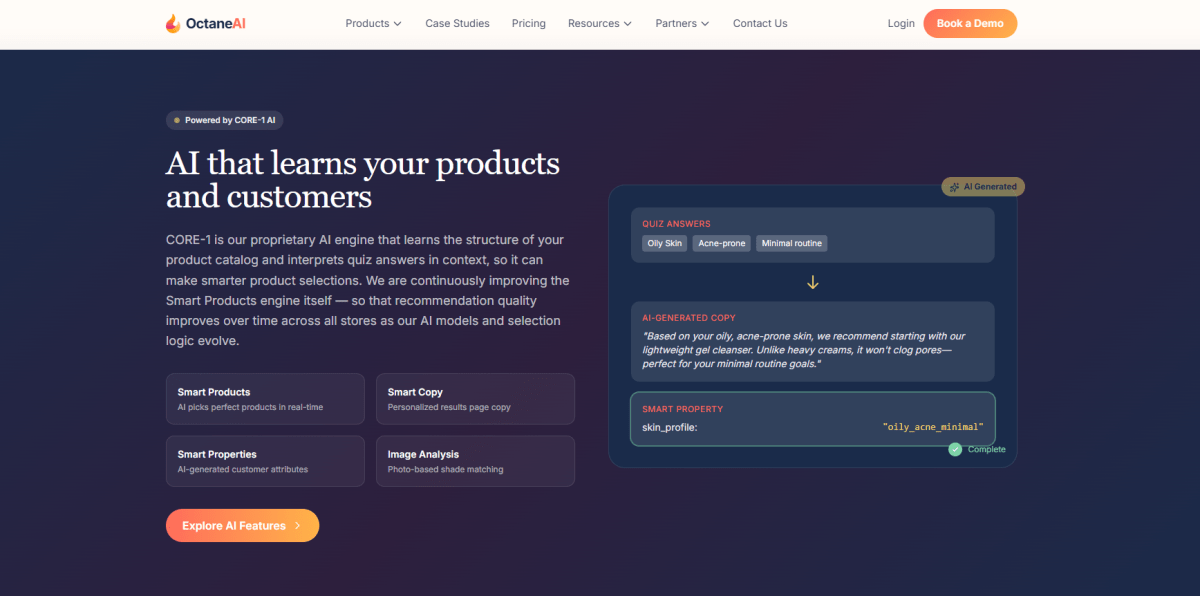
For example, a skincare store could ask about skin type, concerns, and goals before recommending products. Those answers can also become useful customer data for future personalization and email marketing.
That's the real value here. The quiz isn't just a conversion widget. It can become a way to learn why shoppers choose certain products.
Pros
- Strong product recommendation use case
- Collects zero-party preference data
- Can connect quiz results with downstream marketing
Cons
- Works better for products that require consideration
- A poor quiz can add friction instead of improving conversion
- Requires ongoing testing and optimization
Best fit: Beauty, skincare, wellness, fashion, and other stores where customers need help choosing the right product.
8. AdScale: Best AI Paid Advertising Automation
AdScale focuses on the part of marketing that can become expensive and time-consuming very quickly: paid ads.
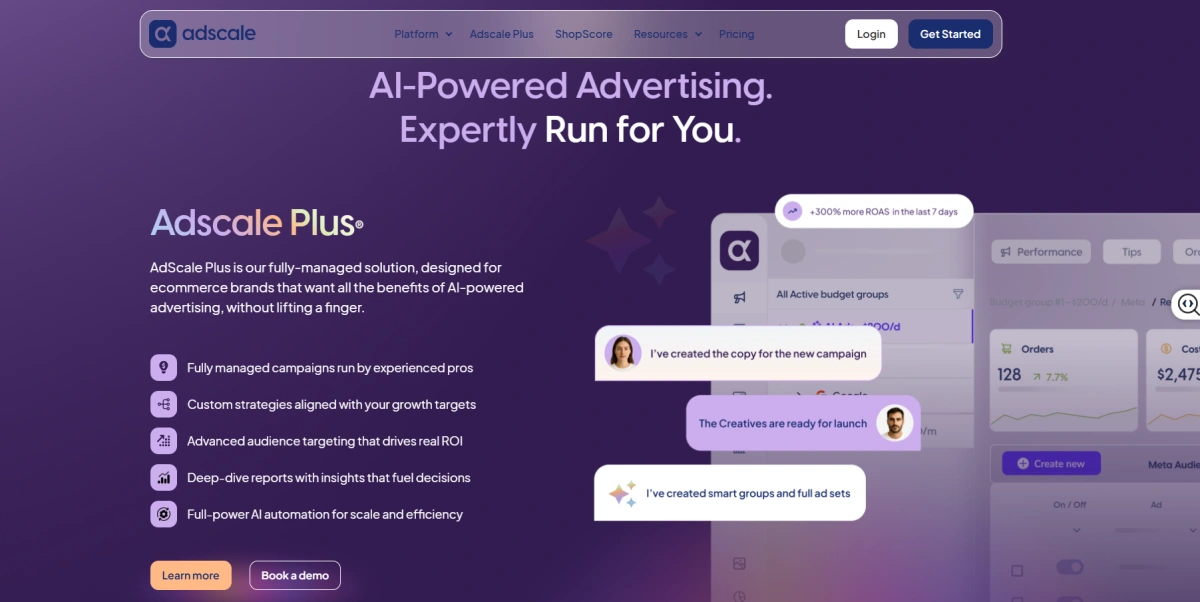
It connects with platforms such as Meta and Google and uses store data to help create campaigns, audiences, creatives, and budget optimization. The idea is to reduce the amount of manual campaign management while giving the system more data to work with.
I'd still treat it as an optimization layer, not a replacement for your advertising strategy. AI can adjust campaigns, but it doesn't know whether your offer, positioning, or product economics make sense.
Pros
- Automates parts of Meta and Google campaign management
- Uses store data alongside advertising data
- Reduces repetitive optimization work
Cons
- Less control for merchants who prefer manual campaign management
- Automated optimization doesn't guarantee profitable campaigns
- Performance still depends heavily on creative, offer, and unit economics
Best fit: Merchants already spending consistently on Meta or Google who want to automate more of the optimization process.
9. Tidio: Best AI Sales Assistant & Chatbot
Tidio's Lyro AI is useful when customer questions are becoming a bottleneck.
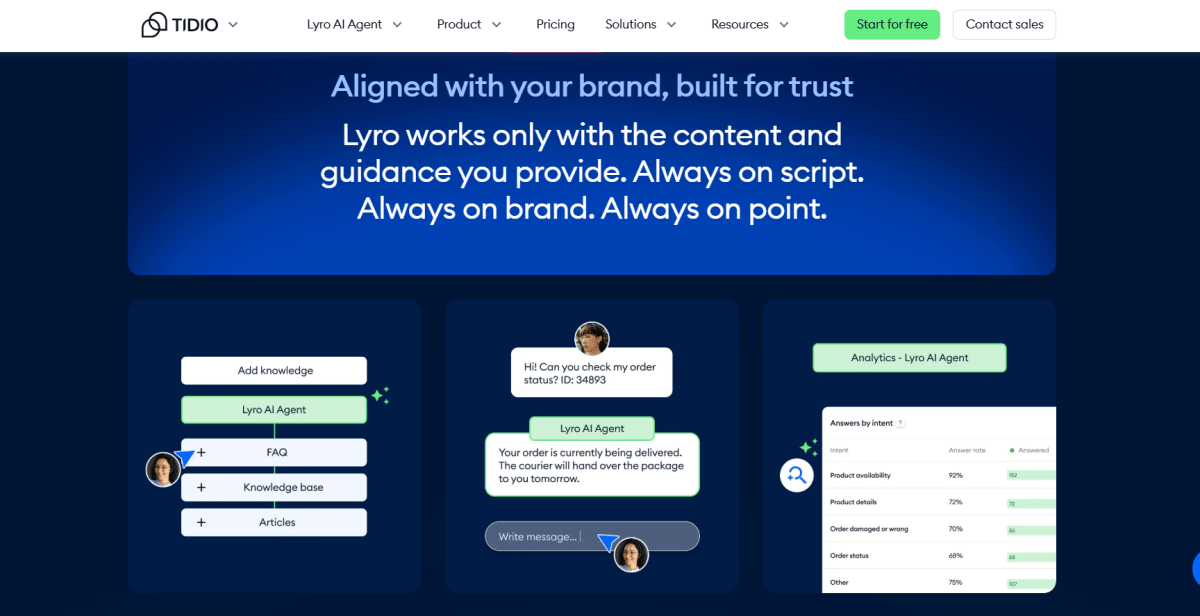
Instead of having your team answer the same questions about products, shipping, returns, or orders repeatedly, you can use AI to handle common conversations and hand more complicated cases to a human.
That makes it relevant to marketing too. A shopper who gets an immediate answer to a product question is closer to making a purchase than someone who has to wait hours for a reply.
Pros
- Combines AI support with live chat
- Useful for both pre-purchase and post-purchase questions
- Can reduce repetitive support workload
Cons
- AI responses still need monitoring
- Less useful for stores with very low support volume
- Some merchants may need more advanced helpdesk functionality
Best fit: Small and growing stores that want 24/7 customer assistance without expanding the support team immediately.
10. SEOWILL: Best AI SEO & Content Optimization
SEOWILL, formerly SEOAnt, is aimed at merchants who want to scale Shopify SEO without manually checking every product and page.
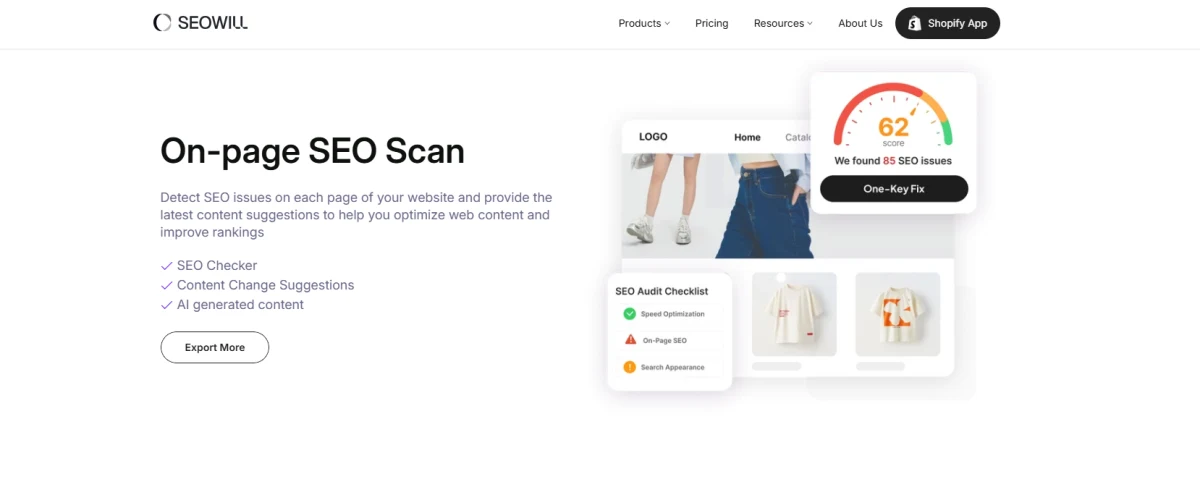
It combines SEO audits and optimization features with AI content generation, including product content and blog posts. Its current Shopify listing also positions it around AEO/GEO, making it relevant if you're thinking beyond traditional Google search.
The important distinction is that AI can speed up the execution, but it doesn't replace SEO strategy. You'll still need to decide which topics, products, and search opportunities are actually worth targeting.
Pros
- Combines technical SEO with AI content tools
- Useful for large product catalogs
- Can speed up repetitive optimization work
Cons
- AI-generated content still needs editing
- Doesn't replace keyword research or content strategy
- Some features are more SEO-focused than marketing-focused
Best fit: Shopify stores with a large catalog or growing organic search strategy.
11. Visby: Best AI Search Visibility & GEO
Rather than focusing only on traditional Google rankings, Visby helps merchants understand how AI platforms such as ChatGPT, Gemini, and Claude perceive and surface their brand. Its Shopify app also includes optimization features for product pages and content.
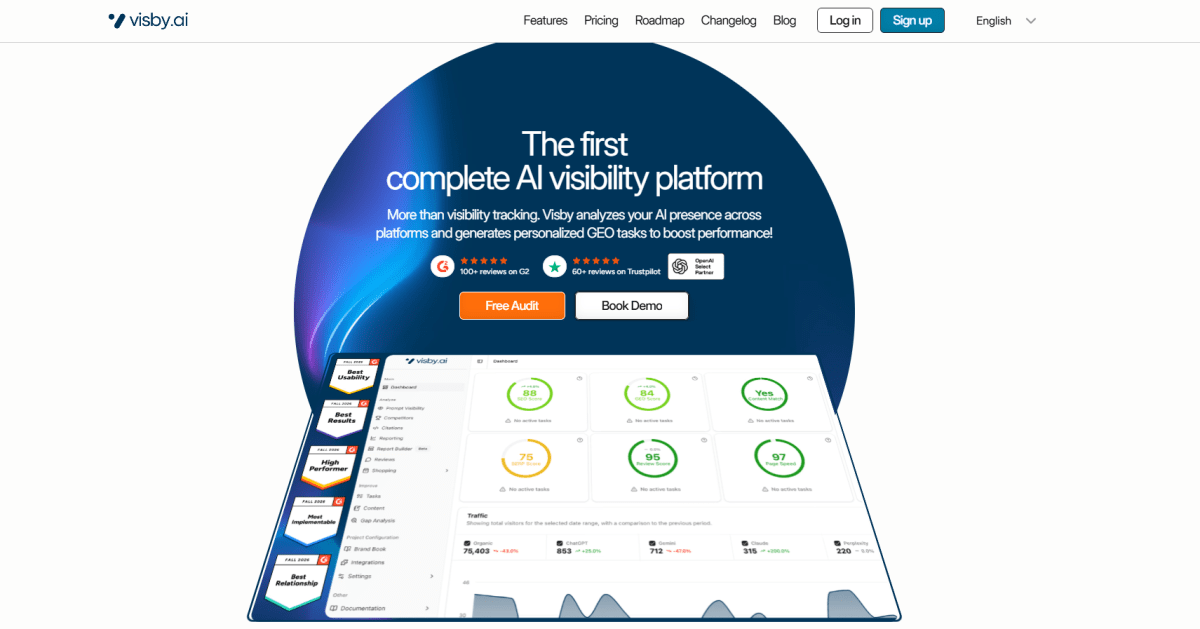
This is a more emerging use case than email, ads, or SEO, so I'd treat it as an additional channel to test rather than something every Shopify store needs immediately.
Pros
- Focuses specifically on AI search visibility
- Helps merchants monitor how AI engines perceive their brand
- Relevant as shoppers increasingly use conversational search
Cons
- AI search optimization is still an emerging area
- Smaller review base than established Shopify apps
- Results are harder to measure than traditional search traffic
Best fit: Merchants already investing in SEO who want to start monitoring visibility across AI search platforms.
Step-by-Step: How to Implement AI Marketing in Your Shopify Store
You don't need to automate your entire Shopify marketing workflow at once. Start with one repetitive task, prove that AI actually saves time or improves performance, then expand from there.
Step 1: Audit Your Current Stack and Identify Bottlenecks
Before installing another AI app, look at where your marketing workflow is slowing you down.
Are you spending hours writing product copy? Manually adjusting ad campaigns? Answering the same customer questions? Building email segments one by one?
Start with the task that takes the most manual effort or has the clearest impact on revenue. That's usually where AI has the easiest business case.
Step 2: Start With Shopify's Built-In AI Tools
Once you've identified the bottleneck, check what Shopify can already handle.
Shopify Magic can help with content creation, while Sidekick can assist with store tasks, analysis, and workflows. Shopify Inbox can also help with customer conversations.
Starting with native tools keeps your tech stack simple and lets you test AI without immediately adding another monthly subscription.
Step 3: Add Specialized AI Apps Where They Make Sense
When Shopify's built-in tools aren't enough, add a specialized app for the specific job you need to solve.
For example, you might use Klaviyo for email and SMS personalization, Rebuy for product recommendations, AdScale for paid advertising, or Tidio for AI customer support.
The key is to avoid overlapping tools. If two apps are both trying to manage the same workflow, you can end up paying twice and making your data harder to manage.
Step 4: Give AI Your Brand Voice and Context
AI works much better when it knows how your brand actually communicates.
Give it clear guidelines around your tone, vocabulary, target customer, product positioning, offers, and words or claims to avoid. For customer-facing AI, also make sure your product information, shipping policies, FAQs, and return rules are accurate.
You don't want every AI-generated product description or chatbot reply to sound like it came from the same generic template.
Step 5: Measure, Test, and Optimize
Once AI is part of your workflow, don't assume it's working just because it saves time.
Measure the outcome you're actually trying to improve. Depending on the use case, that could be conversion rate, AOV, email revenue, CAC, ROAS, response time, or customer satisfaction.
For campaigns and landing pages, run A/B tests where possible. And look beyond revenue alone. An AI-powered campaign that generates more sales but also increases ad spend, discounts, refunds, or other costs may not actually improve profitability.

Best Practices & Common Pitfalls to Avoid
AI can make Shopify marketing much faster, but speed isn't the same as better marketing. A few rules will help you get the benefits without letting automation create new problems.
What You Should Do When Using AI for Shopify Marketing
- Keep a Human in the Loop
Always review AI-generated content before publishing it, especially product claims, promotional copy, customer-facing messages, and anything related to pricing or policies.
AI can produce convincing copy while still getting important details wrong. Human review is what keeps the output accurate and aligned with your brand.
- Use First-Party Customer Data
AI becomes more useful when it's working with real information about your customers.
Use data such as purchase history, customer segments, product preferences, and engagement behavior to make personalization more relevant. The goal isn't to collect as much data as possible, but to use the data you already have responsibly to make better marketing decisions.
What You Should Avoid
- Use AI to Mass-Produce Low-Value Content
Publishing hundreds of AI-generated product pages or blog posts just because you can isn't a marketing strategy.
Thin, repetitive, or inaccurate content can create a poor experience for shoppers and may provide little value in search. Use AI to speed up research and production, but make sure the final content has useful information, original insight, and a reason to exist.
- Let Chatbots Replace Human Support Completely
AI chatbots are great for repetitive questions, but not every customer interaction should be automated.
When a customer has a complicated issue, a complaint, or a situation that requires empathy, give them an easy path to a real person. The best setup is usually AI handling simple conversations while humans step in when judgment or empathy matters.
Final Thoughts
AI can take a lot of work off your plate as a Shopify merchant, but I wouldn't treat it as a shortcut to better marketing.
The real opportunity is using AI to do more of the repetitive work while you spend more time on the decisions that actually matter. That could mean testing more creative ideas, personalizing campaigns, understanding customer behavior, or getting through your data faster.
Start small, keep a human eye on the output, and measure the result against real business metrics. And by real metrics, I mean profit, not just revenue.
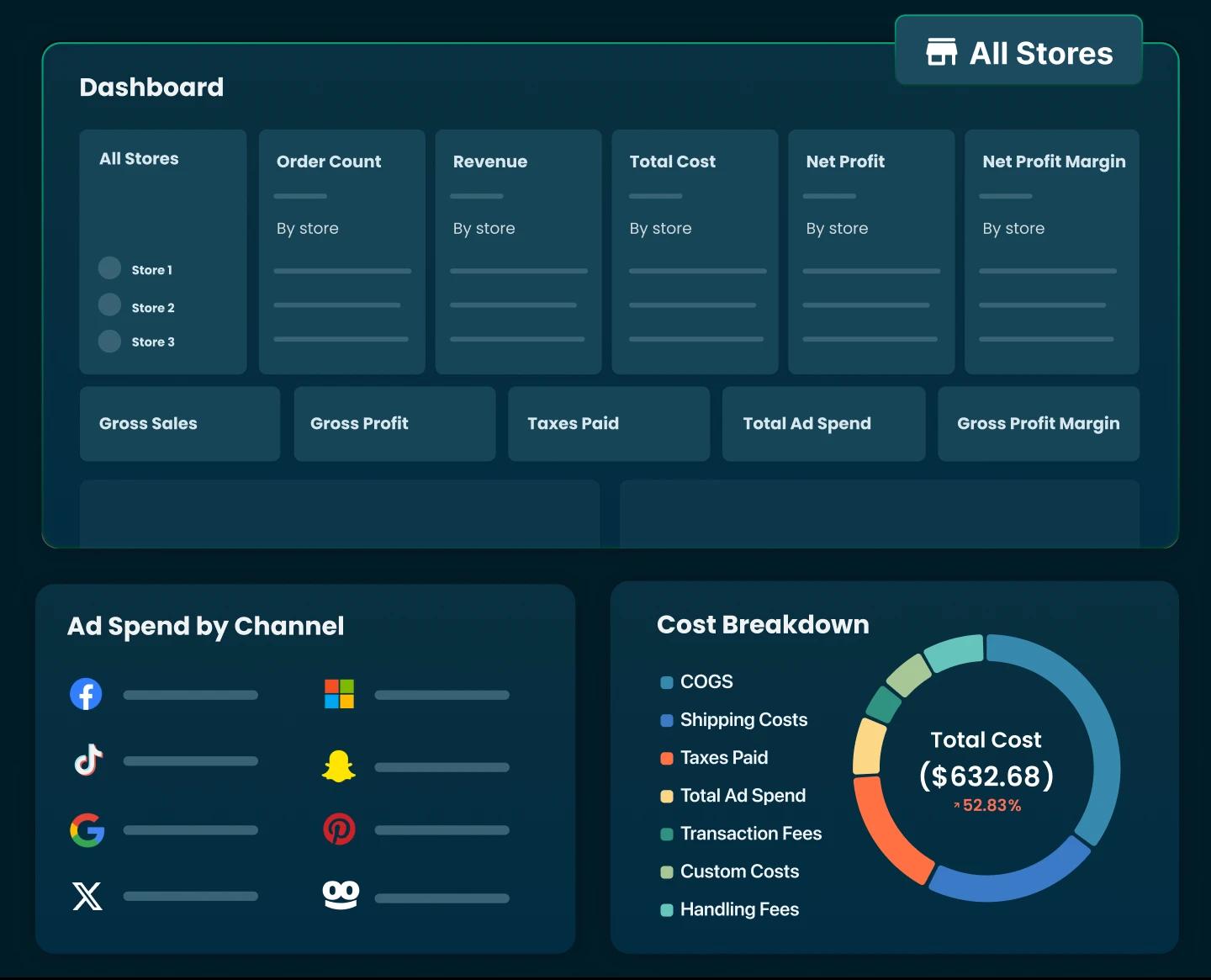
That's the kind of bigger picture you can track with TrueProfit, which brings your revenue, COGS, ad spend, shipping, fees and other costs together in one place, so you can see the net profit behind your marketing.
And with TrueProfit MCP, your AI assistant can analyze that data, break down campaign performance, spot trends, and generate reports without you having to dig through everything manually.


Lila Le is the Marketing Manager at TrueProfit, with a deep understanding of the Shopify ecosystem and a proven track record in dropshipping. She combines hands-on selling experience with marketing expertise to help Shopify merchants scale smarter, through clear positioning, profit-first strategies, and high-converting campaigns.