13 Best Shopify AI Agents for Support, Sales & Operations (2026)


Artificial intelligence has moved well past writing product descriptions or fielding basic support tickets. A new generation of tools - AI agents can now take entire workflows off your plate, running independently without someone watching over every step.
In this guide, you'll learn what Shopify AI agents are, how they differ from chatbots and AI assistants, the best platforms to consider, and how to pick the right one for your store. Let’s get started!
What Are Shopify AI Agents?
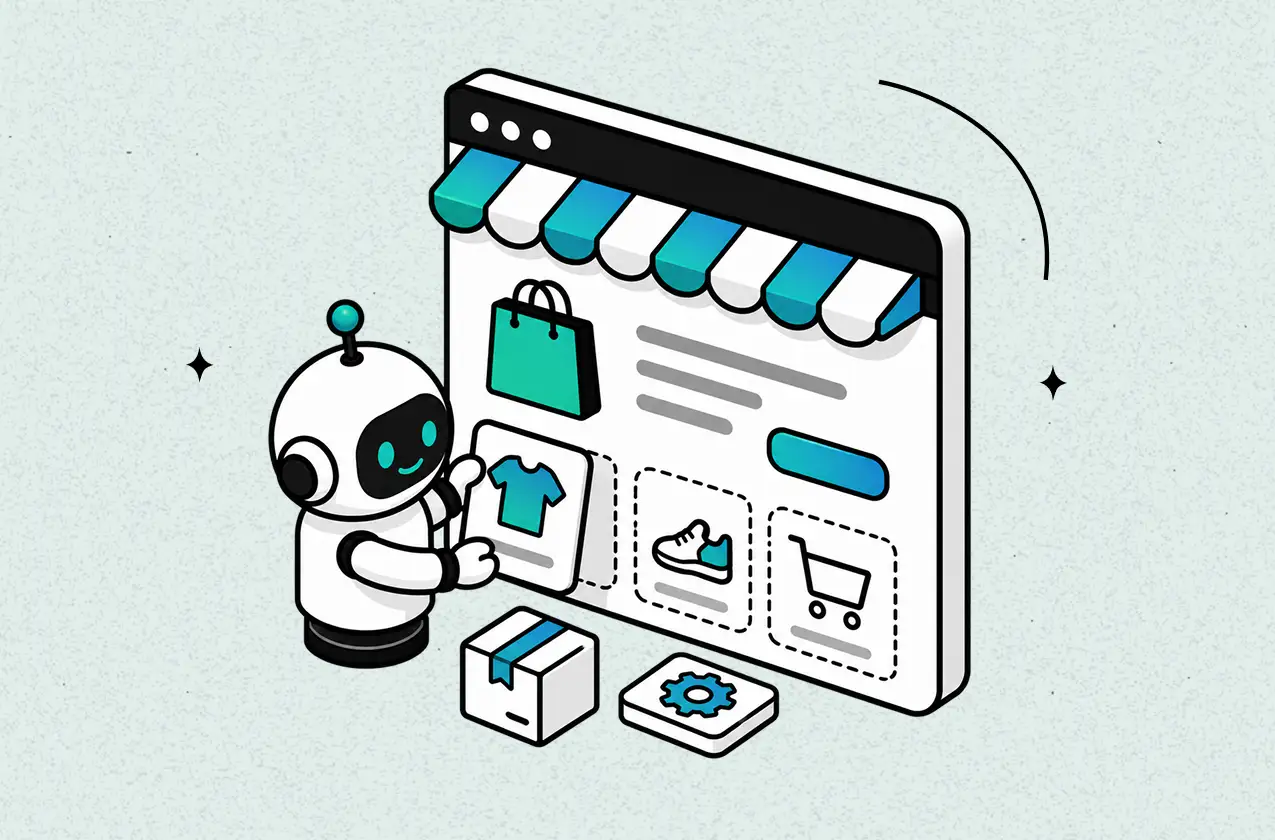
A Shopify AI agent is software that uses artificial intelligence to act on your behalf, answering customers, managing tasks, making decisions, without needing constant input from you or your team.
Shopify has been quietly pushing toward what it calls an "agentic commerce" model, where AI systems behave less like support tools and more like digital employees. These agents don't sit around waiting to be prompted. They go out and execute: handling customer support, making product recommendations, checking inventory, and managing orders.
In more advanced setups, they can also talk to other apps across your tech stack, coordinate actions between systems, and serve both sides of the transaction, helping merchants run operations more efficiently while guiding customers from discovery to checkout.
AI Agents vs. AI Chatbots vs. AI Assistants
Before diving into tools, it's worth getting the terminology straight. These three terms get used interchangeably, but they're quite different in practice.
A chatbot is typically rule-based, handling predefined interactions such as FAQs, order tracking, or simple customer support. An AI assistant is more flexible, using large language models (LLMs) to generate contextual responses or create content, but it still relies on user prompts to initiate each task.
An AI agent goes a step further. Instead of simply responding, it can understand a goal, gather information from connected systems, make decisions based on predefined rules or context, and execute multi-step actions autonomously.
The key distinction is that AI agents are designed to execute end-to-end workflows across systems with a degree of autonomy, while assistants and chatbots remain primarily reactive.

Types of Shopify AI Agents by Use Case
Not all AI agents do the same job, and picking the most popular tool isn't the same as picking the right one. Start by figuring out where the biggest drag on your business is.
1. Customer Service and Support Agents
This is the most mature category, and for most stores, the most immediately useful. These agents handle order tracking questions, returns, FAQs, and complaint triage without someone on your team having to jump in every time.
What sets modern support agents apart from older chatbots is that they can hold context, access live order and shipping information, and follow a conversation across channels: live chat, email, social media, messaging apps. If your support inbox is constantly overflowing, this is typically the highest-ROI place to start.
2. Sales and Conversion Agents
Think of these as virtual sales associates, not just product recommenders. They chat with shoppers in real time, ask questions to understand what someone is actually looking for, suggest relevant products, and follow up on abandoned carts, adapting to what the shopper says, not just what they click.
As these tools get more sophisticated, they're starting to guide customers all the way from first touchpoint to checkout, which is a meaningful shift from passive recommendation engines.
3. Marketing and Campaign Optimization Agents
This category covers agents that handle content creation, product descriptions, email campaigns, social posts, ad copy and at the more advanced end, campaign optimization.
Shopify Magic is the obvious entry point here. But more capable marketing agents go further: they analyze performance data, test creatives, spot audience gaps, and flag where campaigns are losing money. If content creation and campaign management eat up a disproportionate chunk of your week, this is worth looking into.
4. Pricing and Merchandising Agents
Pricing agents move beyond fixed rules by weighing real variables, customer behavior, demand shifts, inventory levels, competitor pricing, to recommend or automatically adjust your prices.
For stores with large catalogs, the upside is compounding. Even marginal improvements in pricing strategy add up fast when you're working across thousands of SKUs.
5. Inventory and Operations Agents
Not the flashiest category, but often the most valuable for stores running complex fulfillment operations. These agents keep tabs on inventory levels, surface unusual demand patterns early, and trigger reorder alerts before you're staring at a stockout.
More advanced systems can also forecast demand using sales trends, seasonality, and external signals, the kind of forward visibility that used to require a dedicated ops analyst.
6. Analytics and Insights Agents
Traditional dashboards show you numbers. Analytics agents help you figure out what those numbers actually mean.
They can identify your best-performing products, uncover high-value customer segments, and answer questions like why did sales drop last week or which marketing channel is actually driving profitable customers. The difference between data and insight is where these agents earn their keep.
7. Agentic Commerce: The Category That's Coming Fast
This one deserves its own spotlight because the implications are significant.
Agentic commerce is the idea that AI agents will eventually browse, compare, and purchase products on behalf of consumers, without the shopper ever visiting your storefront. Think of it as a personal AI shopping assistant that evaluates your products, checks pricing, reviews return policies, and decides where to buy, all before a human makes a single click.
If an AI agent is evaluating your store, it will weigh product information accuracy, pricing competitiveness, availability, and policy clarity. Merchants who invest in getting these fundamentals right today are laying the groundwork for a future where AI systems are doing a lot of the shopping.
Over time, today's siloed sales, support, recommendation, and merchandising agents will likely converge into a broader ecosystem where AI systems communicate directly with each other on behalf of both shoppers and merchants.
Top 5 Shopify's Native AI Tools You Should Know
Before you start evaluating third-party tools, know what Shopify already gives you, much of it is free and requires zero setup. Here’s a quick check:
1. Shopify Sidekick


Sidekick is Shopify's built-in AI admin assistant. It lives inside your dashboard and lets you manage your store through natural language: pull sales reports, edit themes, create discounts, segment customers, all via chat.
It's genuinely useful for quick admin tasks, and it's already deeply plugged into your Shopify data. The trade-off: it's an internal tool, not a customer-facing agent, and it can't run autonomous workflows. But if you're navigating Shopify's admin constantly, it cuts down a lot of that friction.
- Best for: Merchants who want an on-demand admin assistant without touching a single sub-menu.
- Pricing: Free, included in all Shopify plans.
- Pros: Zero setup; deeply connected to Shopify data, and saves time on routine administrative tasks.
- Cons: Designed primarily for internal use, so it can't engage customers directly or act as a fully autonomous business agent.
2. Shopify Magic
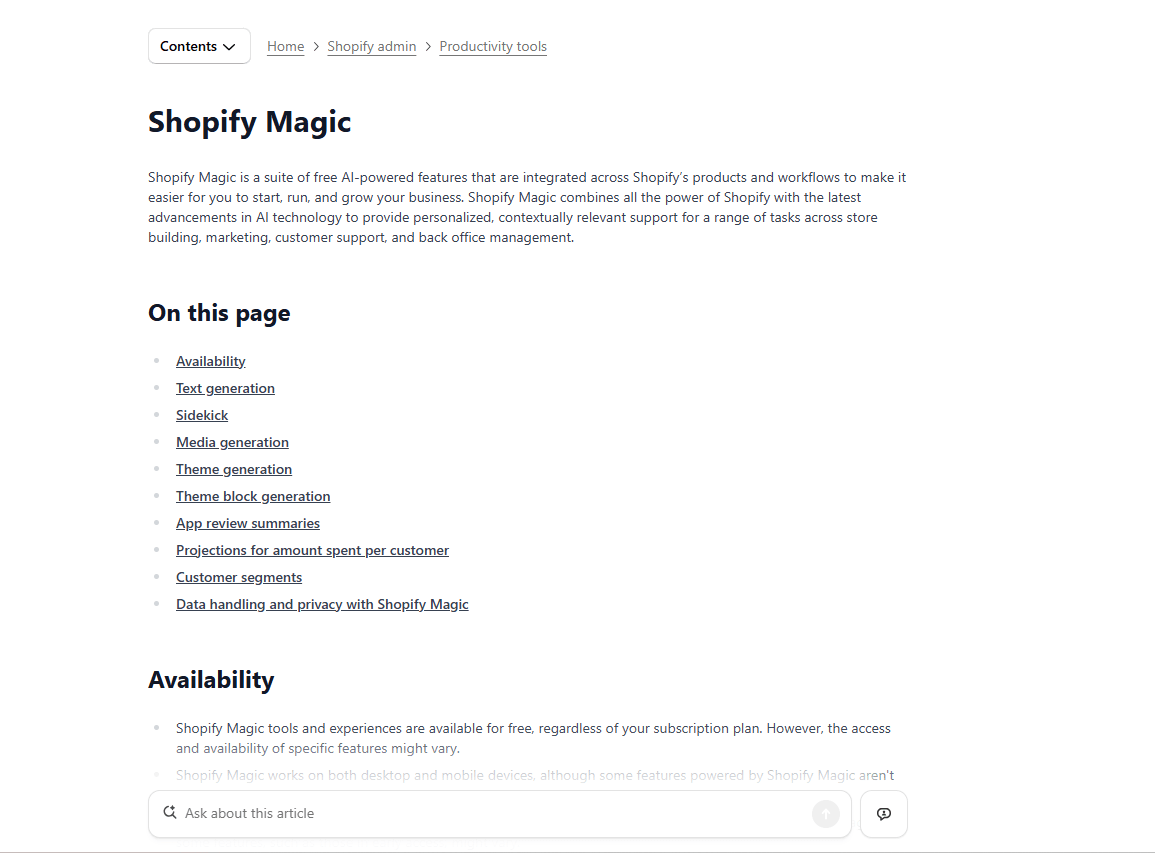
Shopify Magic is Shopify's content generation suite, baked directly into the platform. It handles product descriptions, email subject lines, image editing, background removal, and other content tasks, no installs, no configuration.
It won't replace a content team or run campaigns on its own. But for merchants who regularly upload products or churn out email content, it meaningfully speeds up repetitive work.
- Best for: Solopreneurs and small teams that want to create product and marketing content faster.
- Pricing: Free with all Shopify plans.
- Pros: No additional cost, built directly into Shopify, supports multiple languages, and significantly reduces the time spent on routine content creation.
- Cons: Focused on content generation rather than autonomous actions. It can create assets, but it can't independently launch campaigns, update catalogs, or manage workflows without human approval.
3. Shopify SimGym
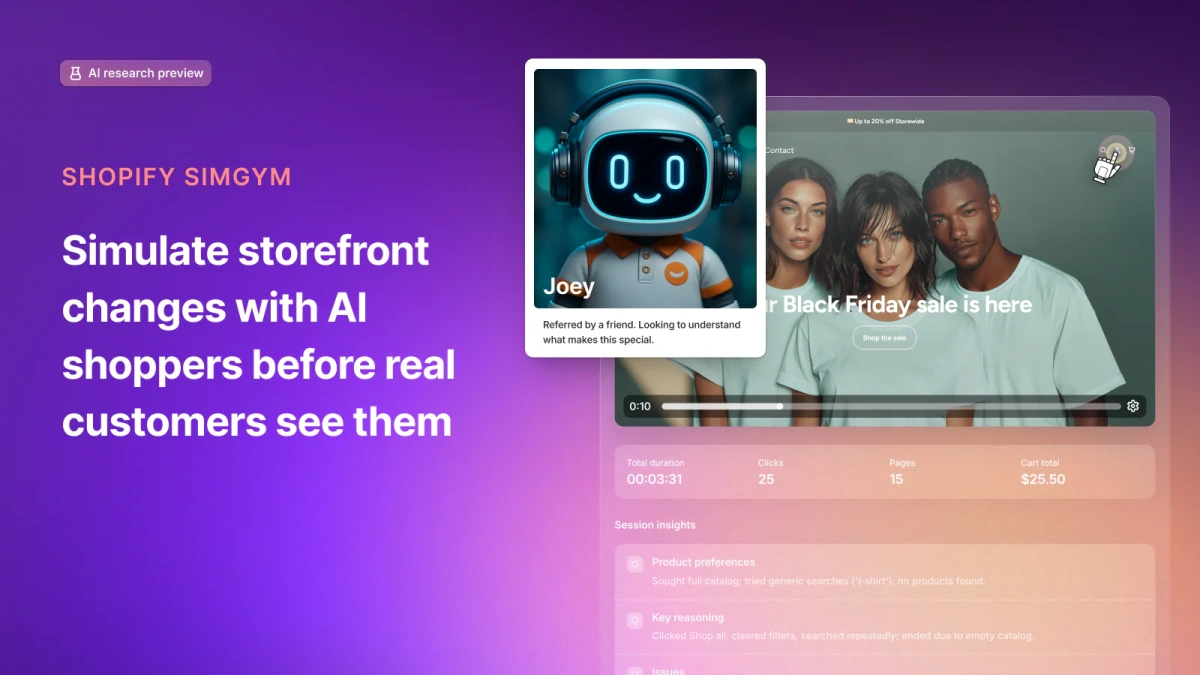
Shopify SimGym is still in limited preview, but the concept is worth paying attention to. It sends thousands of simulated shoppers through your storefront to identify friction points before real customers run into them.
Instead of waiting for live traffic to reveal problems, a slow and expensive way to learn, you can test a new theme or checkout flow and spot issues upfront. SimGym surfaces things like confusing navigation, broken user journeys, and conversion bottlenecks.
- Best for: Merchants and ecommerce teams that want to validate storefront changes before rolling them out to real customers.
- Pricing: Free during the AI Research Preview phase (limited access).
- Pros: Helps uncover conversion bottlenecks early; provides behavioral insights that would normally require significant real-world traffic to discover.
- Cons: Still in restricted preview; findings are based on simulated behavior rather than actual customer interactions.
4. Shopify Catalog
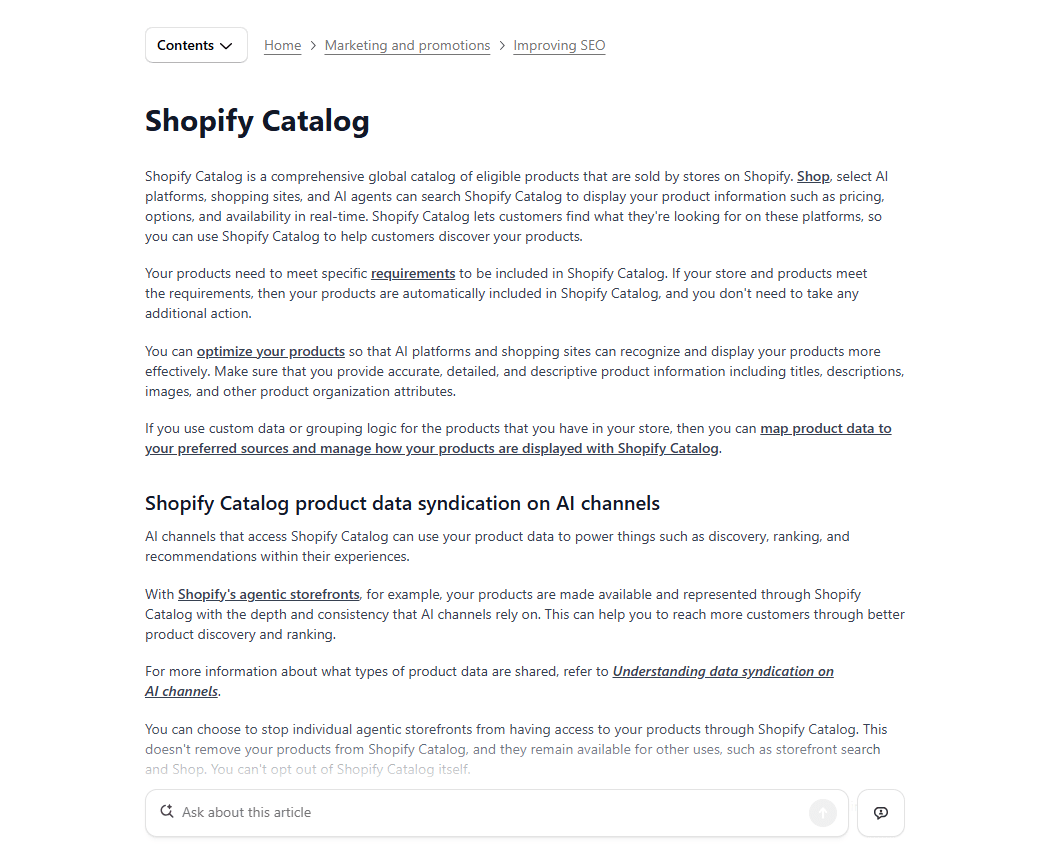
Shopify Catalog works behind the scenes. Its job is to organize your product data like inventory, pricing, attributes into a structured format that AI systems can parse.
As AI-powered shopping becomes more common, this infrastructure is what makes your products discoverable when someone uses ChatGPT or another AI assistant to search for recommendations. It's not something you'll interact with directly, but it's foundational to where ecommerce search is heading.
- Best for: Merchants who want their products to be discoverable in emerging AI-powered shopping environments.
- Pricing: Free and included with all Shopify plans.
- Pros: Requires little ongoing management once product data is properly structured; helps prepare your store for AI-driven product discovery.
- Cons: Visibility ultimately depends on whether external AI platforms choose to surface your products.
5. Agentic Storefronts
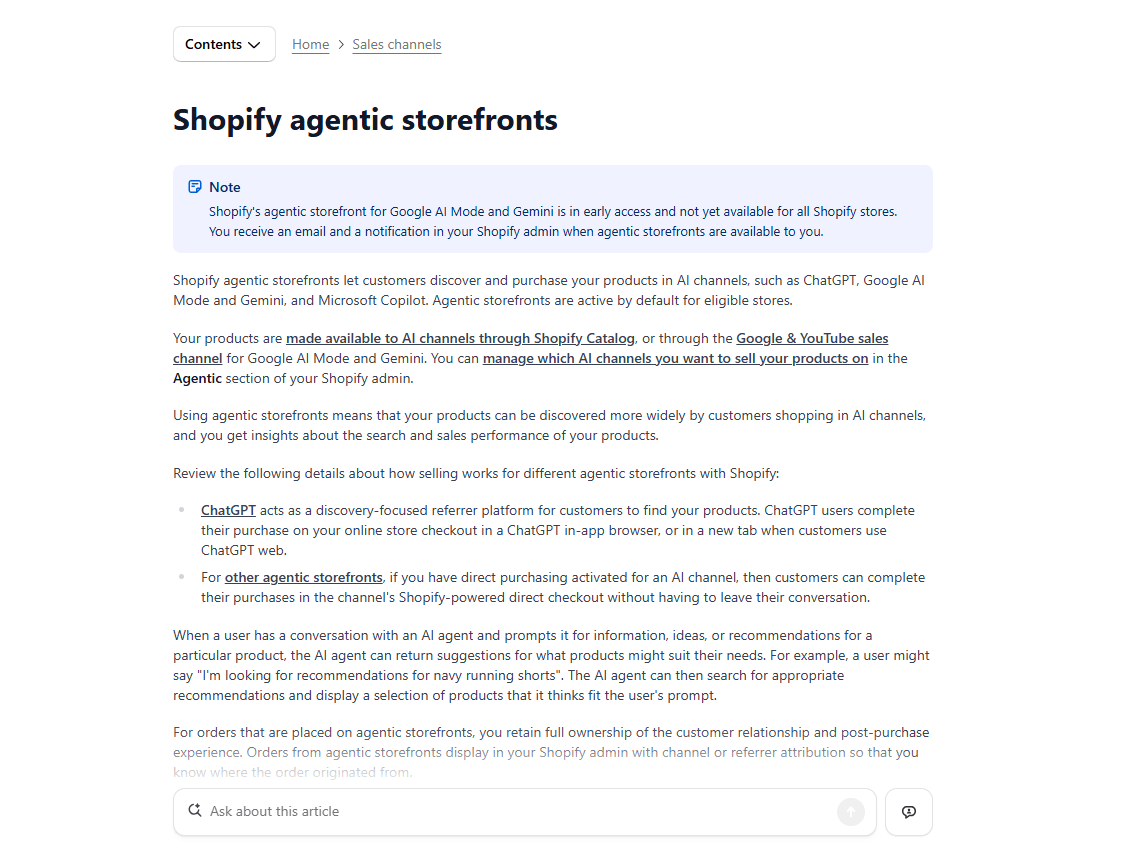
Agentic Storefronts is Shopify's framework for connecting stores with external AI assistants such as ChatGPT and Microsoft Copilot. Instead of sending shoppers to a traditional search engine, these platforms can surface products directly within conversations, complete with current pricing, inventory information, and checkout links.
The goal is to help merchants reach customers earlier in the buying journey, when they're still researching products and exploring options.
As AI-assisted shopping grows, this type of integration may become an increasingly important source of product discovery.
- Best for: Merchants looking to prepare for AI-driven shopping and product discovery.
- Pricing: Free from Shopify; third-party platform costs may vary.
- Pros: Expands product visibility beyond traditional search; supports real-time inventory and pricing data.
- Cons: Merchants have limited control over how external AI platforms rank, display, or recommend products.
8 Best Third-Party Shopify AI Agents Worth Checking Out in 2026
Shopify's native tools cover a solid baseline. But if you need more horsepower, deeper support automation, stronger sales capabilities, custom workflows, or enterprise-scale operations, third-party agents are where you'll find it.
Here are the most notable options worth considering in 2026.
6. Fin AI (by Intercom)
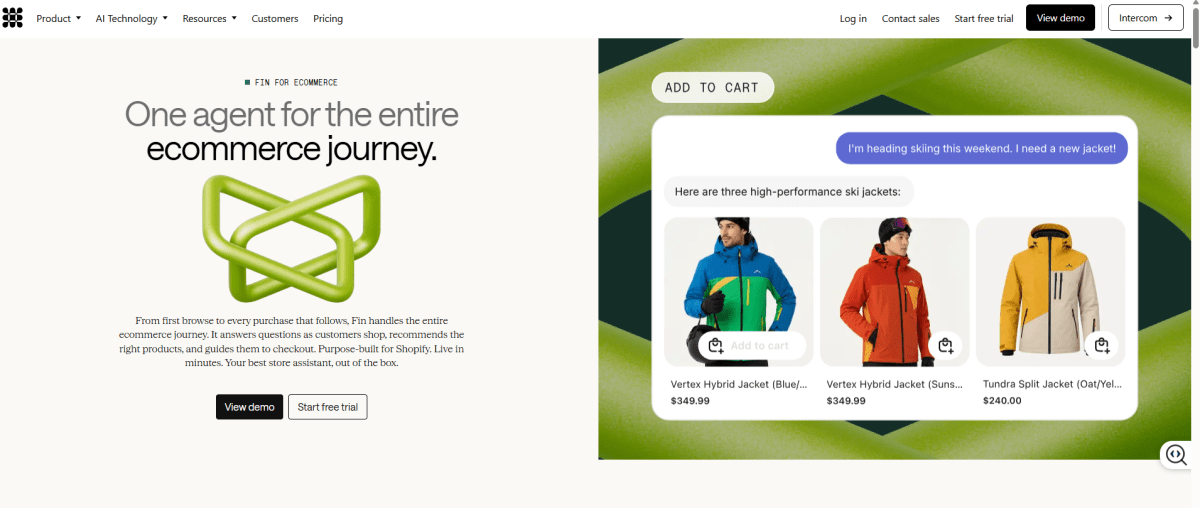
Fin AI is one of the strongest customer support agents available for Shopify stores right now. It connects to your support knowledge base and Shopify data, enabling it to answer questions, check order status, process returns, and work through common support requests without looping in a human.
What makes Fin worth a closer look is the pricing model: instead of charging by seat or usage volume, it charges per resolved conversation. For high-volume stores, that creates a direct line between cost and actual business value.
- Best for: High-volume stores looking to automate customer support while paying based on outcomes rather than agent seats.
- Pricing: Approximately $0.95 per outcome, plus an Intercom subscription.
- Pros: Outcome-based pricing; strong support automation capabilities; can take real actions such as handling returns and order-related requests.
- Cons: Requires an Intercom subscription; implementation can feel complex for smaller teams.
7. Relevance AI
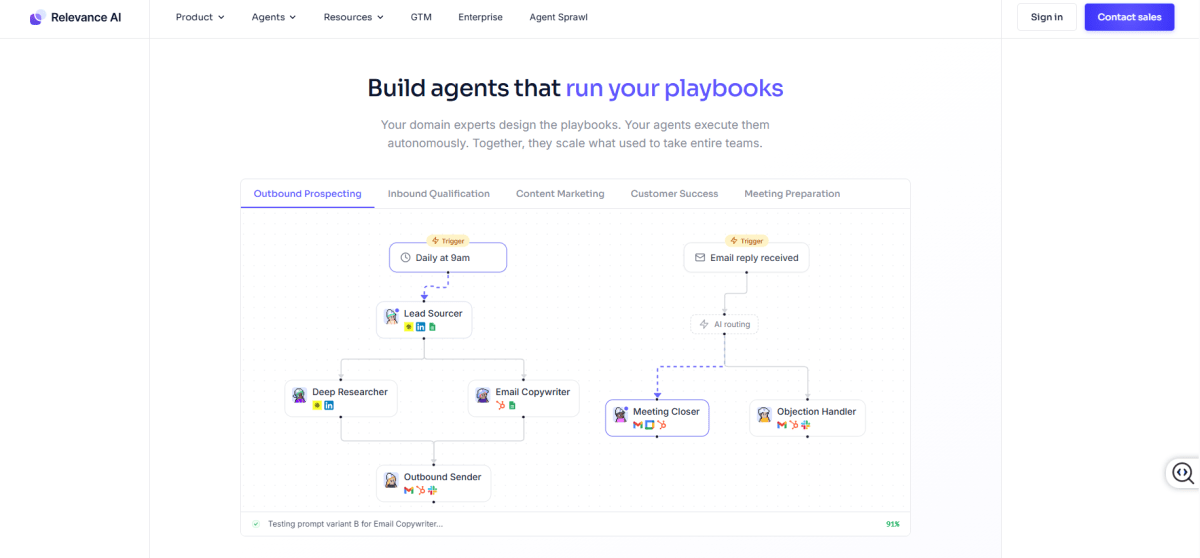
Relevance AI is built for conversational commerce and guided shopping, helping customers navigate large product catalogs through structured conversations, with strong multilingual support for international audiences.
It's particularly well-suited to stores where products require more guidance before purchase, or where you're selling across multiple languages and markets.
- Best for: Technical merchants and growth ecom teams building custom AI workflows.
- Pricing: Free plan available. Paid plans start at $19/month for the Pro plan, with higher-tier Team and Enterprise plans available for larger organizations.
- Pros: Highly customizable; supports sophisticated workflows; integrates well with other business systems.
- Cons: Requires technical understanding; learning curve is significantly higher than plug-and-play tools.
8. Certainly
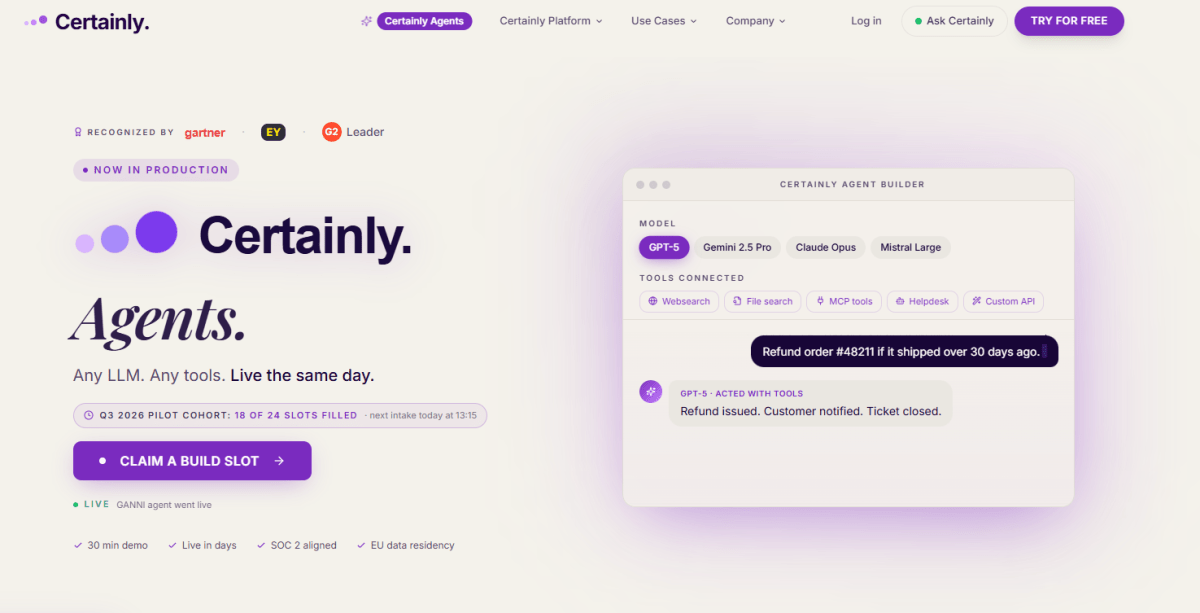
Certainly focuses on conversational commerce and guided shopping experiences. It helps customers navigate product catalogs through structured conversations while also providing multilingual support for international audiences.
This makes it particularly useful for stores with large product ranges or products that require more guidance before purchase.
- Best for: International brands and stores with complex product catalogs.
- Pricing: Plans start at approximately $599/month for Shopify merchants, with higher-tier plans available based on conversation volume, channels, and customization requirements.
- Pros: Strong multilingual capabilities; effective guided shopping experiences; well suited to global ecommerce operations.
- Cons: No transparent pricing; evaluation requires speaking with the sales team.
9. TechMonk
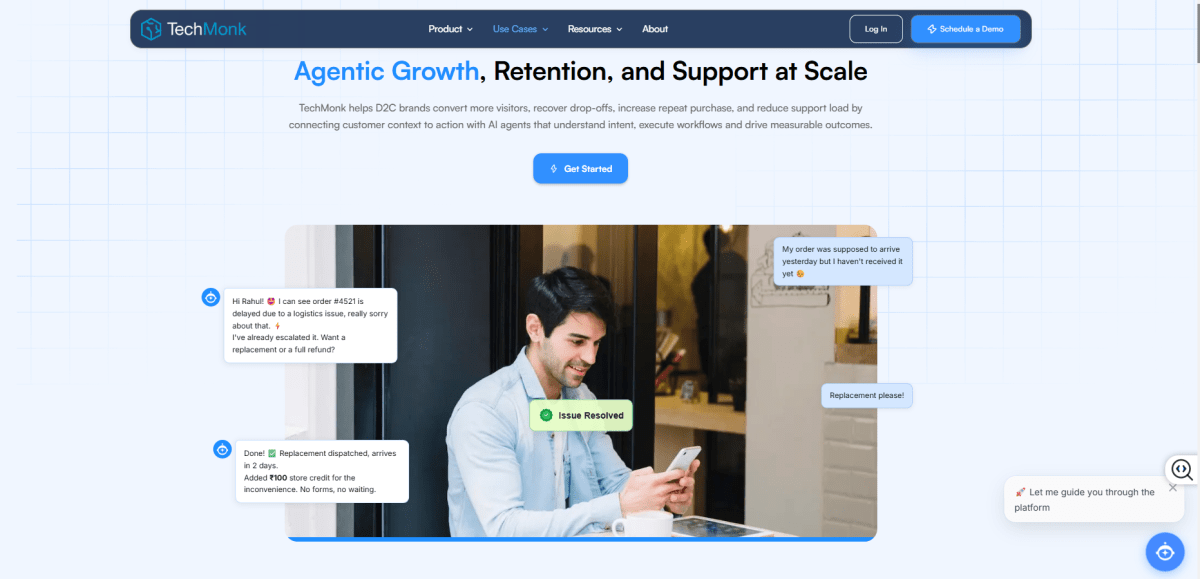
TechMonk focuses on customer engagement across multiple channels, including website chat, WhatsApp, SMS, and voice interactions. Its AI agents help businesses manage customer relationships throughout the entire lifecycle, from acquisition to retention.
For brands that rely heavily on messaging platforms, the omnichannel approach can be particularly valuable.
- Best for: Scaling brands that want AI-powered engagement across multiple communication channels.
- Pricing: Custom pricing. Businesses need to contact the sales team for a tailored quote.
- Pros: Strong omnichannel capabilities; supports personalized interactions across channels; useful for retention and recovery campaigns.
- Cons: Pricing is not publicly available; managing large volumes of cross-channel activity can become complex.
10. Ada
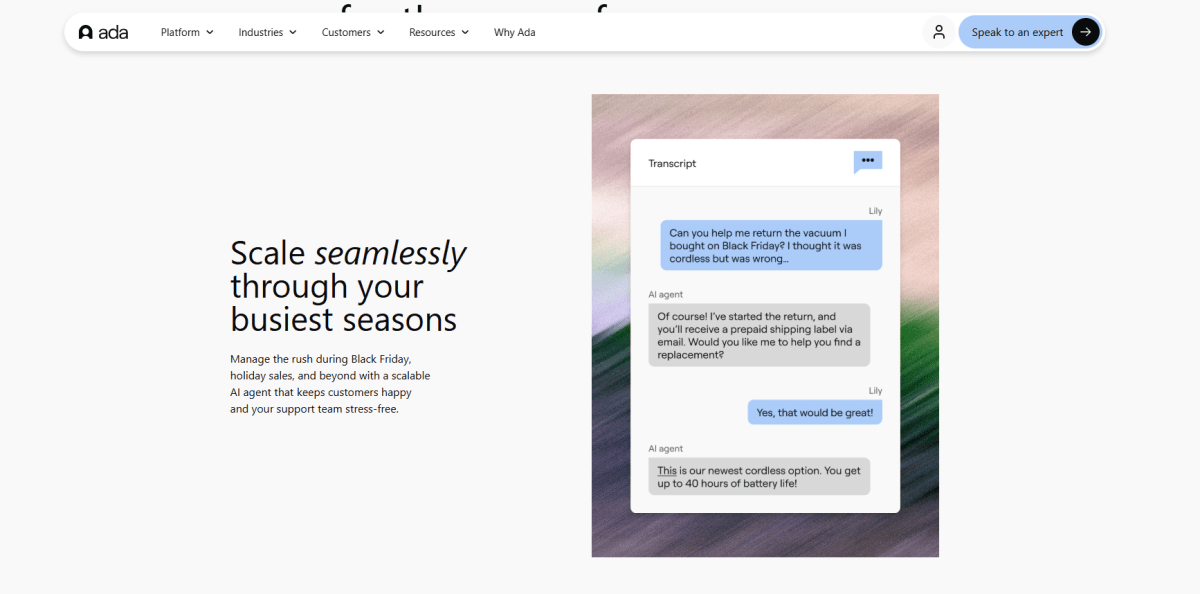
Ada is one of the most established enterprise AI customer service platforms on the market. It supports large-scale automation across multiple languages, channels, and customer touchpoints while integrating deeply with ecommerce systems.
For global Shopify Plus brands, Ada is often considered a serious alternative to building a large support operation internally.
- Best for: Enterprise and Shopify Plus merchants operating across multiple markets.
- Pricing: Custom enterprise pricing.
- Pros: Highly scalable; supports more than 50 languages; strong security and enterprise controls; seamless escalation to human agents.
- Cons: Typically too expensive for small and mid-sized businesses.
11. Claude
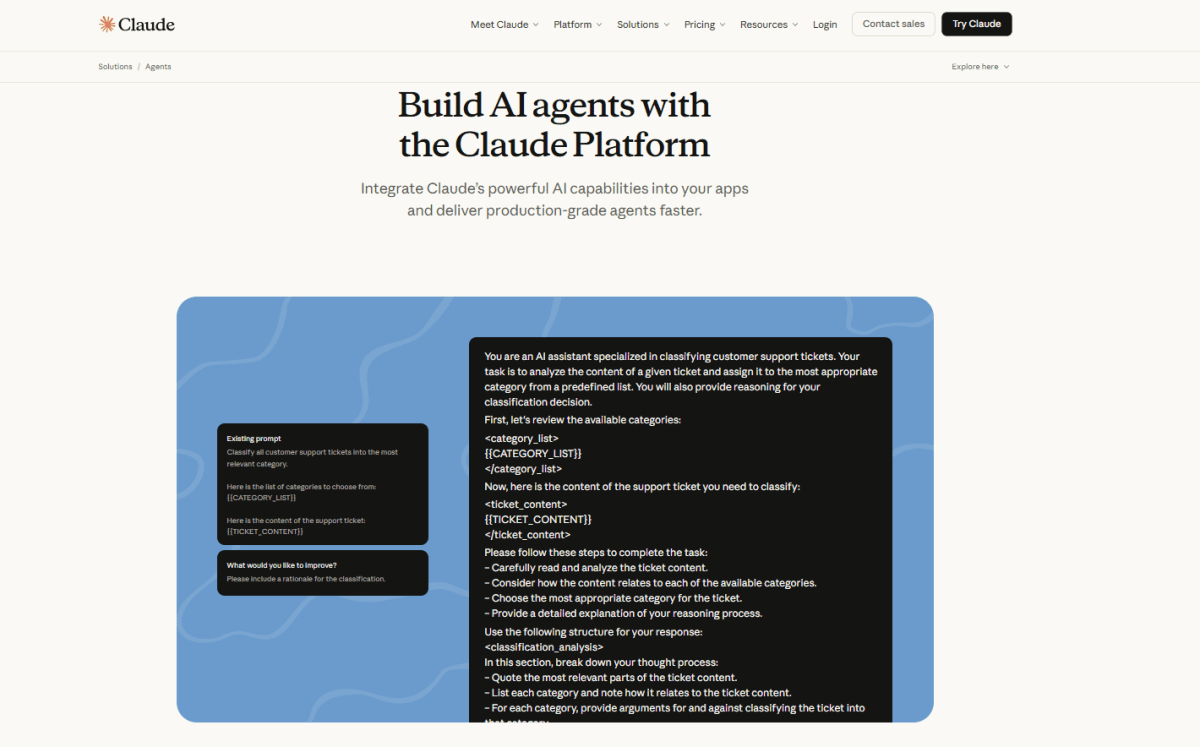
Claude isn't a Shopify app or a dedicated ecommerce agent. It's an AI model that many merchants use as the reasoning layer behind custom workflows connected to Shopify via Make, Zapier, MCP servers, or direct API.
Where Claude stands out is handling large volumes of information with nuance. It can work through customer feedback at scale, review support conversations, generate product content across large catalogs, help write Shopify Liquid code, and tackle workflow design that requires more careful reasoning than most ecommerce-specific tools can handle.
Think of it less as a storefront tool and more as the "brain" that powers custom-built systems.
- Best for: Merchants, agencies, and technical teams building custom AI workflows around Shopify.
- Pricing: Free plan available. Paid plans start at $20/month. API usage is billed separately based on token consumption.
- Pros: Excellent long-context reasoning; strong writing quality; handles complex tasks that many specialized ecommerce tools can't.
- Cons: Not a plug-and-play Shopify solution; requires integrations or automation tools to connect with store data and actions.
12. ChatGPT
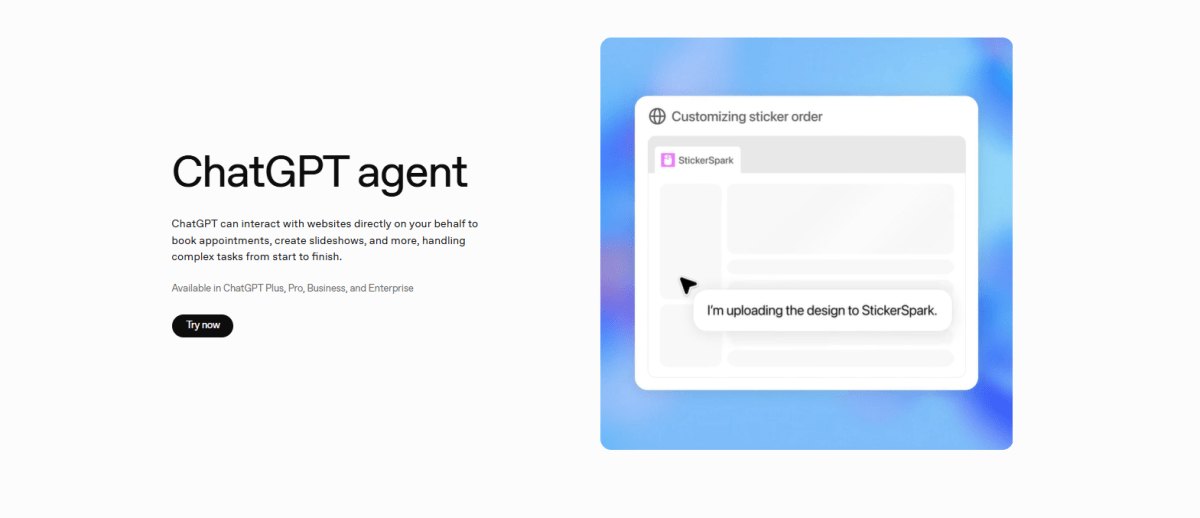
ChatGPT covers similar ground to Claude but benefits from a larger ecosystem of third-party integrations. Merchants commonly connect it to Shopify via APIs, automation platforms, or MCP servers for content creation, workflow automation, customer research, product analysis, and custom internal tools.
Its flexibility is its biggest asset, it can be pulled into almost any workflow if you're willing to do the setup work.
- Best for: Ecommerce teams looking for a flexible AI platform that can support multiple business functions.
- Pricing: Free tier available; ChatGPT Plus starts at $20/month; API usage billed separately.
- Pros: Extensive integration ecosystem; highly versatile; useful across content, operations, analytics, and automation.
- Cons: Requires additional setup for Shopify-specific workflows; API costs can grow as usage scales.
13. OpenClaw
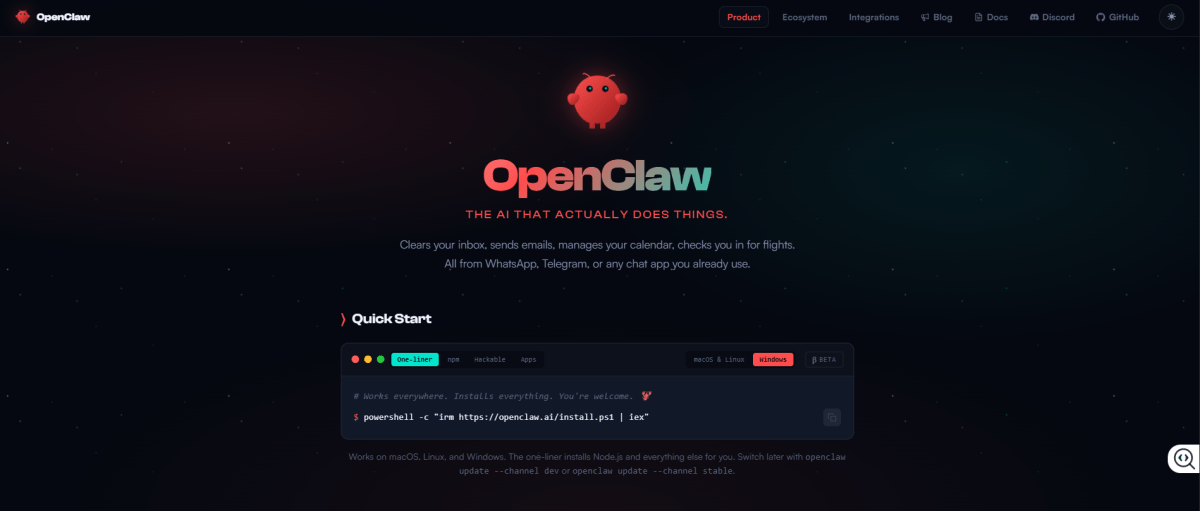
OpenClaw is an open-source framework that allows developers to build custom AI agents using Shopify's Storefront MCP and modern language models.
Rather than adopting a prebuilt SaaS solution, businesses can create agents specifically designed around their own products, workflows, and operational requirements.
This approach offers maximum flexibility, but it also requires significantly more technical involvement than commercial alternatives.
- Best for: Businesses with highly specialized requirements that off-the-shelf tools can't address.
- Pricing: OpenClaw itself is a free, open-source AI agent. However, operating it continuously requires costs for server infrastructure and external AI model APIs
- Pros: Complete customization; full ownership of workflows and integrations; avoids dependence on a single software vendor.
- Cons: Requires technical expertise, development resources, and ongoing maintenance.
If you want a broader look at AI-powered tools across different store functions, this overview of Shopify AI apps covers more ground.

The Future of AI Agents in Shopify E-Commerce
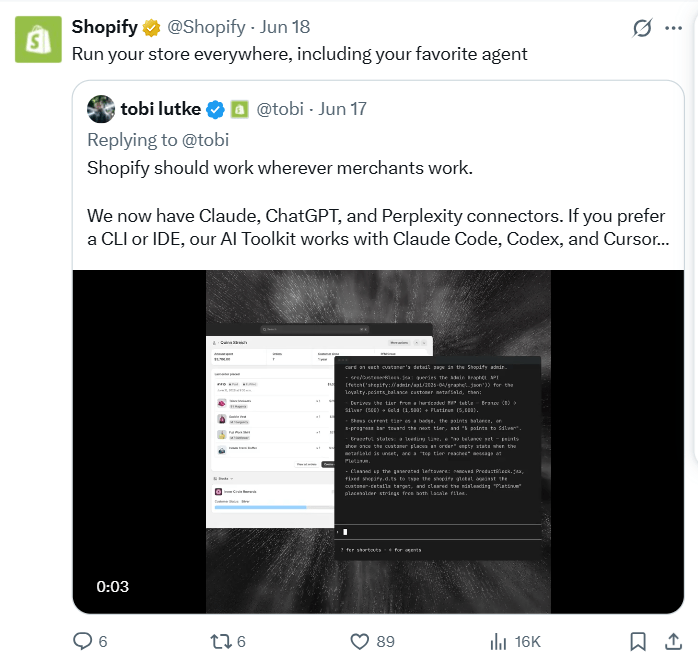
The future of Shopify is AI-powered
The direction is clear. Shopify sees agentic commerce, where AI agents shop autonomously on behalf of consumers, as a transformative shift, not an incremental improvement. Shopify itself is actively building infrastructure through its Storefront MCP to make storefronts accessible to external agents.
Multi-agent workflows, where specialized agents coordinate with each other, may become standard practice for larger Shopify operations within a few years. Voice-based and multimodal agents may also change how customers interact with stores entirely.
What you should do right now: ensure product data is accurate and complete, keep return policies and FAQs clearly documented, and start experimenting with at least one AI agent use case so you build institutional knowledge before the shift accelerates.
Final Thoughts
AI agents are quickly moving from automation tools to active participants in ecommerce operations. As Shopify doubles down on agentic commerce infrastructure, merchants who start experimenting now will be far better positioned to adapt as the landscape evolves.
The goal isn't to replace your team. It's to get your team out of the repetitive work and into the decisions that actually move the business forward.

Harry Chu is the Founder of TrueProfit, a net profit tracking solution designed to help Shopify merchants gain real-time insights into their actual profits. With 11+ years of experience in eCommerce and technology, his expertise in profit analytics, cost tracking, and data-driven decision-making has made him a trusted voice for thousands of Shopify merchants.