




Shopify Business Model Explained: How Shopify Makes Money & Works


Table of Contents
Shopify stands as a pivotal e-commerce platform, enabling businesses of all sizes to launch and operate online stores. Understanding the Shopify business model is crucial for anyone navigating the e-commerce landscape, as it reveals how the platform sustains its growth while empowering millions of merchants. Shopify's robust dual-revenue strategy combines stable subscription services with a dynamic suite of merchant solutions.
This article will thoroughly explore Shopify's strategic framework, detail its diverse revenue streams, examine its expansive ecosystem, and consider its future trajectory in the ever-evolving world of online commerce.
In this blog:
Understanding Shopify's Core Business Model
Shopify has firmly established itself as a foundational platform for online commerce, offering a robust solution that goes far beyond a simple shopping cart. A deep dive into the Shopify business model reveals precisely how it supports merchants globally while generating substantial revenue for the company.
1. What is Shopify?
At its heart, Shopify is a complete commerce platform that allows businesses of any size to start, grow, market, and manage their retail operations. It functions as an "operating system for commerce," providing all the necessary tools for entrepreneurs to sell products online, offline, or across various channels.
This comprehensive approach means merchants avoid the complexity of piecing together numerous separate services, making it an attractive all-in-one solution. To learn more about What Is Shopify and How It Works, delve into our detailed guide.
2. The SaaS Foundation
A crucial component of the Shopify business model is its foundation as a Software-as-a-Service (SaaS) provider. Merchants subscribe to Shopify's platform, paying recurring monthly fees to access its suite of tools and functionalities. This cloud-based approach offers several key advantages:
- Accessibility: Merchants can manage their stores from anywhere with an internet connection, offering unparalleled flexibility.
- No Maintenance: Shopify handles all technical aspects, including hosting, security updates, and server maintenance, freeing merchants from complex IT responsibilities.
- Scalability: The platform is designed to seamlessly grow with any business, capable of handling everything from a handful of products to millions of sales.
This SaaS model provides Shopify with a predictable and recurring revenue stream, a highly valued characteristic in financial markets.
3. Two-Sided Platform
The business model of Shopify effectively creates a dynamic two-sided platform. It strategically connects two primary groups:
- Merchants with Customers: Shopify provides comprehensive tools for store creation, product listing, marketing, and efficient sales processing, directly facilitating sales.
- Merchants with Third-Party Developers & Partners: The platform hosts an expansive App Store and Theme Store where developers can sell extensions and designs, while experts offer specialized services.
This dual focus not only empowers merchants but also cultivates a rich ecosystem that continuously innovates and adds significant value to the core platform.
4. Target Audience
Shopify caters to a remarkably wide spectrum of businesses, showcasing the inherent flexibility and adaptability of its platform.
- Solopreneurs and Small Businesses: With accessible plans like Basic Shopify, individuals and small teams can quickly launch their first online store, requiring minimal technical expertise.
- Mid-sized Businesses: The standard Shopify plan offers more advanced features tailored for growing companies looking to expand their operations.
- Enterprise-level Brands (Shopify Plus): For high-volume businesses and large enterprises, Shopify Plus provides bespoke solutions, dedicated support, and advanced customization options. These features are specifically designed to handle complex needs, manage massive sales volumes, and offer robust API access.
This broad appeal underscores Shopify's versatility, making it suitable for nearly any commercial endeavor.

How Does Shopify Make Money?
Shopify's financial strength is rooted in its innovative dual-revenue engine, strategically designed to provide both stable income and robust growth opportunities. This model masterfully combines recurring subscription fees with a diverse array of merchant services.
Revenue Stream | Category | How Shopify Earns |
|---|---|---|
Tiered Monthly Plans | Subscription | Recurring monthly fees (Basic, Shopify, Advanced) |
Shopify Plus | Subscription | Premium recurring fees from high-volume/enterprise merchants |
Free Trials & Onboarding | Subscription | Converts trial users into long-term paying subscribers |
Shopify Payments | Merchant Solutions | Processing fee on every transaction made through the platform |
Transaction Fees | Merchant Solutions | Extra fee (0.5%–2%) when merchants use outside payment processors |
Shopify Capital | Merchant Solutions | Fixed repayment fee on cash advances and loans |
Shipping & Fulfillment | Merchant Solutions | Fees from discounted carrier labels and fulfillment network services |
App & Theme Store | Merchant Solutions | Commission on every app and theme sold in the marketplace |
Point of Sale (POS) | Merchant Solutions | Hardware sales + POS software subscription fees |
Marketing Tools | Merchant Solutions | Usage or performance-based fees on advertising tools like Shopify Audiences |
1. Subscription Solutions (SaaS Revenue)
Shopify's most predictable income comes from merchants paying a monthly fee to use the platform, and it's structured so there's a plan for every stage of business growth.
Tiered Monthly Plans: Shopify offers four main plans: Basic, Shopify, Advanced, and Plus. As merchants move up, they unlock lower transaction fees, more detailed reporting, and better shipping rates. This tiered structure isn't just good for merchants, it gives Shopify a natural upsell path as stores grow.
Shopify Plus: For high-volume brands and enterprise retailers, Shopify Plus is the top-tier offering. It carries a significantly higher price tag and delivers deeper customization, extensive API access, and dedicated support. Given its premium positioning, Plus contributes a disproportionately large share of Shopify's subscription revenue relative to its merchant count.
Free Trials and Onboarding:Shopify draws in new merchants with free trial periods, letting them explore the platform before committing. The onboarding flow is deliberately simple, the easier it is to launch a store, the more trials convert into long-term subscribers.
Why Merchants Pay: The core appeal is straightforward: merchants get a fully hosted, secure, and scalable storefront without hiring developers or managing infrastructure. It lowers the barrier to starting an online store, which is exactly how Shopify has grown to millions of merchants worldwide.
2. Merchant Solutions (Service/Transaction-Based Revenue)
While subscriptions provide a stable base, this is where Shopify's revenue really scales because the more its merchants sell, the more Shopify earns.
Shopify Payments: This is one of Shopify's biggest money-makers. Instead of sending merchants to a third-party payment processor, Shopify acts as the processor itself, collecting a small fee on every transaction. It's a win for merchants (simpler setup, competitive rates) and a major revenue driver for Shopify.
Transaction Fees for Outside Processors: Merchants who use a payment processor other than Shopify Payments are charged an additional transaction fee like 2% on Basic, 1% on Shopify, and 0.5% on Advanced. This structure clearly nudges merchants toward Shopify Payments, which removes these fees entirely.
Shopify Capital: Shopify offers cash advances and loans to eligible merchants, using their in-platform sales data to assess eligibility. Rather than traditional interest, repayment happens as a fixed percentage of daily sales. It's a flexible funding option for merchants and a consistent revenue stream for Shopify.
Shipping and Fulfillment: Through Shopify Shipping, merchants access discounted carrier rates without leaving the platform. Shopify also runs its own Fulfillment Network, where merchants can outsource warehousing and order fulfillment entirely. Both services generate fees while keeping merchants tightly within the Shopify ecosystem.
App Store and Theme Store: Shopify takes a commission on every app and theme sold through its marketplace. This creates a self-reinforcing cycle, more developers build tools, more merchants buy them, and Shopify earns from every transaction without building the products itself.
Point of Sale (POS) For merchants with physical stores, Shopify sells card readers, receipt printers, and other hardware, plus a POS software subscription. It's how Shopify bridges the gap between online and in-person selling.
Marketing Tools and Advertising Services: Shopify is steadily expanding into marketing, most notably with Shopify Audiences, a tool that helps merchants build high-intent ad targeting segments for platforms like Facebook and Google. These services tie Shopify's revenue growth directly to how well its merchants can attract and convert customers.
Further Reading:
Value Proposition & Competitive Advantage of Shopify
Shopify's enduring success is fundamentally rooted in its compelling value proposition, which effectively addresses the critical needs of online businesses, and its distinct competitive advantages within the market.
1. Ease of Use & Accessibility
Shopify significantly lowers the barrier to entry for e-commerce. Its intuitive interface and guided setup process allow individuals and small businesses to launch a professional online store rapidly, often without requiring any prior coding knowledge.
This remarkable accessibility empowers a much wider range of entrepreneurs to actively participate and thrive in the digital economy.
2. All-in-One Solution
Merchants gain access to a comprehensive suite of integrated tools consolidated into a single platform. This covers every aspect of online commerce, from website design and efficient product management to secure payment processing and streamlined shipping.
This all-in-one approach eliminates the need to integrate multiple disparate systems, providing a seamless and highly efficient operational experience.
3. Scalability & Reliability
The platform is meticulously built to support businesses at every conceivable stage of growth, ranging from a single product seller to a multi-million-dollar enterprise.
Shopify's robust infrastructure is engineered to reliably handle massive traffic spikes and high sales volumes, ensuring that merchants never miss a critical opportunity due to technical limitations or downtime.
4. Focus on Merchant Success
Shopify's business model is fundamentally aligned with the success and growth of its merchants. By consistently offering tools, services, and an empowering ecosystem that directly contributes to merchant prosperity, Shopify ensures its own revenue increases as its merchants thrive. This symbiotic relationship fosters deep loyalty and drives continuous platform improvements and innovations.
5. Comparison to other Marketplaces such as Amazon
Shopify's core advantage over vast marketplaces like Amazon is its unwavering focus on brand ownership. Merchants on Shopify build and cultivate their own direct-to-consumer (D2C) brand, retaining full control over their customer relationships and managing their storefront identity without being constrained by marketplace rules or competing directly with countless other sellers on the same platform.
This approach differs significantly from the marketplace model, where brands often rely heavily on the platform for traffic but possess considerably less control over their brand experience and invaluable customer data.
6. Competitive Landscape
While Shopify is a recognized leader, it operates within a highly competitive e-commerce platform landscape. Key competitors include:
- BigCommerce: Another popular SaaS platform that offers similar features, often catering to slightly larger or more complex businesses.
- WooCommerce: A powerful, open-source e-commerce plugin for WordPress, providing immense customization capabilities but generally requiring more technical expertise from the merchant.
- Squarespace, Wix: These are website builders with integrated e-commerce functionalities, often favored by smaller businesses or individuals who prioritize design flexibility and ease of use for general website creation.
As for now, Shopify continuously innovates and expands its offerings to maintain its significant edge in this dynamic and fast-evolving market.
Final Thoughts
Shopify’s strength lies in its dual revenue engine: predictable subscription income paired with scalable merchant solutions. This model not only drives Shopify’s growth but also empowers millions of entrepreneurs by making e-commerce more accessible and adaptable.
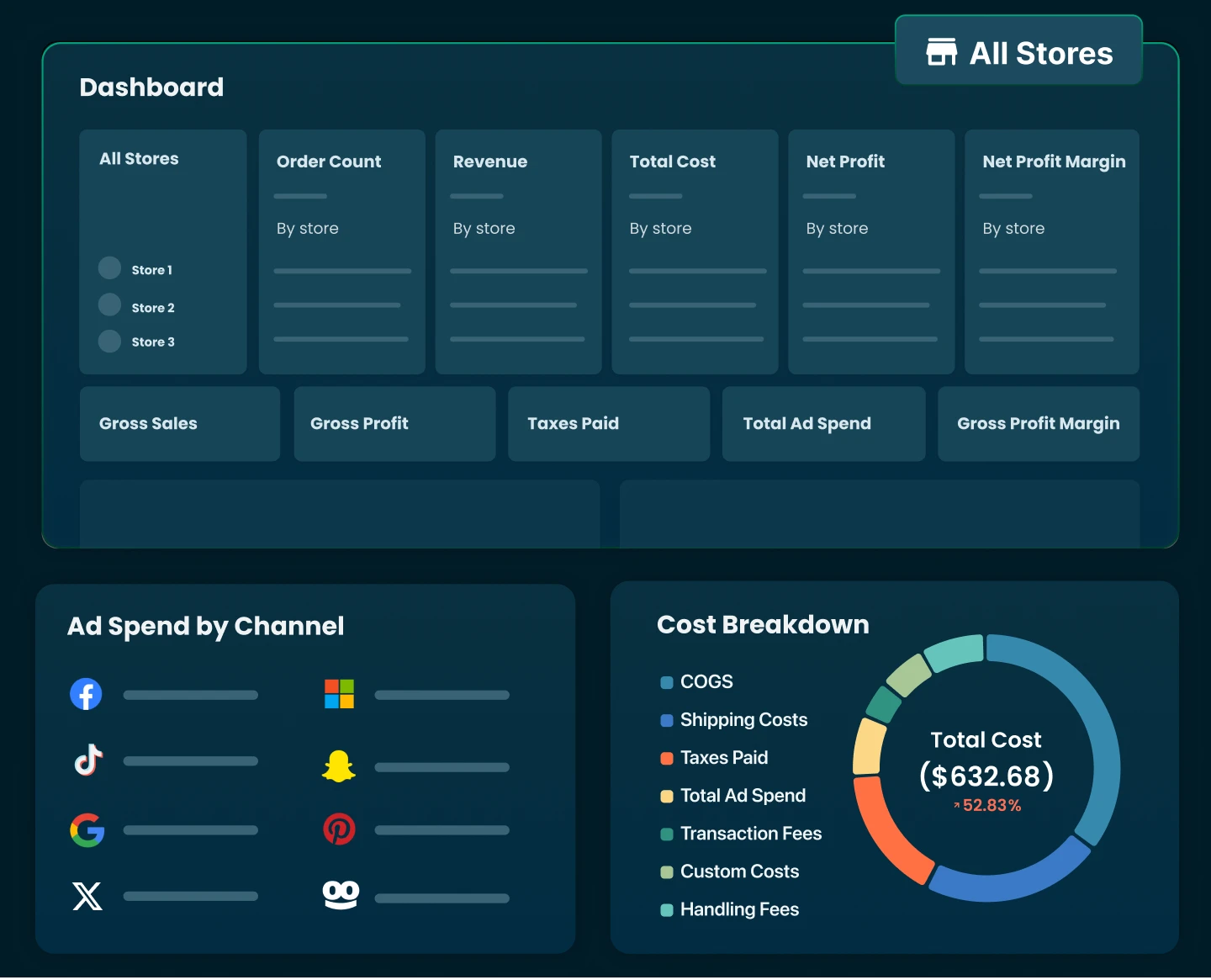
As Shopify continues to evolve, success increasingly comes down to how well merchants manage what happens behind the revenue numbers. Growth alone is not enough if profitability is unclear. That is why understanding net profit becomes essential for long term sustainability. Tools like TrueProfit support this by helping Shopify sellers track every cost and revenue stream, giving them clear visibility into their real bottom line (net profit) and the confidence to scale sustainably.

Harry Chu is the Founder of TrueProfit, a net profit tracking solution designed to help Shopify merchants gain real-time insights into their actual profits. With 11+ years of experience in eCommerce and technology, his expertise in profit analytics, cost tracking, and data-driven decision-making has made him a trusted voice for thousands of Shopify merchants.