
Can You Dropship on Costco in 2026? How It Works & What to Watch Out For


Table of Contents
Costco has great products, competitive prices, and direct-to-customer shipping. So why not use it for dropshipping?
Well, you can, but there’s more to it than simply listing Costco products and pocketing the difference. Costco has specific rules for resellers, and the economics can get tricky fast.
Here’s what you need to know before getting started.
In this blog:
Is Dropshipping on Costco Possible?
Yes, you can use Costco for dropshipping in certain circumstances.
But here’s the part that’s easy to miss: Costco isn’t a dropshipping supplier in the usual sense.
So, while Costco dropshipping is possible, the real question is whether you can make the model work reliably and profitably.
Let’s first look at what Costco dropshipping actually involves.

What Is Costco Dropshipping?
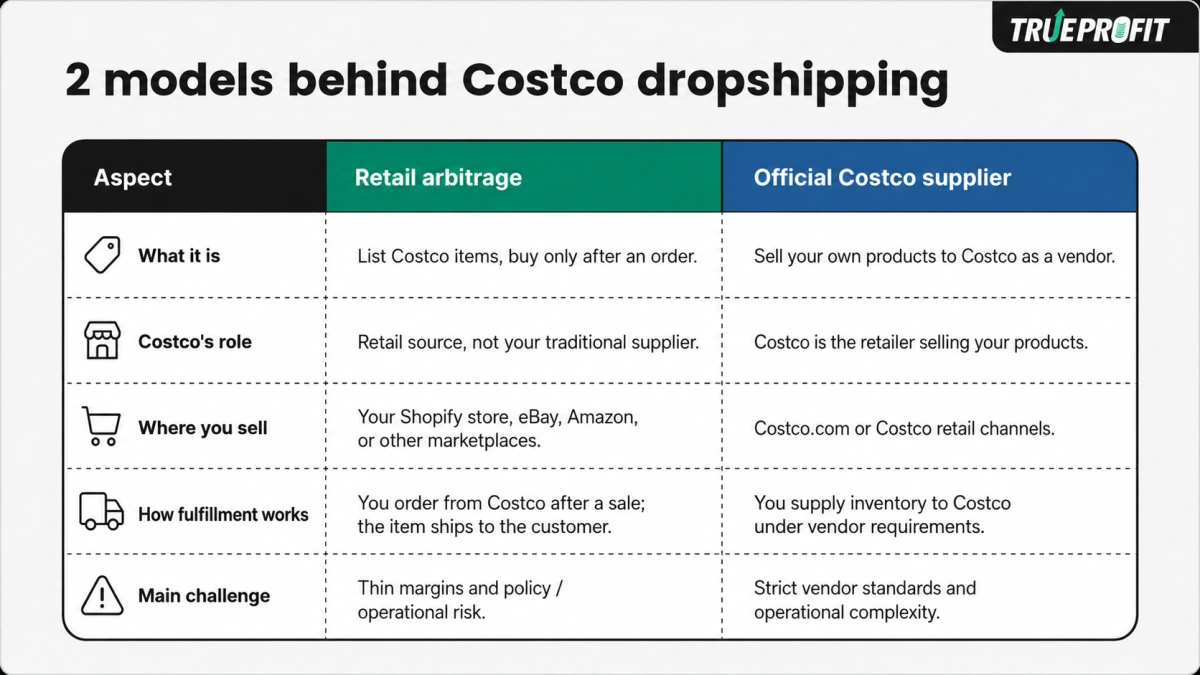
When people say “Costco dropshipping,” they’re usually talking about one of two very different business models. And it’s worth separating them, because the rules, setup, and risks are not the same.

1. Retail arbitrage dropshipping
This is the model most dropshippers have in mind. You find products on Costco.com, list them for a higher price on your own Shopify store, eBay, Amazon, or another marketplace, then purchase the item from Costco after receiving an order. Costco ships the product directly to your customer, so you don’t hold inventory yourself.
In this setup, Costco is your retail source, not your supplier in the traditional sense.
2. Becoming an official Costco supplier
The second model is completely different. Instead of reselling Costco’s products, you supply your own products to Costco for sale through Costco.com or its other retail channels. Here, Costco becomes the retailer, and your business operates as the supplier or vendor.
So when you see someone talking about “becoming a Costco dropship supplier,” make sure you know which model they mean. Retail arbitrage dropshipping means sourcing from Costco. Becoming an official supplier means selling to Costco.
And honestly, both models come with their own operational and policy challenges. That’s why simply finding a product with a good price on Costco.com isn’t enough to decide whether Costco dropshipping is a viable business model.
What to Watch Out for When Dropshipping From Costco
Now, this is where you really want to slow down before jumping into Costco dropshipping.
The model can work under Costco’s reseller terms, but there are several things you’re giving up when you use a retailer as your source. And some of them can become pretty painful once you start getting consistent orders.
Here are the main ones to keep in mind.
1. Costco Can Restrict or Terminate Your Membership
First, there’s the risk of losing access to Costco itself.
Costco does have specific terms for members who purchase products for resale, including through drop shipping. But those resellers are subject to additional conditions, and Costco can take action if those terms are violated.
That can include restricting online shopping, refusing certain customer returns, or even terminating the membership.
So if Costco is going to be part of your sourcing strategy, the membership itself is something you need to protect.
2. Your Margins Can Disappear Quickly
This is probably the easiest trap to fall into.
The Costco price isn't necessarily your true product cost. You still need to account for shipping, marketplace fees, payment processing, refunds, discounts, and potentially sales tax.
Costco also notes that online prices can differ from warehouse prices, while reseller promotions and price adjustments are subject to specific limitations.
So a product that looks like it gives you a $20–$30 spread can end up leaving very little actual profit.
3. Inventory and Pricing Can Change Without Much Warning
Here’s another thing that makes retail arbitrage tricky: you don’t control the supply.
Your store might still be happily selling a product while Costco has already run out of it, changed its price, or made it unavailable for a particular location.
And then you’re stuck with a few not-so-great options.
Cancel the customer’s order. Take a smaller margin. Or find the same product somewhere else at a higher price and absorb the difference.
That might be manageable for one order.
Start doing it at scale, though, and it can quickly turn into an operational headache.
4. You’re Responsible for Customer Problems
This is probably the biggest operational issue to understand.
Even if Costco is the one physically shipping the package, the customer bought from you.
Under Costco’s reseller terms, the reseller remains responsible for customer returns, refunds, damaged orders, and certain non-receipt claims. Costco also has specific limitations around how reseller returns are handled.
So when a customer says, “My order arrived damaged,” they’re not going to care that Costco packed the box.
They’re coming to your store.
And that’s the key distinction here: you can outsource fulfillment, but you can’t outsource responsibility for the customer experience.
5. Costco’s Website Content Isn’t Yours to Freely Reuse
Now, if you’re thinking about scaling this with automation, pay attention to this one.
It might seem convenient to pull product information from Costco.com, copy the descriptions and images, and automatically import everything into your store.
But Costco’s website terms restrict commercial use, copying site materials, and collecting product listings or descriptions without permission.
So there’s a pretty big difference between reselling a product you purchased from Costco and treating Costco.com like an open product database you can freely copy.
That’s especially important if your plan involves automated product imports or large-scale catalog scraping.
6. Scaling Gets Harder Than It Looks
And this is probably the biggest picture to take away.
Retail dropshipping can be useful for testing products without holding inventory. But once you start thinking about building a predictable, scalable business, depending on another retailer creates a lot of variables you simply don't control.
You’re relying on Costco for:
- Product availability
- Pricing
- Order limits
- Fulfillment
- Shipping
- Returns
- Promotions
And Costco specifically states that resellers can’t purchase above stated item limits unless they have a prior agreement.
So even if you find a product that sells really well, you can’t automatically assume you’ll be able to keep buying more of it as your sales grow.
That’s the bigger issue with Costco dropshipping.
It may be possible to make the model work, but possible and scalable are two very different things.
If your goal is to build a long-term ecommerce business, a wholesale or direct supplier relationship will generally give you much more control over the things that actually determine whether the business can scale: pricing, inventory, fulfillment, and customer experience.
So, is dropshipping on Costco possible? Yes, but there’s a big difference between being able to do it and having a business model that’s easy to scale.
Costco’s reseller terms make certain retail dropshipping arrangements possible, but you’re still working with a retailer’s pricing, inventory, order limits, fulfillment, and return policies.
If you’re just testing products, that may be workable. But if you’re looking to build a predictable, scalable store, those limitations are worth thinking through before you build your entire business around Costco.
How to Become an Official Dropship Supplier for Costco.com?
Now, if you're thinking, “What if I don't want to drop ship from Costco? What if I want to drop ship for Costco?” That's a completely different game.
Instead of buying products from Costco and reselling them elsewhere, you would become an approved supplier and let Costco sell your products on Costco.com. You then handle the fulfillment, shipping individual orders directly to Costco members.
And this is where the bar gets much higher.
What You Need to Have in Place
Before you approach a Costco buyer, I'd make sure these areas are already under control.
- EDI and order processing: You need the technical infrastructure to receive and acknowledge purchase orders, send advance shipping notices, and handle electronic invoices. In practice, that usually means working with an EDI provider or having an ERP system that can support Costco's required transactions.
- Fast, reliable fulfillment: Dropship orders aren't sitting in a warehouse waiting for a bulk shipment. You're shipping individual orders directly to customers, so your team needs reliable inventory, fast processing, accurate orders, and carrier-ready packaging.
- Competitive economics: Costco has a strong value proposition, so your pricing needs to make sense for its members while still leaving enough room to cover fulfillment, shipping, returns, and your own margin.
- Product and supplier compliance: Depending on what you're selling, you may need product testing, traceability documentation, safety certifications, or other compliance records. Food and consumable products typically face much heavier requirements than standard general merchandise.
- Insurance and liability coverage: You should also be prepared to meet Costco's insurance and supplier liability requirements before you get too far into the onboarding process.
The important thing here is that having a product Costco might like isn't enough. Your backend needs to be ready before the buyer says yes.
Step 1. Get Your Product and Fulfillment Operation Ready
Start with the basics.
Your product needs to be packaged for individual parcel shipping, not just palletized transportation. Think about what happens when one order leaves your warehouse through UPS, FedEx, or another carrier and travels directly to a customer's doorstep.
You'll also want clear answers to questions like:
- How many orders can you fulfill per day?
- Where is your inventory stored?
- How quickly can you process an order?
- How do you handle out-of-stock situations?
- What happens when an order is damaged or returned?
- Can your current operation handle a sudden increase in volume?
These are the kinds of operational details that become important once you're selling through a retailer at Costco's scale.
Step 2. Get in Front of the Right Costco Buyer
The next step is getting your product in front of the team responsible for your category.
The route can vary depending on what you're selling and where you're operating. General merchandise may go through Costco's corporate buying organization, while food and certain regional products can involve regional buying teams.
If you're a qualifying diverse supplier, Costco also has a supplier diversity program that can provide another route into the organization.
But don't think of this as simply submitting a product and waiting for approval. Your pitch needs to answer a much bigger question:
Why should Costco sell this product to its members?
That means coming prepared with your product's sales performance, pricing, competitive advantage, supply capacity, margins, and fulfillment capabilities.
Step 3. Go Through Vendor Onboarding
If a buyer is interested, that's when the real operational work starts.
You'll typically need to work through commercial terms, shipping arrangements, insurance, supplier documentation, and other vendor requirements before you're fully set up.
This is also where the difference between “I have a product” and “I have a retail-ready business” becomes very obvious.
Step 4. Connect Your Systems and Test Everything
Your ecommerce operation now needs to talk to Costco's systems.
That's where EDI comes in.
Rather than manually checking orders and sending invoices, your systems need to handle the required transactions electronically. Depending on the setup, this can include purchase orders, order acknowledgments, advance shipping notices, and invoices.
You'll also need to test the flow before going live. The goal is simple: when Costco sends an order, your system should know what to do with it, your warehouse should know what to ship, and Costco should receive the right shipping and billing information without someone having to manually fix every step.
Step 5. Start Small and Prove You Can Fulfill
Finally, don't expect to go from zero to massive Costco.com volume overnight.
A new supplier needs to prove that it can consistently deliver the experience Costco expects. That means keeping inventory accurate, shipping orders on time, minimizing cancellations and errors, and maintaining a strong customer experience.
If you can do that consistently, you have a much stronger case for expanding your relationship.

Final Thoughts
And that’s really the part I want you to take away from this guide. Costco can look like an attractive dropshipping opportunity, but once you get into pricing, policies, fulfillment, and supplier requirements, it’s not quite as simple as “find a product and sell it.”
If you want to build something long-term, focus on building a reliable operation first. Then look at Costco as another channel you can grow into.

Rosie Doan is a Senior Content Specialist at TrueProfit with over 4 years of experience creating content for the ecommerce and SaaS industry. Having worked closely with Shopify merchants and ecommerce businesses, she has developed a deep understanding of the challenges store owners face, from growing revenue and acquiring customers to tracking performance, managing costs, and improving profitability.