
How to Choose the Right Dropshipping Agent for Your Business (2026 Guide)


Table of Contents
If you're still testing products and your current supplier is doing the job, I wouldn't rush to add another layer to your supply chain. There's usually no reason to fix what isn't broken.
But the moment you have a proven product and start hitting walls with pricing, fulfillment, quality, or scale, the right dropshipping agent can change everything. The hard part is finding one that solves those problems instead of creating new ones.
Here's what you need to know before choosing one.
In this blog:
What Is a Dropshipping Agent?
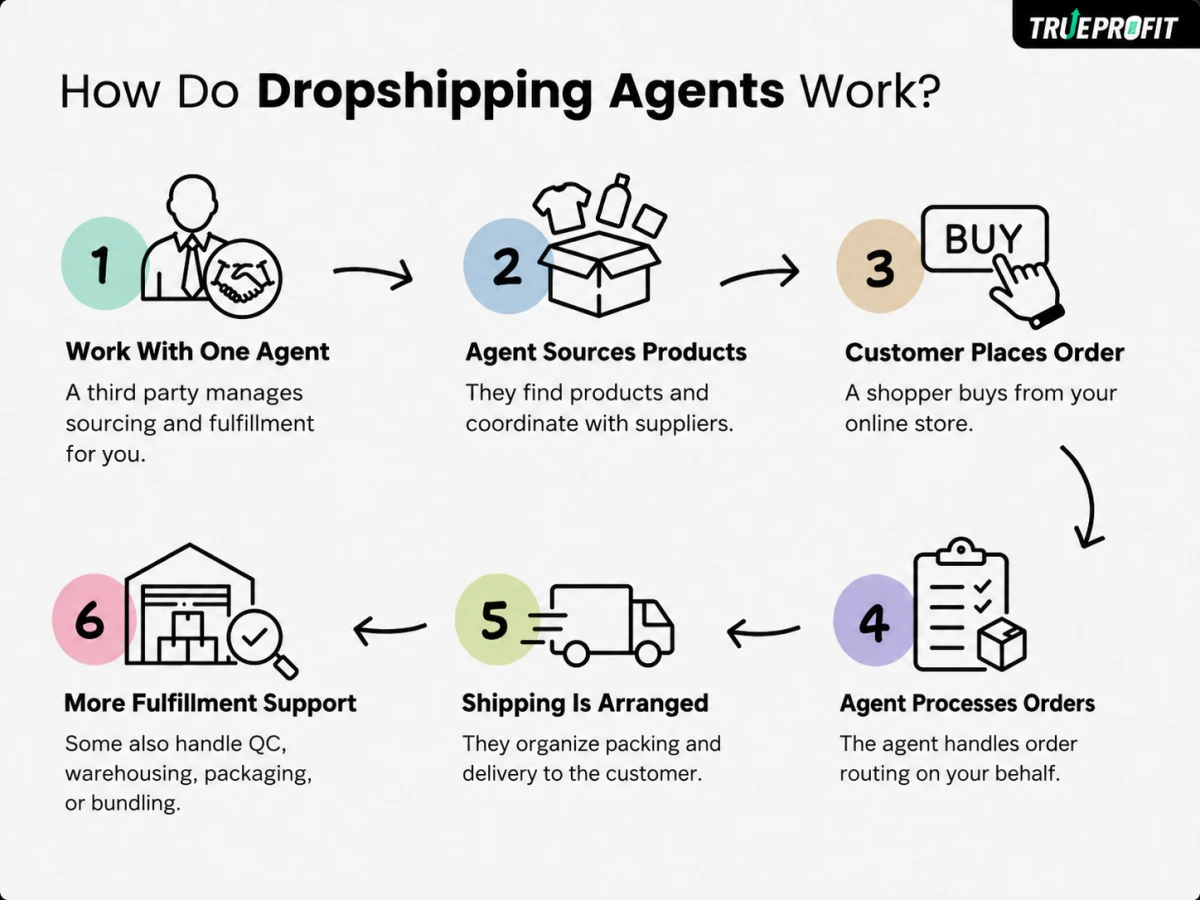
An agent is a third party that manages the supply and fulfillment side of your dropshipping business for you.
Instead of dealing with individual suppliers yourself, you work with one agent who can source products, coordinate with those suppliers, process orders, and arrange shipping on your behalf. Depending on who you work with, they may also handle quality control, warehousing, custom packaging, or product bundling.


What Does a Good Dropshipping Agent Do?
A good agent can take over several parts of the supply chain that are difficult to manage directly from an overseas store.
- Product sourcing: An agent can look for alternative suppliers or manufacturers, often through Chinese sourcing channels such as 1688 and Taobao, rather than limiting you to the suppliers you find on AliExpress. This can open up more sourcing options and potentially improve product costs or quality.
- Quality control: Instead of sending every product straight from the supplier to your customer, an agent can inspect products at their warehouse before fulfillment. Depending on the service, this may include checking product condition, quantity, packaging, or other requirements you specify.
- Shipping and fulfillment: Agents can arrange different shipping methods and manage the fulfillment process from their warehouse. Some also consolidate products or negotiate shipping rates based on order volume. The advantage isn't simply "faster shipping"; it's having more control over which fulfillment method makes sense for your market and economics.
- Custom branding: Once a product is proven, an agent may also coordinate custom packaging, labels, inserts, or other product modifications with manufacturers. Some sourcing agents specifically support private labeling and custom product development, although the available options and minimum requirements vary by provider.
So the value of an agent isn't just getting a product from point A to point B.
It's having someone manage more of the supply chain behind the product.
Dropshipping Agent vs. Supplier: What's the Difference?
A supplier mainly provides the product and fulfills orders. An agent can sit one level above that relationship, helping you source from suppliers, negotiate pricing, coordinate fulfillment, and manage other parts of the supply chain.
That difference matters as your store grows. With a traditional supplier, you're often responsible for finding the product, checking quality, and dealing with fulfillment issues yourself. An agent can take on more of that coordination, giving you greater control without having to manage multiple suppliers directly.
Dropshipping Supplier | Dropshipping Agent | |
|---|---|---|
Product sourcing | Provides products from its catalog | Can source from multiple suppliers |
Supplier negotiation | Usually limited | Can negotiate on your behalf |
Quality control | Depends on supplier | Can inspect products before fulfillment |
Fulfillment | Handles its own orders | Can coordinate fulfillment across suppliers |
Customization | Often limited | May support packaging, bundles, or private labeling |
Best for | Testing and straightforward fulfillment | Growing stores needing more supply chain control |
When Should You Switch to a Dropshipping Agent?
A better signal is that your current supplier is starting to limit the business.
For example, an agent becomes worth considering when:
- Order volume is becoming consistent: You have enough recurring orders to justify negotiating better sourcing or fulfillment terms. A benchmark such as 15–20 orders per day can be a useful starting point for evaluating the economics, but it isn't a universal threshold.
- Margins need improvement: Your product is already selling, but product and shipping costs leave too little room for advertising and other expenses. An agent may be able to source from alternative manufacturers or negotiate better rates.
- You need more control over the product: You're ready for custom packaging, branded inserts, private labeling, or product modifications that a typical marketplace supplier may not support easily.
- Fulfillment is becoming a bottleneck: Stock issues, inconsistent quality, slow processing, or unreliable tracking are creating customer complaints or operational work.
How to Find a Reliable Agent?
The right agent should solve a problem your business actually has.
If shipping is already reliable, there's little value in switching just because another agent promises a slightly lower product price. If your supplier keeps going out of stock, on the other hand, a better sourcing setup could make a huge difference.
So rather than comparing agents feature by feature, evaluate them across four areas that directly affect your business: sourcing, fulfillment, quality, and scalability.
Start With Sourcing: Can They Actually Improve Your Product Economics?
A good agent should be able to do more than find the exact same product you already found on AliExpress.
Give them your current product, supplier, order volume, and target market, then ask what they can improve.
That might mean finding a manufacturer with a lower unit cost, negotiating better terms, identifying a better-quality version, or finding an alternative supplier when the original one becomes unreliable.
This is where your existing supplier data becomes valuable.
If you're currently paying $8 for a product and an agent quotes $6, that's interesting. But don't stop there. Compare the complete landed cost, including shipping, packaging, fulfillment fees, and any other applicable charges.
Then Look at Fulfillment: Can They Handle Your Orders Without Creating More Work?
Once sourcing looks competitive, the next question is operational.
How does an order move from your Shopify store to the agent?
How quickly is it processed?
How are tracking numbers returned?
What happens when an order needs to be changed or cancelled?
These details may seem minor when you're processing 10 orders a day. They're not minor when you're processing hundreds.
A reliable agent should have a fulfillment workflow that can handle your current volume without requiring you to manually monitor every order.
Quality Control: What Happens Before the Product Reaches Your Customer?
This is one of the biggest differences between simply using a supplier and building a more controlled fulfillment setup.
Ask exactly what the agent checks before shipping.
Product appearance? Functionality? Quantity? Packaging?
More importantly, find out what happens when something fails inspection.
A strong QC process can prevent a defective product from becoming a refund, negative review, or support ticket.
And remember, product quality isn't just a supplier issue. It directly affects your economics.
If a supplier saves you $1 per order but produces significantly more refunds, the cheaper sourcing option may actually be reducing your profit.
Finally, Test Their Ability to Scale
Growth changes the fulfillment equation. More orders mean more inventory to secure, more shipments to process, and a lot less room for supplier mistakes.
Ask what happens when order volume increases suddenly. Can they secure enough inventory? Do they have backup suppliers? Can they maintain the same shipping method? Can they support custom packaging or bundles later?
You don't need an agent with every possible service today.
But if the goal is to turn a winning dropshipping product into a scalable business, the agent should be able to grow with the product rather than become the next bottleneck.
The Best Way to Vet an Agent: Run a Small Test
Don't make the decision based entirely on quotes, sales calls, or testimonials.
Give the agent a small batch of real orders and compare the results with your current supplier.
Track:
- Total landed cost
- Processing time
- Delivery time
- Tracking accuracy
- Product quality
- Defect and refund rate
- Response time
- Fulfillment errors
That gives you something much more useful than a sales pitch: actual operating data.

Best Dropshipping Agents: Which One Fits Your Business?
There isn't one “best” dropshipping agent for every store. The better choice depends on what you need to improve in your current fulfillment setup.
Also, one important distinction: not every provider below is technically a traditional dropshipping agent. Some are automation platforms or supplier marketplaces. They're included because they solve different parts of the same sourcing and fulfillment problem.
Best for AliExpress Dropshipping: DSers
DSers is an AliExpress-focused dropshipping solution that connects your store with AliExpress and automates much of the product and order workflow. It supports bulk order placement, product importing, supplier optimization, inventory updates, and automatic tracking sync.
The key thing to understand is that DSers doesn't replace your AliExpress supplier. It makes the existing AliExpress model easier to operate.
Best for: Beginners and stores that are still testing products through AliExpress.
Best for Product Sourcing & Fulfillment: Zendrop
Zendrop is a product sourcing and fulfillment platform. If you already have a product link from AliExpress, you can submit it to Zendrop as a reference. Zendrop then uses its vetted China-based supplier network to find or manufacture a comparable product rather than simply reshipping the AliExpress item.
That makes it useful when the product is already proven, but you want a different sourcing and fulfillment setup.
Best for: Stores looking to move beyond directly fulfilling orders through individual AliExpress suppliers.
Best for US/EU Supplier Access: Spocket
Spocket is a dropshipping marketplace that connects merchants with vetted suppliers across the US, EU, and other regions. Spocket says 80% of its suppliers are in the US and EU, making regional sourcing one of its main differentiators.
This can be useful when delivery speed and supplier location matter more than getting the lowest possible China-sourced product cost.
Best for: Stores primarily targeting US or European customers and prioritizing regional fulfillment.
Best for Scaling Proven Products: Dedicated Dropshipping Agent
A dedicated dropshipping agent is different from a marketplace or automation platform. Instead of choosing from a fixed supplier catalog, you typically work directly with an agent who can source a specific product, coordinate with manufacturers, negotiate pricing, arrange fulfillment, and potentially support quality control or custom packaging.
This becomes more relevant once a product has consistent volume. At that point, the goal isn't simply to find somewhere to buy the product. It's to build a more reliable and profitable supply chain around a proven SKU.
Best for: Growing stores that need deeper sourcing, supplier negotiation, fulfillment, or customization.
How to Switch From Your Current Supplier to a Dropshipping Agent
Switching suppliers becomes a very different decision once a product is already selling.
You're not just changing where the product comes from. You're changing part of the fulfillment system that your customers already depend on.
So the safest approach is not to switch everything at once. Use the transition to test whether the new agent actually gives you a better supply chain.
Start With One Proven Product
Don't move your entire catalog just because an agent offers better pricing.
Start with a product that already has consistent sales. This gives you enough real orders to compare the two setups and see whether the agent can actually improve the economics.
Before switching, establish your baseline:
- Product and shipping cost
- Processing and delivery time
- Refund or defect rate
- Customer complaints
- Net profit per order
That baseline matters because a lower product quote doesn't necessarily mean a more profitable fulfillment setup.
Have the Agent Reproduce the Product Before Moving Orders
Give the agent the existing product link, specifications, variants, packaging requirements, and target market.
Then order a sample.
This is especially important if the agent is sourcing the product from a different supplier or manufacturer. A similar-looking product isn't necessarily the same product, and even small changes in materials, sizing, or packaging can create customer complaints if your product page no longer matches what you're shipping.
The goal here is simple: make sure the new supply matches the customer promise before changing the fulfillment process.
Test the New Agent Alongside Your Current Supplier
There's no reason to make the switch a one-day event.
Keep the current supplier running while sending a controlled number of orders through the new agent. Then compare what actually happens.
I’ll give you an example of supplier vs. agent test results:
Metric | Current supplier | New agent |
|---|---|---|
Landed cost | $8.20/order | $7.60/order |
Processing time | 2–3 days | 1–2 days |
Delivery time | 8–12 days | 5–8 days |
Product quality | 3–5% defects | 1–2% defects |
Tracking accuracy | 92% | 98% |
Defect/refund rate | 4.1% | 2.3% |
Customer complaints | 18/1,000 orders | 9/1,000 orders |
This is much more useful than comparing two sales quotes.
An agent might promise faster shipping, better QC, or lower costs. The test tells you whether those promises translate into better operating results.
Move More Orders Once the Numbers Hold Up
If the new agent consistently performs better, gradually increase the share of orders they handle.
There's also no reason to immediately cut ties with the old supplier if they're still reliable. Keeping a backup supplier can protect the business when your primary source runs into stock shortages, quality problems, or unexpected fulfillment delays.
That becomes increasingly important when one product is responsible for a large share of your revenue.
Use the Switch to Negotiate More Than Price
Once an agent sees your actual order volume, the conversation can move beyond the initial product quote.
This is the point to explore whether they can improve:
- Unit and shipping costs
- Processing times
- Quality control
- Packaging
- Product bundles
- Inventory availability
- Backup sourcing
That's where an agent can become genuinely valuable.
The goal of switching isn't to replace your old supplier. It's to build a supply chain that gives your winning products better economics, more reliable fulfillment, and more room to scale.
Final Thoughts
Choosing a dropshipping agent isn't about finding the one with the cheapest quote or the longest list of services. It's about finding a partner that can improve the parts of your supply chain that are holding your business back.
Start with a proven product, test the agent on a small batch, and compare the actual results against your current setup. If the numbers show better costs, more reliable fulfillment, and room to scale, that's a strong sign you've found the right fit. Otherwise, there's no reason to switch just for the sake of switching.

Irene Le is the Content Manager at TrueProfit, specializing in crafting insightful, data-driven content to help eCommerce merchants scale profitably. With over 5 years of experience in content creation and growth strategy for the eCommerce industry, she is dedicated to producing high-value, actionable content that empowers merchants to make informed financial decisions.