


How to Start AliExpress Dropshipping and Scale a Profitable Store in 2026


Table of Contents
If you're thinking about starting a dropshipping store sourcing from AliExpress, let me save you some trial and error. In this guide, I'll walk you through the whole process: choosing your first product and supplier, handling shipping, calculating your real costs, and scaling once you find a winner.
In this blog:
What Is AliExpress Dropshipping?
AliExpress dropshipping is a way of running a dropshipping store by sourcing products from AliExpress. Instead of working with a private supplier or buying inventory upfront, you browse AliExpress for products, choose the sellers you want to work with, and list those products in your own Shopify or ecommerce store.
When a customer places an order, you purchase the item from the AliExpress seller, who then ships it directly to your customer.
That's the part that makes it so attractive to beginners. You don't need to buy hundreds of units upfront, rent a warehouse, or risk getting stuck with inventory nobody wants. You can test a product first, see how customers respond, and put more money behind it only if the numbers look good.
Pros and Cons
So is AliExpress dropshipping actually worth it? It can be, especially when you're starting out, but you're trading low upfront risk for less control over fulfillment.
Here's the trade-off:
Pros of Sourcing From AliExpress | Cons of Sourcing From AliExpress |
|---|---|
|
|
AliExpress vs. Amazon vs. Etsy Dropshipping: What is the best sourcing option?
So, how does AliExpress compare with Amazon and Etsy as a sourcing option for your store? I’ll walk you through the key differences.
Factor | AliExpress | Amazon | Etsy |
|---|---|---|---|
Product selection | Huge range of generic, trending, and niche products | Huge range, including branded and retail products | More niche, with handmade, personalized, and unique products |
Product cost | Generally lower | Usually retail-level pricing | Often higher, especially for handmade or custom products |
Supplier options | Large pool of independent sellers | Individual sellers, retailers, and brands | Individual sellers, makers, and small businesses |
Direct fulfillment | Commonly available | Possible, but depends heavily on the seller and fulfillment arrangement | Generally not allowed for ready-made products |
Best for | Traditional dropshipping and product testing | Specific products, including some branded/retail products | Unique, handmade, personalized, or seller-designed products |
The biggest difference is how each platform works as a product source. AliExpress is built around a large network of independent suppliers, many of whom are accustomed to fulfilling individual orders directly to customers.
Amazon and Etsy, on the other hand, are primarily retail marketplaces, so sellers may not offer the pricing, fulfillment, or consistency you need for dropshipping.
That's why AliExpress is generally the more practical sourcing option for dropshippers, while Amazon and Etsy may be useful for finding specific products but are less suitable as scalable dropshipping sources.

How To Open A Dropshipping Store Sourcing From AliExpress?
The hard part I want to emphasize here is building a setup that can acquire customers profitably and fulfill orders reliably.
So rather than jumping straight into Shopify (or other ecommerce platform) and importing products, you could work through the process in this order.
1. Start With a Product Worth Testing
Don't start by asking, “What's cheap on AliExpress?”
Start with, “Why would someone buy this product from my store?”
Potential products usually solve a clear problem, have enough perceived value to support a healthy markup, are easy to demonstrate visually, and leave room for advertising and fulfillment costs.

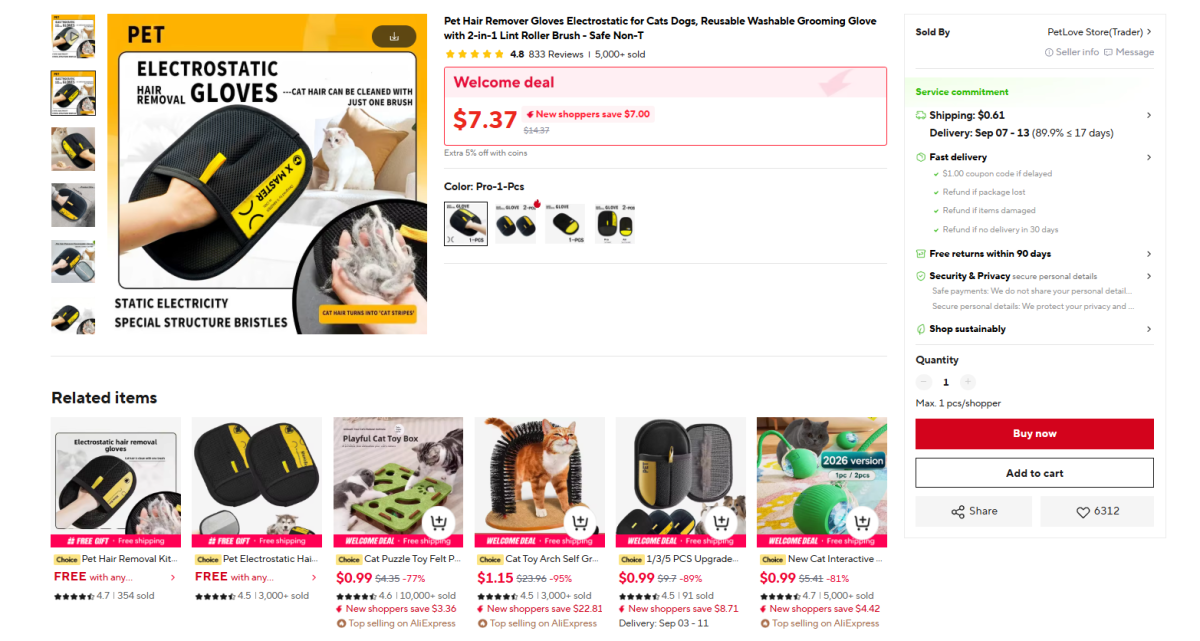
Portable pet hair remover solves an obvious problem for pet owners, is easy to demonstrate in a short video
You also want to think about the product's logistics. Fragile products, very bulky items, products with complicated sizing, or anything likely to create lots of returns can become operational headaches later.
Before you commit, estimate the economics:
Selling price − product cost − shipping − payment fees − ad cost − refunds/discounts = estimated profit
You won't know every number exactly at this stage, but this calculation can quickly eliminate products that look profitable only on paper.
2. Find a Supplier You Can Actually Rely On
Once you've found a promising product, don't immediately choose the first seller you see.
Search for the same or similar product from several suppliers and compare:
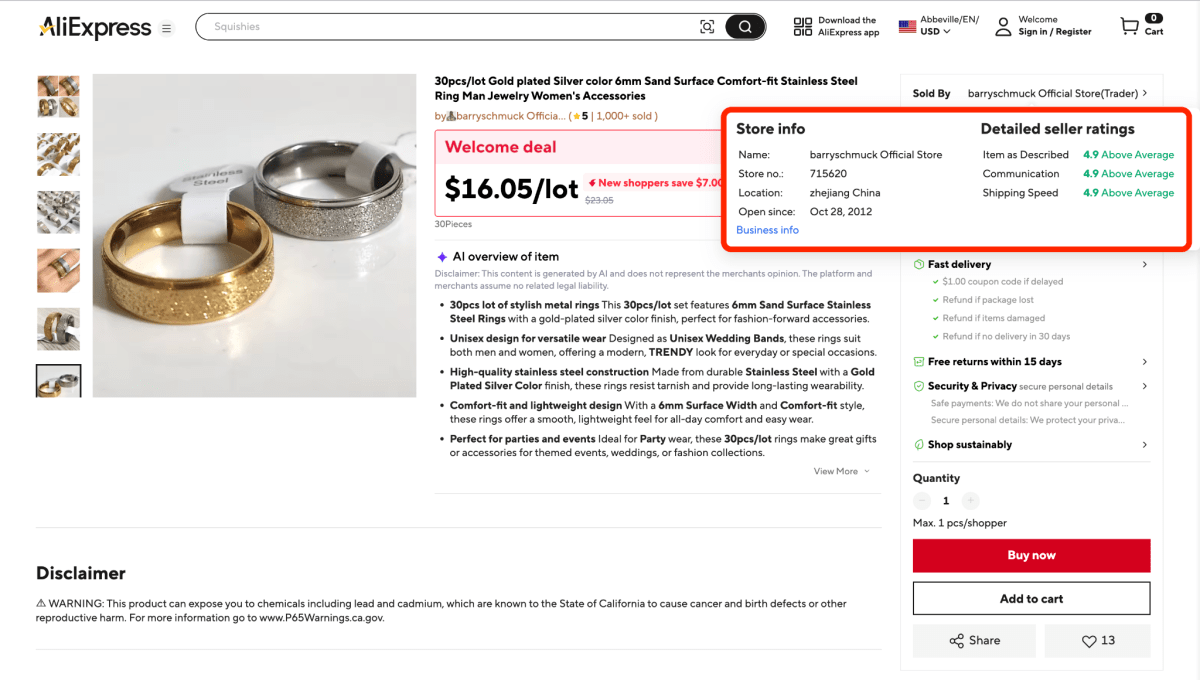
- Seller rating and transaction history
- Number of orders for the product
- Recent customer reviews and photo reviews
- Product quality and consistency
- Processing time
- Shipping methods and estimated delivery times
- Tracking availability
- Communication and response quality
Pay particular attention to recent reviews, not just the overall rating. A supplier with a 95%+ rating can still have recently developed fulfillment or quality problems.
And yes, order a sample.
It's one of the easiest ways to avoid finding out after 50 customers have ordered that the product looks nothing like the listing photos.
3. Set Up Your Store
Once your product and supplier pass your initial checks, build your store around that product or niche.
If you're using Shopify, keep the first version simple. You need a credible storefront, a strong product page, clear shipping information, a straightforward checkout, and the basic policies customers expect.
More importantly, don't copy the AliExpress product page word for word.
Your supplier is selling the product. You're selling the reason to buy it from you.
Show the problem it solves, explain the key benefits, answer common objections, and use product images or videos that demonstrate how it works. If every store selling the same product has the same generic description, yours won't give shoppers much reason to choose you.
4. Connect Your Store to AliExpress
Managing orders manually is possible when you're getting a few sales, but it quickly becomes painful once volume picks up.
A tool such as DSers can connect your store with AliExpress and help with product importing, order processing, supplier management, and tracking synchronization.
The goal isn't just convenience. It's reducing manual work and, more importantly, reducing the chance of fulfillment mistakes as order volume grows.
You should still review orders and supplier performance regularly. Automation doesn't fix a bad supplier.
5. Price the Product Based on Your Full Economics
Here's where you need to stop thinking in terms of simple markup.
If a product costs $10 and you sell it for $30, you don't automatically have a $20 profit.
Suppose you also spend $8 to acquire the customer, $4 on shipping, and another $1 on payment-related costs. You're already down to roughly $7 before accounting for discounts, refunds, apps, or other operating expenses.
That's why I'd calculate your break-even price and break-even CAC before scaling your advertising.
You should know:
- How much it costs to fulfill one order
- How much you can afford to spend to acquire a customer
- How much profit you expect per order
- What happens to your margin when you offer a discount
- Whether the product is still profitable after refunds and failed deliveries
If you don't know these numbers, you're essentially buying revenue and hoping there's profit left over.
You can use our free dropshipping profit margin calculator to quickly and accurately calculate your profit margin after factoring in your key costs, so you know how much room you have for advertising.
6. Launch Small and Test the Entire Funnel
Don't go all-in on ads just because a product looks promising.
Start with a controlled test and evaluate the whole customer journey:
Ad → Product page → Checkout → Purchase → Fulfillment → Delivery → Profit
You need to know where the problem is.
If people aren't clicking the ad, you may have a creative or targeting problem. If they're clicking but not buying, look at the offer and product page. If they're buying but you're losing money, the problem is your unit economics.
And don't judge the product purely by revenue. A store can generate thousands of dollars in sales while losing money once ad spend, shipping, fees, refunds, and product costs are included.
7. Track What Happens After the Sale
Once orders start coming in, track your numbers at the product and order level beyond your Shopify revenue.
At minimum, keep an eye on:
- Net profit (per store, per product, per order, per ad campaign)
- Net profit margin
- Net revenue / Sales
- COGS
- ROAS, POAS
- CAC
- AOV
- Refunds and chargebacks
This gives you a much clearer answer to the question that actually matters: Which products and campaigns are making me money?
A product with a $40 AOV isn't necessarily better than one with a $30 AOV if it costs twice as much to acquire the customer.
8. Scale Once the Numbers Hold Up
Once you've got a product that consistently converts and remains profitable after your real costs, then you have something worth scaling.
Increase ad spend gradually, test new creatives, introduce bundles or upsells, and look for ways to increase AOV and repeat purchases.
At the same time, watch your supplier closely. A supplier who handles 20 orders a week may struggle when you're suddenly sending 200.
That transition is where many Shopify stores hit their first real bottleneck. Once volume becomes consistent, better pricing, faster shipping, custom packaging, or a dedicated fulfillment partner can have a much bigger impact on profit than simply pushing more traffic.
And that's when you can start moving from “testing products through AliExpress” to building a more scalable ecommerce operation.
How Much AliExpress Dropshipping Really Cost You?
One of the biggest misconceptions about AliExpress dropshipping is that you can start with almost no money.
Sure, you don't need to buy inventory in bulk upfront. But you still need to pay for your store, essential tools, product testing, and especially customer acquisition.
For a realistic starting budget, expect around $600–$1,400+ per month. Where you fall in that range depends mainly on how aggressively you're testing products and whether you're relying on paid advertising or organic traffic.
Your biggest costs will usually come from three areas:
Cost | What You May Pay For |
|---|---|
Product costs | The price you pay AliExpress sellers for products after receiving an order |
Shipping | Shipping fees charged by the AliExpress seller, especially for faster delivery options |
Store & domain | Ecommerce platform subscription, domain name, and basic store setup |
Apps & tools | Product research, dropshipping automation, reviews, email marketing, analytics, and other apps |
Product samples | Ordering samples to check product quality, packaging, and shipping before selling |
Advertising | Meta, TikTok, Google, or other paid campaigns used to acquire customers and test products |
Other operating costs | Customer service, creative production, freelancer fees, and other tools or services |
If you're keeping things lean and doing more work yourself, you can stay closer to the $600 end. If you're testing multiple products, running more paid campaigns, or investing in additional tools, your budget can quickly move toward $1,400+.
Shipping Is Where AliExpress Gets Tricky
Shipping is probably the part you need to pay the most attention to.
Why? Because you don't control the fulfillment process, but your customer will still hold you responsible for the delivery experience.
A cheap product with a 15-day delivery time isn't necessarily a good deal if customers expect it in five days. And if you scale paid ads before understanding your actual shipping performance, refunds and support tickets can quickly eat into your profit.
When comparing AliExpress suppliers, don't automatically choose the cheapest shipping option.
Look at:
- Estimated delivery time
- Shipping cost
- Tracking availability
- Destination country
- Carrier and shipping method
- Supplier processing time
For example, a supplier offering $2 shipping that takes three weeks may be worse for your business than one charging $5 but consistently delivering within a week.
Also remember that processing time and transit time are different. A supplier might advertise a 7–12 day delivery window, but if they need another 3–5 days to process the order first, your customer's actual wait is longer.

How to Scale an AliExpress Dropshipping Store
Once you've found a product that consistently sells, the challenge changes. You're no longer trying to prove “Can I sell this?” You're trying to answer “Can my current setup handle 5–10x the order volume without killing the margin or customer experience?”
That's where AliExpress-specific bottlenecks start showing up.
1. Negotiate Better Product Costs as Order Volume Grows
Don't keep paying the same price as the number you see on AliExpress just because your supplier's listing shows a fixed number.
Once you're generating consistent orders, message the supplier and negotiate based on your actual sales volume. Even a small reduction in product cost can have a meaningful impact when you're processing hundreds or thousands of orders.
You can also compare several suppliers selling the same product. This gives you leverage and helps you avoid becoming overly dependent on one seller.
2. Optimize Shipping Before It Becomes a Bottleneck
At 20 orders a week, a few delayed packages might be manageable.
At 500 orders a week, they become a customer service problem.
As volume grows, look at whether you can move more orders to faster or more consistent shipping lines, negotiate better rates, or work with a supplier/agent that has fulfillment options closer to your target market.
3. Consolidate Around Reliable Suppliers
When you're testing, having several suppliers is useful. Once you have a winner, though, supplier sprawl can create its own problems.
Different suppliers may use different packaging, product versions, processing times, and shipping methods. That makes quality control harder as your order volume increases.
Instead, identify the suppliers that consistently meet your standards and build a stronger relationship with them.
4. Start Building a Brand Around the Winner
Once you've confirmed that a product can sell consistently, ask yourself whether you really want to keep competing on the exact same AliExpress listing as everyone else.
This is the point to invest in custom packaging, better creative, differentiated bundles, product improvements, and eventually private labeling where the economics make sense.
You're moving from:
“I found a product that sells.”
to:
“I have an offer and supply chain that competitors can't easily copy.”
5. Make sure your margins have room to scale
Here's what gets tricky once your store starts doing real volume: the numbers get messy fast.
You might have one product selling extremely well, but its shipping cost has gone up. Another product has a great ROAS, but generates more refunds. A third one looks profitable until you include payment fees and the actual product cost.
And when you're running multiple products and ad channels at the same time, it's surprisingly easy to miss those small leaks.
That's where profit-level tracking becomes useful.
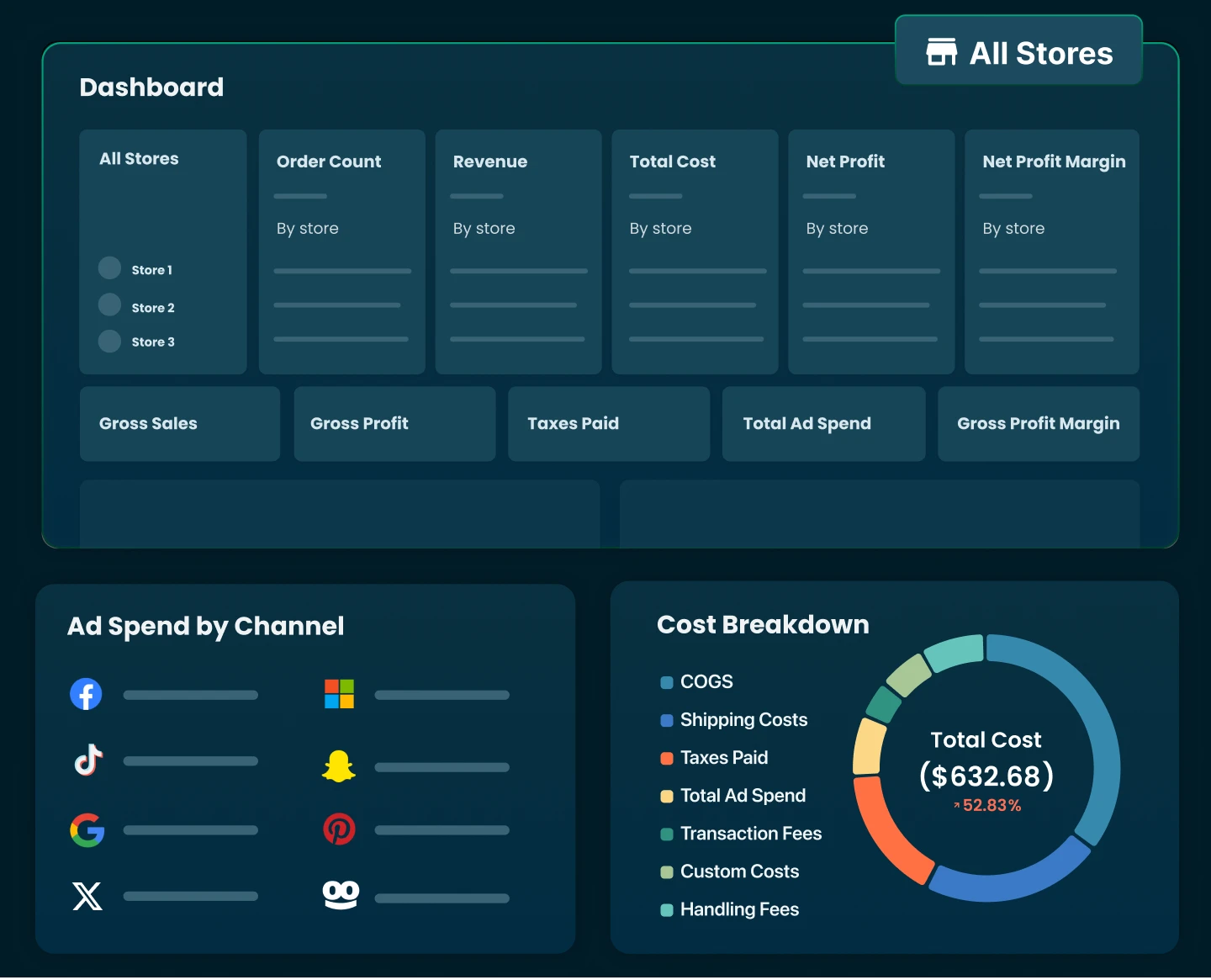
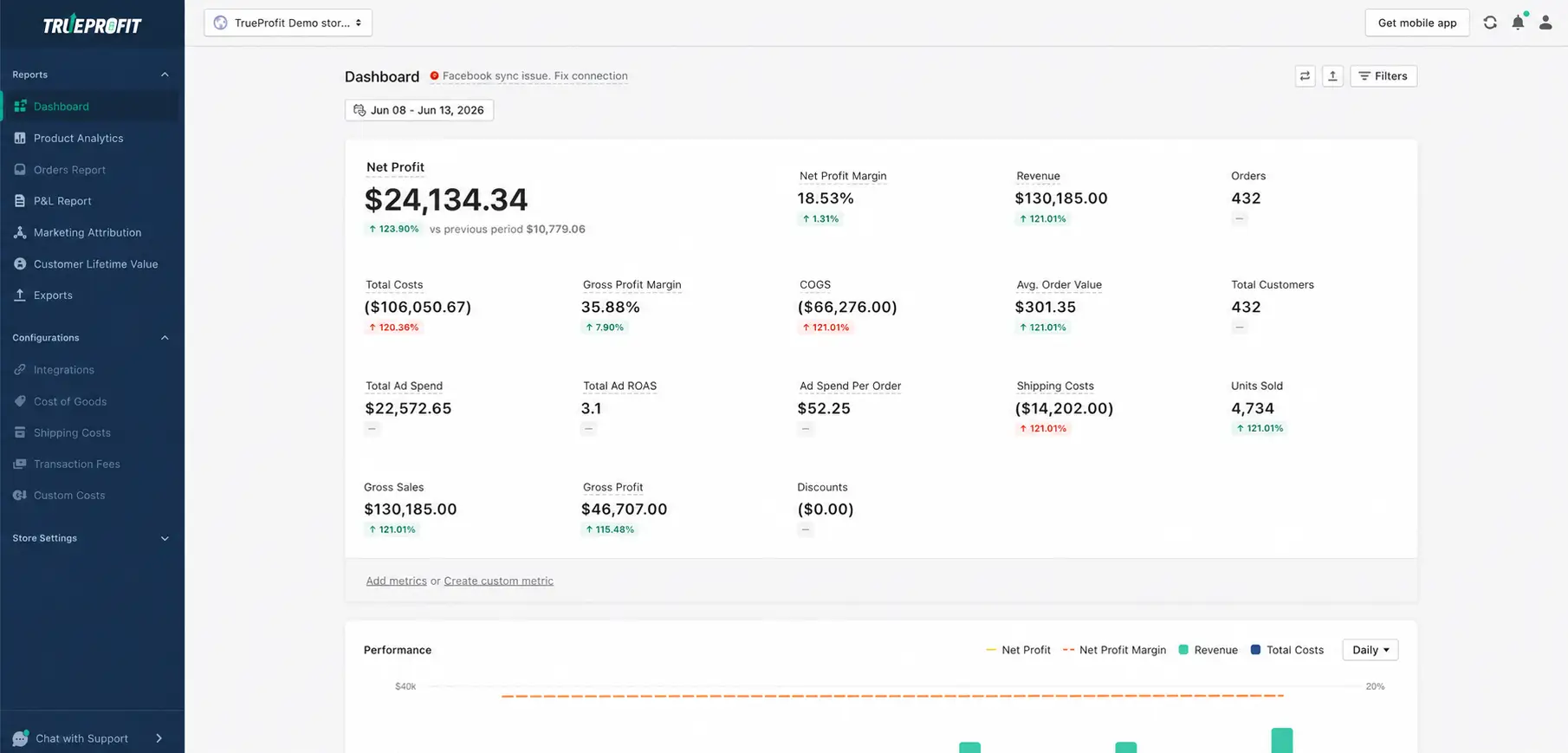
With TrueProfit, you can bring product costs, shipping fees, ad spend, transaction fees, refunds, and other expenses into the same view. Instead of looking at revenue or ROAS in isolation, you can see exactly which products and channels are actually contributing to your bottom line, and how much net margin you have to absorb the scaling marketing costs.
This gives you a much more practical answer when scaling:
- Which product should I put more budget behind?
- Which one looks good on the dashboard but is quietly losing money?
- And where is my margin disappearing?
Final Thoughts
AliExpress dropshipping is a low-risk way to test products without buying inventory upfront, but scaling it takes more than simply increasing ad spend.
Use AliExpress to validate demand, then focus on better suppliers, faster shipping, stronger margins, and a more differentiated brand as your order volume grows.
Most importantly, keep track of your real costs as you scale. More orders only matter when they translate into sustainable profit.

Harry Chu is the Founder of TrueProfit, a net profit tracking solution designed to help Shopify merchants gain real-time insights into their actual profits. With 11+ years of experience in eCommerce and technology, his expertise in profit analytics, cost tracking, and data-driven decision-making has made him a trusted voice for thousands of Shopify merchants.