
How to Dropship on Etsy Properly: What’s Allowed, What’s Not in 2026


Table of Contents
Etsy dropshipping still has a lot of potential in 2026, but it comes with one big caveat. You can’t approach it like traditional dropshipping.
The products you sell, the way you work with suppliers, and even how you present your listings all need to fit Etsy’s rules.
The good news is that there are still plenty of ways to build a low-inventory business on the platform. So, let’s take a closer look at how the model works and what you need to know before getting started.
In this blog:
Etsy Dropshipping Explained: How Does It Actually Work?
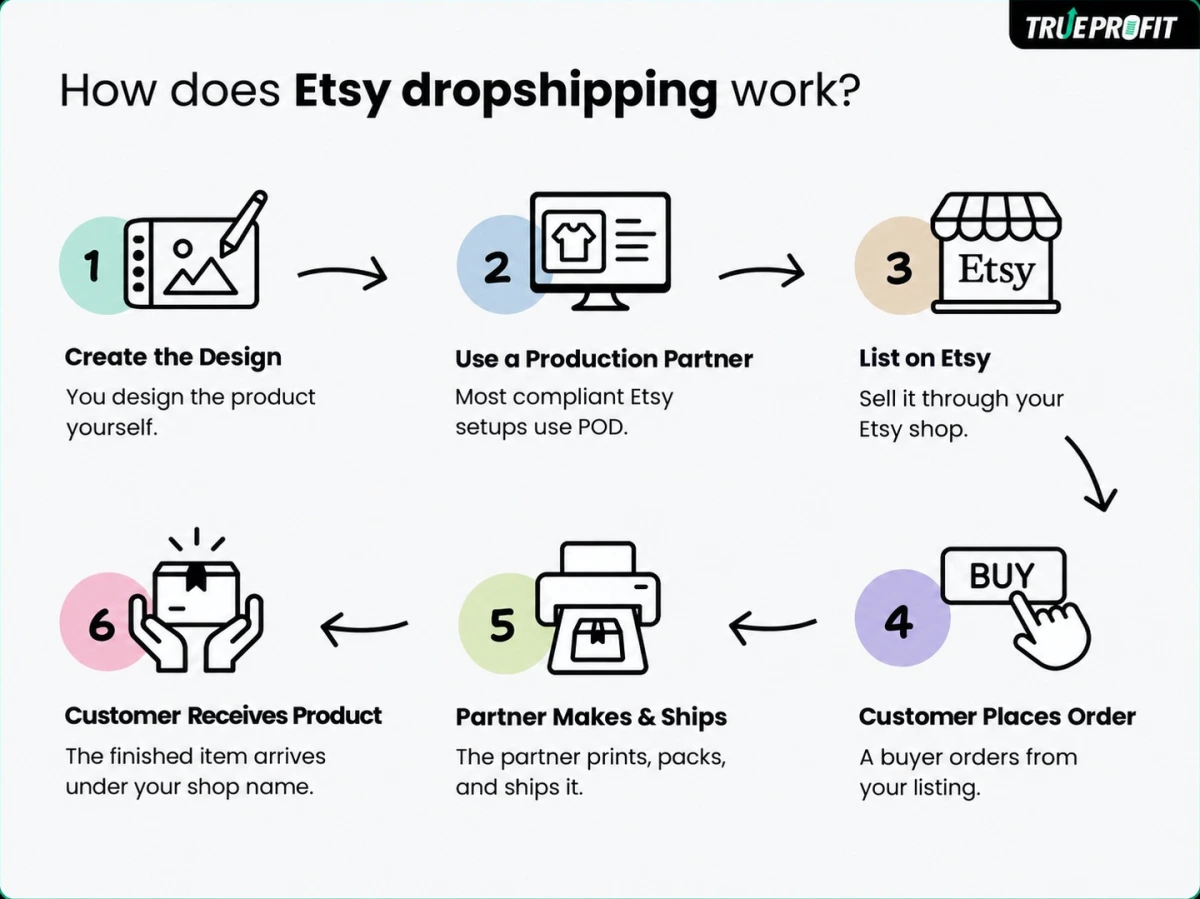
Etsy dropshipping is a business model where you sell products on Etsy without keeping the inventory yourself. When a customer places an order, a third-party supplier produces or ships the product directly to the customer.

On Etsy, the term “dropshipping” creates confusion because traditional dropshipping means selling goods you never stock.
Etsy’s version is narrower. You must have designed the product or be offering an allowed category such as craft supplies or vintage goods.
So, what does that look like in practice?
For most merchants, compliant Etsy dropshipping means print on demand. You upload your artwork onto a blank product, a buyer orders it, and a printer produces and ships it under your shop name.
The Pros and Cons of Dropshipping on Etsy
Like any business model, Etsy dropshipping comes with trade-offs. The biggest advantage is that you can start without buying inventory upfront, while Etsy gives you access to an existing marketplace with built-in customer demand.
On the other hand, you have to work within Etsy’s rules, compete with other sellers, and give up some control over production and fulfillment when using a third-party partner.
Pros | Cons |
|---|---|
Low upfront inventory costs | Etsy fees can cut into margins |
No need to hold stock | Less control over fulfillment |
Access to Etsy’s existing traffic | Strict marketplace policies |
Easy to test new designs | High competition in popular niches |
Scalable with POD | Supplier quality can affect reviews |

Can You Actually Dropship on Etsy? Here’s What Etsy Allows
If you’re planning to dropship on Etsy, this is probably the first thing you want to get clear. Etsy does allow some forms of dropshipping, but there’s an important catch. The model needs to look closer to made-to-order fulfillment than traditional reselling.
If you list generic products from a wholesale catalog and claim them as handmade, Etsy can remove them and permanently suspend your shop. So, the way I look at it, the policy really comes down to one question: did you design, make, or curate the item?
What Etsy Allows
So, what can you actually sell? I’d break Etsy’s allowed models down into a few main categories:
Allowed on Etsy | Why it is allowed |
|---|---|
Print on demand with your original design | You create the artwork, and a production partner makes it after sale. |
Disclosed production partners | You are transparent about who makes or ships the item. |
Craft and party supplies | Etsy supports sellers that supply materials to the creative community. |
Vintage items at least 20 years old | These are curated goods, not mass produced modern items. |
For me, print on demand is the clearest example. You can create an original graphic and connect Etsy to a production partner such as Printful or Printify. After a customer buys, the partner prints and ships the item.
It works much like dropshipping because you don’t hold inventory, but Etsy treats it as handmade because you contributed the design.
Craft and party supplies are also explicitly allowed. If you sell blank jewelry chains, beads, yarn, or party goods that help buyers create something new, Etsy accepts that model even when you didn’t physically make the items.
What Etsy Prohibits
Now, this is where I’d tell merchants to be extra careful.
Etsy’s Help Center is pretty direct: reselling commercially available items you did not make or design is prohibited.
Prohibited on Etsy | Why it gets flagged |
|---|---|
Reselling generic AliExpress or Temu items | You played no role in designing or creating them. |
Hiding a production partner | Misleading buyers about handmade origins. |
Copying another Etsy seller’s product | Violates Etsy’s originality rules. |
Listing commercially available goods as handmade | False handmade claim, even if a supplier ships after sale. |
This includes sourcing a product from AliExpress, CJ Dropshipping, or a factory catalog and listing it under a handmade category. Even if you use a supplier to fulfill, you still need to be transparent.
And this is something I really wouldn’t try to work around. Hiding your production partner or saying an item was made by you when it wasn’t can lead to permanent account closure.
You may have also seen sellers discussing an Etsy forum thread claiming dropshipping is now allowed after years of debate. But I wouldn’t take that as a green light for AliExpress reselling. Etsy clarified that production partners and certain categories are acceptable, while traditional dropshipping remains banned.
Your Step-by-Step Guide to Etsy Dropshipping Legally
Each step below reduces the risk of policy violations and surprise fees. Let’s dive in!
Step 1: Prepare Your Startup Budget
Before you start listing products, I’d work out your budget first. Etsy dropshipping is relatively cheap to start because you don’t need to buy inventory upfront, but there are still costs for listings, production, samples, marketing, and refunds.
For Etsy, you don’t necessarily need to spend at that level from day one. If you create your own designs, use free tools, and focus on organic Etsy traffic, your initial costs can stay much lower.
For paid ads, around $300–$500/month is a reasonable starting range for testing, rather than putting a large budget behind unproven products.
Here’s where the budget typically goes:
Cost | What to expect |
|---|---|
Etsy setup & listing fees | Varies by market and listing volume |
Product samples | A few samples to check quality before launch |
POD/production | Paid per order, so no upfront inventory |
Design tools | $0 if using free tools |
Marketing & ads | $0 for organic, or around $300–$500/month for paid testing |
Refunds & unexpected costs | Keep a small buffer |
Step 2: Choose a Product Model
Once the budget is clear, the next step is choosing the right product model. Etsy gives you a few options, but they don’t all work the same way.
You can sell POD, customized goods, craft supplies, or vintage items. For most new sellers, POD is the easiest place to start because there’s no inventory to hold and production partners can integrate directly with Etsy.
Craft supplies can work well too, but the model is closer to bulk reselling. Vintage is different again, since sourcing, photography, and fulfillment require more hands-on work.
Step 3: Create Designs People Actually Want
This is where Etsy dropshipping starts to differ from traditional dropshipping. Your designs are not just a branding element. They’re also a key part of making the business fit Etsy’s rules.
Use tools like Canva, Photoshop, Illustrator, or Procreate to create original artwork, typography, or illustrations. The goal is to bring your own creative input to the product rather than simply reselling something from a supplier catalog.
At the same time, stay away from copied phrases, characters, logos, or images protected by trademark or copyright. A product can sell well and still create problems if the design itself isn’t yours.
If you’re looking for inspiration, check out print-on-demand design trends to see what’s gaining traction before settling on a niche.
Step 4: Find a Production Partner You Can Trust
Once you have the product model and designs in place, the next challenge is finding a production partner that can deliver consistently.
Look for a partner that offers the products you want, ships to your main markets, and supports Etsy integration. Printful and Printify are common choices, but product selection alone shouldn’t be the deciding factor.
Pay attention to production time, shipping speed, blank quality, and defect rates. And before you start listing at scale, order a few samples. It’s the easiest way to check product quality, packaging, and actual delivery times before those factors affect your customers and reviews.
Step 5: Set Up Your Etsy Shop
The next step is getting your Etsy storefront ready for customers. Create your account, choose a shop name, add your policies, and configure payments.
In Shop Manager, add your production partner under the production settings so Etsy knows who is making or fulfilling the products.
From there, focus on the details that affect both trust and compliance: accurate categories, clear listing descriptions, and transparent production information. If a third party is printing or manufacturing your products, make that clear rather than trying to make the process look more hands-on than it really is.
Step 6: List and Fulfill Orders
With the shop set up, you can move on to publishing products and managing orders.
Connect your production partner to Etsy or use its publishing tool to push your listings. When an order comes in, the supplier will usually handle fulfillment automatically, but you still need to keep an eye on production status, shipping updates, and customer messages.
And remember, the production partner handles the order, but you own the customer experience. If there’s a production mistake, delayed shipment, or defective item, you’re still responsible for resolving it quickly and keeping the buyer satisfied.
Best Suppliers and Tools Dropshippers Actually Need
Now, let’s talk about the suppliers and tools that can actually help you run an Etsy dropshipping business. I’ve grouped the most relevant options by what they’re best at, from product creation and fulfillment to design.
Best Etsy Suppliers and Production Partners
Supplier | Best for | What it offers |
|---|---|---|
Printful | Quality-focused POD | Apparel, accessories, home products, personalization, Etsy integration |
Printify | Product variety | Large product catalog, multiple print providers, Etsy integration |
Gelato | International selling | Local production network, global fulfillment, Etsy integration |
Gooten | Automated POD fulfillment | Multiple product categories and automated order fulfillment |
Printful
Printful is a solid choice if you want a straightforward POD setup with more control over product quality and branding. It connects directly with Etsy, lets you create and publish products, and handles production and fulfillment after an order comes in.
It’s a good fit for sellers who care about consistent quality and a simpler fulfillment workflow, rather than simply looking for the lowest possible product cost.
Printify
Printify makes more sense if product variety and pricing flexibility are your priorities. It connects directly with Etsy and gives you access to a network of print providers, so you can compare products and production costs.
The tradeoff is that quality and fulfillment can vary between providers. That makes ordering samples before scaling especially important.
Gelato
If you’re targeting customers across multiple countries, Gelato is worth considering. It integrates directly with Etsy and uses a network of production partners to produce and ship orders closer to customers.
That can be useful when delivery speed and international fulfillment are important parts of your customer experience.
Gooten
Gooten is another POD option that Etsy itself lists as an example of a production partner. It can be a good fit if you want to automate production and fulfillment across a wider range of products.
The key with any of these suppliers is the same: your product still needs to meet Etsy’s rules, and the production partner needs to be disclosed where required.
Tools to Create and Manage Your Etsy Products
The right tools can take care of a lot of the repetitive work behind an Etsy dropshipping store, from creating product designs and listings to managing inventory and orders.
Tool | Best for | What it helps with |
|---|---|---|
Canva | Design creation | Product artwork, graphics, mockups, and marketing creatives |
Adobe Illustrator / Photoshop | Advanced design | Original illustrations, typography, and image editing |
Procreate | Hand-drawn designs | Original illustrations and artwork |
Vela | Etsy listing management | Bulk editing and managing Etsy listings |
LitCommerce | Multichannel selling | Sync Etsy with Shopify, Amazon, eBay, and other channels |
Sellbrite | Inventory & order management | Manage listings, inventory, and orders across channels |
AutoDS | Store automation | Product, inventory, pricing, and order automation |
The important part is not which software you use. It’s whether the final design is actually your own. Using a POD supplier doesn’t make a ready-made design Etsy-compliant. The product still needs to be based on your original design or the buyer’s customization.

Final Thoughts
So, is Etsy dropshipping worth trying? Yes, but don’t treat it like a quick-money play.
The good news is that you can start lean, test designs without holding inventory, and scale the products that actually get traction. The catch is that Etsy is pretty strict, and your success still comes down to what you sell, how well you present it, and how much profit you keep.
My advice? Start small, test fast, and let the numbers tell you what to scale. Don’t throw dozens of products into your shop and hope something sticks. Find a few winners, improve your listings, watch your margins, and build from there.

Lila Le is the Marketing Manager at TrueProfit, with a deep understanding of the Shopify ecosystem and a proven track record in dropshipping. She combines hands-on selling experience with marketing expertise to help Shopify merchants scale smarter, through clear positioning, profit-first strategies, and high-converting campaigns.