
How to Dropship on eBay Legally in 2026 For Beginners (Without Getting Banned)


Table of Contents
Here's the first thing to know about eBay dropshipping: it's not banned. What isn't allowed is the way some beginners try to do it.
So before you start uploading products, you need to understand where eBay draws the line.
From choosing a compliant supplier to calculating your real profit and keeping your shipping promises, this guide walks through what it takes to build an eBay dropshipping business safely in 2026.
In this blog:
What Is eBay Dropshipping?

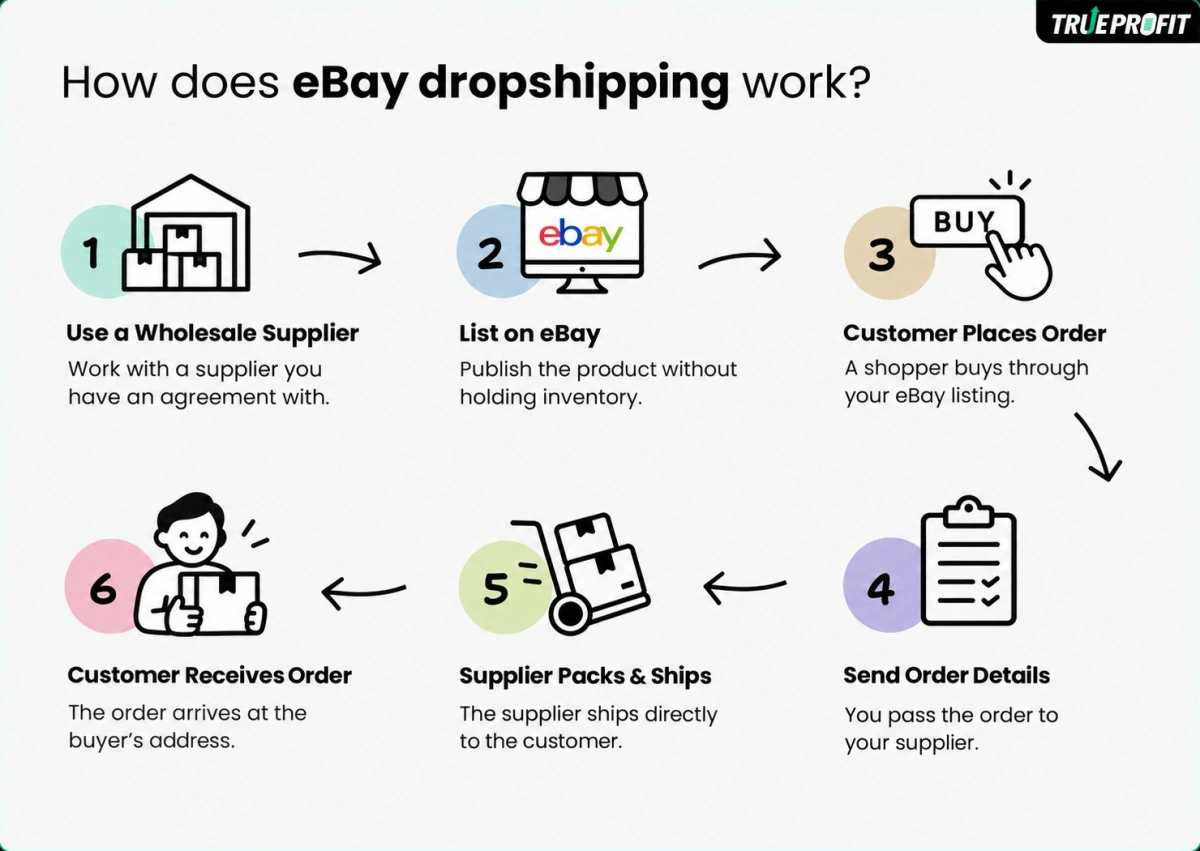
At its core, it’s pretty simple. You sell a product on eBay without keeping the inventory yourself. When a customer places an order, your supplier handles the packing and ships the product directly to them.
But there’s one detail you really need to get right: your supplier matters. eBay allows you to dropship through a wholesale supplier you have an agreement with. What you can’t do is wait until you make a sale, buy the product from Amazon, Walmart, Target, or another marketplace, and have that retailer ship it to your customer.
Pros of eBay Dropshipping
So, what are the advantages of dropshipping with eBay?
- Low startup costs: You don't need to buy and store a large amount of inventory upfront, so you can test products with less capital.
- Built-in traffic: eBay already brings millions of buyers to the marketplace, giving you a source of traffic without having to rely entirely on paid ads.
- Less operational work: Your supplier takes care of inventory, packing, and shipping while you focus on the selling side.
- Easy to test products: You can experiment with different products and niches without committing to bulk inventory.
- Good way to learn ecommerce: You get hands-on experience with product research, pricing, listings, customer service, and order management.
There’s also real income potential. Some industry sources estimate that eBay dropshippers make around $700 to $3,000 per month, although actual earnings vary widely depending on experience, product margins, sales volume, and account limits.
Beginners may start with a few hundred dollars in monthly profit, while more experienced sellers can scale much higher.
Cons of eBay Dropshipping
Now, this is where people sometimes underestimate eBay dropshipping.
The low barrier to entry doesn't mean eBay dropshipping is easy. There are a few trade-offs you need to account for from day one.
- Strict sourcing rules: eBay allows wholesale dropshipping, but retail arbitrage isn't allowed. Breaking the rules can lead to listing removals, restrictions, or even account suspension.
- Heavy competition: You're often selling products that other merchants can source too, so competing purely on price can quickly eat into your margin.
- Selling fees: eBay takes a cut from each sale, so your selling price needs to leave enough room for supplier costs, fees, refunds, and profit.
- Less control over fulfillment: Your supplier handles the physical order, but you are still responsible for making sure it arrives on time and keeping the buyer satisfied.

Is Dropshipping Allowed on eBay?
Before you start listing products, there’s one eBay rule you absolutely need to understand: not every type of dropshipping is allowed.
What Type of Dropshipping Does eBay Allow?
The simplest way to think about it is this: wholesale dropshipping is allowed; retail arbitrage is not.
With compliant dropshipping, you have an agreement with a wholesale supplier before you start selling. You list the supplier's products on eBay, and when an order comes in, the supplier ships the product directly to your customer.
You don't need to physically hold every product yourself. But you are still responsible for the sale. That includes making sure the item is available, the order ships within the timeframe you promised, and the buyer receives the product as expected.
So, if you're choosing a supplier, don't just look at product prices. Check whether they can reliably keep inventory, fulfill orders on time, and provide tracking. Your supplier's performance can directly affect your eBay store.
Why Retail Arbitrage Is Against eBay’s Policy
Here's where things get a little different.
Let's say you find a product on Walmart for $20 and list it on eBay for $35. A customer buys it, so you go back to Walmart, purchase the product, and enter your customer's address for delivery.
That's retail arbitrage, and eBay does not allow this type of dropshipping. Its policy specifically prohibits selling an item on eBay and then purchasing it from another retailer or marketplace to ship directly to the buyer.
The reason this distinction matters is simple: eBay wants you to have a legitimate fulfillment arrangement in place, rather than relying on another retailer to fulfill your eBay orders after the sale.
What Happens If You Break eBay’s Dropshipping Rules?
This is the part you don't want to learn the hard way.
If eBay finds that you're violating its dropshipping policy, it can take action against your listings or account. Depending on the situation, this can include removing listings, issuing warnings, restricting selling activity, or suspending your account.
And that's why I wouldn't build an eBay dropshipping business around trying to find loopholes or hide where your products come from.
Get the sourcing model right from the beginning. Work with a legitimate wholesale supplier, keep your listing information accurate, and make sure you can deliver what you promise to the buyer.
How to Start eBay Dropshipping Without Breaking the Rules
Now that you know what eBay allows, let's get into the part that actually matters: how to set up your eBay dropshipping business the right way.
The process itself is pretty straightforward. The tricky part is getting each step right before you start scaling. Your product, supplier, pricing, shipping, and seller performance all connect, so a weak link in one area can quickly create problems somewhere else.
Step 1: Set Up Your eBay Seller Account
Before worrying about products, get your eBay account ready to sell.
Create your account, complete the required seller information, and set up your payment details so you can receive payouts without issues.
It's also worth checking your selling limits and seller performance requirements from the beginning. eBay may place limits on how much you can list or sell, especially when you're just starting out.
Don't overcomplicate this part.
Get the account clean, get the basics in place, and then move on to finding products.
Step 2: Find a Compliant Wholesale Supplier
This is where you really don't want to cut corners.
eBay allows dropshipping through a wholesale supplier you have an agreement with. What you shouldn't be doing is listing a product from Amazon, Walmart, Target, or another retailer, then buying it from them after a customer places an order.
That's retail arbitrage, and eBay doesn't allow it.
When you're comparing suppliers, don't just chase the lowest product cost. Look at the things that will actually affect your store once orders start coming in:
- Inventory reliability
- Processing and handling times
- Shipping options
- Tracking availability
- Product quality
- Return and refund process
If you're selling to US buyers, a supplier with US-based inventory can also give you an advantage when it comes to delivery speed.
Step 3: Research Products Before You List Them
This is where a lot of beginners go wrong.
They find a product that looks interesting, see a few sales on eBay, and immediately add it to their store.
Instead, look at the numbers first.
eBay's Product Research tool gives sellers access to up to three years of sales data, including average sold prices, sales trends, sell-through rates, shipping costs, and the number of sellers selling a product.
Use that data to look for products with:
- Consistent demand
- Reasonable competition
- A healthy selling price
- Enough room for profit after your costs
- Low risk of damage or frequent returns
And don't forget about intellectual property.
Branded products can come with additional restrictions, especially if you're using brand names, logos, or copyrighted images without the proper rights. For beginners, generic or unbranded products are usually a much simpler place to start.
The goal isn't to find the product with the most sales.
It's to find a product that has demand and still makes sense for your business.
Step 4: Set Shipping Times You Can Actually Keep
This is one area where being overly optimistic can hurt you.
Maybe your supplier says they usually ship within one business day. That's great, but if they sometimes take three or four days, don't promise one-day handling on eBay.
Your handling time should reflect what your supplier can consistently achieve.
The same goes for your shipping service and estimated delivery dates.
A slightly slower promise that you meet every time is much better than an aggressive promise that keeps getting missed.
Step 5: Fulfill Orders Without Creating Chaos
Once a customer places an order, get the details to your supplier quickly and double-check that everything is correct.
When the supplier ships the order, make sure valid tracking is uploaded within your stated handling time.
Sounds simple enough.
But this is also where small operational problems start adding up. One wrong address isn't a disaster. Repeated errors across dozens or hundreds of orders are a different story.
That's why it's worth having a clear fulfillment process from the beginning, even when your store is still small.
How Much Does eBay Dropshipping Cost?
Starting a dropshipping business doesn't necessarily require a huge upfront investment. Depending on your setup, you can start with a relatively small budget and gradually increase your spending as you validate products and generate sales.
But if you're specifically starting on eBay, the numbers look a little different. Here's what you can realistically expect to spend:
For a small eBay dropshipping store, a realistic starting budget is around $100-$500. You can start toward the lower end if you're testing a handful of products yourself.
A larger buffer gives you more room to cover supplier payments, refunds, and unexpected order costs while you're still figuring out what sells.
Here's where that money typically goes:
Expense | Typical starting cost |
|---|---|
eBay account/listing fees | $0+ |
Product samples | $20–$100 |
Initial supplier/order cash buffer | $50–$300 |
Dropshipping software | $0–$50+/month |
Product research tools | $0–$30+/month |
Marketing/Promoted Listings | $0–$100+ |
Total starting budget | ~$100–$500 |

eBay Marketplace or Build Your Own Shopify Store? When to Switch
eBay is a pretty good place to start a dropshipping business.
You already have access to buyers, you don't need to build an audience from scratch, and you can test products without putting a lot of money into inventory.
But there's a trade-off.
You're building your business on a marketplace you don't control.
eBay sets the rules, controls the selling environment, and takes a cut from every sale. As your store grows, you may start wanting more control over your brand, customer experience, and profit margins.
That's when Shopify starts becoming more interesting.
eBay vs. Shopify: Which One Makes More Sense?
The biggest difference is what each platform is good at.
eBay is built around marketplace demand. Shopify is built around ownership and control.
eBay | Shopify | |
|---|---|---|
Traffic | Built-in marketplace traffic | You generate your own |
Startup | Lower barrier to entry | More setup required |
Branding | Limited | Full control |
Customer experience | Platform-controlled | Fully customizable |
Competition | Direct marketplace competition | You control the environment |
Scaling | Subject to marketplace rules | More flexibility |
Best for | Testing and getting initial sales | Building a long-term brand |
For a beginner, eBay can make more sense simply because you don't have to figure out traffic and product demand at the same time.
You can focus on finding products that sell, learning how customers respond, and figuring out your unit economics.
Shopify is a different game. You get much more control, but you're also responsible for bringing people to your store through SEO, paid ads, social media, email, or other channels.
When Does It Make Sense to Move to Shopify?
Don't switch to Shopify just because having your own store sounds more professional.
Switch when you've already proven that you have something worth scaling.
For example, if you've found a product that consistently sells on eBay, the supplier can handle the volume, and the margins still look healthy after all your costs, you have much more useful data to work with.
That's a stronger foundation for a Shopify store than starting with a random product and hoping your first ad campaign takes off.
You might consider expanding to Shopify when:
- You have consistent sales from a few winning products
- You understand your target customer
- Your supplier can support higher order volume
- Your margins can absorb marketing costs
- You want to build a recognizable brand
- You want more control over the customer experience
Final Thoughts
The biggest mistake you can make with eBay dropshipping is treating it like a race to get as many products live as possible.
That's not where the real advantage is.
The advantage comes from finding products with healthy economics, working with suppliers you can trust, and building a fulfillment process that can keep up when sales start coming in.
Once you've figured that out, scaling becomes much easier.
And when you eventually move into Shopify or other sales channels, keep the same discipline: know your costs, know your margins, and know which products are actually making you money.
eBay can be a starting point. But if you approach it the right way, it can also become the first step toward building a much bigger ecommerce business.

Harry Chu is the Founder of TrueProfit, a net profit tracking solution designed to help Shopify merchants gain real-time insights into their actual profits. With 11+ years of experience in eCommerce and technology, his expertise in profit analytics, cost tracking, and data-driven decision-making has made him a trusted voice for thousands of Shopify merchants.