6 Best Shopify Courses for Every Skill Level in 2026 (Free & Paid Options)


Table of Contents
Learning Shopify itself isn’t particularly difficult. The hard part is finding a course that actually matches your level and your goals when there are thousands of options out there.
You can find courses that teach you how to build a store from scratch, improve your marketing, customize your design, or understand ecommerce strategy. So instead of throwing another huge list at you, this guide breaks down the best Shopify courses in 2026 and what each one is actually useful for.
Before getting into the details, here’s a quick overview of the six options and what each one is best suited for.
In this blog:
1. Shopify Academy
If you’re completely new to Shopify, Shopify Academy is probably the first place I’d check. You’re learning from Shopify itself, and the platform offers both free and paid educational content covering topics such as running a store, Shopify fundamentals, B2B, and working with Shopify as a Partner.

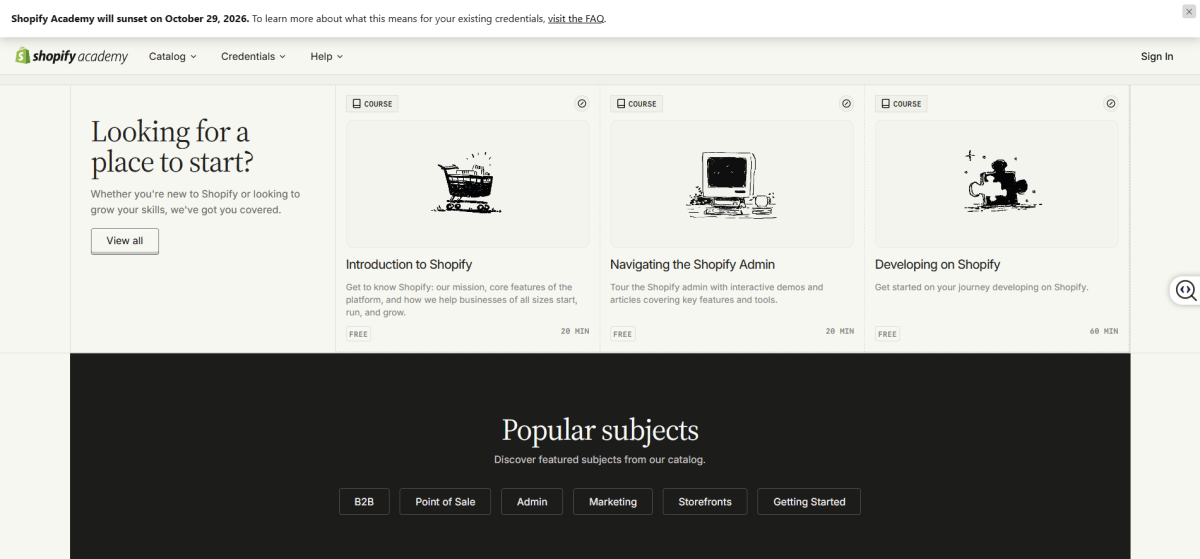
That makes it a good starting point if your immediate goal is simply to understand how Shopify works before paying for a third-party course.
What you’ll learn:
- Store setup and Shopify fundamentals: Get familiar with the Shopify platform and the basics of running a store.
- Free official learning resources: Shopify Academy includes free content alongside paid learning options, so you can start without committing to a course fee.
- Best suited for beginners: It makes the most sense when you’re still figuring out Shopify rather than looking for an advanced ecommerce strategy.
One thing to keep in mind is that Shopify Academy is broader than a single beginner “build a store from zero” course. So if you want a very linear, hands-on curriculum where someone walks you through every step in sequence, another platform may feel easier to follow.

2. Google Digital Marketing & E-commerce on Coursera
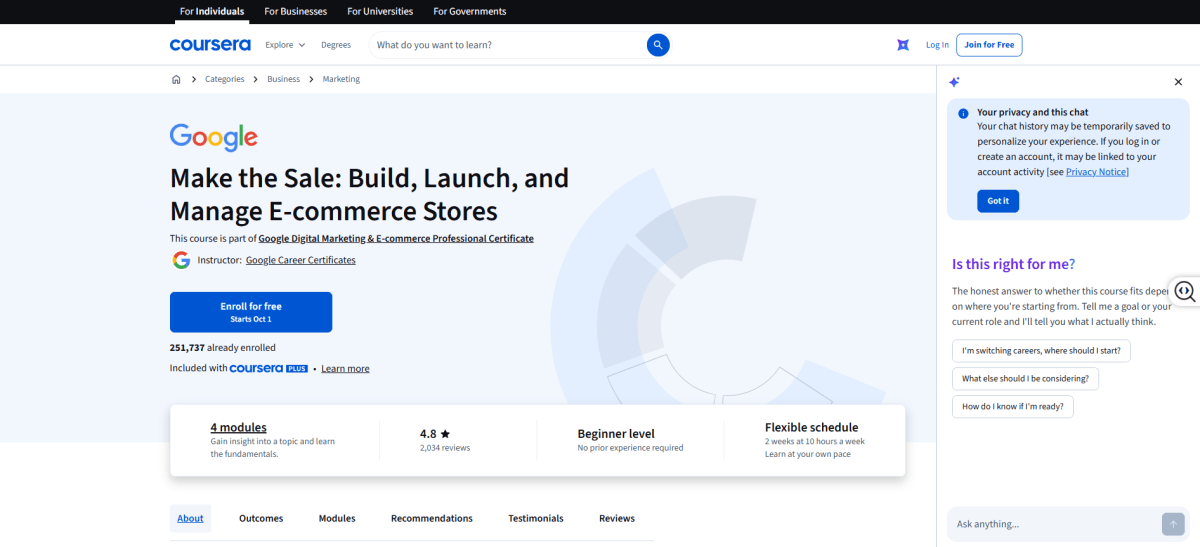
If you’re looking for more than just the Shopify dashboard, this one is worth checking out. Google’s Digital Marketing & E-commerce Professional Certificate on Coursera covers the bigger picture of running an online business, with Shopify included in the hands-on ecommerce coursework.
One example is Make the Sale: Build, Launch, and Manage E-commerce Stores, where you get to work with Shopify while learning the basics of building and managing an ecommerce store.
What you’ll learn:
- Ecommerce and digital marketing fundamentals: You’ll cover things like online store management, digital marketing, customer acquisition, and ecommerce strategy.
- Structured learning path: Instead of picking random Shopify tutorials, you get a step-by-step curriculum that takes you through different parts of ecommerce.
- Best for broader ecommerce skills: This makes more sense if you want to understand not just how to use Shopify, but also how to actually market and grow an online store.
The catch is that Shopify isn’t the whole focus. So if you just want someone to walk you through setting up your store from scratch, a Shopify-specific course will probably be more direct.
3. Complete Shopify Courses on Udemy
If you learn better by following along than sitting through theory, Udemy is worth checking out. There are plenty of Shopify courses that take you from the dashboard to a working store, so you can learn while actually building something.
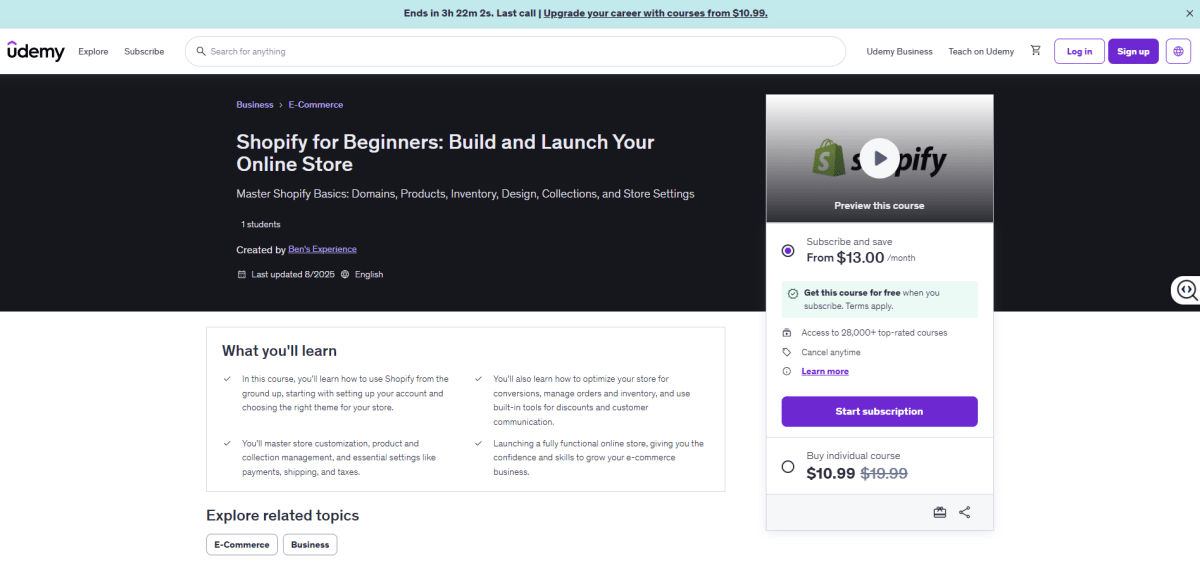
For example, Shopify for Beginners: Build and Launch Your Online Store was updated in April 2026 and walks beginners through Shopify basics, theme selection, store design, SEO fundamentals, product pages, and payment setup.
What you’ll learn:
- Store building from scratch: Follow practical lessons on setting up your Shopify store, choosing a theme, adding products, and getting the basic structure in place.
- Practical step-by-step lessons: Instead of only explaining what Shopify does, these courses let you follow the same steps inside the platform as you build.
- Best for hands-on beginners: This works well if you want to finish the course with an actual store rather than just a general understanding of Shopify.
The main thing I’d watch for is how recently the course was updated. Shopify changes its interface and features over time, so an older course can still teach the fundamentals but may not match what you see in your admin today.
4. LinkedIn Learning Shopify Courses
If you don’t want to sit through a 20-hour Shopify course, LinkedIn Learning is a more focused way to learn the platform. Its Shopify library covers everything from store setup and product management to payments, SEO, reports, and sales channels.
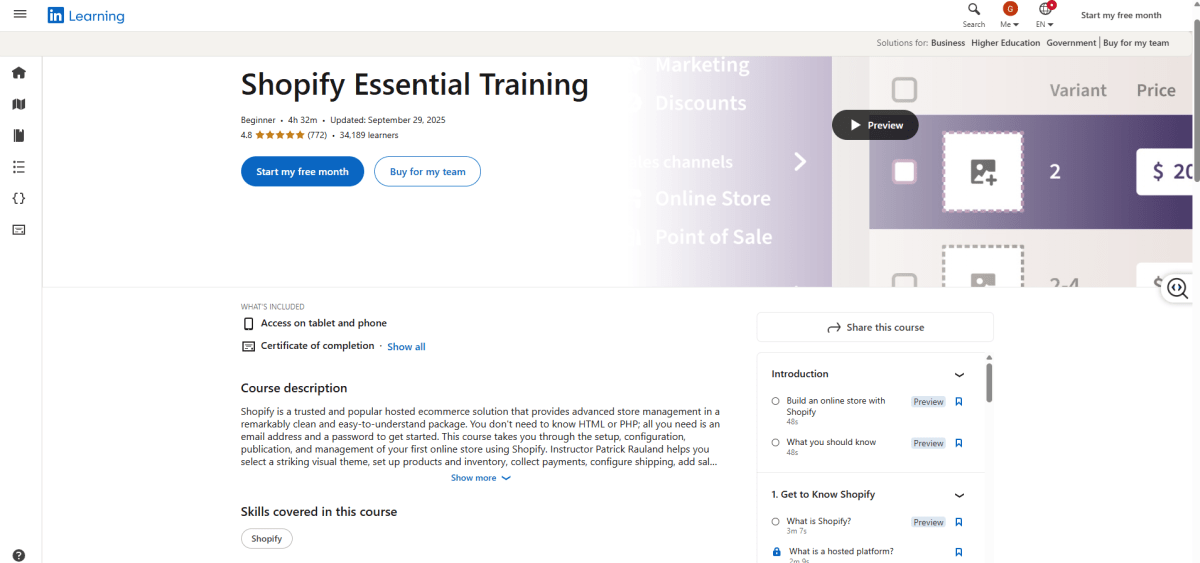
A good example is Shopify Essential Training by Patrick Rauland. It’s a 4-hour 32-minute beginner course that walks through setting up, managing, and launching a Shopify store, including products, inventory, payments, shipping, orders, and promotion.
What you’ll learn:
- Shopify essentials and platform navigation: Get familiar with the Shopify admin, products, inventory, payments, shipping, orders, and other core features.
- Short, focused lessons: The course breaks topics into individual lessons, so you can jump straight to the part you need instead of watching everything from start to finish.
- Best for quick upskilling: This makes sense if you already know a bit about ecommerce and mainly want to get comfortable using Shopify without committing to a long course.
The trade-off is that LinkedIn Learning tends to focus more on how Shopify works than on building a complete ecommerce business strategy. For deeper marketing, product research, or growth tactics, you’ll probably need additional courses or resources.

5. Shopify Courses on Skillshare
If you already know what part of Shopify you want to improve, Skillshare can be a good place to learn one skill at a time. Its Shopify library covers topics across store setup, design, theme customization, and ecommerce, so you can pick a class based on what you actually need right now.
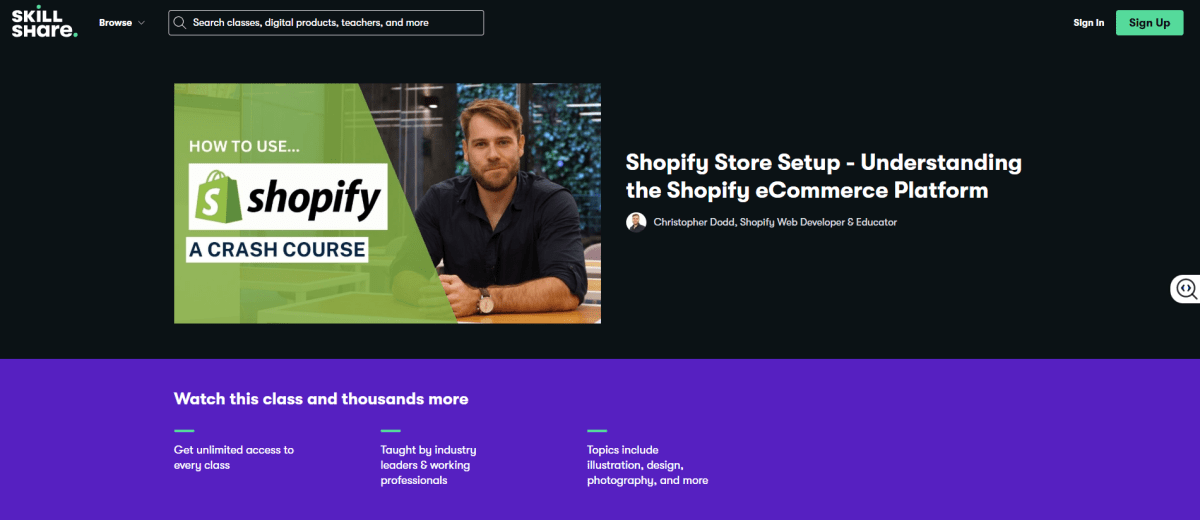
For example, Shopify Store Setup - Understanding the Shopify eCommerce Platform by Christopher Dodd covers the core pieces of a Shopify store, including products, collections, pages, navigation, themes, apps, and custom data.
What you’ll learn:
- Marketing, design, and specific Shopify skills: Instead of taking one broad course, you can focus on areas such as store design, theme customization, or other parts of running a Shopify store.
- Learn individual topics: Classes are broken into focused lessons, which makes it easier to jump into a specific topic without going through an entire ecommerce curriculum.
- Best for targeted learning: This works well if you already have a Shopify store and want to improve one particular area rather than learn everything from scratch.
The catch is that the experience can feel more pick-and-choose than a structured Shopify course. So if you’re starting from zero and want a clear path from store setup to launch, a more comprehensive course may be easier to follow.
6. Shopify Courses on YouTube
If you’re still figuring out what you actually need to learn, YouTube gives you more flexibility than a traditional course. You can learn the basics, follow a full store setup tutorial, or search for a specific Shopify problem without committing to a full curriculum.
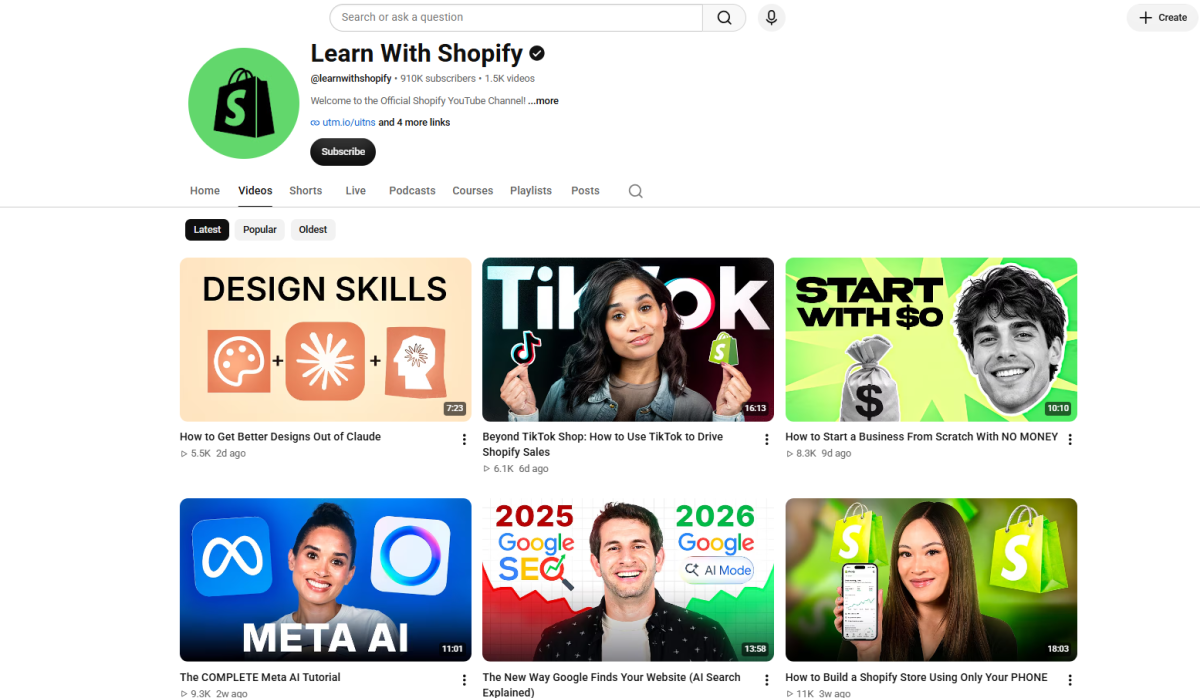
One channel worth checking out is Learn With Shopify, which has an official beginner tutorial series covering the core steps of setting up and managing a Shopify store.
What you’ll learn:
- Free Shopify tutorials: Learn the basics without committing to a paid course or subscription.
- Step-by-step store building: Follow along with practical walkthroughs covering areas such as products, themes, navigation, payments, shipping, and fulfillment.
- Best for beginners on a budget: It’s a practical starting point if you want to get familiar with Shopify before investing in a more structured course.
The trade-off is that YouTube is less structured than a dedicated course platform. You’ll need to filter through different videos and creators yourself, so it works best when you already know what you’re trying to learn.
How to Choose the Right Shopify Course for You
1. Your Current Shopify Experience
Start with your actual skill level, not where the course says you should be.
If you’re completely new to Shopify, you’ll want a course that covers the fundamentals without assuming you already understand products, collections, themes, payments, fulfillment, or the Shopify admin.
If you’re already running a store, spending hours on those basics probably won’t move the needle. Look for a course that goes deeper into the area you’re trying to improve, whether that’s conversion optimization, Shopify SEO, analytics, or marketing.
2. What You Want to Achieve
A good course should have a clear outcome.
If your goal is to launch your first store, prioritize practical store-building skills. If you’re already selling and want more customers, a course focused on marketing and acquisition will be more relevant. And if your store gets traffic but struggles to turn that traffic into sales, you may get more value from conversion-focused training.
This is also a good way to avoid courses that try to cover everything but don’t go deep enough into anything.
3. Course Depth and Hands-On Practice
I’d pay close attention to how much of the course is actually spent doing, not just watching.
For Shopify, that means seeing the instructor work inside the platform, build or optimize a store, explain the reasoning behind decisions, and ideally give you something to implement yourself.
A long course isn’t automatically a comprehensive one. The useful question is whether you’ll finish with skills you can apply to your own store.
4. Instructor or Platform Credibility
Look beyond the star rating.
Check who created the course, how closely their experience matches what you want to learn, and whether recent students mention that the lessons are practical and easy to follow. For technical Shopify topics, an instructor who keeps the material updated matters too.
Reviews are useful for spotting recurring issues, but they shouldn’t be the only signal you use.
5. Price and Access Model
Compare the learning value, not just the upfront price.
Some Shopify education is free, while other courses sit behind subscriptions or charge separately. A cheaper course can make sense for a narrow skill, while a more comprehensive program may be worthwhile if it replaces several smaller resources.
Also check what your payment actually gives you. Access length, downloadable resources, projects, community support, and future updates can make a meaningful difference.
6. How Recently the Course Was Updated
This is particularly important with Shopify.
The fundamentals of ecommerce don’t change overnight, but Shopify’s interface, features, and workflows do. Before enrolling, check the course’s last update date and preview a few lessons if possible.
An older course can still be useful for concepts like product management or ecommerce fundamentals. But if you’re following a screen-by-screen tutorial, you want the Shopify interface and workflows to be reasonably close to what you’ll see in your own admin.
Final Thoughts
The best Shopify course depends on what you need to learn right now. Beginners can start with the fundamentals, while experienced merchants may get more value from focused training in marketing, SEO, design, or analytics.
The important part is what you do with the knowledge. Choose a course that fits your current goals, then put the lessons into practice as you build and grow your store.


Lila Le is the Marketing Manager at TrueProfit, with a deep understanding of the Shopify ecosystem and a proven track record in dropshipping. She combines hands-on selling experience with marketing expertise to help Shopify merchants scale smarter, through clear positioning, profit-first strategies, and high-converting campaigns.