

Time Decay Attribution Model: What It Is, Pros & Cons (2026)


What Is Time Decay Attribution?
How Does Time Decay Attribution Work?
Time Decay Attribution Model Example
1. All touchpoints receive equal credit
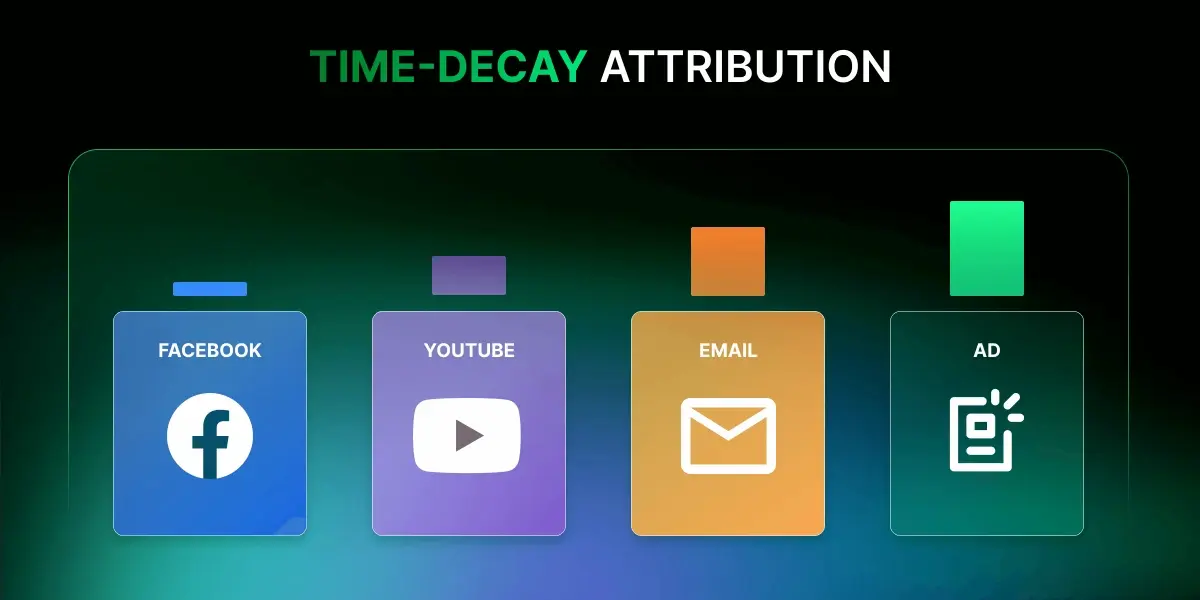
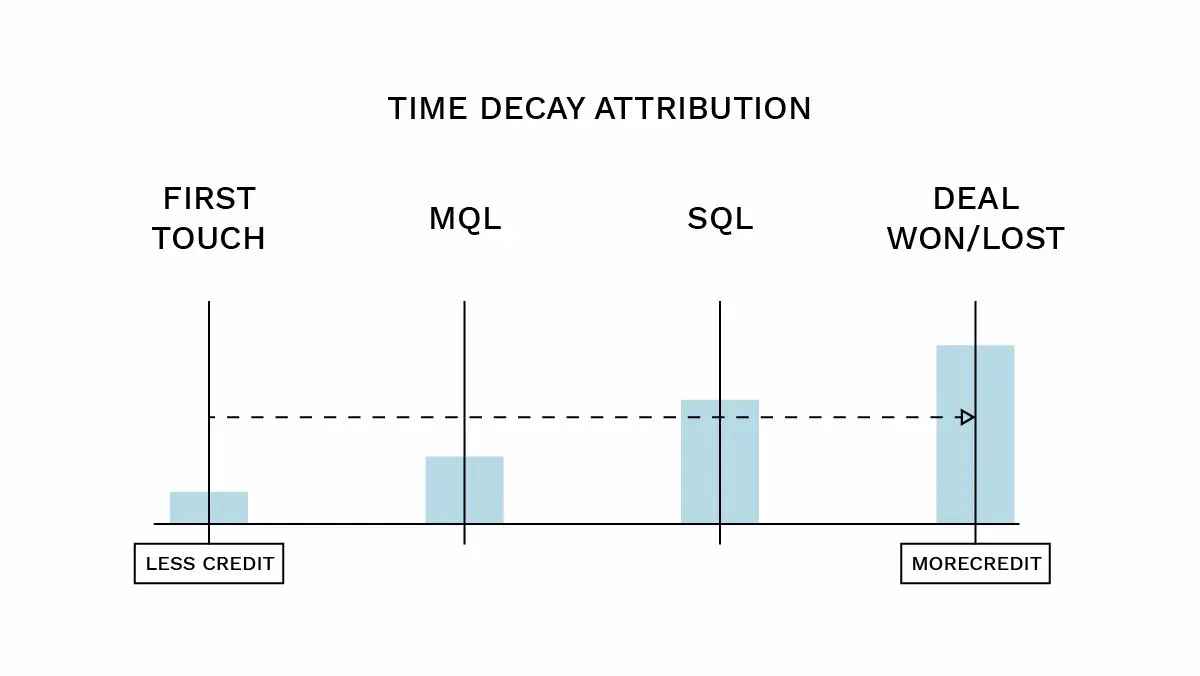
Every interaction in the customer journey plays a role in conversion. Unlike some models that only credit the first or last interaction, the time decay model assigns value to all touchpoints, giving more credit to those closer to the sale while still acknowledging earlier influences.
2. Accurate credit allocation
Properly attributing conversions to marketing efforts is essential for businesses. The time decay model provides a balanced approach by prioritizing touchpoints that have the greatest influence right before a purchase. This ensures a more realistic representation of marketing impact, helping businesses fine-tune their strategies.
3. Identifying effective marketing channels
4. Accurate customer journey
Traditional attribution models often oversimplify the customer journey by equally distributing credit or favoring a single touchpoint. The time decay model, however, takes timing into account, offering a more accurate reflection of how customers move through the funnel. This allows marketers to predict patterns and compare the effectiveness of different campaigns over time.
5. Adaptable for Different Business Needs
6. Works Well with Other Attribution Models
7. Easy to set up and use
Unlike machine learning-based attribution models, time decay attribution is easy to set up and apply. It doesn’t require extensive data analysis skills, making it accessible to marketers of all experience levels. Its simplicity helps teams focus more on strategy and execution rather than complex calculations.
Cons of Time Decay Attribution Model
1. Overemphasis on recent interactions
Time decay attribution gives more credit to touchpoints closer to the conversion event. While this helps identify effective strategies, it can lead to an overemphasis on recent interactions. As a result, earlier touchpoints such as those that raise awareness or spark initial interest may be undervalued. This could cause businesses to underinvest in tactics aimed at attracting new customers.
2. Not ideal for all business types
The time decay model isn’t always the best choice for businesses with short sales cycles or simple customer journeys. In such cases, simpler attribution models like Last Click or First Click may provide similar insights without the added complexity. For these businesses, the time decay model might not justify the additional effort and analysis required.
3. Potential for misinterpretation
For businesses with more complex sales processes where customers take time to research and compare options or later-stage interactions may be overvalued. This could lead to overinvestment in strategies focused on closing sales, while neglecting earlier-stage strategies that nurture leads and build awareness.
4. Ignores Interaction Value

Tracy is a senior content executive at TrueProfit – specializing in helping eCommerce businesses scale profitably through content. She has over 4 years of experience in eCommerce and digital marketing editorial writing. She develops high-impact content that helps thousands of Shopify merchants make data-driven, profit-focused decisions.










The Newsletter for Dropshippers
Who Hate Losing Money
Weekly tactics from dropshippers & eCom operators who've cracked profitability in an era where thin margins kill most stores.
Your next wise move starts with seeing your True Net Profit now.
Get instant net profit insights into your numbers to make every choice count with TrueProfit!