Dropshipping Taxes in 2026: What Every US Ecommerce Owner Actually Owes


If you started dropshipping dreaming of easy passive income, tax season can be a rude awakening. Between juggling sales tax across US states, figuring out what you owe the IRS, and the new import duty rules, it's easy to feel lost. The good news: dropshipping taxes aren't as scary as they look once you know which ones apply to you.
This guide breaks down every dropshipping tax you face in 2026, with real numbers so you can see how each one hits your bottom line.
The 4 Types of Dropshipping Taxes
As a dropshipper, you'll typically deal with four tax obligations: income tax, self-employment tax, sales tax, and import duties. Together, they determine how much you owe at the federal, state, and international levels.
You'll also come across source tax rules, but these aren't a separate tax. Instead, they determine which sales tax rate you charge when collecting sales tax from customers. Understanding both the taxes themselves and how sales tax is calculated helps you stay compliant and avoid costly mistakes.
1. Income Tax on Your Profit
Income tax is the tax on the money your business actually makes. As a dropshipper you pay it to the federal government, and usually your state too, on your net profit, not your total sales. Whether you cleared $500 or $50,000 last year, that profit counts as income and the IRS treats it that way.
Say your store nets $40,000 in profit. If you're based in Texas, which has no state income tax, you only owe federal tax on it. If you're in Georgia, you'd owe federal tax plus roughly 5.39% to the state, about $2,150 on that $40,000. Where you live changes the bill.
How you report it depends on your business structure. If you're just starting out, you're almost certainly the first row:
Most dropshippers start as a sole proprietor or single-owner LLC. Both are taxed the same way: your store's profit lands on your personal tax return.
2. Self-Employment Tax
Self-employment tax (SE tax) is the one that catches new dropshippers off guard. It's how self-employed people pay into Social Security and Medicare, the same programs a normal paycheck deducts for. When you have a regular job, your employer quietly covers half of it. Running your own store, you're both the boss and the worker, so you pay the full 15.3% yourself, on top of income tax.
The good news: you get to deduct half of it later, which lowers your other tax. And the Social Security part only applies to the first $184,500 of profit in 2026, which most stores won't hit.
Say your store nets $50,000 profit this year. That's roughly $7,000 in self-employment tax alone, before regular income tax even starts. Once you're clearing $40K to $50K in profit, it's worth asking an accountant about an S-Corp, which can cut this bill.
3. Sales Tax (US)
Sales tax is the small percentage added at checkout that your customer pays and you pass on to the government. You're the middleman: you collect it from buyers, then send it to the state. Here's the catch for dropshippers, you only have to collect it in states where your business has nexus.
Nexus is just a fancy word for "enough of a connection to a state that they can make you collect tax there." No nexus, no obligation. Once you have it, you register for a permit, collect tax at checkout, and remit it to that state.
Two things create nexus:
- Physical nexus comes from a physical presence: an office, an employee, or inventory stored in a warehouse. Most dropshippers don't hold inventory, so this rarely applies.
- Economic nexus comes purely from sales volume. After the 2018 Supreme Court ruling in South Dakota v. Wayfair, states can tax out-of-state sellers based on sales activity alone, no physical presence needed. This is the one that matters most for dropshippers.
For example: you run your store from Ohio but sell $120K into California this year. That crosses California's threshold, so now you register in California and start charging California buyers their local sales tax (around 7.25% base, higher with local add-ons) on top of collecting in your home state. Thresholds have been shifting fast, so more on the numbers below.
4. Import Duties on Overseas Goods
Import duties (also called customs duties or tariffs) are fees the US government charges on products coming into the country from abroad. If your supplier ships from overseas (AliExpress, CJ Dropshipping, direct-from-China factories), every inbound package now gets hit with these fees.
This used to be a non-issue for low-value orders, but in 2026 it's one of the biggest cost changes to hit the dropshipping model in years. Full breakdown below.
5. Source Tax (Origin vs Destination)
Source tax isn't a separate bill, it's the rule that decides which sales tax rate you charge: the rate where your business sits, or the rate where your customer lives. Good news for most dropshippers: your Shopify tax settings or a tax app handles this automatically. You mostly need to know it exists so you understand why rates differ order to order.
The one case worth understanding:
- Selling within your home state: a few "origin-based" states (Arizona, Illinois, Ohio, Pennsylvania, Tennessee, Texas, Virginia) let you charge every in-state buyer your local rate. Most other states are "destination-based," meaning you charge the buyer's rate.
- Selling into other states: almost always the buyer's rate (destination-based). If you have nexus in California and ship there, you charge the California rate, even if your home state does it differently.

When Do You Pay Dropshipping Taxes?
Dropshipping taxes aren't paid once a year. Income tax comes in quarterly installments, sales tax is remitted on each state's schedule, and duties are paid at the border. Here's the calendar at a glance:
Quarterly Estimated Income Tax
If you expect to owe $1,000 or more in federal tax for the year, the IRS requires quarterly estimated payments using Form 1040-ES. For 2026, the due dates are April 15, June 15, September 15, 2026, and January 15, 2027. Miss them and you face underpayment penalties plus interest.
A simple habit: set aside 25% to 30% of every payout into a separate tax account. When the deadline hits, the money is already there.
State Income Tax
You owe state income tax to the state where you live and operate, usually on the same quarterly schedule as federal.
A handful of states have no personal income tax, including Florida, Texas, Nevada, Washington, and Wyoming. Operate in one and you skip the state layer, but still owe everything federal.
Sales Tax Filing
Once registered in a state, you file and remit on that state's schedule: monthly, quarterly, or annually depending on volume. You file even in periods where you collected nothing (a "zero return"). Skipping it triggers penalties.
Import Duties
Duties are paid at the point of entry, not on a schedule. They land the moment your supplier's shipment crosses into the US. Best practice: have your carrier handle Delivered Duty Paid (DDP), meaning the duty is settled up front so your customer never gets a surprise postage-due bill.
How to Manage Dropshipping Taxes
Managing taxes as a dropshipper comes down to four moves: know your true net profit, track your nexus footprint, use a resale certificate to avoid double tax, and keep clean records year-round. Get these right and filing becomes routine instead of a scramble.
1. Know Your True Net Profit
Get the profit number wrong and your estimated payments are wrong too. You either overpay the IRS or get penalized for underpaying.
This is harder than it sounds. Your real profit is buried under ad spend across platforms, payment fees, app subscriptions, shipping, refunds, and now import duties, and calculating your dropshipping profit margin by hand in a spreadsheet almost always misses something.
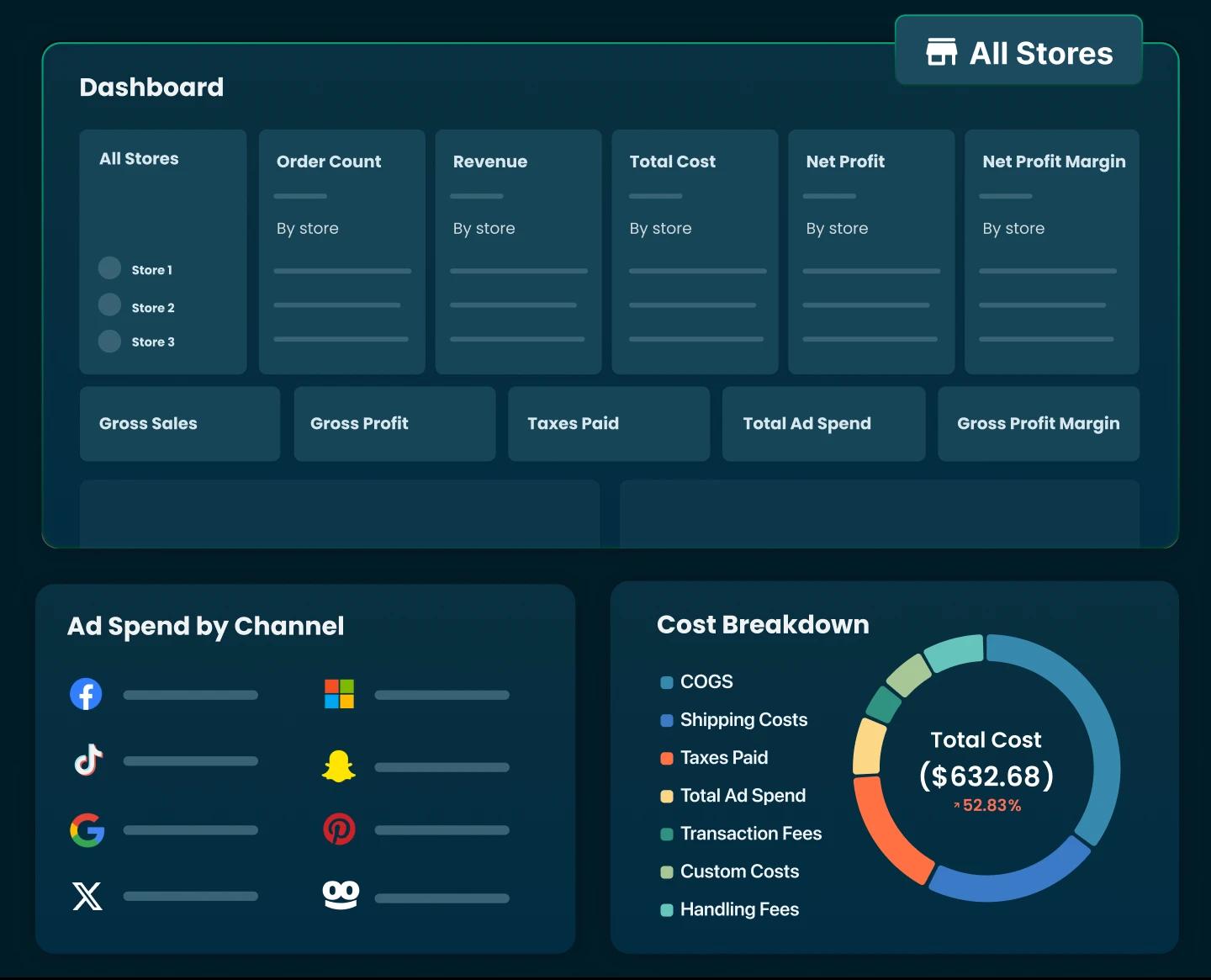
A net profit analytics tool fixes that. TrueProfit connects to your Shopify store and every cost source, then calculates real-time net profit automatically: COGS, ad spend, fees, shipping, and app costs all in one place.
The profit figure you use for estimated taxes becomes the actual number, not a guess, and your deductible expenses are tracked and ready for your CPA. Revenue is not profit, and only your true net profit tells you what you actually owe.
2. Track Your Nexus Across States
You can't collect tax in the right states if you don't know where you have nexus. And the thresholds change every year.
In 2026, 45 US jurisdictions enforce economic nexus. Most use a $100,000 sales threshold, but the big markets differ:
The classic "$100K or 200 transactions" rule still exists in many states, but the trend in 2025 and 2026 is to drop the transaction trigger. Illinois removed its 200-transaction threshold effective January 1, 2026, so sellers there hit nexus only after $100K in sales.
That helps dropshippers move lots of cheap items. A seller doing many $5 orders used to cross a transaction count long before hitting real revenue. As more states go sales-only, that trap disappears.
3. Use a Resale Certificate to Avoid Double Tax
Dropshipping is a two-part sale: your customer buys from you, and you buy from your supplier. Without the right paperwork, you can get charged sales tax twice, once by your supplier and once when you sell.
A resale certificate stops that. It tells your supplier "I'm reselling this, so don't charge me tax, I'll collect it from the buyer instead." You get one by registering for a sales tax permit in your home state, then send the certificate to your supplier.
Example: you buy 100 phone cases from a US supplier to fulfill orders. With a resale certificate on file, the supplier doesn't charge you sales tax on that purchase. You only collect tax from your actual customers at checkout.
One catch: rules vary by state. Most accept out-of-state or multi-state forms, but stricter states like California may want an in-state permit first. Check both your state and your supplier's.
4. Keep Clean Records Year-Round
The dropshippers who get audited are almost always the ones with messy books. Keep every invoice, ad receipt, supplier charge, and payout record, and separate business from personal finances with a dedicated account.
Common deductible expenses: ad spend, Shopify and app subscriptions, product samples, home office costs, software, and professional fees. Track them as they happen, not in April. A tool that logs profit and expenses in real time turns tax season from a reconstruction project into a download.
Final Thoughts
Taxes don't have to be the hardest part of running a dropshipping business, but they do require accurate records and consistent tracking. The earlier you understand where you owe tax, keep up with quarterly payments, and separate revenue from actual profit, the fewer surprises you'll face at tax time.
If you're growing across multiple states or sourcing products internationally, consider working with an ecommerce CPA. Pair that with a profit tracking tool that captures ad spend, fees, COGS, shipping, and duties automatically, and you'll have the numbers you need to stay compliant while making better business decisions.


Harry Chu is the Founder of TrueProfit, a net profit tracking solution designed to help Shopify merchants gain real-time insights into their actual profits. With 11+ years of experience in eCommerce and technology, his expertise in profit analytics, cost tracking, and data-driven decision-making has made him a trusted voice for thousands of Shopify merchants.