



Marginal Cost vs Marginal Benefit: Key Differences, Formulas & Examples

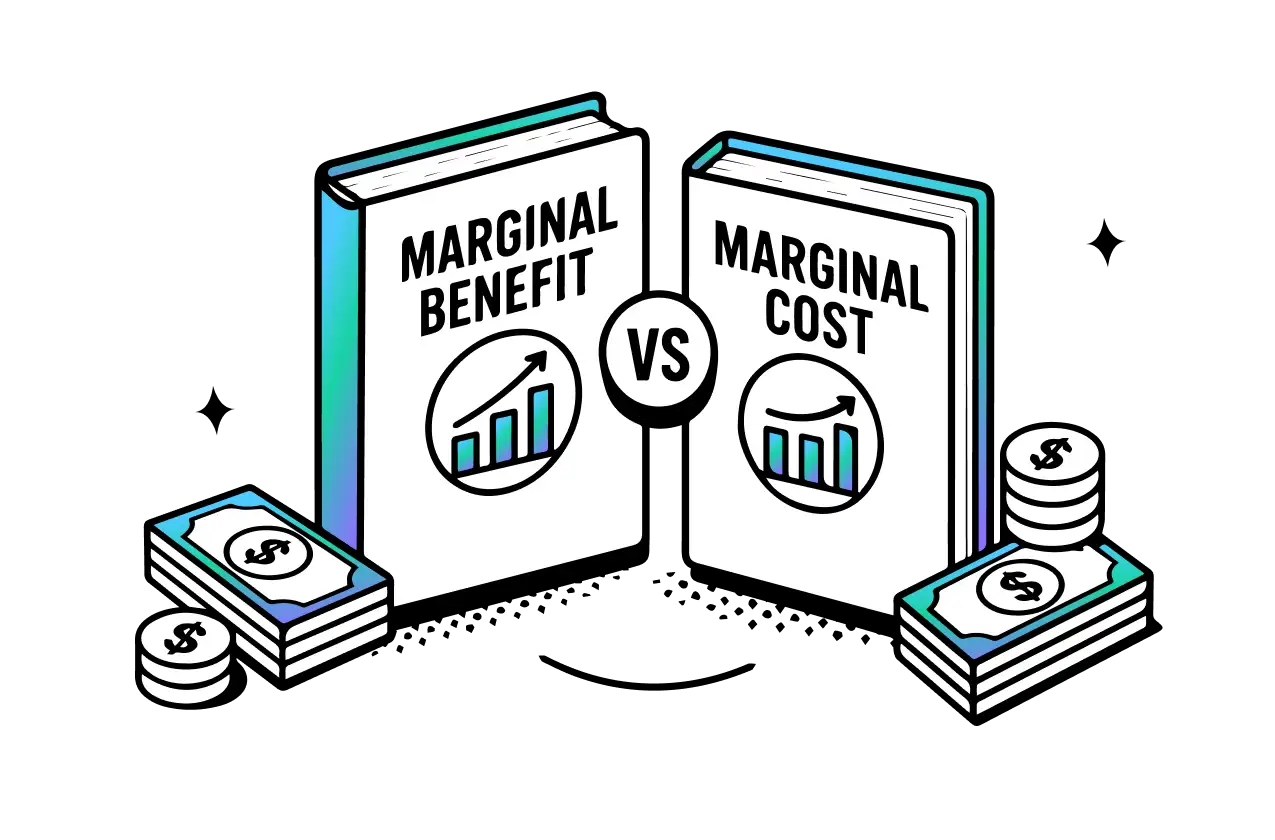

Table of Contents
Every scaling decision in ecommerce eventually comes down to one simple comparison: Does the next unit make you more money than it costs to produce and deliver?
Whether you’re increasing ad spend, restocking inventory, or testing a new SKU, you’re always operating in the same framework: marginal benefit vs marginal cost.
This article breaks it down in practical ecommerce terms, not academic theory, so you can actually use it in decision-making.
In this blog:
What Is Marginal Benefit?
Definition and Formula
In economics, marginal benefit is the maximum amount a consumer is willing to pay for one additional unit of a product. That willingness to pay reflects the extra value or satisfaction the customer expects to get.
In ecommerce, we usually simplify this from the seller’s perspective. Marginal benefit is the additional revenue generated from selling one more unit.
This is often close to your selling price, assuming stable pricing and demand.
However, in real business decisions, marginal benefit can also include repeat purchase potential, customer lifetime value (LTV), brand exposure or strategic value.
If you sell a phone case for $25 and receive one additional order, that sale generates $25 in additional revenue. For most ecommerce decisions, this incremental revenue works as your measure of marginal benefit.
The concept helps answer a question every store owner runs into:
How much value does the next sale actually create for the business?
Formula
Example
Say you sell a home decor item on Shopify and you're considering increasing sales from 200 units to 250 units.
Current total revenue from 200 units: $4,000
Projected total revenue from 250 units: $4,900
MB = ($4,900 − $4,000) / (250 − 200) = $18 per unit
That means each additional unit sold is expected to generate an average of $18 in additional revenue.
Types of Marginal Benefit
Marginal benefit doesn't always stay positive. It shifts depending on volume, market saturation, and how hard you're pushing sales.
Knowing which state you're in for a given SKU helps you avoid pouring money into products or campaigns that have already peaked.
The Law of Diminishing Marginal Benefit
Each additional unit you sell tends to generate less value than the one before it. That's the law of diminishing marginal benefit, and it shows up everywhere in ecommerce.
Your first 100 sales of a new product might come from warm audiences at full price. The next 100 require broader targeting and higher ad spend. By the time you're pushing for 500 sales, you might be discounting 20% and paying 3x the cost per acquisition.
The revenue per unit stays the same (or drops with discounts), but the effort and cost to generate each sale keeps climbing.

What Is Marginal Cost?
Definition and Formula
Marginal cost is what it actually costs you to source, fulfill, and sell one more unit. It includes your COGS, shipping, packaging, transaction fees, and any extra ad spend needed to drive that sale.
Formula
Continued Example
Using the same inventory expansion scenario:
- Current order: 200 units
- Current total cost: $2,000
After increasing inventory:
- New order: 250 units
- New total cost: $2,350
The additional 50 units increase total cost by $350.
Marginal Cost:
MC = ($2,350 − $2,000) ÷ (250 − 200) = $7 per unit
Now compare this with the marginal benefit from earlier:
- MB = $18 per unit
- MC = $7 per unit
Net Marginal Benefit = $18 − $7 = $11 per unit
Each additional unit produces roughly $11 in net marginal benefit, which suggests expanding inventory is likely profitable.
How Marginal Cost Changes as You Scale
Marginal cost isn't fixed. It shifts as your order volume changes, and that directly affects whether scaling is actually profitable.
At lower volumes, marginal cost often decreases. You get better supplier pricing, spread fixed costs over more orders, and benefit from 3PL efficiency.
But after a certain point, it starts going back up. Suppliers may charge rush fees, shipping distances expand, return rates rise, and customer support costs grow.
For example, a dropshipper might pay $8 per unit at 200 orders per month. At 500 orders, better supplier terms bring it down to $6.50. But at 1,000 orders during peak demand, rush fulfillment and split shipments can push marginal cost back up to $9.50 per unit.
Marginal Cost vs Marginal Benefit: Key Differences
Side-by-Side Comparison
These two concepts sit on opposite sides of every decision you make as a store owner. One looks at what you gain from selling more. The other looks at what it takes to make that extra sale happen. Here's the breakdown:
How They Work Together
Marginal benefit and marginal cost always work as a pair. You really can't understand one without looking at the other.
When marginal benefit is higher than marginal cost, each additional unit you sell is adding to your profit. Growth is working in your favor.
But once marginal cost climbs above marginal benefit, the situation flips. Every new sale starts to chip away at your profit instead of building it. That's usually the point where scaling further stops making sense, at least under the current conditions.
The Decision Rule: Where Marginal Benefit Equals Marginal Cost
The most important point on the graph is where marginal benefit (MB) and marginal cost (MC) meet. Economists call this the equilibrium point, but for store owners, it's simply where growth is most profitable.
At this level, the value generated by the next sale is exactly equal to the cost of making that sale happen. Push beyond this point and you're usually adding more cost than profit. Stop too early and you're leaving profitable growth on the table.
Here's a simple way to read each zone:
- MB > MC: Every additional sale generates more value than it costs. Growth is still profitable, so there's room to scale.
- MC > MB: The cost of acquiring and fulfilling the next sale is higher than the value it brings in. Expanding further at this stage can hurt profitability.
- MB = MC: This is the optimal point. You've hit the balance where profit is maximized and resources are being used most efficiently.
For ecommerce businesses, this isn't just a textbook concept. The same logic applies whenever you're deciding whether to increase ad spend, place a larger inventory order, expand into a new channel, or push for more sales volume. The goal isn't just to grow. It's to grow while the additional benefit still outweighs the additional cost.
Using MC and MB to Make Better Business Decisions
1. Deciding Whether to Discount a Slow-Moving SKU
A seasonal product has been sitting in your warehouse for months, tying up cash and racking up storage fees. The obvious move might be to run a discount, but the real question is whether the extra sales you'd get are still profitable.
At a 25% discount, the product sells for $30 instead of $40. After accounting for product cost and advertising, each sale still generates more value than it costs. Marginal benefit remains higher than marginal cost, so the discount helps move inventory without killing profitability.
The situation changes if the discount gets too aggressive. Once the selling price drops below the cost of acquiring and fulfilling the sale, every additional order destroys profit. At that point, liquidation, bundles, or marketplace clearance may be better options than cutting the price even further.
2. Scaling Facebook Ads
A lot of store owners assume that if ads are profitable today, spending more will automatically produce more profit tomorrow. In reality, the economics often shift as budgets increase.
Imagine bumping your monthly ad spend by $500 and generating $800 in additional revenue. The extra revenue exceeds the extra cost, so the decision makes sense.
But after another budget increase, that same $500 only brings in $450 in additional revenue. The economics have flipped. The marginal benefit of the extra spend is now lower than the marginal cost.
This is usually a sign you've hit diminishing returns. Instead of continuing to scale, it might be time to improve your creatives, test new audiences, or explore other acquisition channels.
3. Adding a New Product Variant
A best-selling product often creates pressure to launch more variants. More colors, sizes, or styles seem like an easy way to bump revenue, but every new option comes with additional costs.
A new color variation might generate extra sales, but it can also require inventory commitments, product photography, supplier minimum orders, and more warehouse complexity. If the expected revenue exceeds those incremental costs, the launch is probably worthwhile.
One common mistake is ignoring cannibalization. If customers simply switch from an existing color to the new one, total sales may not increase much at all. In that case, the actual marginal benefit is lower than it first appears.
4. Running a Flash Sale
A flash sale can create a quick surge in orders, which makes it tempting whenever inventory starts piling up. The challenge is understanding the true cost behind the promotion.
The additional revenue generated during the sale represents your marginal benefit. The marginal cost includes a lot more than just marketing expenses. Discounts reduce margin, returns often spike, and support teams may need to handle a higher volume of customer inquiries.
As long as the extra revenue comfortably exceeds these additional costs, the promotion can be a profitable way to move inventory. But when discounting goes too deep or return rates jump, the gap between marginal benefit and marginal cost narrows fast, turning what looks like a successful sale event into a much less profitable outcome.

Final Thoughts
Marginal cost and marginal benefit are behind every scaling decision you make as a store owner. Marginal benefit tells you what the next sale is worth. Marginal cost tells you what it takes to make that sale happen. The point where the two meet is where your profit is maximized.
The hard part isn't understanding the concept. It's knowing your real numbers. Transaction fees, return rates, shipping surcharges, and ad costs are easy to undercount. And when they are, you end up scaling past your actual break-even point without realizing it.

Lila Le is the Marketing Manager at TrueProfit, with a deep understanding of the Shopify ecosystem and a proven track record in dropshipping. She combines hands-on selling experience with marketing expertise to help Shopify merchants scale smarter, through clear positioning, profit-first strategies, and high-converting campaigns.