




What Is Marginal Analysis? Formula, Examples & Step-by-Step Guide


Table of Contents
Growing an ecommerce business often comes down to a series of small decisions. Should you increase your ad budget? Run a discount? Add another product to your catalog?
Some of those decisions will drive profit. Others will simply add cost.
Marginal analysis helps you tell the difference by comparing the additional benefit of a decision with its additional cost.
In this guide, you'll learn how marginal analysis works, how to calculate it, and how ecommerce businesses use it to make more profitable decisions.
In this blog:
What Is Marginal Analysis?
What It Really Means
Marginal analysis is a method of evaluating decisions by looking at what changes when you do one more unit of something. For ecommerce, that unit could be one more ad dollar spent, one more SKU listed, one more order fulfilled, or one more hour spent on product sourcing.
The word "marginal" doesn't mean small or unimportant. It means "one additional unit." You're not looking at total costs or averages. You're looking at what happens at the edge, at the very next step forward.
Key Concepts You Need to Understand
To use marginal analysis properly, there are two core ideas you need to be clear on.
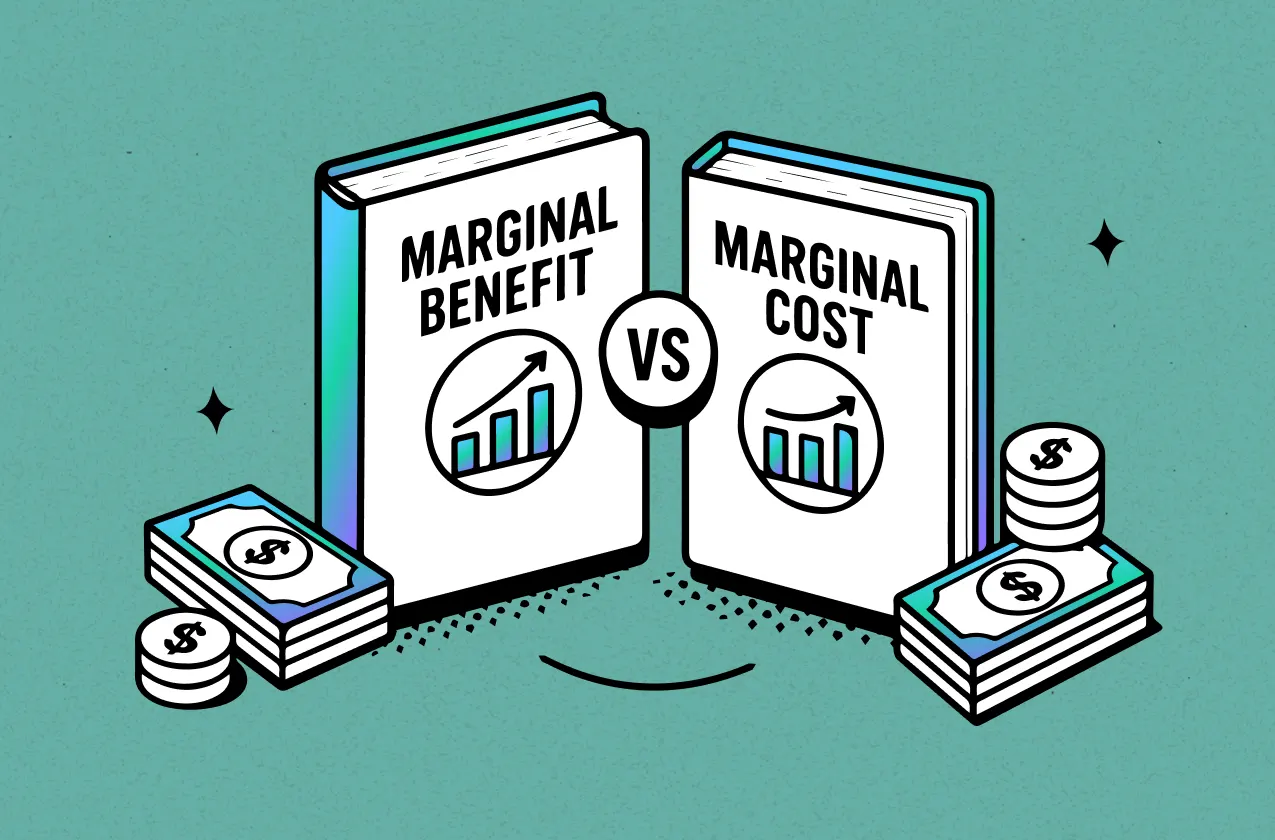
- Marginal Cost (MC) is the extra cost of doing one more unit of something. For example, what it costs you to run one more ad dollar, fulfill one more order, or source one more product.
- Marginal Benefit (MB) is the extra value you get from that same additional unit. It could be extra revenue, extra profit, or even improved efficiency depending on the decision you're making.
The entire logic of marginal analysis comes from comparing these two: cost vs. benefit, but at the next unit, not in total.
Why This Matters More for Ecommerce Merchants
In a traditional business, costs are relatively stable. In ecommerce, almost everything is variable. Ad CPCs shift daily. Shipping surcharges change quarterly. Return rates spike after promotions. Supplier costs fluctuate with MOQ changes.
That means your next order is often less profitable than your average order, especially as you scale. Marginal analysis is the tool that shows you exactly where that tipping point is.

The Golden Rule of Marginal Analysis
At its core, marginal analysis is about comparing the additional benefit of a decision with its additional cost. The goal is simple: continue investing as long as the value created by the next unit exceeds the cost required to produce it.
Whether you're increasing ad spend, launching a promotion, adding a new product, or hiring support, the same decision framework applies.
In practice, businesses rarely calculate this perfectly. Instead, marginal analysis provides a framework for evaluating whether the next investment is likely to improve profitability or reduce it.
Marginal Analysis Formula: How to Calculate It
The formula is built on two numbers: marginal benefit and marginal cost. Understanding each one is what makes this concept actionable for your store.
Formula:
Here's a quick example to make this concrete.
Worked Example: Should You Increase Ad Spend?
You're running Meta ads at $3,000/month. Your total ad-attributed revenue is $10,500, giving you a blended ROAS of 3.5x. You're considering bumping the budget to $4,000.
Here's where marginal analysis comes in. You don't care about what the full $4,000 will return on average. You care about what the next $1,000 will return.
You test a $500 increment first. Results:
The next $500 is barely profitable. You're right at the tipping point. Pushing another $500 beyond that would almost certainly flip negative.
This is the kind of decision that blended ROAS hides. Your overall ROAS still looks great at 3.2x. But the marginal ROAS on that last increment is 1.8x, and after costs, you're barely breaking even.
Common Marginal Analysis Applications in Ecommerce
Marginal analysis is most valuable when you're deciding whether to do more, less, or none of something. Instead of focusing on averages, it examines the impact of the next action: the next advertising dollar, the next discount campaign, the next product launch, or the next operational investment.
Here are some of the most common ways ecommerce businesses apply marginal analysis in practice.
1. Scaling Ad Spend
Marginal analysis helps determine the point at which increasing ad spend stops generating profitable returns. Rather than looking at overall campaign performance, it evaluates whether the next dollar invested is likely to produce enough additional profit to justify the cost.
You're spending $3,000/month on Meta ads with a 3.5x ROAS. Should you bump it to $4,000? The question isn't whether your average ROAS is good. It's whether the next $1,000 will return more than it costs in profit (not just revenue).
If your last $500 increment only returned 1.8x, you've likely crossed the threshold. Marginal ROAS is more useful than blended ROAS because it tells you where to push and where to pull back.
2. Running a Sitewide Discount
Discounts can increase sales volume, but that doesn't automatically mean they increase profit. Marginal analysis helps estimate whether the additional orders generated by a promotion are enough to offset the margin sacrificed on every sale.
Suppose you're considering a 15% sitewide promotion. Before launching it, calculate how many extra orders you'd need just to break even on the discount. Many stores see order volume rise during promotions while overall profitability declines because the additional sales aren't large enough to compensate for lower margins.
If the numbers don't work, a targeted offer to specific customer segments may deliver better results than a blanket discount.
3. Adjusting Your Free Shipping Threshold
Finding the right free shipping threshold requires balancing customer incentives with fulfillment costs. Marginal analysis helps determine whether the increase in average order value is large enough to justify the additional shipping expense.
Imagine your store currently offers free shipping on orders above $40. You're considering raising the threshold to $60. The potential benefit is that customers add more items to their cart to qualify for free shipping, increasing average order value.
If the change increases AOV by $15 on average while only adding $6 in shipping costs, the additional revenue more than covers the expense. In that case, the adjustment may improve overall profitability.
4. Adding a New SKU
Launching a new product isn't just a revenue decision, it's also an operational one. Marginal analysis helps determine whether a new SKU will generate enough incremental profit to justify the additional costs and complexity it brings.
For example, a dropshipper managing 50 products wants to add a 51st. The marginal cost includes supplier communication, listing creation, product images, customer support, and ongoing management, not just the product cost itself.
If the new SKU mainly cannibalizes existing bestsellers rather than attracting new customers, the expected benefit may be much smaller than it first appears.
How to Run a Marginal Analysis (Step by Step)
Here's a repeatable process you can apply to any incremental decision in your store.
Step 1. Define the Decision
The first step is identifying what "one more unit" actually means. Depending on the situation, that could be an additional ad budget, a new product listing, a fulfillment hire, or a promotional campaign.
Step 2. Identify All Marginal Costs
A complete analysis should account for all additional costs associated with the decision. These may include direct expenses such as COGS and ad spend, as well as indirect costs like operational complexity, management time, and opportunity cost.
Step 3. Estimate the Marginal Benefit
The expected benefit should be based on historical performance and current business data. Past campaign results, conversion rates, and average order value can all help estimate the value created by the next investment.
Step 4. Compare Marginal Benefit and Marginal Cost
Once both numbers are available, the decision becomes much clearer. If marginal benefit exceeds marginal cost, moving forward is usually justified. If costs outweigh benefits, resources may be better allocated elsewhere.
Step 5. Account for Diminishing Returns
Most ecommerce activities experience diminishing returns as spending increases. For that reason, results should not be assumed to scale linearly, and larger investments are often best tested in smaller increments first.

Final Thoughts
Marginal analysis provides a simple framework for making better business decisions. Instead of focusing solely on revenue or top-line growth, it helps you evaluate whether the next investment is actually likely to increase profit.
The reality is that not every opportunity is worth pursuing. Sometimes spending more creates more value. Sometimes it simply adds cost.
Before making your next move, ask yourself one question:
Will the additional benefit outweigh the additional cost?
If the answer is yes, keep going. If not, your resources are probably better invested elsewhere.

Harry Chu is the Founder of TrueProfit, a net profit tracking solution designed to help Shopify merchants gain real-time insights into their actual profits. With 11+ years of experience in eCommerce and technology, his expertise in profit analytics, cost tracking, and data-driven decision-making has made him a trusted voice for thousands of Shopify merchants.