Shopify vs. Etsy Fees: A Detailed Breakdown and Cost Comparison for Sellers(2026)


Table of Contents
- 1. Shopify vs. Etsy Fees at a Glance
- 2. Etsy Fee Structure: What You Actually Pay
- 3. Shopify Fee Structure: What You Actually Pay
- 4. Real-World Cost Scenarios: Shopify vs. Etsy by Sales Volume
- 5. Beyond the Fees: Hidden Costs on Both Platforms
- 6. Tips To Reduce Fees on Both Platforms
- 7. The Bottom Line
- 8. Shopify vs. Etsy Fees FAQs
Choosing between Shopify and Etsy isn't just a branding decision. It's a financial one. The platform you pick will shape your profit margins from your very first sale.
Etsy starts cheaper but charges more per transaction. Shopify costs more upfront but gets significantly cheaper as you scale. This guide breaks down every fee on both platforms, runs real cost scenarios, and tells you exactly when each platform makes financial sense.
In this blog:
- 1. Shopify vs. Etsy Fees at a Glance
- 2. Etsy Fee Structure: What You Actually Pay
- 3. Shopify Fee Structure: What You Actually Pay
- 4. Real-World Cost Scenarios: Shopify vs. Etsy by Sales Volume
- 5. Beyond the Fees: Hidden Costs on Both Platforms
- 6. Tips To Reduce Fees on Both Platforms
- 7. The Bottom Line
- 8. Shopify vs. Etsy Fees FAQs
Shopify vs. Etsy Fees at a Glance
The honest answer: neither platform is universally cheaper. Etsy suits low-volume sellers who want a quick start. Shopify suits growing brands that need control and better margins at scale.

Etsy Fee Structure: What You Actually Pay
Etsy's fees look small individually. Combined, they can take 15% or more of your revenue on every sale. Here is every fee you need to account for.
1. Listing Fees
Every listing costs $0.20, whether you are adding a new product or renewing an expired one. Listings stay active for four months. If the item doesn't sell, you pay another $0.20 to keep it live.
For sellers with large catalogs, this adds up quickly. 100 active listings costs $20 every four months just to stay visible.
2. Transaction Fees
Etsy charges 6.5% of the total order amount, including the item price, shipping charged to the buyer, and any gift wrap fees. This applies to every sale, no exceptions.
On a $45 order (product + shipping), that's $2.93 taken by Etsy before anything else.
3. Payment Processing Fees
In most regions, Etsy Payments is mandatory. It charges 3% + $0.25 per transaction, applied to the full payment amount including tax and shipping.
On the same $45 order, that is another $1.60. Combined with the transaction fee, Etsy has now taken $4.53 from a $45 sale, before you account for your product cost.
4. Offsite Ads Fees
This is where Etsy surprises many sellers. Etsy automatically promotes your listings across Google, Facebook, and other networks. If a buyer clicks one of those ads and purchases within 30 days, you owe Etsy a fee:
- Under $10,000 in annual sales: 15% fee on those attributed sales (you can opt out)
- Over $10,000 in annual sales: 12% fee, and opting out is no longer available
At scale, mandatory Offsite Ads can cost you hundreds of dollars a month with no way to turn them off.
5. Currency Conversion Fees
If your shop currency differs from your payment account currency, Etsy charges a 2.5% conversion fee on the converted amount.
6. Etsy Ads (Optional On-Site Advertising)
You can also choose to run ads within Etsy search results. The cost is variable and based on your daily budget and bid amounts. These are separate from Offsite Ads.
7. Etsy Pattern (Optional Store Website)
Etsy Pattern gives you a standalone website outside the marketplace for $15/month. Sales through Pattern don't carry Etsy's transaction fee, though payment processing fees still apply.
Etsy Fees: Pros and Cons
Pros:
- No monthly subscription, so low risk for very new sellers
- Built-in audience of buyers actively searching for handmade and vintage goods
- $0.20 listing fee makes product testing affordable
Cons:
- Combined fees (transaction + processing) routinely exceed 9-10% per sale
- Mandatory 12% Offsite Ads fee once you hit $10,000 in annual revenue
- No cap on total fee spend; the more you sell, the more you pay proportionally
Shopify Fee Structure: What You Actually Pay
Shopify operates on a subscription model. You pay a fixed monthly fee for your store, and in return, Shopify charges zero transaction fees if you use Shopify Payments. Understanding what Shopify is and how it works helps clarify why the monthly cost is worth it at the right sales volume.
1. Shopify Subscription Plans
The Starter plan does not include a full store. It only supports selling through social media or embedded buy buttons.
For most new Shopify sellers, Basic at $39/month is the right starting point. When to upgrade to the Grow or Advanced plan depends on whether the lower processing fees save you more than the plan increase costs.
For a deeper breakdown, the Shopify vs. Shopify Plus comparison covers when enterprise-level features make sense.
2. Payment Processing with Shopify Payments
When you use Shopify Payments, there are no additional Shopify transaction fees. You only pay the credit card processing rate:
Use a Shopify fees calculator to estimate your exact costs based on your plan and monthly sales volume.
3. Transaction Fees for Third-Party Gateways
If you use PayPal, Stripe, or any other third-party processor instead of Shopify Payments, Shopify charges an additional transaction fee on top of that processor's rate:
- Basic: 2.0%
- Grow: 1.0%
- Advanced: 0.6%
The takeaway: use Shopify Payments wherever it is available in your region.
4. Additional Costs to Budget For
These are not hidden, but they are easy to overlook when calculating total cost of ownership:
- Themes: Shopify offers solid free themes that work well for new stores. Premium themes cost $180 to $350 as a one-time purchase.
- Domain name: A custom domain typically costs $14 to $20 per year. You can buy through Shopify or a third-party registrar. See the Shopify domain cost breakdown for the full picture.
- Apps: The Shopify App Store has thousands of apps for marketing, reviews, inventory, and more. Many cost $10 to $50 per month. Costs stack fast if you add multiple tools.
- Shipping: Shopify offers discounted shipping rates through its platform. Understanding how Shopify shipping rates work helps you decide whether to use Shopify's built-in rates or a third-party carrier app. You can also print shipping labels directly through Shopify at discounted carrier rates.
- Marketing: Shopify has no built-in audience. You pay to drive your own traffic, whether through SEO, paid ads, email marketing, or social content.
Shopify Fees: Pros and Cons
Pros:
- Zero transaction fees with Shopify Payments
- Full ownership of your brand, store design, and customer data
- Scales efficiently: fixed costs spread across more sales as you grow
Cons:
- Monthly subscription is a fixed cost even in slow months
- Requires active marketing investment; no built-in audience
- App subscriptions can significantly increase overhead
Real-World Cost Scenarios: Shopify vs. Etsy by Sales Volume
The clearest way to see which platform costs less is to compare real numbers. The examples below use a $40 product with $5 shipping (total order: $45), applying standard US rates.
Scenario 1: Beginner (5 Sales/Month, $225 Revenue)
Etsy:
- Listing fees: 5 x $0.20 = $1.00
- Transaction fees: 5 x ($45 x 6.5%) = $14.63
- Payment processing: 5 x (($45 x 3%) + $0.25) = $8.00
- Total: ~$23.63 (not including Offsite Ads)
Shopify (Basic + Shopify Payments):
- Subscription: $39.00
- Payment processing: 5 x (($45 x 2.9%) + $0.30) = $8.03
- Total: ~$47.03
Verdict: Etsy is cheaper at this volume. The $39 Shopify subscription outweighs its per-sale savings when you're moving fewer than 15-20 items a month.
Scenario 2: Growing Business (50 Sales/Month, $2,250 Revenue)
Etsy:
- Listing fees: 50 x $0.20 = $10.00
- Transaction fees: 50 x ($45 x 6.5%) = $146.25
- Payment processing: 50 x (($45 x 3%) + $0.25) = $80.00
- Offsite Ads (estimated 5 attributed sales): 5 x ($45 x 15%) = $33.75
- Total: ~$270.00
Shopify (Basic + Shopify Payments):
- Subscription: $39.00
- Payment processing: 50 x (($45 x 2.9%) + $0.30) = $80.25
- Total: ~$119.25
Verdict: Shopify saves you roughly $150/month at this volume. That's $1,800 per year that stays in your pocket.
Scenario 3: Scaling Brand (250 Sales/Month, $11,250 Revenue)
Etsy:
- Listing fees: 250 x $0.20 = $50.00
- Transaction fees: 250 x ($45 x 6.5%) = $731.25
- Payment processing: 250 x (($45 x 3%) + $0.25) = $400.00
- Mandatory Offsite Ads (25 attributed sales at 12%): 25 x ($45 x 12%) = $135.00
- Total: ~$1,316.25 (11.7% of revenue)
Shopify (Grow Plan + Shopify Payments):
- Subscription: $105.00
- Payment processing: 250 x (($45 x 2.7%) + $0.30) = $378.75
- Total: ~$483.75 (4.3% of revenue)
Verdict: Shopify saves over $830/month at this scale. For a seller doing $11,250/month, that's roughly $10,000 in fee savings per year.
To get a fuller picture of what earnings look like on the platform, see how much you can actually make from Shopify.

Beyond the Fees: Hidden Costs on Both Platforms
Direct fees are only part of the picture. The total cost of running a store on either platform includes time, tools, and traffic.
Hidden Costs on Etsy
- Mandatory ad fees at scale: Once you cross $10,000 in annual sales, Etsy's 12% Offsite Ads fee is unavoidable. It is not optional. Plan for it in your pricing.
- Limited pricing power: Because you are competing inside a marketplace, race-to-the-bottom pricing pressure can erode margins faster than fees alone.
- No customer ownership: Etsy owns the buyer relationship. You cannot email your customers directly, build a loyalty program, or retarget them outside of Etsy's ecosystem.
Hidden Costs on Shopify
- Marketing budget: Shopify gives you a store, not an audience. Budget for SEO, paid ads, email marketing, or social content from day one. Many new Shopify sellers underestimate this cost.
- App subscriptions: A typical growing Shopify store might use 5 to 10 paid apps. At $15 to $50 each, that is $75 to $500/month in additional overhead.
- Setup investment: A custom domain, a premium theme, and initial store setup can cost $200 to $400 before you make your first sale. For a full breakdown, see how much a Shopify website actually costs.
Tips To Reduce Fees on Both Platforms
A few small changes in how you run your store can make a real difference in how much you pay in fees over time.
On Etsy
- Bundle products: Fewer listings = fewer listing fees. You’ll also increase your average order value, so each sale goes further.
- Focus on Etsy SEO: The more traffic you get organically, the less you rely on ads, and the less you pay in ad fees.
- Price with Offsite Ads in mind: Once you pass $10K/year, the 12% fee is mandatory. Build that into your pricing early so it doesn’t eat into your margins later.
On Shopify
- Use Shopify Payments: This is the easiest win. Third-party gateways add an extra 0.6%–2.0% on top of their own fees.
- Upgrade plans when it makes sense: The lower transaction fees can offset the higher monthly cost once you’re doing enough volume (around $30K+/month).
- Clean up your apps regularly: App subscriptions add up fast. If a tool isn’t driving revenue or saving real time, cut it.
- Lean into organic marketing: SEO and email take longer, but they pay off. Over time, they reduce your reliance on ads and keep acquisition costs low.
The Bottom Line
Shopify vs. Etsy isn’t really about which platform is cheaper. It’s about how fees scale as your business grows.
Etsy keeps things simple with low upfront costs, but its percentage-based fees stack up quickly as you sell more. Shopify asks for a higher starting investment, but gives you more control and significantly better margins once you start scaling.
The key is understanding where your money actually goes. Fees, ads, apps, and hidden costs all add up and they directly impact your net profit, not just your revenue.
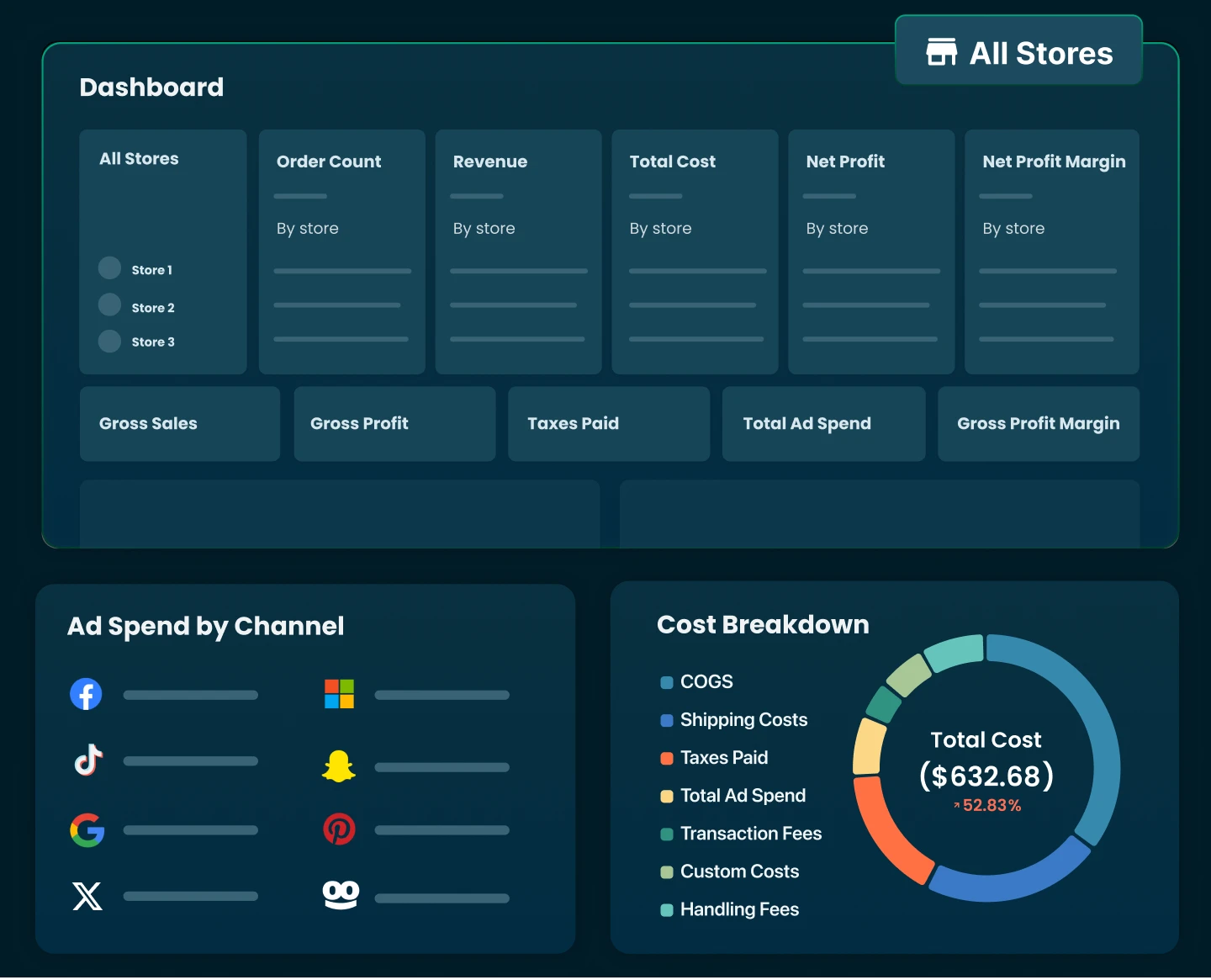
That’s why serious Shopify sellers don’t just track sales. They track profit. Tools like TrueProfit help you see every cost in one place, so you can understand your real margins and make better decisions as you grow.

Lila Le is the Marketing Manager at TrueProfit, with a deep understanding of the Shopify ecosystem and a proven track record in dropshipping. She combines hands-on selling experience with marketing expertise to help Shopify merchants scale smarter, through clear positioning, profit-first strategies, and high-converting campaigns.