AI Dropshipping: How AI Is Reshaping the Business in 2026


Table of Contents
I've watched dropshipping go through a lot of cycles. The "get rich quick" phase, the print-on-demand gold rush, the TikTok arbitrage era. But nothing has shifted the ground under this business model quite like AI has in the last two years.
Here's the thing though: most of what you read about AI dropshipping is either breathless hype ("automate everything and print money!") or dismissive eye-rolling ("it's all a scam"). The truth sits in a more useful middle.
So throughout this piece, I'll walk you through what AI dropshipping really is, which tools are worth your money, and its real impact on the dropship market in 2026 & beyond.
What Is AI dropshipping
AI dropshipping is the practice of using artificial intelligence tools to automate and optimize the parts of a dropshipping business that used to eat your time and budget: product research, store creation, copywriting, ad management, pricing, and customer support.
It is not a separate business model. You are still dropshipping. The difference is that machine learning models now handle tasks that previously required either your own labor or a team of freelancers.
AI does not create demand out of nothing. It helps you find demand faster and respond to it more efficiently. Whether that efficiency translates into profit depends entirely on how you use it, which brings us to the mechanics.

How AI Transforms Key Dropshipping Workflows
AI changes six core areas of your dropshipping software: research, sourcing, content, support, and pricing. Each one gets faster, but each one still needs your review to protect margin. Let me take them one at a time.
Product Research And Validation

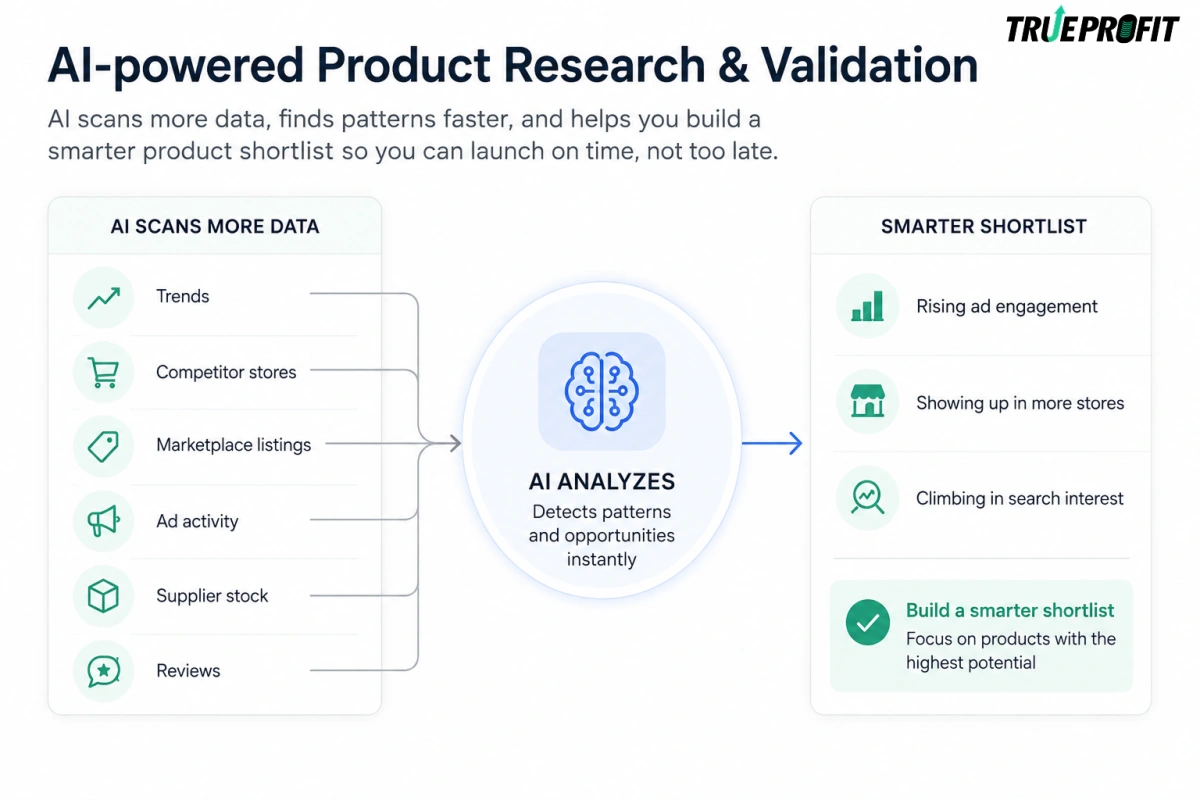
Traditional product research meant scrolling AliExpress, spying on competitor stores, and trusting your gut. AI tools now analyze sales data, search trends, and social signals across marketplaces to surface products with rising demand before they saturate. Some tools score products on competition, profit potential, and trend velocity, which compresses days of manual work into minutes.
The caveat: everyone using the same tool sees the same "winning" products. An AI recommendation is a starting point, not a moat. By the time a product shows up as "trending" in a popular research tool, thousands of other sellers are looking at the same data point.
Store And Listing Creation
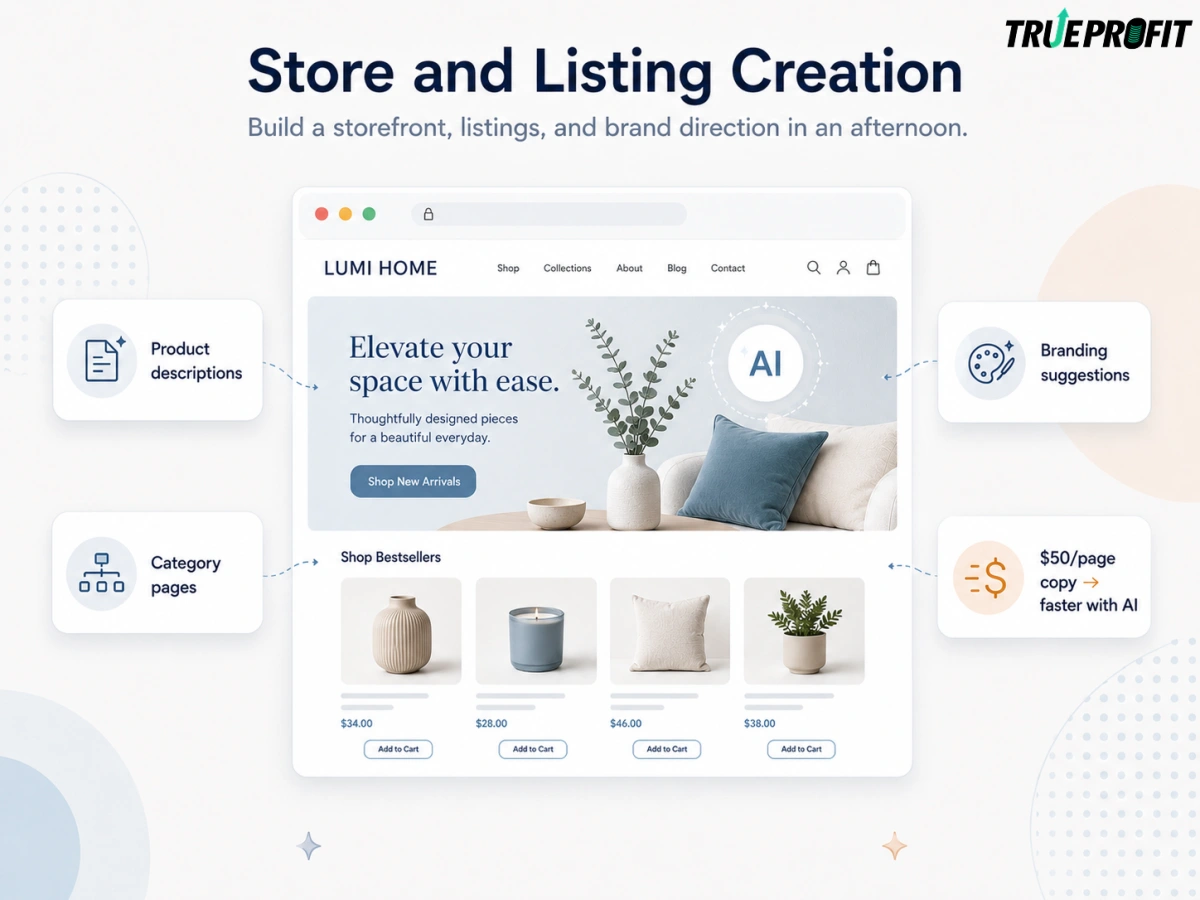
This is where AI has made the biggest visible dent. You can now generate a full storefront, complete with product descriptions, category pages, and branding suggestions, in an afternoon. Large language models write listing copy that used to cost $50 a page from a freelancer.
The quality is genuinely good now, good enough that the bottleneck has shifted from writing copy to differentiating it, since your competitors have the same tools.
Advertising And Creative
AI generates ad copy, produces video variations, and, more importantly, manages bidding. Meta and Google's own AI-driven campaign types (Advantage+ and Performance Max) lean heavily on machine learning to allocate spend. Third-party tools layer on top to test creatives at scale.
This is a double-edged sword I'll return to later: automated ad platforms are very good at spending your money, and only sometimes good at spending it profitably.
Pricing And Margin Management
Dynamic pricing tools adjust your prices based on competitor moves, demand, and inventory signals. Done well, this protects margin during demand spikes and stops you from leaving money on the table when a product is trending.
Done carelessly, it triggers a race to the bottom where you and three competitors keep undercutting each other until nobody makes money.
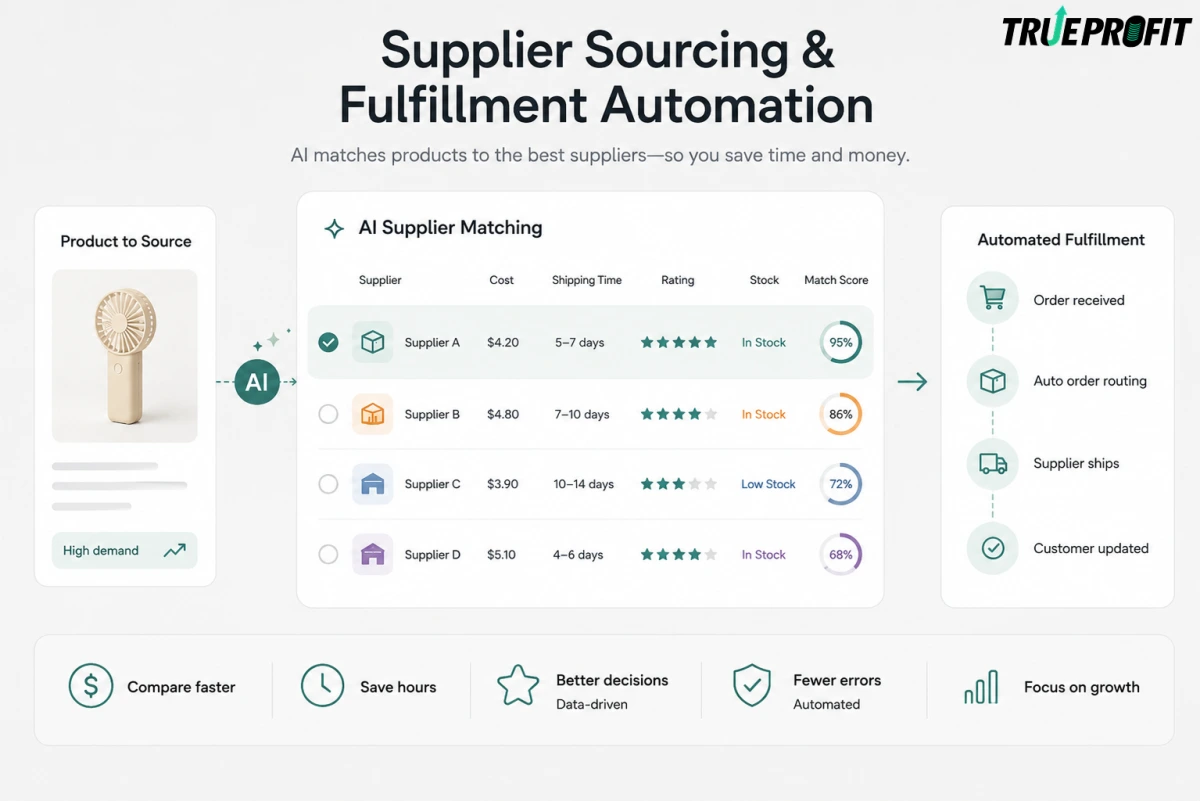
Supplier Sourcing And Fulfillment Automation
AI restructures sourcing and automates fulfillment, and honestly, this is where a lot of hours get saved. Sourcing is slow when you're comparing cost, shipping time, ratings, stock, returns, and communication across dozens of suppliers. AI-driven systems match products to suppliers on those factors, which makes that first comparison faster and far more structured.
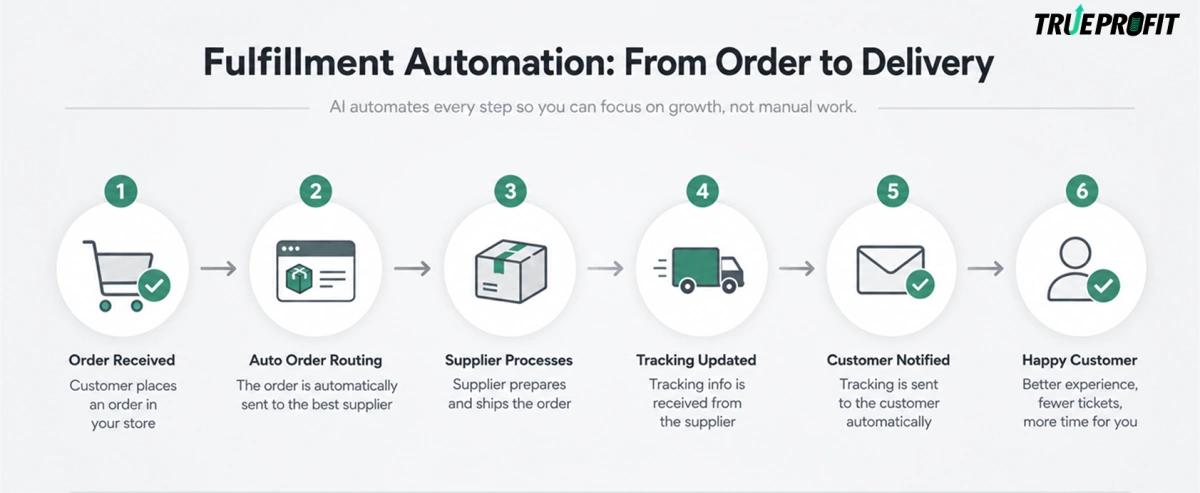
But the bigger change happens after the sale. Your software can automate order routing, fulfillment triggers, inventory syncing, shipping updates, and tracking notifications.
Customer Service
AI chatbots and email agents now handle a large share of routine tickets: order status, returns, sizing questions, and the endless "did my order ship yet" messages that dominate a dropshipping inbox. For a lean operation, this is one of the clearest wins, real labor savings on genuinely repetitive work, and it scales without you hiring.
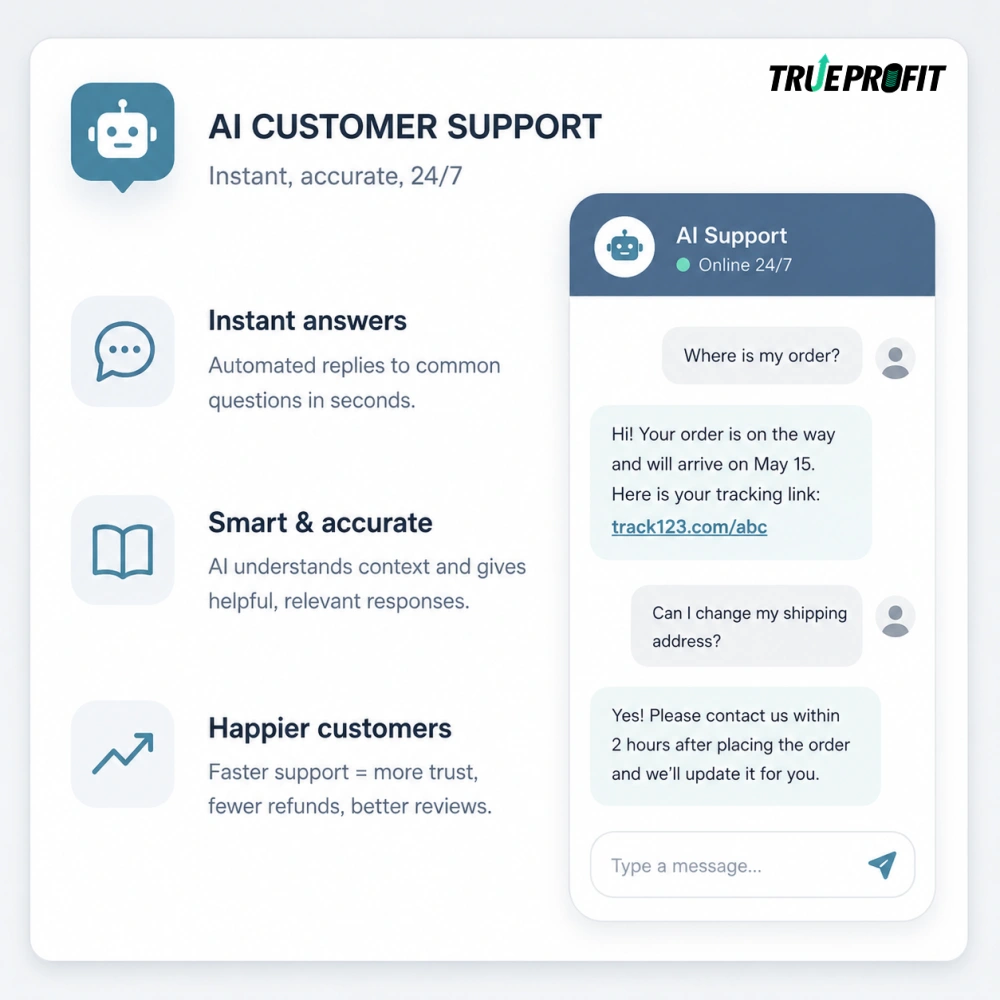
That said, keep a human escape hatch. Bots are fine for order status; they're bad at defusing an angry customer or handling an edge-case refund. The stores that get this right automate the volume and route the sensitive cases to a person.
14 Popular AI Dropshipping Tools
Below are the ones worth knowing, grouped by the job they handle best so you can find your fit fast. I won't rank them, because the best pick depends entirely on the bottleneck you're actually facing.
One word of caution before you start subscribing to everything. Add tools one at a time, tied to a real bottleneck, and cancel anything that isn't moving a number on your dashboard within about 30 days. That's the cleanest way to use AI without drowning your store in monthly fees.
Best for product research
These tools help you find and validate winning products before you spend on testing.
1. Sell The Trend: All-in-one platform covering product research, ad creation, and store setup.
2. Spocket: Uses AI to surface winning products from US and EU suppliers with fast shipping.
3. Ecomhunt: Curates hand-picked winning products daily, with profit and engagement data attached.
Best for sourcing and automation
These handle the operational grind, from matching suppliers to fulfilling and tracking orders.
4. AutoDS: Automates inventory management, price and stock monitoring, and order fulfillment across multiple stores.
5. Doba: Adds AI-powered sourcing, automatic price adjustments, and supplier management.
Best for store building
6. Storebuild.ai: Builds a complete Shopify store in minutes, handling design, product selection, and pages with no coding.
Best for content and creatives
These draft your pages, ad copy, and visuals so you can test more angles, faster.
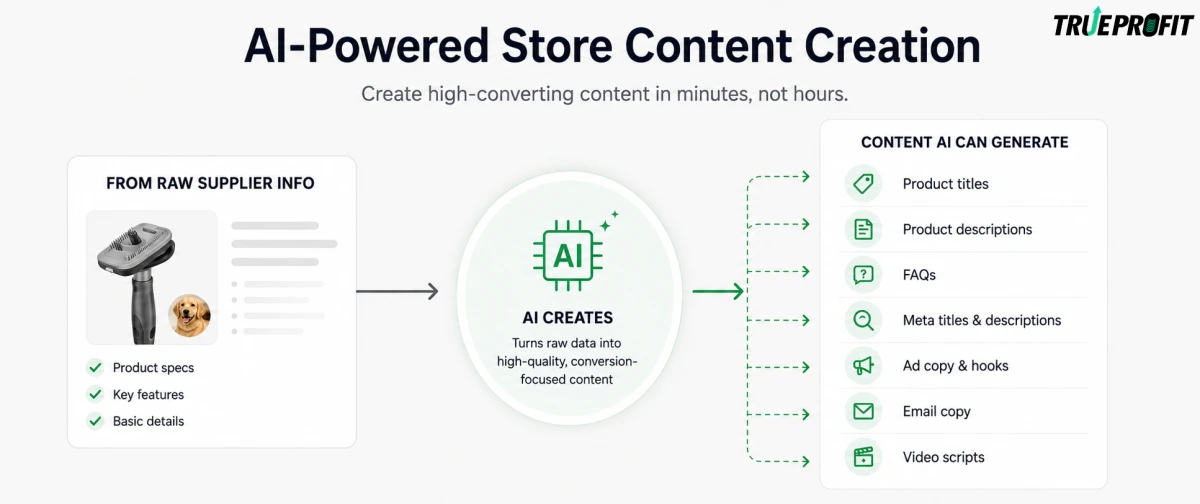
7. Shopify Magic: Generates product descriptions and store copy natively inside Shopify.
8. Copy.ai: Produces ad copy, email copy, and marketing content across channels.
9. Canva: Creates product images and creative assets with AI-assisted design tools.
10. Creatify: Spins up multiple short-form video ad variations from a single product concept.
Best for Ad management:
11. Meta Advantage+: Uses AI to optimize targeting, budgeting, and creative delivery
Best for customer support
12. Tidio: AI chatbot that answers order, shipping, and return questions, with a usable free tier.
13. Shopify Sidekick: Built-in AI assistant that helps manage store tasks and customer queries.
Best for profit analytics
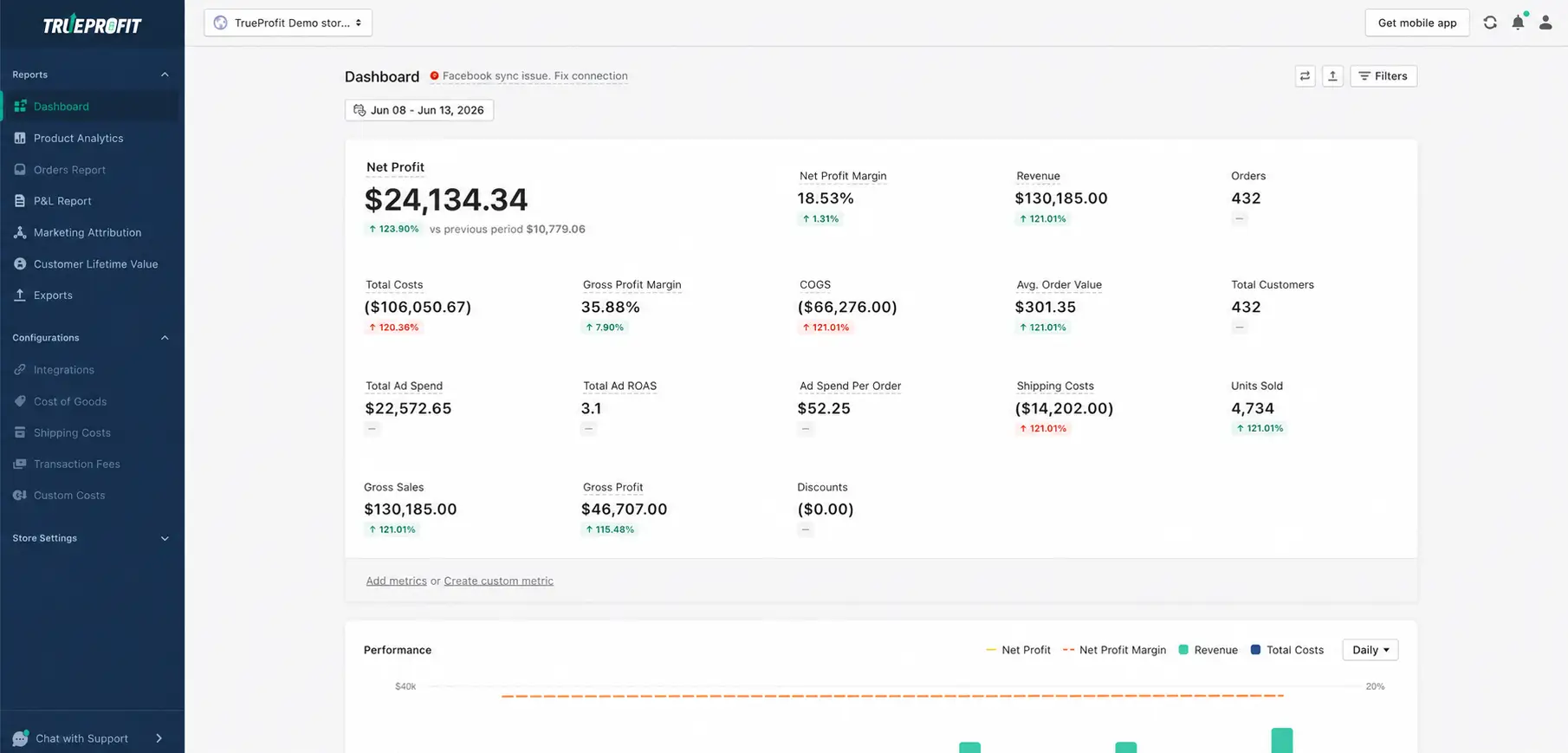
14. TrueProfit: Tracks real net profit after every cost, so you know which products and channels are actually worth scaling.
Is AI Dropshipping Worth It or Just Hype?
Both, honestly. Let me give you the balanced view:
Where the hype is real:
AI genuinely collapses the time and cost of tasks that used to be real bottlenecks. Writing 200 product descriptions, spinning up a store, drafting ad variations, answering repetitive tickets, these are now fast and cheap. If you value your time at anything above minimum wage, the labor savings alone can justify a modest tool stack.
Where the hype falls apart:
AI does not give you a competitive advantage, because your competitors have the exact same tools. When everyone can generate a beautiful store and perfect copy in an afternoon, none of those things are differentiators anymore. The barrier to entry drops, which means more competition, which means thinner margins. AI can actually make the underlying economics harder, not easier.
And the automation-spending problem is real. AI ad tools are optimized to hit the goals you set, but if you set the wrong goal (say, maximizing purchases without a target return on ad spend) they will cheerfully put you into a loss.
And here’s my honest take:
AI dropshipping is worth it as an efficiency tool and a cost-reducer. It is not worth it as a magic profit button, because that button does not exist. The merchants who succeed treat AI as leverage on top of solid fundamentals: a real niche, genuine product-market fit, disciplined ad management, and relentless attention to net margin. The ones who fail treat AI as a substitute for those fundamentals.
If you take one thing from this section: AI changes your costs and your speed. It does not change the need to be profitable, and it arguably makes profit discipline more important, not less.

How AI Impact Dropshippers In 2026 And Beyond
Here's where I think AI is taking the industry, and how it will shape dropshipping software over the next few years.
- Consolidation into all-in-one platforms
Right now most dropshippers run a stack of five to ten separate tools. AI is expected to have heavy consolidation, with platforms bundling research, store building, ads, and support into single subscriptions. This is good for convenience and potentially bad for costs if bundled pricing creeps up.
- Agentic automation
The current generation of tools assists you. The next generation will act more autonomously, running experiments, reallocating budget, and adjusting listings without a human in the loop for every decision. This raises the stakes on setting correct guardrails, because an autonomous agent optimizing for the wrong metric can do damage fast.
- The differentiation squeeze intensifies
As AI-generated stores and copy become universal, the things AI cannot easily replicate become more valuable: genuine brand, community, unique sourcing, and customer experience. Commodity dropshipping gets harder. Brand-led ecommerce gets relatively more defensible.
- AI-native buying behavior
As shoppers increasingly use AI assistants to research and even purchase, product data quality and structured content will matter more for visibility. Being "findable" by AI agents becomes a new channel to understand.
- Profit visibility becomes table stakes
This is the trend I feel most confident about. As tool stacks grow and automation touches more cost lines, the merchants who survive will be the ones with real-time, accurate net profit tracking across every channel and cost. You simply cannot manage a semi-autonomous, multi-tool operation on gut feel and a revenue dashboard.
How to Get Started with AI Dropshipping
If you're convinced it's worth trying, here's the sequence I'd recommend, deliberately ordered to protect your downside.
Step 1: Nail The Fundamentals First
Pick a niche you can actually differentiate in, one where you can offer a specific angle, audience, or bundle competitors aren't. AI amplifies whatever you point it at, including a bad idea, so a weak niche just means you'll fail faster and more expensively. Do this before you spend a cent on tools.
Step 2: Set Up Profit Tracking From Day One
Before you scale anything, get a net profit dashboard that pulls COGS, ad spend, transaction fees, and shipping into one place, ideally one that syncs your ad platforms and Shopify automatically so you're not rebuilding a spreadsheet every week (this is the job platforms like TrueProfit are built for).
The reason this comes second, not last: every tool you add later touches a different cost line, and without a single profit view you won't be able to tell which ones are actually paying for themselves.
Flying blind is the most common way dropshippers lose money, and automation only makes it worse.
Step 3: Add One AI Tool At A Time
Resist the urge to buy the whole stack. Start with your biggest bottleneck, usually product research or copywriting, run it for two to three weeks, and check the impact on your net margin before adding the next. If a tool doesn't move a number you care about, cut it.
Step 4: Automate Customer Service Early
It's a low-risk, high-relief win that frees your time for higher-leverage work. Point the bot at your repetitive tickets (order status, shipping, sizing) and route anything emotional or refund-related to a human.
Step 5: Approach Ad Automation With Guardrails
This is where automation can hurt you fastest. Set a target ROAS rather than a raw purchase goal, cap your daily budget while you're testing, and check the results against your profit dashboard, not the ad platform's own reporting, which counts revenue but not your costs.
Step 6: Review The Whole P&L Weekly
Not revenue. Not orders. Net profit, broken down by product and channel. Let that number decide which products to scale, which to kill, and which tools earn their subscription.
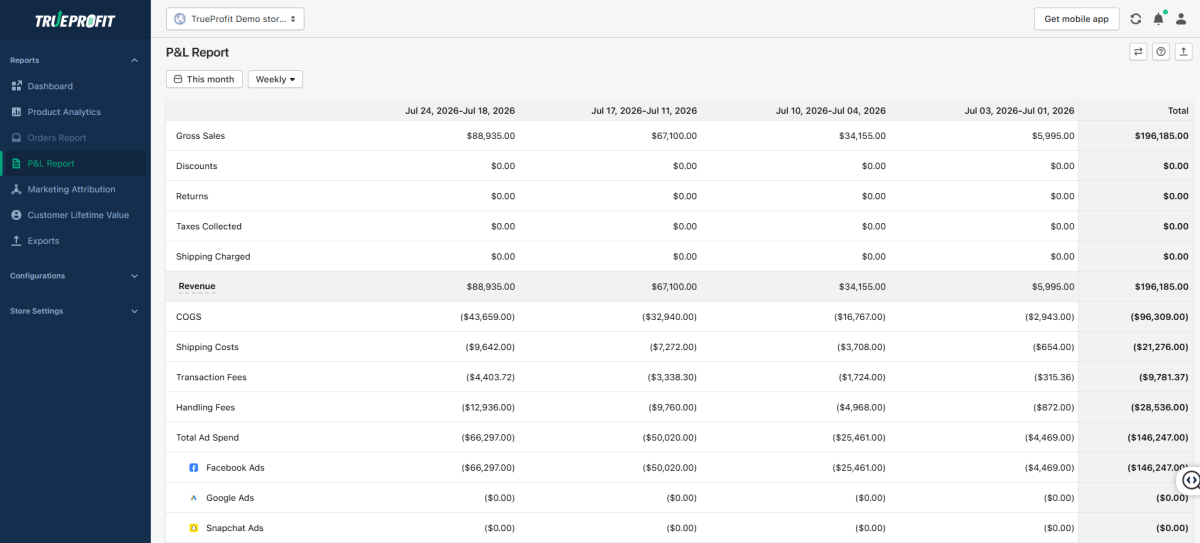
The through-line: add AI incrementally, measure its effect on profit each time, and never let a tool run unmonitored just because it's automated.
Final thoughts
AI has genuinely changed dropshipping. It has made the operational grind faster and cheaper, lowered the barrier to entry, and handed small operators capabilities that used to require a team. Those are real gains and I don't want to understate them.
But AI has not repealed the laws of this business. Competition is fiercer precisely because the tools are so accessible. Margins are still thin. Automated ad platforms will still spend you into the ground if you let them. And revenue will still, always, be a vanity metric next to net profit.
The way I see it, AI is a powerful lever, and a lever amplifies force in whatever direction you apply it. Point it at a profitable, well-differentiated business and it compounds your advantage. Point it at a shaky one and it just helps you lose money faster.

Harry Chu is the Founder of TrueProfit, a net profit tracking solution designed to help Shopify merchants gain real-time insights into their actual profits. With 11+ years of experience in eCommerce and technology, his expertise in profit analytics, cost tracking, and data-driven decision-making has made him a trusted voice for thousands of Shopify merchants.