How Much Does High-Ticket Dropshipping Really Cost to Start? (2026 Breakdown)


Table of Contents
- 1. What Determines Your Starting Cost?
- 2. Upfront Costs: What You Pay Before Your First Sale
- 3. Recurring Monthly Costs: What You Pay to Stay Running
- 4. High-Ticket vs. Standard Dropshipping: Full Cost Comparison
- 5. Tips to Start High-ticket Dropshipping Business on a Leaner Budget
- 6. Is High-Ticket Dropshipping Worth the Higher Cost?
- 7. Final Thoughts
- 8. High-ticket Dropshipping Costs FAQs
Let's be honest: most guides lowball this number.
They'll tell you $100 - $500 gets you started. And technically, yes, you can open a Shopify store for $39. But a store that actually sells $800 standing desks or $1,500 electric bikes needs more than a domain and a theme. It needs real advertising, a trustworthy storefront, vetted suppliers, and a cash buffer for when things go wrong.
Realistically, you have to budget at least $5,000 to get started, and make sure you have $10,000 in cash to prepare. This guide breaks down exactly where that money goes.
In this blog:
- 1. What Determines Your Starting Cost?
- 2. Upfront Costs: What You Pay Before Your First Sale
- 3. Recurring Monthly Costs: What You Pay to Stay Running
- 4. High-Ticket vs. Standard Dropshipping: Full Cost Comparison
- 5. Tips to Start High-ticket Dropshipping Business on a Leaner Budget
- 6. Is High-Ticket Dropshipping Worth the Higher Cost?
- 7. Final Thoughts
- 8. High-ticket Dropshipping Costs FAQs
What Determines Your Starting Cost?
Your actual number depends on five variables. Here's how each one moves the budget.
If you're doing everything yourself, starting organically, and keeping tools lean, $2,500 is workable. If you're running paid ads from launch and outsourcing design or setup, budget closer to $5,000.

Upfront Costs: What You Pay Before Your First Sale
1. E-Commerce Platform and Hosting
Your e-commerce platform is where every cost decision downstream flows from. Choose carefully.
Shopify Basic is $39/month ($29/month billed annually). New accounts often get a 3-month trial at $1/month, use that time to build your store before paying full price. Additional platform costs to plan for:
- Premium theme (Turbo, Prestige): $180–$350 one-time
- Shopify Payments activation: free, but expect 2–5 days on first payouts
WooCommerce is free as a plugin. The real costs are:
- Managed WordPress hosting (SiteGround, Kinsta, WP Engine): $25–$80/month
- Premium theme (Flatsome, Astra Pro): $60–$150 one-time
- SSL certificate: usually bundled with hosting, confirm before signing up
BigCommerce starts at $39/month with no additional transaction fees, which becomes meaningful at higher sales volumes.
For high-ticket products, Shopify wins on simplicity and conversion-focused apps. WooCommerce is cheaper long-term if you're comfortable managing your own hosting.
Estimated upfront platform cost: $39–$400
2. Domain and Professional Email
A .com domain costs $10–$20/year through Namecheap or GoDaddy. Don't skip this because buyers spending $800 on a product will notice if your store runs on a free subdomain.
Professional email through Google Workspace is $6/user/month. [email protected] carries more weight than a Gmail address when you're chasing down supplier agreements or following up on a $1,200 order.
Estimated first-year cost: $80–$100
3. Business Registration and Legal Setup
An LLC isn't legally required to start, but it separates your personal assets from business liability. That matters when you're processing high-value transactions and the occasional chargeback dispute lands in your inbox.
- LLC formation: $50–$500 depending on state (Wyoming: $100; Delaware: $90; California: $70 + $800 annual franchise tax)
- Registered agent: $50–$150/year through services like Northwest Registered Agent
- EIN: Free through IRS.gov, issued instantly
- Legal page templates: Free via Shopify's generator, or $50–$200 for professionally drafted versions
- Lawyer consultation: $150–$500/hour, it’s worth it if your refund and warranty policies are complex
Estimated upfront legal cost: $150–$800
4. Product Samples and Supplier Vetting
This is the cost most beginners skip. Selling a $1,200 patio heater or a $900 ergonomic chair you've never touched is a real risk to your reputation, and your margin if the quality doesn't match the listing.
Sample costs typically run 50%–100% of retail:
- $300–$600 item: expect to pay $150–$400 for a unit
- $800–$1,500 item: expect to pay $400–$900
- International shipping: add $50–$150 per unit
Buy at least one sample of your primary product. It lets you verify quality, photograph it yourself, and understand the real shipping timeline before you start selling.
Estimated sample cost: $200–$1,000+
5. Ad Creative and Store Content
Campaigns don't run on nothing. Before your first ad goes live, you need assets.
- Product photography: Free if you shoot the sample yourself. $150–$500 if you hire someone.
- Video ads: Free with a smartphone. $300–$1,500 if outsourced via Fiverr or Upwork.
- Product page copy: Free if you write it. $50–$200 per page if outsourced.
For branded dropshipping, where your store's look directly influences whether a buyer trusts you with $1,000, the visual investment pays back in conversion rate faster than almost anything else.
Estimated creative cost: $0–$1,500
Recurring Monthly Costs: What You Pay to Stay Running
1. Platform Subscription
Tips: The Shopify plan upgrade pays for itself at around $6,600/month in sales processed through a third-party payment processor. Below that, stay on Basic.
2. Payment Processing Fees
Every sale has multiple fee layers. Most sellers only think about the headline rate, here's the full picture.
Fee breakdown on a $1,000 sale:
Using Shopify but not Shopify Payments? Add an extra 0.5%–2% Shopify transaction fee on top of your processor's rate. On a $1,000 sale, that's an additional $5–$20 you'll see on your billing statement if you're not paying attention.
Other payment fees to track:
- Chargeback fee: $15–$25 per dispute, win or lose. Lose the dispute and you also forfeit the sale amount.
- International card surcharge: 1.5%–2%, applied automatically on cards issued outside the US.
- Currency conversion: 1%–2% when your store currency and bank currency differ.
- Buy now, pay later (Klarna, Afterpay): 2%–6% merchant fee. Good for conversion on high-ticket items, but it eats margin fast.
On a store doing $5,000/month with an $800 average order value, total processing fees typically land at $175–$300/month. Build that in from day one.
3. Advertising
Advertising is the biggest recurring expense for most high-ticket stores. Budget at least $1000–$2,000/month to test 1 product once the store is live.
High-ticket buyers don't convert on first touch (obviously). They research, compare, leave, come back. Your ads need to support that full journey, cold acquisition, retargeting, and email follow-up, not just drive clicks.
Typical monthly ad channel breakdown will look something like this:
Organic dropshipping through SEO and content marketing is worth building alongside paid ads from day one. Every article you publish keeps driving traffic without an ongoing cost.
4. Apps and Software
Start lean. Add tools only when a specific gap is costing you money or time.
A lean first-month stack, order sync, support tool, reviews, profit tracking, runs about $60–$150/month.
5. Supplier Fees
This is where most cost guides stop short. Your supplier relationship has its own recurring fee structure that directly affects your margin.
- Supplier directory access: Worldwide Brands, SaleHoo, and similar B2B platforms charge $67–$299/year for verified supplier lists.
- Dropship program enrollment: Some brands charge $50–$300 to join their official dropship program and unlock wholesale pricing.
- Per-order handling fees: Many high-ticket suppliers charge $2–$15 per order on top of product cost. At 50 orders/month and $10/order, that's $500/month in fees that won't show up in your product cost, only in your margin.
- Return restocking fees: Most high-ticket suppliers charge 15%–25% on returned items. On a $1,000 product, you absorb $150–$250 per return.
These fees are buried in supplier agreements. Read every clause before committing to a supplier relationship.
6. Returns and Chargeback Reserve
One return in standard dropshipping costs $5–$30. One return in high-ticket dropshipping costs $150–$1,000+, depending on return shipping, restocking fees, and whether the item arrives back in resalable condition.
In your first six months, set aside $300–$600/month as a reserve, or 8%–12% of monthly revenue, whichever is larger. In niches like furniture, outdoor power equipment, or fitness machines, return rates of 5%–10% are common and need to be explicitly planned for.
High-Ticket vs. Standard Dropshipping: Full Cost Comparison
If you’re wondering how the cost structure differs between a standard dropshipping store and a high-ticket one, this table breaks it down clearly, so you can see where the money actually goes and the trade-offs you’re making.

Tips to Start High-ticket Dropshipping Business on a Leaner Budget
You can trim costs without cutting corners on the things that actually drive revenue.
1. Use Shopify Basic and a Free Theme
Shopify's free themes like Dawn, Sense, Refresh are clean and conversion-tested. There's no reason to pay $300 for a premium theme before your first sale. Upgrade after you've cleared $5,000 in revenue. Use the $1/month trial to build your store before full billing kicks in.
2. Build Organic Traffic from Day One
Paid ads produce results faster but require constant spend. SEO compounds, a well-ranked article drives qualified traffic for years at no ongoing cost.
Write product comparison pages, buying guides, and niche-specific content from launch. If budget is the primary constraint, the guide on how to start a dropshipping business with no money covers the leanest possible approach in detail.
3. Negotiate Supplier Terms Before You Commit
Many suppliers will reduce per-order handling fees or waive enrollment costs if you commit to a minimum monthly volume. Even 10–15 orders/month can get you better terms than the default program rate. Ask, don't assume the listed price is the only option.
4. Start With One Niche and Three to Five Products
A focused niche reduces research costs, concentrates ad spend, and makes your positioning clearer. Don't diversify until you have a profitable core. Three products selling reliably beats fifteen products tested half-heartedly.
Is High-Ticket Dropshipping Worth the Higher Cost?
The math says yes, but only if you're tracking real profit, not just revenue.
1. Fewer Sales, Less Operational Overhead
At $250 average net profit per sale, you need 40 orders/month to hit $10,000. At $12 net profit, you need 834.
The operational difference between 40 and 834 monthly orders, in customer service volume, returns, payment processing, and supplier coordination, is enormous. High-ticket doesn't just pay better per sale. It's genuinely easier to run at equivalent revenue.
3. Risk Is Real, Plan for It
One $1,000 return with a 20% restocking fee and return shipping runs you $350–$400 net. That's two or three sales' worth of profit gone in a single transaction.
The dropshipping success rate data is clear: the sellers who fail most often run out of money during the ad testing phase, not because the model doesn't work. The solution isn't a smaller budget. It's a more accurate one.
Final Thoughts
High-ticket dropshipping costs more to start than most guides will tell you. It takes longer to turn profitable than most beginners expect. And it punishes undercapitalization harder than low-ticket models, because every mistake - a bad return, a failed ad test, a chargeback - hits harder in dollar terms.
But the unit economics are genuinely good. Fewer sales, higher margins, and a more defensible position than selling $15 impulse products at scale.
If you go in with a realistic budget of $5,000–$10,000, a focused niche, reliable suppliers, and a system for tracking real profit from day one, the model works.
The sellers who fail are almost always the ones who started with $500, ran out of cash during the testing phase, and decided dropshipping doesn't work. It does work, just not on a shoestring.
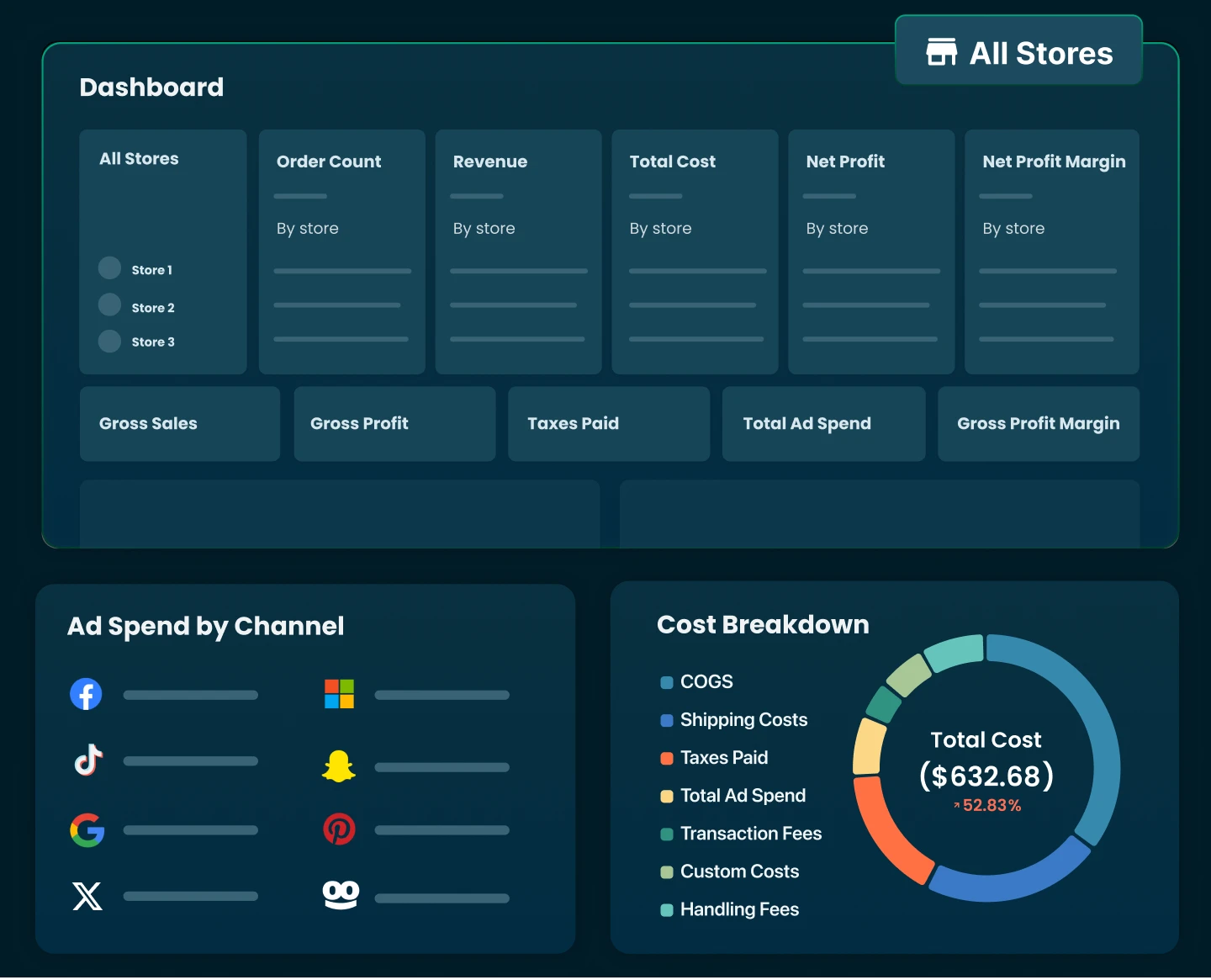
Once you're live, tracking net profit accurately matters more than almost any other operational habit. TrueProfit calculates real margin for Shopify sellers automatically by pulling in COGS, shipping, ad spend, transaction fees, and returns, so you always know your actual bottom line.
Irene Le is the Content Manager at TrueProfit, specializing in crafting insightful, data-driven content to help eCommerce merchants scale profitably. With over 5 years of experience in content creation and growth strategy for the eCommerce industry, she is dedicated to producing high-value, actionable content that empowers merchants to make informed financial decisions.