How to Track Dropship Expenses in 2026 (The Complete Guide)


Table of Contents
- 1. Why Tracking Expenses Matters for Dropshippers
- 2. What Dropshipping Expenses Should You Track?
- 3. How to Track Dropship Expenses Effectively
- 4. 3 Easy Ways to Track Dropshipping Expenses
- 5. What Does Real Spending For Dropship Stores Look Like In 2026?
- 6. How to Reduce Dropshipping Expenses Without Hurting Growth
- 7. Final Thoughts
- 8. How to Track Dropship Expenses FAQs
The stores that last in 2026 are not the ones with the flashiest revenue screenshots. They are the ones that know, to the dollar, what they keep.
This guide explains how to track dropship expenses accurately and turn your financial data into better business decisions.
In this blog:
- 1. Why Tracking Expenses Matters for Dropshippers
- 2. What Dropshipping Expenses Should You Track?
- 3. How to Track Dropship Expenses Effectively
- 4. 3 Easy Ways to Track Dropshipping Expenses
- 5. What Does Real Spending For Dropship Stores Look Like In 2026?
- 6. How to Reduce Dropshipping Expenses Without Hurting Growth
- 7. Final Thoughts
- 8. How to Track Dropship Expenses FAQs
Why Tracking Expenses Matters for Dropshippers
Every expense reduces your profit, but not every expense is easy to see.
Supplier costs, advertising, payment fees, shipping, software subscriptions, and refunds often come from different platforms. If you don't track them in one place, it's difficult to know which products are truly profitable or why your margins are changing.
Accurate expense tracking helps you understand your true net profit, control costs, prepare for taxes, and make better decisions as your business grows.

What Dropshipping Expenses Should You Track?
As a rule of thumb, if an expense reduces your net profit, it belongs in your tracking system. That covers a lot more than product cost and ad spend.
Below are the eight expense categories I'd tell any dropshipper to monitor, ordered roughly from the largest and most obvious down to the ones stores tend to forget.
- Cost of goods sold
- Ad costs
- Shipping & fulfillment costs
- Payment processing fees
- Ecommerce platform fees
- Returns, refunds and chargebacks
- Taxes
- Other operating costs
Let’s dive into each of them!
1. Cost of Goods Sold (COGS)
Cost of Goods Sold (COGS) is the direct cost of the products you sell. For dropshippers, that is usually the amount paid to the supplier each time an order is fulfilled.
Supplier prices change often, so tracking COGS at the product level lets you catch a shrinking margin before it turns into a real problem.
Common COGS include:
- Product purchase cost
- Supplier fulfillment fees
- Packaging costs (if charged separately)
- Product customization fees
2. Advertising and Marketing Costs
Customer acquisition is the single largest expense for most dropshipping stores. Whether you run paid ads or invest in organic growth, every marketing dollar should be measured against the profit it brings back, not just the revenue.
ROAS alone will mislead you here. A campaign with a strong ROAS can still lose money once product cost, shipping, and operating expenses are stacked on top.
Common marketing expenses include:
- Meta Ads
- Google Ads
- TikTok Ads
- Pinterest Ads
- Influencer collaborations
- Affiliate commissions
- Email marketing campaigns
3. Shipping and Fulfillment Costs
Even when your supplier handles fulfillment, shipping fee is not always baked into the product price. Faster delivery options, fulfillment surcharges, customs charges, and returns all push up your real cost per order.
Tracking these gives you the true landed cost of every sale, which is the number your pricing should actually be built on.
Common shipping expenses include:
- Shipping fees
- Express shipping upgrades
- Fulfillment service fees
- Customs and import charges
- Return shipping costs
4. Payment Processing Fees
Every sale carries a processing cost. Whether a customer pays by credit card, PayPal, or another gateway, transaction fees shrink the amount you actually keep.
Each fee looks small on a single order. Multiply it across your monthly volume and it becomes a line worth managing.
Common payment fees include:
- Credit card processing fees
- Payment gateway fees
- Currency conversion fees
- Chargeback fees
- Payment dispute fees
5. Ecommerce Platform and Software Costs
A dropshipping store usually runs on a stack of tools beyond the ecommerce platform itself. These recurring subscriptions handle product imports, inventory, support, marketing, analytics, and accounting.
Any single subscription looks cheap. Added together, the stack becomes a meaningful monthly cost that deserves its own line.
Common software expenses include:
- Ecommerce platform subscription
- Dropshipping automation tools
- Inventory management software
- Email marketing platforms
- Customer support software
- Analytics and reporting tools
- AI tools
- Accounting software
6. Returns, Refunds, and Chargebacks
Not every order becomes revenue you keep. Refunds, returned orders, and chargebacks all cut into real profit and belong in your records as expenses.
Leave them out and your products will look more profitable than they are, which is exactly how a "winning" product quietly drains a store.
Common expenses include:
- Customer refunds
- Refund processing fees
- Chargeback losses
- Dispute fees
- Return shipping costs
7. Taxes and Import Duties
Taxes turn into a serious expense fast, especially if you import products or sell across regions. Depending on where you operate and sell, you may owe customs duties, import taxes, and other government fees on top of income tax.
Tracking these across the year is what keeps budgeting, cash flow, and filing from becoming a scramble.
Common tax-related expenses include:
- Import duties
- Customs fees
- VAT or GST on business purchases
- Estimated income tax payments
- Sales tax paid on business expenses
8. General Operating Expenses
Finally, do not overlook the everyday cost of running the business. These are not tied to individual orders, but they still come straight out of profit.
They also tend to grow with revenue, which makes them just as worth watching as advertising or product cost.
Common operating expenses include:
- Freelancer or virtual assistant payments
- Accounting and bookkeeping services
- Business insurance
- Office supplies
- Internet and phone expenses
- Education and training
- Legal and professional services
- Bank fees
If even one cost category is missing, your profit numbers stop reflecting reality, making it easier to overprice, overspend on ads, or think a product is profitable when it isn't.
Next, I'll show you how to track every cost and calculate your true net profit without spending hours updating spreadsheets.
How to Track Dropship Expenses Effectively
Knowing which costs to track is only half the job. The other half is a system that captures every one of them accurately and consistently, so the numbers you act on are the real numbers.
Here is how to keep that tracking organized.
1. Separate Business and Personal Finances
The fastest way to simplify tracking is to keep business money separate from personal money.
Use a dedicated business bank account and card wherever possible. It makes expenses easy to identify, transactions easy to reconcile, and taxes far easier to file without digging through personal purchases.
If you have not opened a business account yet, at least dedicate one payment method to the store so your records start clean.
2. Record Expenses as They Happen
Waiting until month-end to sort receipts is how transactions go missing and reports go wrong.
Log each cost the moment it lands, whether that is a supplier invoice, a new ad campaign, a software renewal, or a shipping charge. The closer your records sit to real time, the more your profit math can be trusted.
3. Organize Expenses by Category
Every expense should map to a category so you can see where the money goes. Consistent categories are what make it possible to spot spending trends, flag waste, and produce reports you can actually read.
4. Save Receipts and Supporting Documents
Recording the expense is only useful if you can back it up. Keep digital copies of supplier invoices, ad receipts, processor statements, shipping invoices, software bills, and tax documents.
Those records verify your spending, support tax deductions, and save you if a question comes up later. Cloud storage or accounting software keeps them easy to find.
5. Reconcile Your Expenses Regularly
At least once a month, match your records against your bank statements, payment gateways, and supplier invoices. That reconciliation is what catches:
- Missing transactions
- Duplicate charges
- Supplier pricing changes
- Unexpected subscription renewals
- Refunds and chargebacks that were never recorded
Done consistently, it keeps your reports accurate and stops small errors from compounding into big ones.
6. Automate Tracking as You Grow
Manual tracking holds up fine at a handful of orders a week. Past that, juggling costs across suppliers, ad platforms, processors, and software turns into a daily time sink.
Automation removes the manual entry, cuts human error, and gives you a live view of performance. Instead of updating spreadsheets every night, you consolidate costs automatically and see your real net profit whenever you want it, which makes profitable products and runaway spending far easier to catch.
3 Easy Ways to Track Dropshipping Expenses
Three methods cover dropshipping expense tracking: profit-tracking software, accounting software, and a spreadsheet.
The table below sets the trade-offs side by side.
1. Profit-Tracking Software (best for real-time margins)
Profit-tracking software connects your store with your ad platforms, payment providers, shipping tools, and other business apps to show live net profit after every cost. It works like a real-time P&L report for a dropshipping store, minus the manual entry that eventually breaks a spreadsheet.
I’m very confident to introduce to you TrueProfit as the best net profit tracking tool for dropshippers running businesses on Shopify.
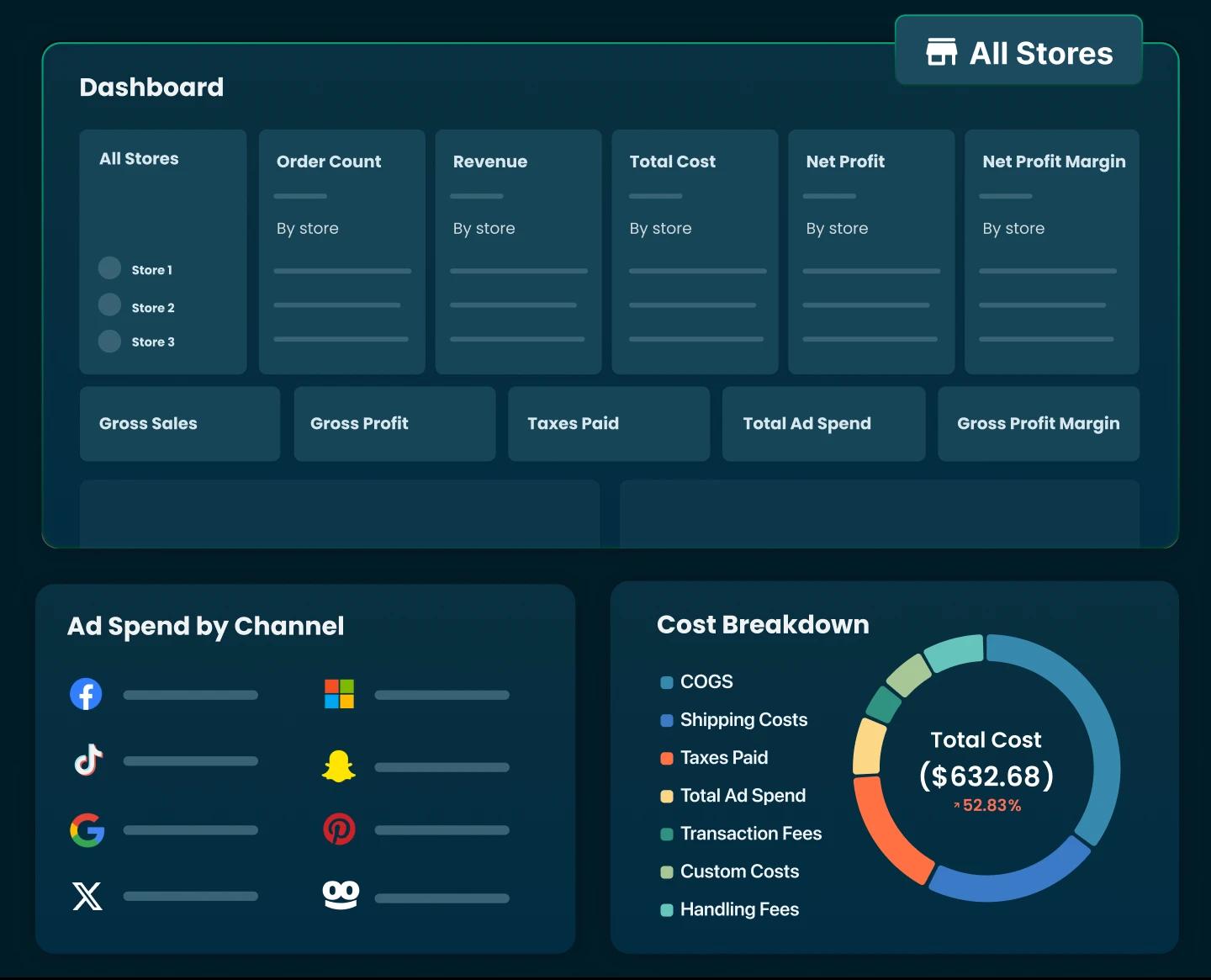
Living up to its name, TrueProfit pulls all types of costs such as COGS, ad spend, shipping, transaction fees, refunds and more automatically, then calculates actual net profit per order, per product, and per store in real time, giving you the lens to your store’s true bottom line.
Unlike traditional accounting software, TrueProfit is built around how ecommerce businesses actually operate. By combining Shopify data with all of your cost sources, it shows exactly how much profit you're keeping after every sale, not just how much revenue or gross profit you generated.
2. Accounting Software (best for formal books)
Accounting software such as QuickBooks or Xero handles official books, tax prep, and reconciliation. The limitation is structural. Neither platform reads Shopify payouts natively, so posting orders and fees correctly usually needs a connector like A2X ($29 to $169/mo).
Accounting software is the right tool for clean books at tax time or for investors. It is not real-time, though, and was never designed to optimize ad-level margin day to day.
3. Spreadsheet (best for beginners)
A spreadsheet is free, flexible, and adequate at a handful of orders a week. A column per cost category, a row per order, and a net-margin formula are enough to run it. Early on it even carries a hidden benefit: it forces you to understand your unit economics by hand rather than trusting a dashboard.
Its ceiling is scale. Manual entry breaks down past a few dozen orders a day, data goes stale between updates, and one miskeyed cell silently corrupts the profit figure. It belongs at the starting line, not in a store moving real volume.

What Does Real Spending For Dropship Stores Look Like In 2026?
Benchmarks make abstract categories concrete, so here is what real spending looks like. The breakdown below comes from 1,000+ dropshipping stores using TrueProfit in June 2026, mapping where every revenue dollar goes on average.
These percentages aren't targets. Every dropshipping business has a different product mix, pricing strategy, and marketing model.
Instead, use this data as a reference point.
If your advertising costs are significantly above average, it may be time to improve your creatives, targeting, or conversion rate. If your COGS are much higher, consider negotiating with suppliers, bundling products, or adjusting your pricing.
The goal isn't to match these numbers exactly, it's to understand which expense category is having the biggest impact on your profitability.
How to Reduce Dropshipping Expenses Without Hurting Growth
Benchmarking shows where the money goes. Reducing it is the next move, and the good news is that most of the largest dropshipping costs are controllable. Rather than trimming everything evenly, aim at the categories with the most impact on margin, which is why this list runs in order of leverage.
1. Reduce Customer Acquisition Costs
Advertising is usually the biggest expense, so it is the first place to look for savings.
Instead of just cutting the ad budget, raise efficiency: test new creatives, sharpen targeting, improve landing pages, and lift conversion rates. Building owned channels like email and SMS steadily lowers your reliance on paid traffic over time.
Accurate conversion tracking matters just as much. Weak attribution pushes ad platforms to optimize for the wrong users, which quietly inflates acquisition cost without adding sales.
2. Negotiate Better Supplier Pricing
Since COGS is typically your second-largest expense, even small pricing wins move the profit margin noticeably.
As order volume grows, push for lower unit costs, volume discounts, or reduced shipping from suppliers. Consolidating purchases with fewer suppliers strengthens your position at the table and simplifies operations at the same time.
3. Optimize Payment Processing Fees
Payment fees are unavoidable, but they are not fixed.
Compare providers, review your plan regularly, and understand how each fee hits your margin. At high volume, even a small cut in processing cost turns into meaningful annual savings.
4. Minimize Returns and Chargebacks
Every refund or chargeback costs more than the product itself. You often lose the processing fee, the shipping, and the support time on top of it.
Cutting returns starts before the sale: accurate descriptions, realistic photos, clear sizing, and reliable fulfillment partners all reduce the gap between what customers expect and what arrives.
5. Review Software and Operating Costs Regularly
As a store grows, unused subscriptions pile up almost invisibly.
Audit your software stack every quarter and ask whether each tool earns its keep. Cutting redundant apps or consolidating similar ones lowers recurring cost without touching daily operations.
Final Thoughts
Tracking dropship expenses isn't just about keeping your books organized. It's about understanding where every dollar goes and making decisions based on real profit instead of revenue alone.
Whether you're managing a new store or scaling an established business, building a consistent expense tracking system helps you control costs, protect your margins, and identify opportunities to grow more profitably. As your business expands, automating the process can save time, reduce errors, and give you a clearer view of your financial performance.


Harry Chu is the Founder of TrueProfit, a net profit tracking solution designed to help Shopify merchants gain real-time insights into their actual profits. With 11+ years of experience in eCommerce and technology, his expertise in profit analytics, cost tracking, and data-driven decision-making has made him a trusted voice for thousands of Shopify merchants.