




Contribution Margin vs. Gross Margin: Complete Breakdown For Ecom Sellers


Table of Contents
Most ecommerce store owners track gross margin. Far fewer track contribution margin. That gap is expensive.
Gross margin tells you how much is left after your product costs. Contribution margin tells you how much is left after every variable cost tied to that sale, including your ads, Shopify fees, shipping, and commissions. If you're only looking at gross margin, you may be scaling products that are quietly losing money.
This guide explains both metrics clearly, with ecommerce-specific examples, so you know exactly which number to use and when.
In this blog:
What is Gross Margin?
Gross margin is the revenue remaining after subtracting the direct cost of acquiring or producing your products. For ecommerce store owners, it's essentially your selling price minus what you paid for the product.
The gross margin formula is:
COGS (Cost of Goods Sold) for an ecommerce store includes your supplier or manufacturing cost, inbound shipping to your warehouse, customs and import duties, and any direct packaging costs baked into the product unit cost.
It does not include your Meta ads, Shopify transaction fees, outbound shipping to customers, or fulfillment labor. Those are operating costs, not COGS.
Let’s take a look at this example: You sell a skincare serum for $45. Your supplier charges $14 per unit including inbound shipping.
- Net Sales Revenue: $45
- COGS: $14
- Gross Profit: $31
- Gross Margin: 69%
That 69% looks strong. But it doesn't account for the $8 you spent on Meta ads to get that sale, the $1.80 Shopify transaction fee, or the $5 shipping label. Once those come in, the picture changes significantly.
Essentially, gross margin is your sourcing efficiency score. It tells you how well you're buying a product relative to what you're charging for it.

What is Contribution Margin?
Contribution margin is the revenue left after subtracting all variable costs, not just COGS. For ecommerce, this means every cost that changes with each order: ad spend, platform fees, outbound shipping, and fulfillment costs per unit.
To calculate contribution margin, use this math:
It shows you how much each sale actually contributes to covering your fixed overhead (rent, salaries, software subscriptions) and generating real profit.
Beyond COGS, contribution margin pulls in:
- Paid ad spend: Your Meta, Google, or TikTok cost per order attributed to that product
- Shopify and payment fees: Typically 0.5-2% transaction fees plus 2.9% + $0.30 per Stripe or PayPal transaction
- Outbound shipping: The label cost to ship to your customer
- Fulfillment costs: 3PL pick-and-pack fees per order if applicable
- Affiliate or influencer commissions: Any performance-based payouts per sale
- Returns and refund costs: Variable costs from returns processing, restocking, or reshipping
Every one of these scales directly with your order volume. Double your sales and all of these double too. That's why contribution margin is the number that tells you whether growth is actually making you more money.
If your contribution margin goes negative after including ads, you're paying for the privilege of making sales. More volume just means more losses. This is the hidden trap that kills ecommerce stores that are "growing" but never profitable.
Gross Margin vs. Contribution Margin: Key Differences
The two metrics serve different purposes. Here's how they compare across the dimensions that matter most for an ecommerce store.
1. Cost Components: What Gets Subtracted
Gross margin subtracts only COGS. Contribution margin subtracts COGS plus every other variable cost per order.
For an ecommerce store, the gap between the two is typically filled by ad spend, platform fees, and outbound shipping. That gap can easily be 20-40 percentage points for stores relying on paid traffic.
2. When to Use Each Metric
Metric | Use It When You're Asking... |
|---|---|
Gross Margin | Is my product sourcing efficient? Should I switch suppliers? Is my pricing covering product costs? |
Contribution Margin | Is this product profitable to sell at current ad costs? Can I afford to scale this? What's my real break-even? |
Gross margin is the right lens for supplier decisions and product pricing at the unit cost level. Meanwhile, contribution margin is the right lens for almost every growth and scaling decision.
In short, this is how the two metrics differ side by side:
How Ecommerce Store Owners Should Apply Both Metrics In Real Life
1. Deciding Which Products to Promote
Your ad budget should go to products with strong contribution margin, not strong gross margin. They're not always the same product.
For instance, a product with a 70% gross margin might drop to 25% contribution margin once you factor in a $12 cost per order on Meta and a $6 shipping label. A product with a 45% gross margin but lower ad costs and cheaper fulfillment might deliver 35% contribution margin. In this case, that second product is the better one to scale.
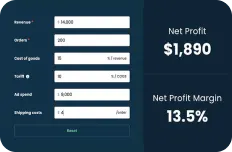
Not sure if your product is actually profitable? Use our free Gross Profit Margin Calculator to find out in seconds.
2. Evaluating Whether Your Ad Spend Is Actually Working
Most ecommerce store owners look at ROAS to judge ad performance. ROAS doesn't tell you if you're profitable. Contribution margin does.
If your Meta campaign generates $10,000 in revenue at a 3x ROAS, you spent $3,333 on ads. But if your COGS, fees, and shipping on those orders total another $5,000, your contribution margin is $1,667 on $10,000 revenue. That's 16.7%.
Whether that's good depends on your fixed costs. If your ROAS benchmark doesn't account for all variable costs, you're optimizing for the wrong number. Use contribution margin to set a minimum acceptable ROAS for each product, not a blanket store-wide target. If you're calculating profit margin on a product, always include attributed ad cost in the variable cost stack.
3. Making Scaling Decisions With Confidence
Before you double your ad budget or expand to a new market, check your contribution margin, not your gross margin.
Scaling multiplies every variable cost alongside revenue. If your contribution margin ratio is 20% at $50k/month revenue, it will still be roughly 20% at $150k/month. The question is whether that 20% covers your fixed costs at the new volume and still leaves profit.
Stores that scale on gross margin alone often discover at $150k/month that they're less profitable than they were at $50k. Understanding how growth affects overall profit margins before you scale is the difference between growing into profit and growing into a cash crisis.

Final Thoughts
Gross margin tells you if your product makes sense. Contribution margin tells you if your business makes sense.
Relying on gross margin alone can be misleading, especially in ecommerce where variable costs like ads, shipping, and transaction fees can quickly eat into profits. Contribution margin brings you closer to the truth by showing how much each sale actually contributes to your bottom line.
For Shopify sellers, tracking these metrics manually across different tools gets messy fast. That’s where TrueProfit comes in as a leading profit tracking and analytics solution. It connects all your revenue and costs in one place, from COGS to ad spend and transaction fees, so you can see both your true net profit (bottom line) in real time (along with contribution margin and gross margin of course).

Irene Le is the Content Manager at TrueProfit, specializing in crafting insightful, data-driven content to help eCommerce merchants scale profitably. With over 5 years of experience in content creation and growth strategy for the eCommerce industry, she is dedicated to producing high-value, actionable content that empowers merchants to make informed financial decisions.