




Non-Operating Expenses: Definition, Examples, and Impact on Ecommerce Profit


Table of Contents
When ecommerce brands review their profit and loss statement, most attention usually goes to revenue, product costs, ad spend, fulfillment, and software subscriptions. These are the expenses directly tied to running the business every day.
But not every cost comes from daily operations.
For ecommerce merchants, understanding non-operating expenses is important because they can make a profitable store look less profitable on paper. They can also distort net profit, cash flow, and financial decision-making if they are not separated from normal operating costs.
In this article, we’ll explain what a non operating expense is, how it differs from an operating expense and how online sellers can monitor and reduce these costs.
In this blog:
What Are Non-Operating Expenses?
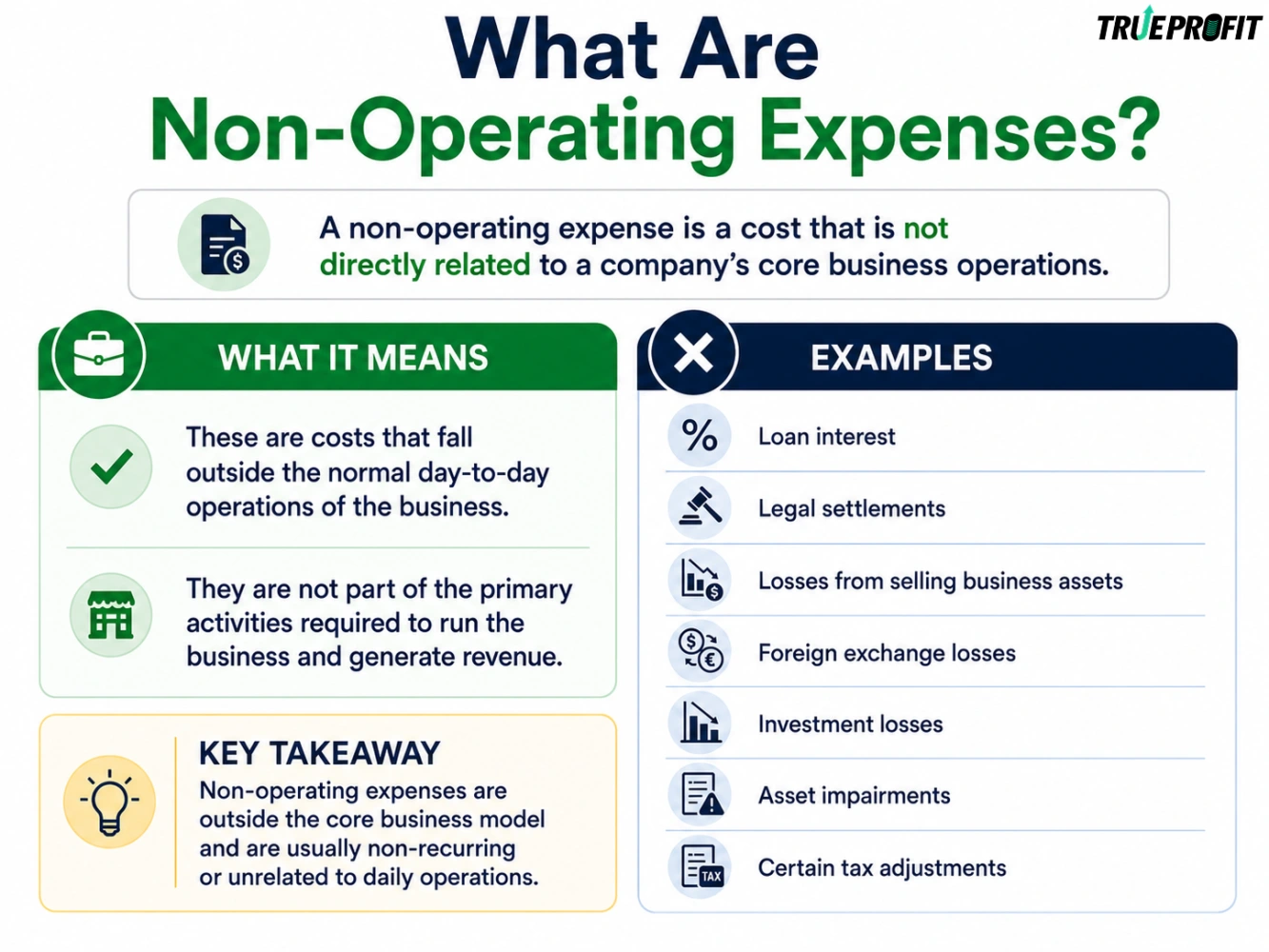
A non-operating expense is a cost that is not directly related to a company’s core business operations such as sourcing products, marketing, selling, processing orders, shipping, handling returns, paying ecommerce tools, and managing employees or contractors.
Non-operating expenses, on the other hand, come from financial, legal, accounting, or one-off events that are outside the normal process of selling products.
Common examples include:
- Interest expense on loans
- Foreign exchange losses
- Legal settlements
- Asset impairments or write-offs
- Investment losses
- Certain tax-related expenses
- Losses from selling assets
These expenses still affect net profit, but they are not usually part of day-to-day ecommerce performance.


Key Characteristics of Non-Operating Expenses
Non-operating expenses usually have a few common traits.
First, they are not directly connected to selling products. For example, if a Shopify brand pays interest on an inventory financing loan, that interest cost is not part of fulfilling an order or running an ad campaign.
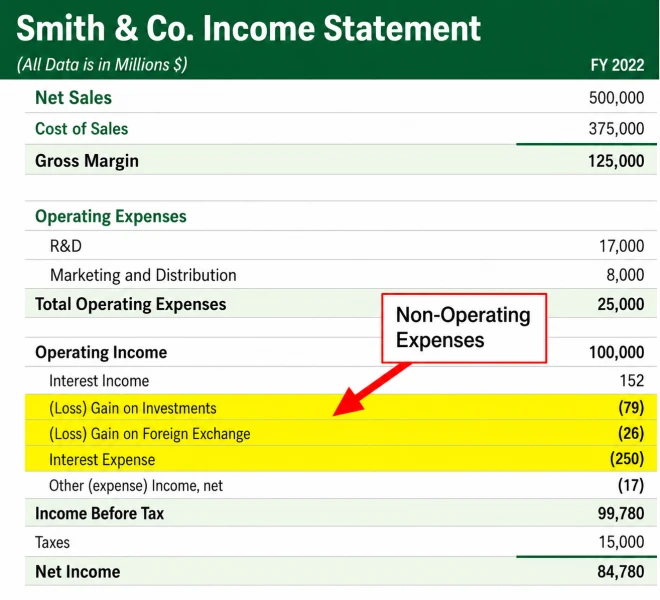
Second, they often appear below operating income on an P&L Report. This helps business owners and accountants separate operating performance from other financial events.
Third, they may be irregular or unpredictable. A legal settlement, asset write-off, or foreign exchange loss may happen occasionally rather than every month.
Finally, non-operating expenses can have a major impact on net income. Even if a store has strong operating profit, large non-operating expenses can reduce or even erase final net profit.
Source: EDUCBA
Common Types of Non-Operating Expenses in Ecommerce
1. Interest Expense
Interest expense is one of the most common non-operating expenses for ecommerce brands.
Many online stores use financing to purchase inventory, expand into new markets, improve cash flow, or invest in growth. This can include:
- Business loans
- Inventory financing
- Credit lines
- Merchant cash advances
- Revenue-based financing
- Credit card debt
- Equipment loans
The borrowed money may support business growth, but the interest itself is not considered an operating cost. It is a financing cost.
For example, a DTC skincare brand may borrow $100,000 to fund a large inventory order before Black Friday. The product cost is part of inventory and cost of goods sold when sold, but the interest paid on the loan is a non-operating expense.
2. Taxes
Taxes can be more complex because some taxes are operational, while others are usually treated separately.
For ecommerce businesses, income taxes, deferred tax adjustments, and certain tax penalties may be classified outside operating expenses. These costs affect the final bottom line, but they are not part of the store’s day-to-day selling activity.
Examples may include:
- Income tax expense
- Deferred tax adjustments
- Tax penalties
- Tax-related interest
- Prior-period tax corrections
Sales tax is different. Sales tax collected from customers is generally not treated as a business expense in the same way, because the merchant is collecting it on behalf of the tax authority.
For ecommerce operators, it is important to work with an accountant to classify taxes correctly.
3. Currency Exchange Losses
Currency exchange losses, also called FX losses, are common for cross-border ecommerce brands.
This often affects stores that sell in one currency but pay suppliers, contractors, or platforms in another currency.
For example:
- A US-based brand pays a European supplier in EUR
- A UK-based Shopify store receives revenue in USD
- A store sells globally but reports financials in one base currency
- A merchant holds balances in multiple payment accounts
If exchange rates move unfavorably, the business may record a currency exchange loss.
For example, suppose an ecommerce company expects to pay €50,000 to a supplier. If the exchange rate changes before payment is made, the company may end up paying more in its reporting currency than expected. That difference may be recorded as a foreign exchange loss.
FX losses are usually considered non-operating because they come from currency fluctuations, not from the core act of selling products.
4. Asset Write-Offs and Impairment
An asset write-off happens when a business determines that an asset has lost value or no longer has usable value.
For ecommerce businesses, this may include:
- Damaged warehouse equipment
- Obsolete packaging machinery
- Lost or damaged inventory in special cases
- Technology systems that are no longer usable
- Leasehold improvements that lose value
- Written-off brand assets or acquired assets
An impairment occurs when the recorded value of an asset is higher than its recoverable value. In simpler terms, the business admits that something it owns is worth less than previously recorded.
For example, an ecommerce brand may invest in custom warehouse equipment, but later move to a 3PL model and stop using that equipment. If the equipment cannot be sold for its book value, the company may record a write-off or impairment loss.
5. Legal Fees and Settlements
Legal costs may be operating or non-operating depending on their nature.
Routine legal costs, such as contract review or trademark registration, may be part of normal business operations. But major legal settlements, lawsuits, compliance penalties, or unusual legal disputes are often treated as non-operating expenses.
Examples include:
- Settlement from a lawsuit
- Regulatory penalties
- Intellectual property disputes
- Compliance fines
- One-time legal judgments
For ecommerce brands, legal issues can arise from product claims, advertising compliance, customer data handling, supplier contracts, or intellectual property disputes.
A one-time legal settlement can heavily reduce net income, even if the brand’s operating business is performing well.
6. Investment Losses
Some ecommerce companies invest excess cash into stocks, funds, startups, crypto assets, or other ventures. If those investments lose value or are sold at a loss, the loss is not part of ecommerce operations.
For example, a profitable Shopify brand may invest in another startup. If that investment declines in value, the loss would usually be recorded as a non-operating expense.
This type of loss affects net profit but does not show whether the ecommerce store itself is healthy.
Differences Between Non-Operating Expenses and Operating Expenses
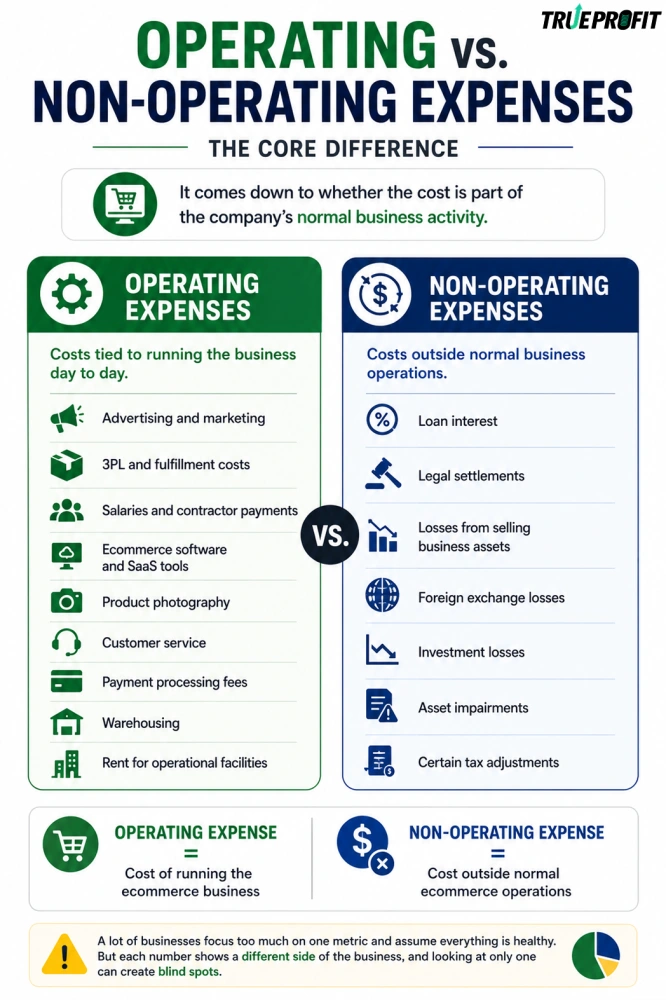
The difference between operating and non-operating expenses comes down to whether the cost is part of the company’s normal business activity.
For ecommerce, operating expenses are the costs required to run the store and generate sales. Non-operating expenses are costs that happen outside the core business model.
For a deeper comparison, it helps to understand the difference between operating profit and net income, especially when non-operating expenses are involved.

Why Non-Operating Expenses Matter for Ecommerce Profitability
Non-operating expenses matter because they can change how profitable your business appears.
If you only look at net profit, you may miss the difference between a weak operating model and a strong business affected by one-time or financing-related costs.
1. Misleading Profit Margins
A brand may have strong product margins, efficient ad spend, and healthy repeat purchase behavior, but still show low net profit because of non-operating expenses.
For example:
Metric | Amount |
|---|---|
Revenue | $500,000 |
Cost of goods sold | $200,000 |
$300,000 | |
Operating expenses | $220,000 |
Operating income | $80,000 |
Interest expense | $25,000 |
FX loss | $10,000 |
Net income before tax | $45,000 |
In this example, the business generated $80,000 in operating income. But after non-operating expenses, profit dropped to $45,000 before tax.
If the owner only looks at net income, they may think the store is less efficient than it really is. The real issue may be debt cost or foreign exchange exposure, not poor operating performance.
2. Impact on Net Income
Non-operating expenses directly reduce net income.
Net income is the final profit after all expenses, including operating expenses, non-operating expenses, interest, taxes, and other gains or losses.
A simplified formula looks like this:
This means a large non-operating expense can turn an otherwise profitable period into a low-profit or loss-making period.
For ecommerce brands seeking investors, loans, or acquisition opportunities, this distinction matters. Buyers and lenders often want to understand whether profit changes are caused by the core business or by one-time financial events.
3. Cash flow misunderstanding
Some non-operating expenses affect cash flow, while others may be non-cash accounting entries. For example, loan interest usually affects cash flow because the business pays real money to a lender.
But an asset impairment may reduce accounting profit without creating an immediate cash outflow.
This is why ecommerce brands should review profit and cash flow together. A store may show lower accounting profit due to a write-off, but still have healthy cash flow. On the other hand, a store may show decent profit but struggle with cash flow because of high interest payments.
Key Metrics to Monitor Alongside Non-Operating Expenses
Non-operating expenses should not be analyzed in isolation. They are most useful when reviewed alongside other ecommerce profitability metrics.
1. Net Profit vs Operating Income
Operating income shows how profitable the core business is before non-operating items. Net profit shows what remains after all expenses. Net profit margin tells you what percentage of every dollar of revenue actually becomes profit.For ecommerce brands, comparing both numbers is essential.
If operating income is healthy but net profit is weak, non-operating expenses may be the problem. If both operating income and net profit are weak, the issue may be deeper, such as low gross margin, high ad spend, poor retention, or inefficient fulfillment.
2. EBITDA
EBITDA stands for earnings before interest, taxes, depreciation, and amortization.
It is often used to evaluate operating performance before financing structure and certain accounting expenses.
For ecommerce businesses, EBITDA can help separate the performance of the store from interest costs, tax effects, and non-cash charges. However, EBITDA should not be the only metric you use. It does not show working capital needs, inventory cash flow, or debt repayments.
3. Cash Flow
Cash flow shows how money actually moves in and out of the business.
This is especially important for ecommerce because cash can be tied up in inventory, supplier deposits, ad spend, and fulfillment costs.
Non-operating expenses can affect cash flow differently. Interest payments reduce cash. Asset impairments may not immediately reduce cash. Legal settlements may create a large one-time cash outflow.
Reviewing cash flow helps you understand whether a non-operating expense is only an accounting entry or a real liquidity issue.
4. Contribution Margin
Contribution margin shows how much profit is left after variable costs directly tied to orders.
For ecommerce, contribution margin often includes:
- Revenue
- Discounts
- Product cost
- Shipping cost
- Fulfillment cost
- Payment fees
- Returns
- Ad spend, depending on how the business defines contribution margin
Contribution margin helps reveal whether each order is profitable before fixed operating costs and non-operating expenses.
If contribution margin is weak, reducing non-operating expenses will not fix the core problem. But if contribution margin is strong and net profit is weak, non-operating expenses may deserve closer review.
Managing Non-Operating Expenses More Effectively
Manual tracking often creates blind spots. Ecommerce expenses come from many different sources, including Shopify, ad platforms, payment gateways, shipping carriers, fulfillment partners, and apps. If these numbers are copied into spreadsheets by hand, it is easy to miss costs, delay updates, or categorize expenses incorrectly.
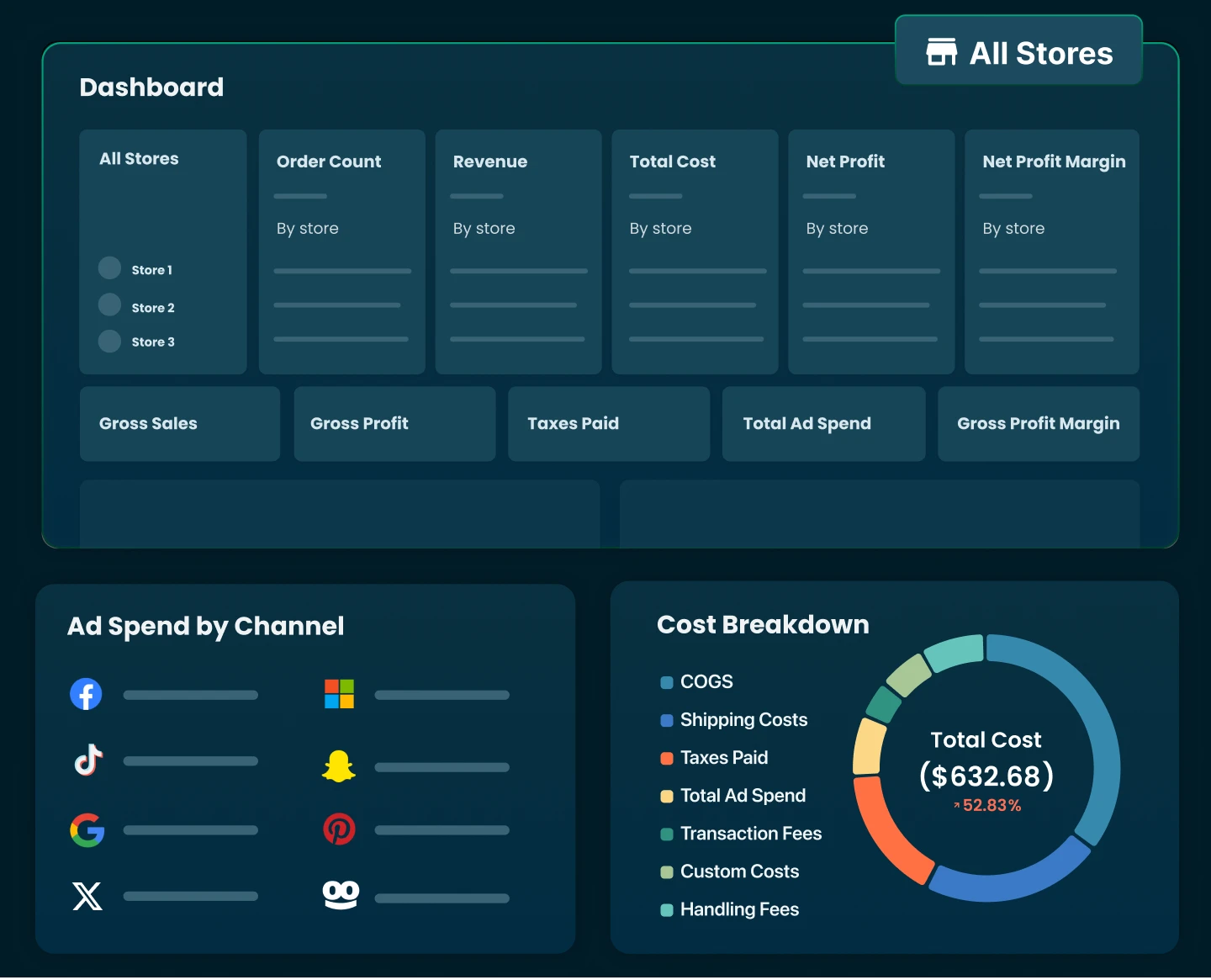
That is where TrueProfit fits naturally into the process. TrueProfit helps ecommerce merchants like you automatically track key costs such as COGS, shipping, transaction fees, ad spend, handling fees, taxes, and other expenses in one place, so you can see your net profit more clearly and in real time.
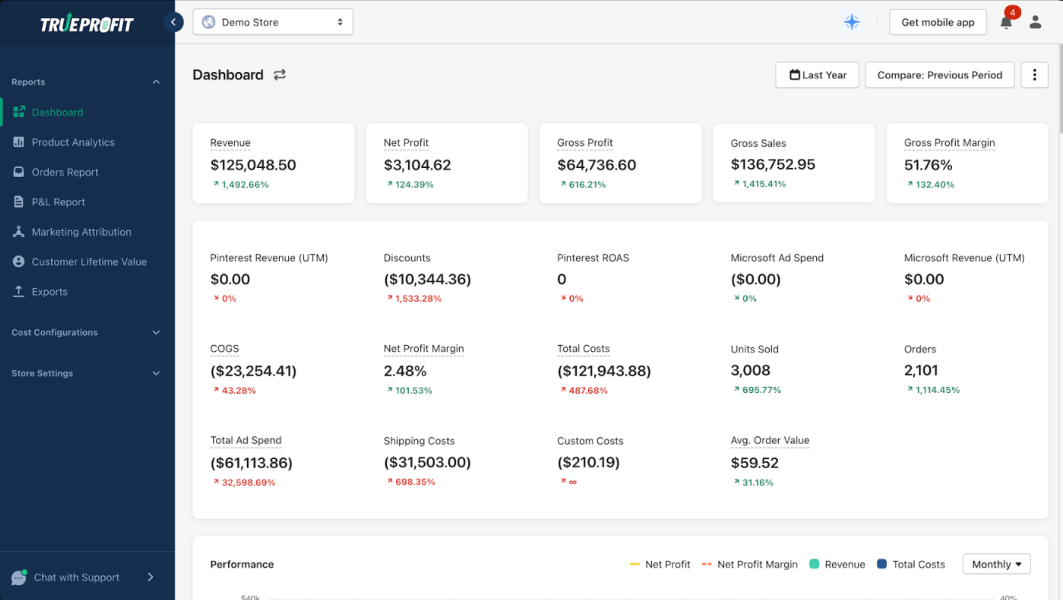
For non-operating expenses, this clarity is especially valuable. Even if items like loan interest, FX losses, or legal settlements still need to be reviewed separately with an accountant, TrueProfit gives you a more accurate picture of the store’s operating profitability first. That makes it easier to separate what is happening inside the core business from what is affecting profit outside normal operations.
Final Thoughts
When you separate non-operating expenses from day-to-day operating costs, you get a more accurate view of what is really driving profit up or down. A temporary FX loss, loan interest payment, or one-time legal cost should not be confused with poor product margins, rising ad costs, or fulfillment inefficiencies.
For ecommerce sellers, the goal is not to eliminate every non-operating expense. Some are part of scaling. The real goal is to track them clearly, understand their impact, and prevent them from hiding the true profitability of the business.
Harry Chu is the Founder of TrueProfit, a net profit tracking solution designed to help Shopify merchants gain real-time insights into their actual profits. With 11+ years of experience in eCommerce and technology, his expertise in profit analytics, cost tracking, and data-driven decision-making has made him a trusted voice for thousands of Shopify merchants.