




Revenue vs. Cash Flow: What’s the Difference and Why Both Matter


Table of Contents
Here's a mistake I see constantly: business owners treating revenue and cash flow as if they're basically the same number, just measured slightly differently.
They're not. A business can report $2 million in revenue and still not be able to make payroll. It can have a healthy cash balance and be quietly hemorrhaging market share. Both scenarios are more common than you'd think.
Revenue tells you how much your business earned from sales. Cash flow tells you how much actual money moves in and out of your business bank account over a period of time. Understanding the gap between those two things is one of the most useful financial skills you can develop as a business owner.
Let's break both down properly.
In this blog:
What Is Revenue?
Revenue is the total income your business generates from sales or services before any expenses come out. It's the "top line" because it sits at the very top of your Pnl statement. Everything else flows from it.
It measures sales performance. Not financial health. That distinction matters.
Not all revenue is created equal, and the difference tells you a lot about where your money actually comes from.
- Operating revenue is income from your core business. Product sales for an e-commerce store. This is the number you should care about most, because it shows whether your main business model is working.
- Non-operating revenue covers everything else like interest on cash reserves, proceeds from selling old equipment, rental income from spare office space. It's real money, but it's not repeatable income you can build a business plan around.
The gap between what you sell and what you actually collect is also worth understanding. Gross revenue is the raw total before any adjustments. Net revenue is what's left after stripping out returns, refunds, and discounts. For most e-commerce businesses, the difference between those two numbers is surprisingly large.
How Revenue Gets Recorded
Revenue runs on accrual accounting. That means it's recognized the moment a sale happens, not when cash actually lands in your account.
An ecommerce brand can make $10,000 in sales during a Black Friday weekend using Shop Pay installments or Net-30 wholesale terms.
That $10,000 shows up as revenue immediately.
But the cash may arrive weeks later, while ad spend, inventory payments, and fulfillment costs are already due today.
This timing gap is the root cause of almost every revenue vs. cash flow confusion I've seen. The sale is real. The profit margin is real. The cash just isn't there yet.
Why Revenue Matters (and Where It Falls Short)
Revenue is one of the clearest indicators of a business’s performance and growth potential.
Tracking where revenue comes from and how it changes over time helps businesses make better decisions and maintain healthy profitability. It also provides insight into whether current growth is sustainable, which channels are performing best, and where future expansion opportunities may exist.
Revenue is also useful because it signals demand. If revenue is growing consistently, customers want what you're selling. It's also the starting point for every profitability calculation, from gross profit all the way down to net profit.
But it can lie to you if you look at it in isolation. It's entirely possible to grow revenue fast and destroy profitability at the same time. That's the uncomfortable reality behind revenue growth vs. profit growth, especially in e-commerce where customer acquisition costs can eat your margins alive.

What Is Cash Flow?
Cash flow is the net movement of actual money in and out of your business during a given period. It doesn't care when a sale was made or when an invoice was sent. It only cares when cash physically moves.
The Three Types of Cash Flow
Cash flow is usually divided into three categories on the Statement of Cash Flows:
- Operating cash flow (CFO) is cash generated by running your business: money in from customers paying invoices, money out for salaries, rent, inventory, and utilities. This is the number you want positive and growing. If operating cash flow is consistently negative while revenue looks fine, something is structurally wrong.
- Investing cash flow (CFI) tracks cash used to buy or sell long-term assets like equipment, property, or another business. Negative CFI isn't automatically bad. Buying a new warehouse or upgrading your tech stack will make this negative. The question is whether your operating cash flow can absorb it.
- Financing cash flow (CFF) covers money raised or repaid through debt and equity. Taking on a loan, repaying it, issuing shares, paying dividends. This tells you how the business funds itself when operations alone aren't enough.
Why Cash Flow Is the Survival Metric
A business can generate strong revenue and still shut down if it runs out of cash.
Cash flow is what keeps the business operating day to day. It pays employees, covers operating expenses, keeps inventory moving, and helps maintain good relationships with suppliers and partners.
Revenue may look impressive on paper, but it does not automatically mean the business is financially healthy. Money can still be tied up in inventory, unpaid invoices, debt payments, or rising expenses.
That’s why cash flow matters so much. It shows whether the business actually has enough money available to keep operating without constant financial pressure.
Strong cash flow gives a company flexibility and stability. Weak cash flow creates problems quickly, even when sales are growing.
Revenue vs. Cash Flow: Key Differences at a Glance

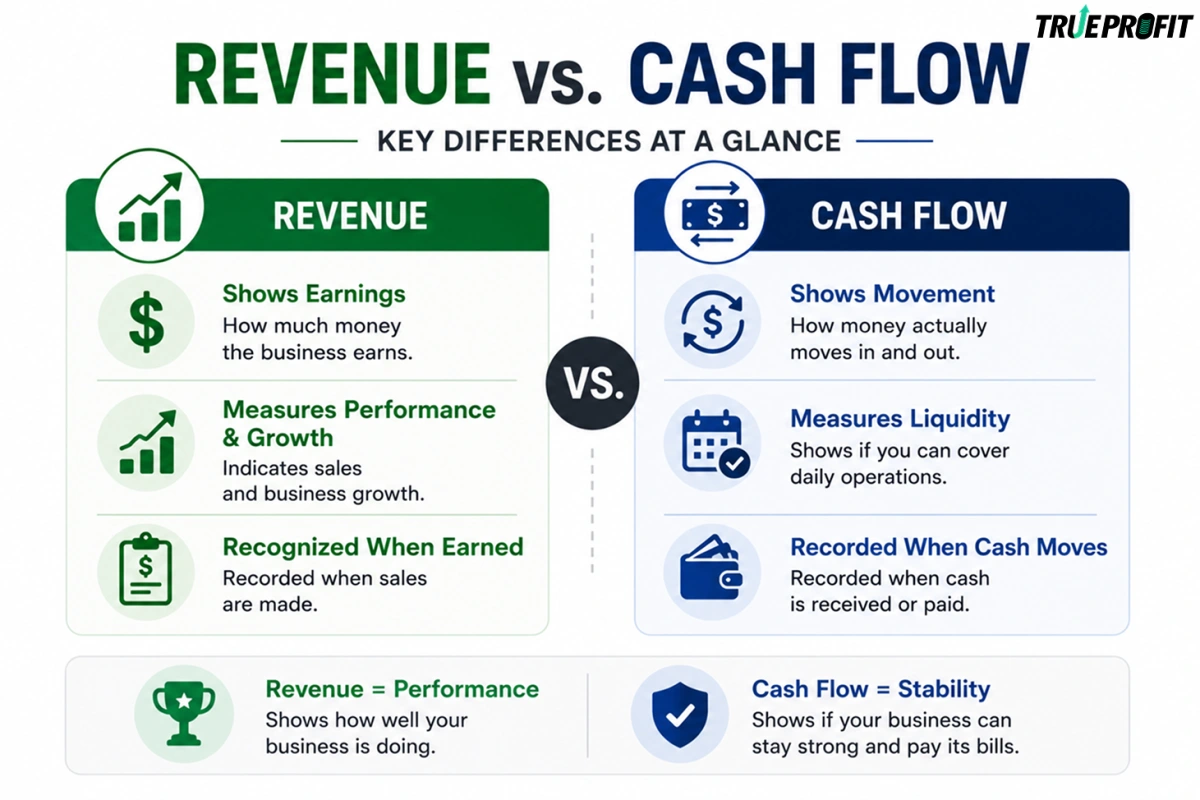
Revenue and cash flow are closely connected, but they measure different parts of an organization’s financial health.
Revenue shows how much money the organization earns. Cash flow shows how money actually moves in and out of the organization over time.
Both metrics are important, but they serve different purposes. Revenue helps measure financial performance and growth, while cash flow helps determine whether the organization can cover daily operations and upcoming expenses.
Understanding the difference between the two makes financial planning and decision-making much clearer, especially for government and nonprofit organizations.
Here’s a quick side-by-side comparison:
Feature | Revenue | Cash Flow |
|---|---|---|
Definition | Income generated from sales/services | Actual cash moving in and out |
Recorded When | When earned or invoiced | When cash is received or paid |
Accounting Basis | Accrual basis | Cash basis |
Main Focus | Growth and sales performance | Liquidity and business survival |
Includes | Sales, fees, subscriptions, interest | Customer payments, expenses, loans, taxes |
Reported On | Cash Flow Statement | |
Accounts Receivable Effect | Revenue can rise before customers pay | Cash flow rises only after payment arrives |
Inventory / Expense Effect | Costs may appear later | Cash leaves immediately when paid |
Financing Effect | Loans are not revenue | Loans increase cash flow |
Can One Be High While the Other Is Low? | Yes, strong sales but slow collections | Yes, funding or loans can boost cash temporarily |
Bottom Line | Measures business growth | Measures financial health and survival |
For example
For example, a clothing boutique might generate $600,000 in annual revenue, with nearly 60% of sales happening between November and January during the holiday season.
During those peak months, cash flow looks strong because customers are actively buying and cash is coming in quickly. But the business still has to cover fixed expenses all year long, including $12,000 monthly rent, payroll, inventory restocking, and utilities.
From February through September, monthly revenue may drop to only $20,000–$30,000 while expenses stay relatively stable. If the owner spends too much of the holiday-season cash or fails to plan ahead, the business can run into cash flow problems during slower months even though annual revenue still looks healthy on paper.
This is why revenue and cash flow measure different things. Revenue shows how much the business sells over time. Cash flow shows whether enough cash is available when bills actually need to be paid.
Why You Need to Track Both Revenue and Cash Flow
Revenue and cash flow measure different parts of the business, so relying on only one number can give you the wrong impression.
A business can grow revenue quickly while still running into cash problems because payments are delayed, inventory costs are too high, or expenses are growing faster than collections. The opposite can happen too. A company may still have cash in the bank while revenue slowly declines in the background.
That’s why both metrics matter together. Revenue shows how the business is performing. Cash flow shows how stable the business really is.
Looking at both gives a much clearer picture of what is actually happening inside the business.

Revenue vs. Cash Flow vs. Profit: How All Three Fit Together
Before finishing, I also want to talk about where profit fits into the picture.
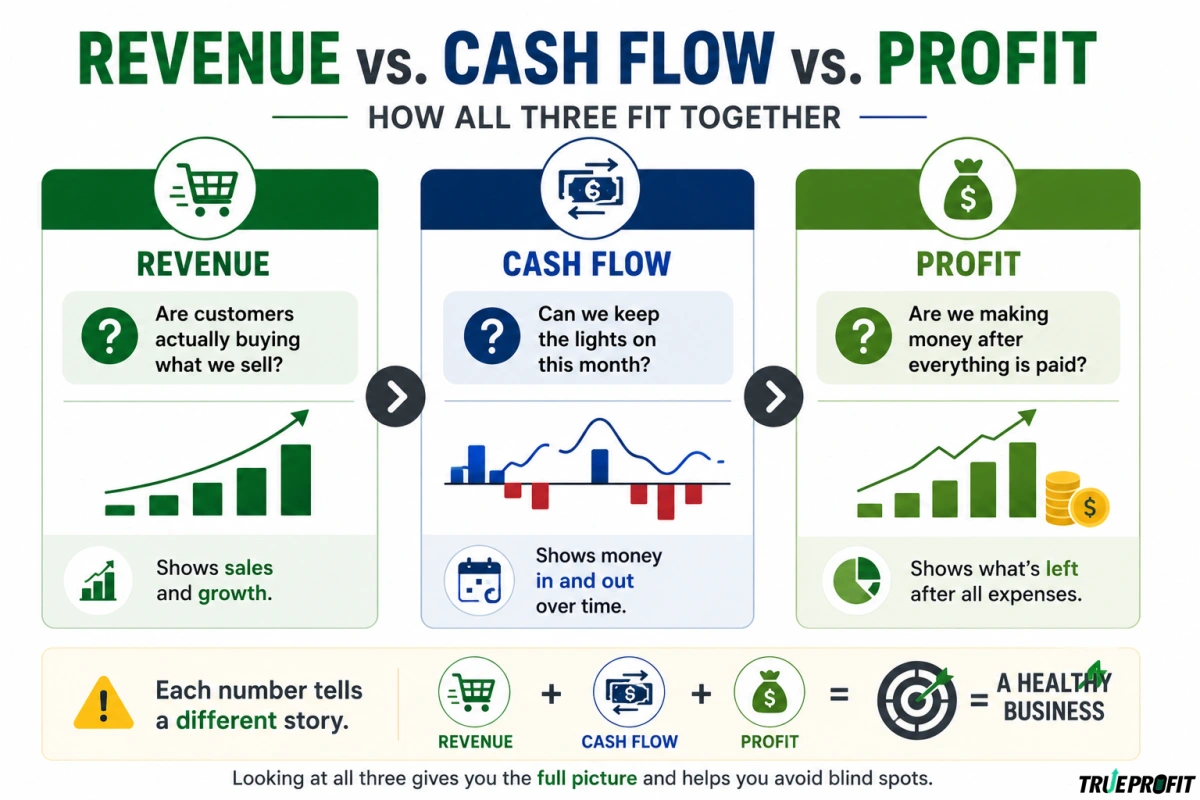
Once you add profit into the picture, things get more complete. Each metric answers a distinct question about your business.
- Revenue: Are customers actually buying what we sell?
- Cash flow: Can we keep the lights on this month?
- Profit: Are we making money after everything is paid?
A lot of businesses focus too much on one metric and assume everything is healthy. But each number shows a different side of the business, and looking at only one can create blind spots.
Some companies grow revenue quickly but still struggle because cash comes in too slowly while expenses need to be paid immediately. Others generate strong sales but operate with very thin profit margins, so the business keeps working harder without keeping much money in return.
The opposite can happen too. A company may still have healthy cash flow for a while even though revenue growth has already started slowing down underneath. At first, everything looks stable. The pressure usually appears later.
That’s why I think it’s important to look at all three together instead of treating one metric as the whole story.
Why Profit and Cash Flow Still Diverge
One thing that confuses a lot of people is that a profitable business is not always cash-flow positive.
A company can report healthy profit numbers while still struggling with cash in real life. That usually happens because profit and cash flow measure different things.
Some expenses reduce profit without reducing cash, like depreciation. In other cases, revenue may be recorded before customers actually pay. Inventory also uses cash before it generates sales.
Because of this, the income statement and the bank account often tell slightly different stories.
That’s why it helps to look beyond the P&L alone. Comparing profit, cash flow, and balance sheet activity gives a much clearer view of where money is actually being earned, spent, or tied up inside the business.
Final Thoughts
Revenue and cash flow are both essential, but they measure very different parts of a business. Revenue shows whether sales are growing and customers are buying. Cash flow shows whether the business actually has enough money available to cover payroll, inventory, operating expenses, and day-to-day operations.
The important thing is not to treat strong revenue as automatic proof of financial health. A business can generate impressive sales while still struggling with delayed payments, rising costs, heavy inventory spending, or weak operating cash flow. That’s why revenue, profit, and cash flow should always be viewed together rather than in isolation.
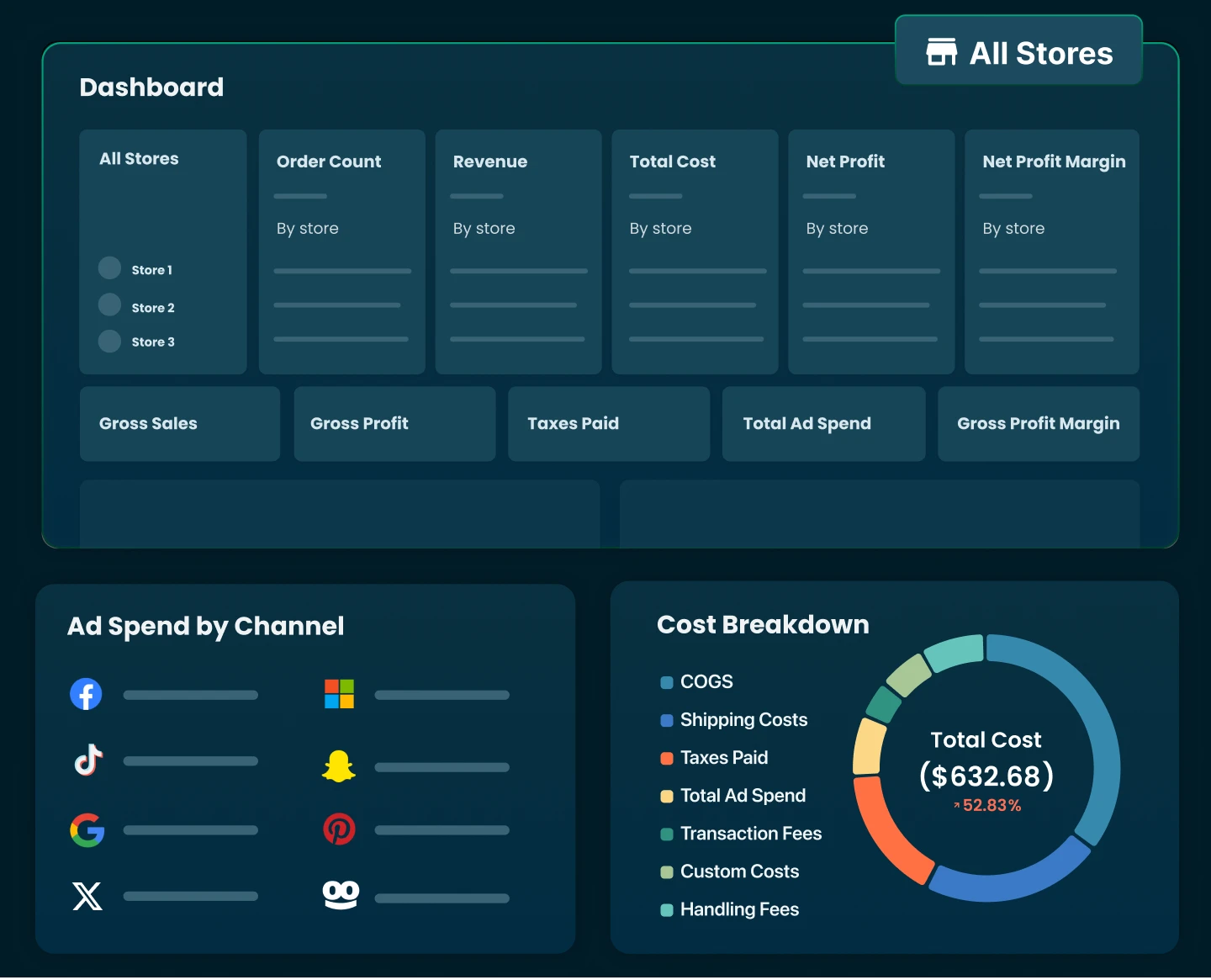
For Shopify sellers, having clear visibility into these numbers becomes even more important as the business scales. Tools like TrueProfit can help centralize sales, ad spend, shipping costs, transaction fees, and other expenses into one dashboard, making it easier to understand how much net profit the business is actually keeping - not just how much revenue it generates.

Harry Chu is the Founder of TrueProfit, a net profit tracking solution designed to help Shopify merchants gain real-time insights into their actual profits. With 11+ years of experience in eCommerce and technology, his expertise in profit analytics, cost tracking, and data-driven decision-making has made him a trusted voice for thousands of Shopify merchants.