How Shopify Agentic Storefronts Are Changing Ecommerce in 2026


Table of Contents
- 1. What Are Shopify Agentic Storefronts?
- 2. How Shopify Agentic Storefronts Actually Work
- 3. How to Set Up Shopify Agentic Storefronts in 5 Steps
- 4. What AI Discovery Means for Ecommerce Brands
- 5. The Brand Risks You Need to Manage
- 6. How Agentic Storefronts Compare to Shopify's Other AI Features
- 7. How to Make AI Recommend Your Brand More Often
- 8. Final Thoughts
- 9. Shopify Agentic Storefronts FAQs
In 2026, AI is reshaping the shopping journey. Rather than searching, comparing, and clicking through dozens of pages, shoppers increasingly just ask an AI assistant to find the right product for them. And the brands that get named in those conversations will shape the next wave of ecommerce growth.
Shopify Agentic Storefronts are built for exactly this shift. In this guide, you'll learn how they work, how to prepare your store for AI-driven discovery, and what the new channel means for your brand's visibility, strategy, and profitability. Let’s get started!
In this blog:
- 1. What Are Shopify Agentic Storefronts?
- 2. How Shopify Agentic Storefronts Actually Work
- 3. How to Set Up Shopify Agentic Storefronts in 5 Steps
- 4. What AI Discovery Means for Ecommerce Brands
- 5. The Brand Risks You Need to Manage
- 6. How Agentic Storefronts Compare to Shopify's Other AI Features
- 7. How to Make AI Recommend Your Brand More Often
- 8. Final Thoughts
- 9. Shopify Agentic Storefronts FAQs
What Are Shopify Agentic Storefronts?
Shopify Agentic Storefronts is a native sales channel introduced in Shopify's Winter '26 Edition that syndicates your product catalog to major AI platforms, letting AI agents discover, recommend, and sell your items directly inside AI chat experiences.
Instead of a shopper visiting your website first, AI assistants like ChatGPT, Google Gemini, and Microsoft Copilot can now discover your products, compare them with other options, answer buying questions, and send customers directly to your Shopify checkout when your products are the best match.
Think of it this way:
Traditional ecommerce journey
Customer → Google Search → Your Shopify store → Purchase
Agentic commerce journey
Customer → AI assistant → AI recommends your product → Shopify checkout → Purchase
Your Shopify store still handles the product pages, inventory, pricing, payments, and fulfillment. Agentic Storefronts simply gives AI systems a standardized, machine-readable way to understand your catalog so they can confidently recommend your products.
The whole point of the feature is to secure your placement in Generative Engine Optimization (GEO). As more shoppers ask AI assistants "What's the best standing desk under $300?" or "Recommend a minimalist backpack for travel," Shopify wants your products to appear in those AI-generated recommendations instead of being invisible to AI shopping agents.
In other words, Agentic Storefronts don't replace your online store. They make your store discoverable to AI-powered shopping experiences, creating a new acquisition channel alongside Google Search, social media, and marketplaces.

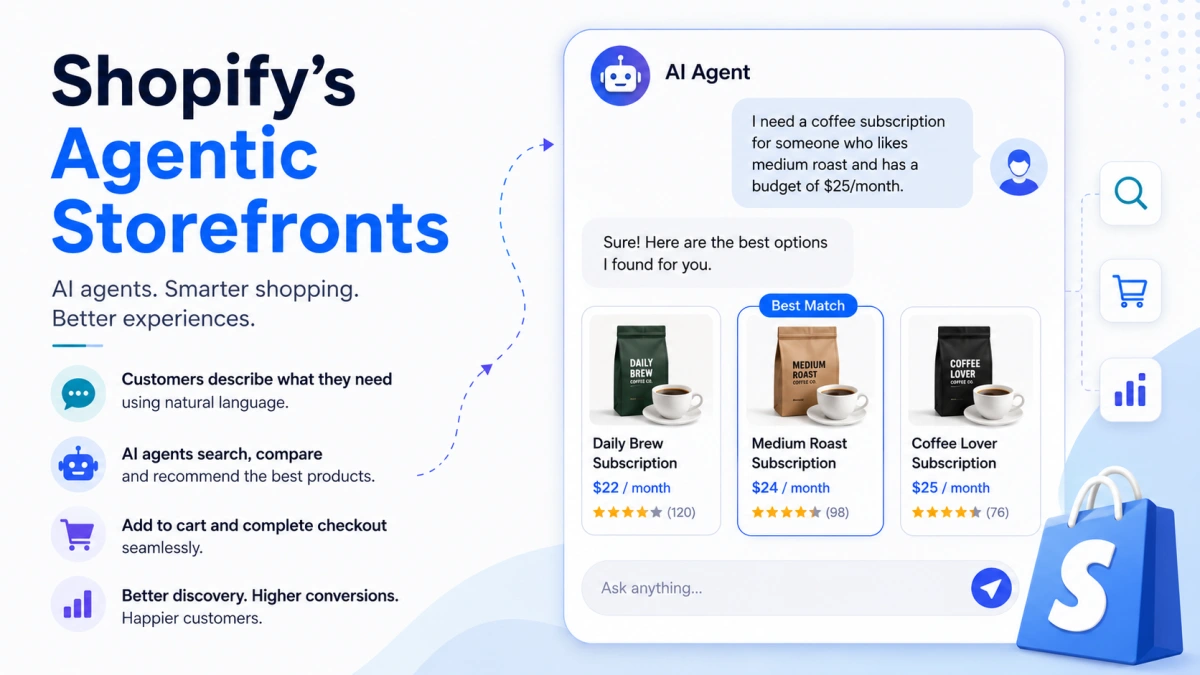
Agentic Storefronts vs. Traditional Shopify Storefronts
Your traditional storefront and your agentic storefront serve two different audiences. One is built for people browsing your website; the other helps AI systems understand and recommend your products. Here’s a quick comparison:

How Shopify Agentic Storefronts Actually Work
Shopify syndicates your product data through Shopify Catalog to connected AI platforms. Those platforms surface your products when a shopper asks a relevant question, then hand the buyer to your checkout to finish the order.
Where Your Products Can Appear
Today the channel connects merchants to ChatGPT, Microsoft Copilot, AI Mode in Google Search, and the Gemini app. Perplexity appeared in Shopify's original December announcement, and the list keeps growing.
Coverage isn't identical across platforms, though. ChatGPT is live for millions of US-selling merchants, with buyers finishing checkout on your store through an in-app browser. Google AI Mode, Gemini, and Copilot support native checkout via the Universal Commerce Protocol for eligible or select brands.
How AI Finds, Recommends, and Sells Your Products
Say a shopper asks for waterproof hiking boots under $150. The agent queries the Shopify Catalog and pulls matching products from participating merchants. Google rank and ad budget do not decide whether you appear. Your data does.
The buying step changed in March 2026. OpenAI's original in-chat checkout, Instant Checkout, is gone. Shoppers now browse and compare in ChatGPT, then complete the purchase on your own storefront through an in-app browser or a new tab. You stay the merchant of record on every channel.
This was a conversion decision, not a philosophical one. Fewer than 30 Shopify merchants ever went live on Instant Checkout, and Walmart found in-chat checkout converting roughly three times worse than a click-through to its own site. The model the industry settled on is blunt: discover in AI, buy on your own site.
What the Buyer Experience Looks Like
The agent narrows the field, then one tap sends the shopper to your checkout. That handoff actually works in your favor: your post-purchase upsells still fire, you keep the customer data and saved payment details, and checkout stays on your brand. The catch is that the agent, not your homepage, forms the first impression, so your data now has to do the convincing your site used to do. Getting that data ready is most of the work of switching the channel on, and there's less of it than you'd think.
How to Set Up Shopify Agentic Storefronts in 5 Steps
There's barely any setup here, since the channel is on by default for eligible merchants. The work that matters is confirming you're live and getting your product data into shape so agents pick you.
Step 1. Confirm You Are Already Live
Before you touch a single setting, check whether you're already in. Shopify switched agentic storefronts on by default for eligible US-selling merchants in March 2026, with no opt-in required.
The fastest test: open ChatGPT, search your own product category, and see whether your store comes up.
Step 2. Manage Your AI Channels in Admin
The controls sit under Settings, then Sales Channels, then Agentic Storefronts. ChatGPT is on automatically for eligible US merchants. Copilot and Google AI Mode need a manual toggle. This is also where you switch individual platforms off if you want out of one.
Step 3. Structure Your Product Data
Go through your titles, descriptions, attributes, prices, stock counts, and shipping details, and state materials, dimensions, compatibility, and use cases as plain facts. Agents cannot read between the lines of clever copy, so "breathable waterproof trail boot, Gore-Tex, US sizes 7 to 13" beats "adventure-ready footwear" every time.
Step 4. Add Policies and Brand Voice
Fill in your Knowledge Base so agents answer customer questions the way you would. Shopify's Knowledge Base App stores your shipping and return policies, FAQs, and brand voice, which stops the agent from guessing when a shopper asks about a 30-day return window.
Step 5. Validate and Monitor Performance
Run your product pages through a schema validator like Google's Rich Results Test to confirm agents can read them, then keep an eye on orders, average order value, and conversion in your admin. Once you're juggling several channels at once, keeping the numbers straight gets fiddly fast, and that's where the better Shopify analytics apps earn their keep by pulling channel-level data into one place. Those same numbers also tell you whether the channel is worth keeping on at all, which is the question a lot of merchants land on next.
What AI Discovery Means for Ecommerce Brands
AI discovery hands you a channel that costs nothing extra and reaches shoppers at the exact moment they're deciding. The catch is that you win it with data and operations rather than creativity, which is a real shift for brand teams used to competing on look and feel.
Reach Buyers Without Paying for Every Click
Your products can turn up in AI conversations that owe nothing to Google rankings or paid social, with no fees beyond standard payment processing under the current model. For anyone watching ad costs climb year after year, a channel that doesn't bill per click is worth a look. And if you're shoring up the rest of your setup at the same time, this roundup of must-have Shopify apps is a good starting point.
Higher-Intent Traffic, Better Conversion Potential
Agents surface products when someone is ready to buy, not idly browsing, and the early numbers back that up. In Q1 2026, AI-driven traffic to Shopify stores grew eight times year over year, orders from AI-powered searches climbed nearly thirteen times, and new buyers ordered through AI channels at close to twice the rate of other channels.
Why Early Adoption Matters
Agents learn which stores to trust. Clean inventory, honest shipping windows, and complete attributes all teach an agent that you're a safe recommendation. Shopify's own analysts compare this moment to the way merchants treated mobile traffic back in 2012: small enough to dismiss, right up until it stopped being small.

The Brand Risks You Need to Manage
For all that upside, the channel comes with real trade-offs around brand control, price, attribution, and data. It's better to plan for them now than to discover them after they've cost you a quarter.
1. Your Product Data Is Your New Brand Experience
When a shopper meets your product through an agent, they skip past your story, your reviews, and your packaging before they ever reach your site. The agent frames that first impression, so the trust your homepage used to build now has to live inside your product data instead. For brand-led sellers, that's the hardest adjustment to make.
2. AI Makes Price Competition Even Tougher
Agents optimize for the buyer, which usually means surfacing the cheapest comparable option. If your edge is quality or brand rather than price, the agent won't necessarily carry that message for you. Bake your differentiators into your structured data, not just your marketing copy, or they simply won't travel.
3. Measuring ROI Gets Harder
Working out where an AI order came from, and whether it actually made money, is harder than tracking a Google or Meta campaign. Revenue is easy to see; profit after cost of goods, shipping, and returns is not. A Shopify profit tracker that breaks out net profit per order across channels, including newer ones like agentic storefronts, keeps a rising order count from quietly hiding a shrinking margin.
4. What Happens to Your Product Data?
Your product data, pricing, and inventory flow to third-party AI platforms through Shopify Catalog. Know exactly what leaves your store and how those platforms use it before you lean on the channel.
How Agentic Storefronts Compare to Shopify's Other AI Features
Agentic storefronts serve the AI agents shopping on behalf of buyers, while Shopify's other AI tools serve you, the operator. The two are easy to confuse, so the table below lines them up.
Feature Comparison at a Glance
How to Make AI Recommend Your Brand More Often
It all comes back to product data, because an agent recommends only what it can read and verify. In a market where agents mediate discovery, the quality of that data is a form of brand building.
Optimize product data for AI recommendations
Lead your titles with the category keyword and the attributes shoppers filter on. In the descriptions, state materials, sizes, compatibility, and use cases as plain facts. A product with rich data quietly outperforms a competitor selling the exact same item with a vague listing, over and over again.
Keep your catalog accurate in real time
Stale data loses sales faster than almost anything else. If an agent recommends you and the price or stock turns out wrong at checkout, the sale collapses and the agent learns to stop trusting your store. Keep price, stock, and shipping current in real time.
Help AI understand your products with schema
Apply Schema.org Product markup across the catalog, and include offers, availability, reviews, and pricing. Rich schema is often the difference between an agent finding you and an agent actually recommending you.
Measure profit, not just AI orders
Revenue isn't profit, and nowhere does that gap hurt more than with AI-driven sales. When an AI agent recommends your product and orders start rolling in, it's easy to celebrate. But the real question is quieter and far more important: is that order still making you money after COGS, shipping, transaction fees, ad spend, refunds, and chargebacks?
As AI becomes a bigger force in how shoppers discover products, merchants need to know what's actually driving profit, not just what's driving volume.
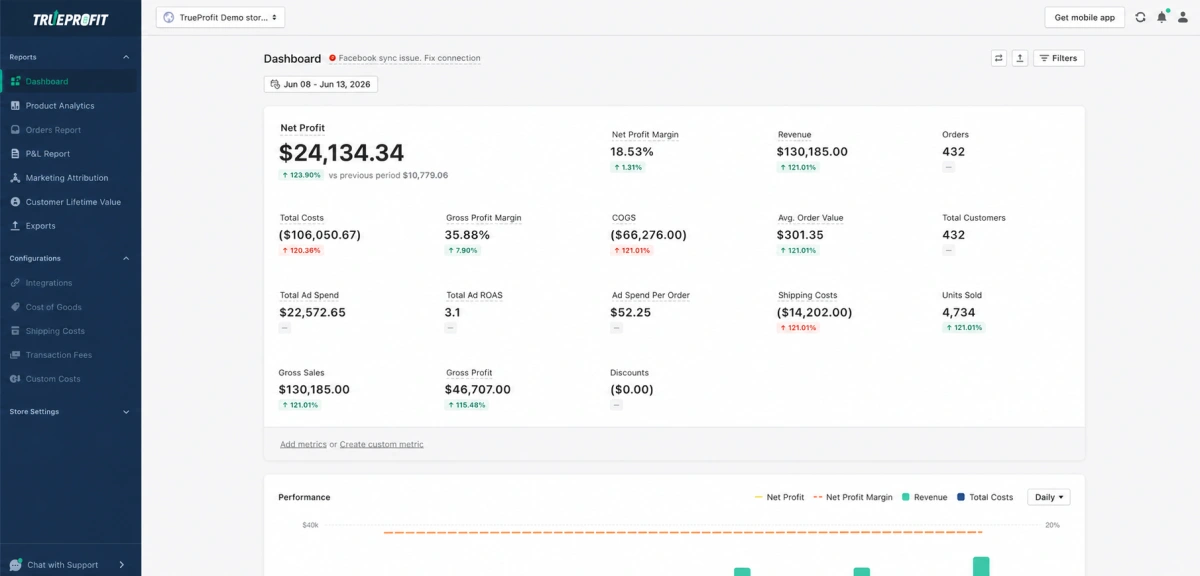
TrueProfit helps Shopify stores track net profit in real time by pulling every major cost into one dashboard, so you can see exactly which products and channels are fueling sustainable growth, and which are just keeping you busy.
Final Thoughts
Shopify Agentic Storefronts mark the start of a new way customers discover products. Your storefront still handles the actual purchase, but AI increasingly shapes which brands shoppers even see before they visit your site.
The merchants who benefit most won't necessarily be the ones with the best-looking storefronts. They'll be the ones with the most complete, accurate, and AI-friendly product data. Investing in your catalog today pays off not just in AI shopping experiences, but across your entire ecommerce ecosystem.

Lila Le is the Marketing Manager at TrueProfit, with a deep understanding of the Shopify ecosystem and a proven track record in dropshipping. She combines hands-on selling experience with marketing expertise to help Shopify merchants scale smarter, through clear positioning, profit-first strategies, and high-converting campaigns.