What Is Shopify Retention Rate? Definition, Formula & Benchmarks (2026 Guide)


Table of Contents
- 1. What is Shopify Retention Rate?
- 2. Retention Rate vs. Repeat Purchase Rate vs. Active Customer Retention Rate
- 3. What Is the Average Retention Rate for Ecommerce Stores?
- 4. What Is the Average Customer Retention Rate on Shopify by Industry?
- 5. What’s a Good Retention Benchmark at Each Stage of Growth?
- 6. 5 Actionable Strategies to Improve Your Shopify Retention Rate
- 7. Key Metrics You Should Track Alongside Retention Rate
- 8. Final Thoughts
- 9. Shopify Retention Rate FAQs
Growth gets expensive when customers don’t come back.
Many Shopify stores focus heavily on acquisition but pay far less attention to what happens after the first order. The result is a cycle where more budget goes into replacing lost customers instead of building on existing demand.
That’s where customer retention becomes important. Stores with strong retention don’t just generate repeat purchases. They build more predictable revenue, improve customer lifetime value, and grow more efficiently over time.
In this guide, we’ll break down what Shopify retention rate actually means, what benchmarks make sense in 2026, how to measure it correctly, and practical ways to improve retention without sacrificing profit.
In this blog:
- 1. What is Shopify Retention Rate?
- 2. Retention Rate vs. Repeat Purchase Rate vs. Active Customer Retention Rate
- 3. What Is the Average Retention Rate for Ecommerce Stores?
- 4. What Is the Average Customer Retention Rate on Shopify by Industry?
- 5. What’s a Good Retention Benchmark at Each Stage of Growth?
- 6. 5 Actionable Strategies to Improve Your Shopify Retention Rate
- 7. Key Metrics You Should Track Alongside Retention Rate
- 8. Final Thoughts
- 9. Shopify Retention Rate FAQs
What is Shopify Retention Rate?
What It Means
Before understanding Shopify retention rate, we need to understand CRR (Customer Retention Rate) first.
CRR (Customer Retention Rate) is the percentage of customers who come back and make another purchase within a specific period. It measures how well a business keeps its existing customers over time.
Shopify retention rate is simply the application of CRR in the context of a Shopify store. It shows the percentage of customers who return to buy again from your Shopify store over a given period.
It’s one of the clearest ways to measure whether your store is building customer loyalty instead of relying only on acquiring new customers.
How It’s Calculated
The basic formula is:
For example:
Imagine your Shopify store had:
- 1,000 customers on January 1
- 1,300 customers on March 31
- 500 of them were brand-new customers
👉Retention Rate = (1,300 − 500) ÷ 1,000 × 100 = 80%
That means 80% of your original customers stayed and continued buying.
Why Retention Matters for Shopify Stores
One of the biggest advantages is lower customer acquisition costs (CAC). Acquiring a new customer is often significantly more expensive than keeping an existing one, which means every retained customer reduces the pressure to spend more on growth.
Retention also creates a compounding effect on net profit. That happens because retained customers tend to buy more frequently, stay longer, and generate more value over time. As retention improves, businesses can spend less effort replacing customers and invest more into improving products, customer experience, and long-term growth.

Retention Rate vs. Repeat Purchase Rate vs. Active Customer Retention Rate
These three terms are often used as if they mean the same thing, but they actually measure different parts of customer behavior. Confusing them can lead to the wrong conclusions and poor growth decisions.
- Customer Retention Rate focuses on whether customers stay with your store over a specific period of time.
- Repeat Purchase Rate measures how many customers return to make another purchase, regardless of timing.
- Active Customer Retention tracks customers who are still actively purchasing or engaging with your store over a specific period. It answers: “Out of the customers who were active before, how many are still active now?
In simple terms, CRR shows who stayed, RPR shows who bought again, and active retention explains why they keep coming back.
Here’s a quick comparison table:
What Is the Average Retention Rate for Ecommerce Stores?
According to Shopify, the average customer retention rate across brands on its platform was 30%, meaning only about 30% of customers return to make another purchase while the remaining 70% do not come back.
While that may seem low compared to some industries, it reflects just how competitive ecommerce has become. Customers can easily compare alternatives, switch between stores, and chase better prices, all of which make it harder for brands to bring them back.
At the same time, that number shouldn’t be treated as a ceiling. Retention rates can vary widely depending on factors like product category, customer experience, and post-purchase strategy, meaning some brands can significantly outperform the average.
What Is the Average Customer Retention Rate on Shopify by Industry?
Shopify retention rate varies significantly across industries, meaning there is no single benchmark that applies to all merchants. On Shopify, retention is strongly influenced by product type, purchase frequency, and customer buying behavior.
Brands selling consumable or repeat-purchase products (such as beauty, food, or supplements) typically achieve higher retention rates because customers naturally need to repurchase. In contrast, brands selling durable or one-time purchase products (such as furniture or electronics) often see lower retention due to longer replacement cycles.
As a general benchmark, Shopify retention rates often fall into these ranges (Rivo’s data):
The pattern is fairly simple: categories that encourage regular replenishment or repeat use usually see higher retention rates, while products that customers buy less frequently tend to retain fewer customers over time. That’s why a 20% retention rate may be strong for furniture but underperforming for consumables or beauty brands.

What’s a Good Retention Benchmark at Each Stage of Growth?
Industry benchmarks are useful, but retention targets should also reflect where your store is in its growth journey. A retention rate that looks healthy for a newer store may not be enough for a more mature brand.
From what we’ve observed across TrueProfit customers, stores at different growth stages tend to prioritize retention differently. As order volume grows, merchants usually shift from validating repeat demand to actively optimizing retention and customer lifetime value using cohort and profitability data.
- Early-stage stores ($0 to $30k/month): At this stage, there often isn’t enough customer history to run reliable cohort analysis. The goal is to confirm that customers are willing to come back at all. Based on patterns we commonly observe across growing ecommerce stores, a 15%–20% Repeat Purchase Rate (RPR) can be an encouraging early sign that product-market fit is starting to emerge.
- Growth-stage stores ($30k to $200k/month): As order volume becomes more stable, retention starts becoming a growth lever rather than just a health metric. Across stores in this range, we often see stronger operators maintaining around 25%–35% Customer Retention Rate (CRR) while actively tracking repeat purchases, cohorts, and customer lifetime value.
- Established brands ($200k+ /month): At this scale, retention isn't just a revenue strategy, it's a valuation driver. Acquirers and investors price Shopify brands on CLV and customer cohort retention. A brand doing $500k/month with 40%+ retention is worth materially more than one with the same revenue and 20% retention. Protecting and growing CRR becomes a strategic imperative.
These numbers aren’t fixed benchmarks or guarantees. They reflect patterns we’ve seen across stores at different stages and should be used as directional targets alongside industry context and purchase behavior.
5 Actionable Strategies to Improve Your Shopify Retention Rate
A lot of retention advice starts and ends with “send a welcome email” or “launch a loyalty program.” Those tactics can help, but on their own, they rarely create meaningful retention gains. Stores that retain customers well usually focus on improving the experience across the entire customer journey, especially after the first purchase.
1. Turn Your Order Tracking Page Into a Retention Channel
Most stores treat the order tracking page as a status update. In reality, it’s one of the few places customers actively return to after checkout.
Instead of showing only shipping information, use that space to keep customers engaged. Add personalized product recommendations, simple usage tips, or content that helps customers get more value from what they just bought. This can also be a good place to introduce referral incentives rather than relying entirely on email.

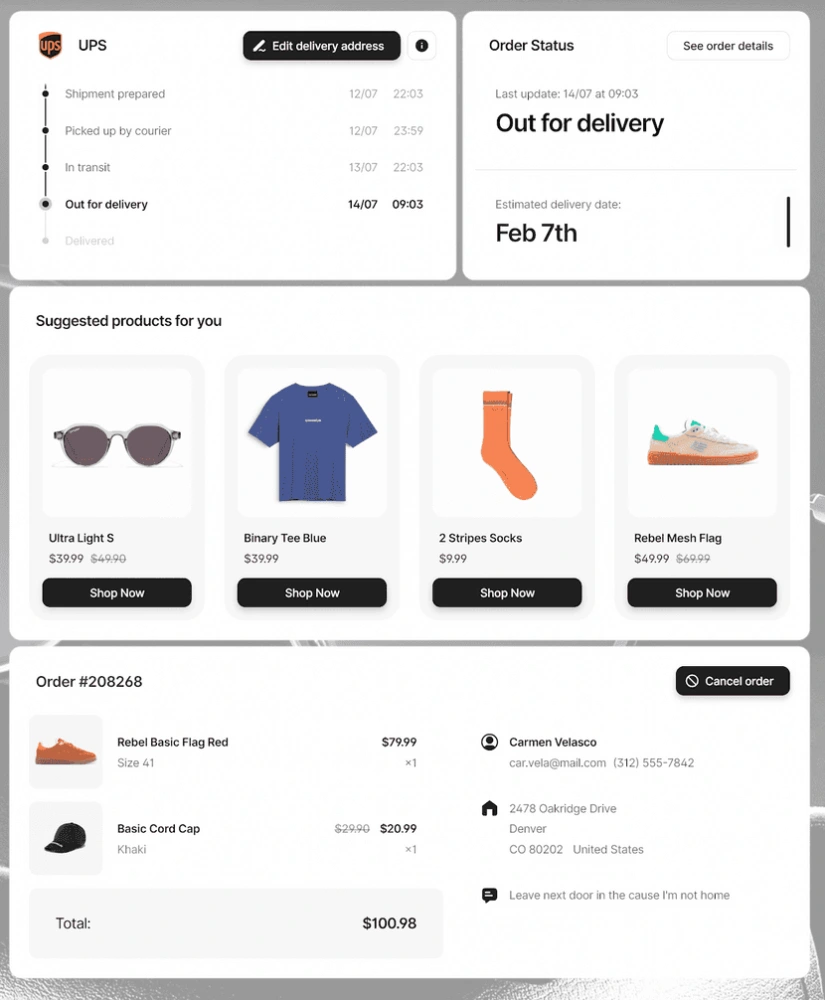
Customers visit this page because they’re already invested in the purchase, which often makes engagement stronger than traditional promotional campaigns.
2. Educate Before You Offer Another Discount
Many stores send a discount code immediately after the first order. That may generate short-term sales, but it can also train customers to wait for promotions.
A better approach is to create a short post-purchase email sequence that helps customers succeed with the product first.
For example:
- Day 1: Unboxing guide and getting started tips
- Day 4: Common mistakes and expected results
- Day 10: Customer story or community content
- Day 18: Advanced usage tips or complementary products
- Day 25–28: Reorder reminder timed to the purchase cycle
This approach reduces buyer hesitation, increases product satisfaction, and creates a more natural reason to return.
3. Build Loyalty Around Access, Not Just Discounts
Traditional points programs still work, but they’re no longer enough to stand out.
Instead of rewarding customers only with discounts, give them reasons to feel connected to your brand. Early product access, exclusive collections, limited releases, or opportunities to provide feedback can create stronger long-term loyalty.
A simple structure might look like:
- Tier 1: Early access to launches
- Tier 2: Exclusive products or member-only offers
- Tier 3: Community access or product feedback opportunities
The goal is to make staying feel more valuable than switching.
4. Introduce Subscription Options Where They Make Sense
If customers naturally reorder your products, subscriptions can remove friction from that decision.
This works especially well for categories with predictable buying cycles, such as skincare, supplements, coffee, pet supplies, and household products.
The positioning matters here. Instead of leading with “save 10%,” focus on convenience and continuity. Messaging around flexibility, automatic delivery, and not running out often creates stronger long-term retention than discount-first offers.
5. Use Customer Data to Personalize the Experience
Sending the same email to everyone becomes less effective as your store grows.
Retention improves when communication feels relevant. Small actions, like asking customers about their goals after purchase or segmenting based on behavior, can make follow-up messages more useful.
Examples include:
- Customers who bought Product A but not Product B
- Customers who haven’t engaged in 60 days
- Customers who viewed bundles but didn’t purchase
Personalization doesn’t need to be complicated. The goal is simply to make each message feel more relevant to where the customer is in their journey.
When retention improves, the result usually isn’t one big win. It comes from a series of smaller improvements that make customers more likely to come back, buy again, and stay longer.
Key Metrics You Should Track Alongside Retention Rate
Retention rate is an important metric, but it rarely tells the full story on its own. A declining retention rate usually appears after other signals have already started changing. That’s why high-performing ecommerce brands track supporting metrics that help explain where retention is improving, where it’s weakening, and how that impacts revenue over time.
- Customer Lifetime Value (CLV): CLV helps you understand whether those retained customers are actually becoming more valuable over time. If retention stays stable but CLV declines, it may mean customers are spending less or returning less frequently than before.
- Churn Rate: Churn gives you the opposite view of retention by showing how quickly customers are leaving. Tracking churn together with CRR makes it easier to spot retention problems earlier instead of waiting until repeat purchases slow down.
- Repeat Purchase Rate (RPR): RPR helps explain whether customers are returning after their first order. A store can have acceptable retention numbers but still struggle to turn first-time buyers into repeat customers. Looking at both metrics together gives a more complete view of customer behavior.
- Net Revenue Retention (NRR) (especially useful for subscription or hybrid models): NRR adds a revenue layer to retention analysis. It shows whether your existing customer base is generating more or less revenue over time, which helps reveal whether retention is translating into actual business growth.
- Net Profit: This is where the story becomes real. Retention and revenue metrics can look strong on the surface, but they don’t always translate into actual profitability. Net profit reveals what’s left after all costs like ad spend, shipping, transaction fees, and operations are accounted for. And that’s where things often get uncomfortable: a store can improve retention while still becoming less profitable if costs grow faster than revenue. That’s why net profit is the ultimate validation metric, it tells you whether retention-driven growth is actually sustainable.
Final Thoughts
Shopify retention rate isn’t just a performance metric, it’s a clear signal of how healthy and sustainable your business really is. When customers come back, growth becomes more stable, more predictable, and less dependent on rising ad costs.
Instead of constantly chasing new buyers, you start compounding value from the customers you’ve already earned. That shift is what turns short-term sales into long-term business stability.
In the long run, improving retention is one of the most reliable ways to increase profitability, strengthen customer relationships, and scale your Shopify store with less friction.
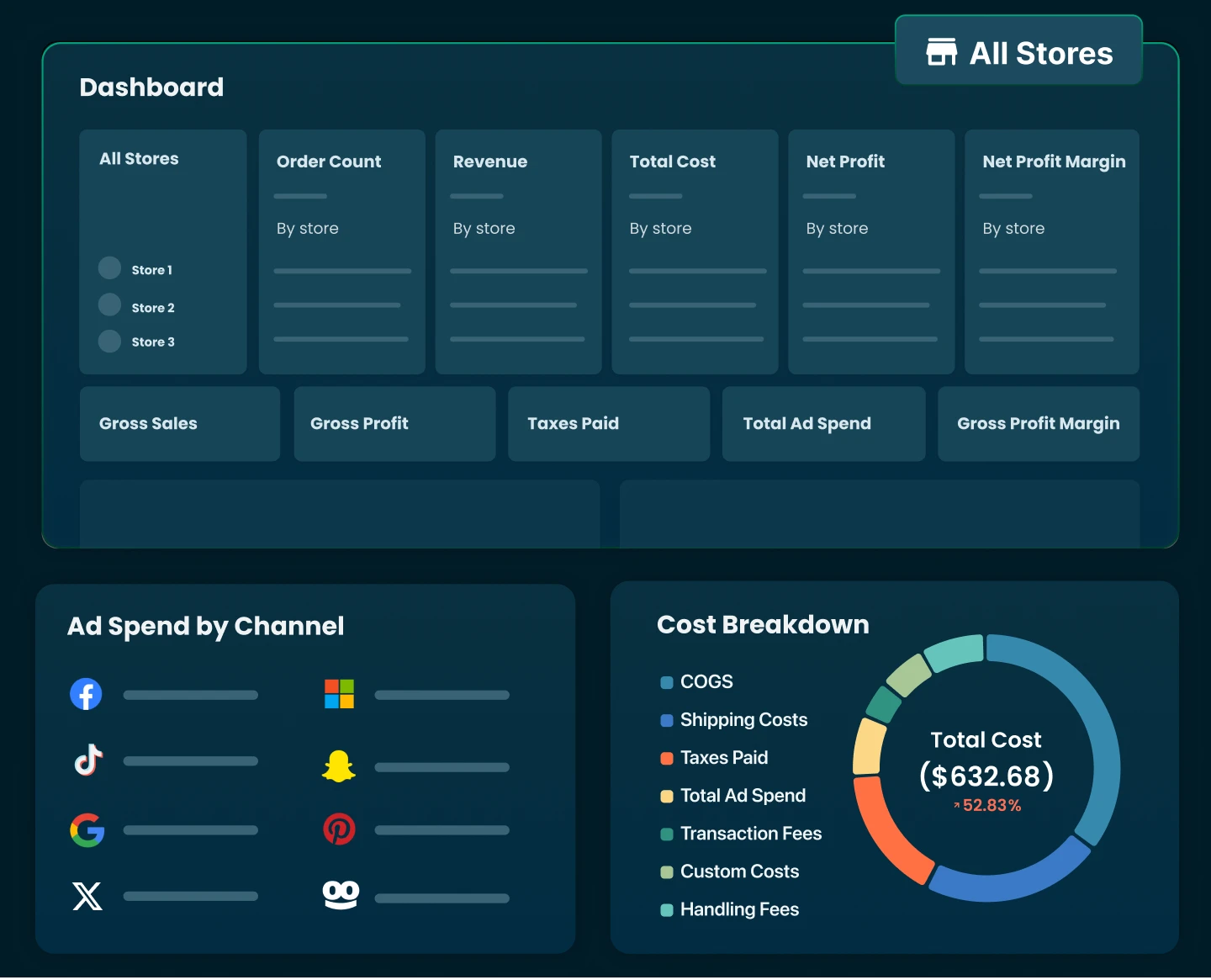
For Shopify merchants who want to see how retention and other metrics actually impact profitability, tools like TrueProfit help connect the dots by showing real-time net profit, alongside with all other important ecommerce metrics, so you always know your true business performance.

Irene Le is the Content Manager at TrueProfit, specializing in crafting insightful, data-driven content to help eCommerce merchants scale profitably. With over 5 years of experience in content creation and growth strategy for the eCommerce industry, she is dedicated to producing high-value, actionable content that empowers merchants to make informed financial decisions.