




What is the Model Context Protocol (MCP)? How MCP Works Explained Simply


Table of Contents
AI tools are getting smarter. But they're only as useful as the systems they can access. That's where Model Context Protocol (MCP) comes in.
MCP is quickly becoming the standard way for AI applications to connect with business software, databases, and external tools. If you've heard people talking about MCP but aren't sure what it actually does or why it matters, you're in the right place.
This guide explains how MCP works, its core features and why ecommerce businesses should pay attention.
In this blog:
What Is MCP?
Model Context Protocol (MCP) is an open standard that enables AI models to connect with external tools, data sources, and business applications through a single, standardized protocol.
Introduced by Anthropic in late 2024, MCP eliminates the need to build custom integrations between every AI application and every software platform. Instead, developers and businesses can connect both sides through one shared communication layer.
The easiest way to understand MCP is to compare it to a USB-C port.
Just as USB-C allows a laptop to connect to different devices through one standard connector, MCP allows AI systems to communicate with databases, SaaS tools, APIs, and internal business systems through one common protocol. Rather than building a separate integration for every AI tool and every application, MCP provides a common language that both sides can understand.
What Can MCP Do?
MCP supports two primary capabilities: Resources and Tools.
Resources give AI access to live information from external sources, including:
- Databases
- Documentation
- Analytics platforms
- File systems
- Code repositories
Instead of relying only on information from its training data, the AI can retrieve up-to-date context directly from connected systems.
Tools allow AI to perform actions on connected applications and services, such as:
- Updating a CRM record
- Creating a support ticket
- Sending a Slack message
- Triggering an automated workflow
This enables AI to move beyond answering questions and actively assist with business operations.
The Integration Problem MCP Solves
MCP solves what engineers call the N×M integration problem. Think of it this way: if you run an online store, you probably use separate tools for ads, fulfillment, email, and analytics. Before MCP, connecting each AI tool to each of those apps required a custom-built bridge, one for every single pair.
Ten AI tools talking to ten store apps could mean up to 100 separate custom connections to build and maintain. MCP collapses that math: any AI tool that speaks MCP can talk to any app that also speaks MCP, using the same shared protocol. The number of connections needed drops from 100 down to 20 (10 AI tools plus 10 app servers), and they all use the same standard.

How MCP Architecture Works
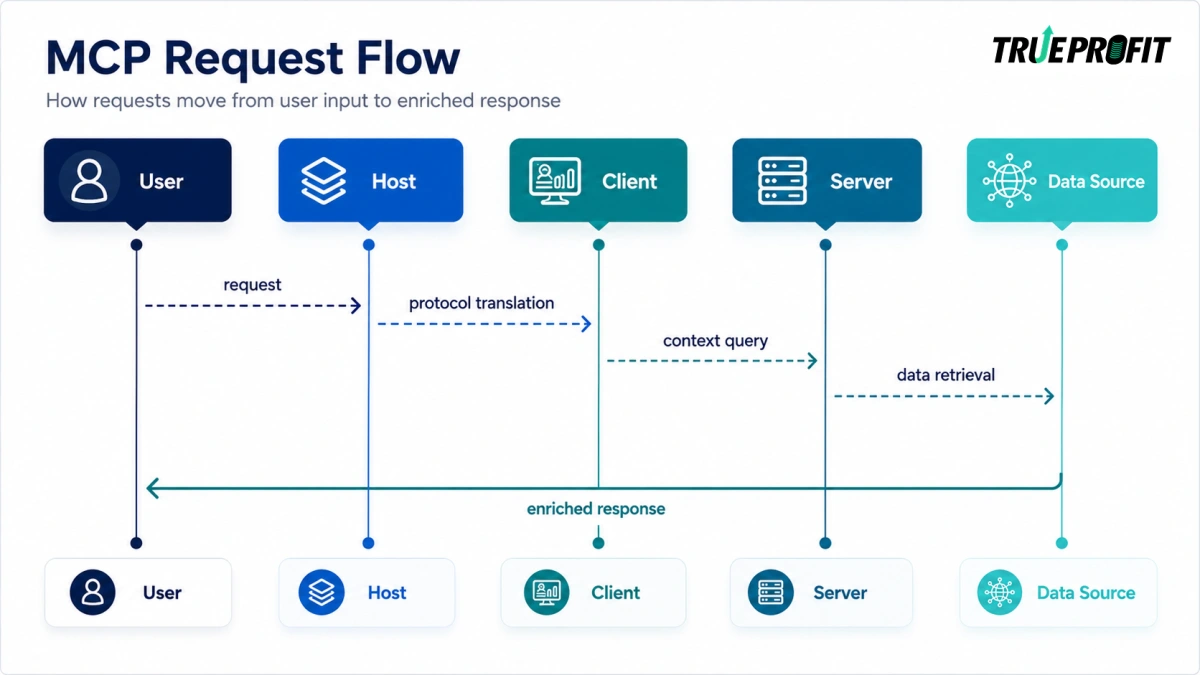
MCP runs on a three-layer model, Host, Client, and Server, where each layer has a distinct job and a structured way of passing messages to the next.

The Three Players in Every MCP Connection (and What Each One Does)
Before looking at how data moves through MCP, I want to break down the three key players that make each connection possible.
- The Host is the AI application you're talking to directly: Claude Desktop, ChatGPT, or a custom AI tool your business uses. It's the thing you type messages into.
- The MCP Server is a small background program that connects to one specific tool or data source: your store platform, your ad accounts, your profit analytics. Think of it as a dedicated translator between the AI and that particular system.
- The Client is the invisible middleman running inside the Host. It manages the connection between the AI and each Server, one Client per Server, so the AI can talk to multiple tools at once without getting confused.
In practice: you ask Claude a question, the Client handles the connection to the right Server, the Server fetches what's needed from your actual store data, and the answer comes back to you.
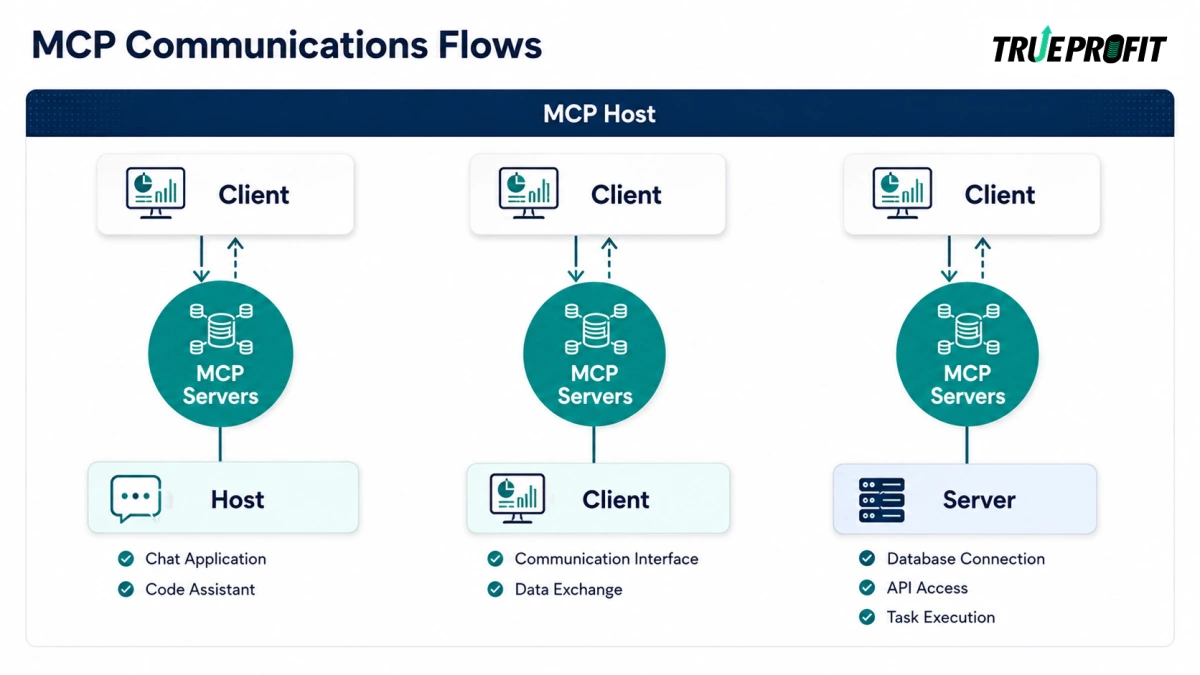
How Messages Flow Between Client and Server
MCP uses a message format called JSON-RPC 2.0, which just means every exchange between the Client and Server is a standardized, structured package, like a formal order form rather than a phone call. Both sides always know exactly what format to expect.
Connections are stateful and persistent, meaning the AI and Server remember the context of the whole session, not just the last message. It's like a staff member who holds the full conversation in mind rather than starting from scratch with each question.
Every session follows three phases:
- Initialize (Client and Server introduce themselves and share what they can do)
- Exchange (messages flow back and forth as work gets done)
- Terminate (the session closes cleanly)
That structure is what makes MCP integrations more reliable than custom-built alternatives.
Benefits of MCP: Why it matters for AI integration in Ecommerce
As businesses adopt more AI tools, connecting those models to the data and systems they need becomes increasingly complex. MCP addresses this challenge by providing a standardized way for AI applications to access information and interact with external services.
- Simplifies integrations by replacing multiple custom connections with a single standardized protocol.
- Provides access to real-time data from databases, documents, business applications, and APIs, helping AI generate more accurate and context-aware responses.
- Enables AI to take action, not just retrieve information, by allowing it to update records, create tickets, send messages, and trigger workflows.
- Improves scalability by making it easier to connect new tools, data sources, and AI applications without rebuilding integrations.
- Enhances security and governance through controlled access, permissions, and clearly defined interactions between AI systems and external services.
- Reduces vendor lock-in because MCP is an open standard that works across different AI models and software platforms.
- Accelerates AI adoption by lowering the technical complexity of connecting AI to existing business systems.
- Creates more powerful AI workflows by combining data retrieval and task execution across multiple tools through a single protocol layer.
Why MCP Matters for Ecommerce
For ecommerce businesses, MCP makes it easier to connect AI assistants with the systems that power daily operations, including ecommerce platforms, marketing tools, analytics dashboards, customer support software, and internal databases.
Rather than building and maintaining separate integrations for every AI application, businesses can use MCP as a standardized connection layer.
As adoption grows across the AI ecosystem, MCP is becoming a scalable way to build AI-powered workflows that can access data, automate tasks, and support decision-making across the entire ecommerce tech stack. For teams managing several connected systems, a unified AI workspace can provide a central environment for accessing tools, data sources, and workflows without constantly switching between separate platforms.
MCP vs. Traditional API Integrations
Before understanding this difference, you need to understand the technology most software integrations rely on today: APIs.
An API (Application Programming Interface) is a set of rules that allows different software applications to exchange data and perform actions with one another. For example, your ecommerce platform might use APIs to connect with advertising platforms, CRM systems, analytics tools, or customer support software.
Traditional API Limitations
Traditional APIs rely on predefined endpoints and parameters that developers must manually integrate and maintain. When an API changes, those integrations often need to be updated as well.
They also leave most of the context management to the client. Applications need to determine which APIs to call, combine the returned data, and decide how that information should be used. In most cases, API interactions follow a simple request-response pattern with little awareness of previous interactions or ongoing workflows.
How MCP Is Different
MCP takes a more flexible approach. Instead of relying on hardcoded endpoints, MCP servers expose their available tools, resources, and capabilities in a machine-readable format that AI systems can discover at runtime.
This allows AI applications to understand what data and actions are available without requiring a custom integration for every service. MCP also standardizes how resources such as documents, files, and database records are structured, making it easier for AI models to access relevant context and reason over it.
Another major difference is that MCP supports stateful, bidirectional communication. Rather than waiting for a single response, AI systems can receive updates, progress notifications, and partial results throughout a workflow. This makes MCP especially valuable for AI agents handling multi-step tasks across multiple systems.
Dimension | MCP | Traditional APIs |
|---|---|---|
Tool Discovery | AI can automatically discover available capabilities | You must manually document and integrate endpoints |
Data Access | Standardized resources and templates | Custom data-fetching logic for each service |
Reverse AI Calls | Native support through sampling and elicitation | Usually requires webhooks or custom callback systems |
Cross-Platform Support | Works across MCP-compatible hosts | Each platform requires its own integration |
Maintenance | Update the MCP server once | Update every individual connector |

MCP vs. RAG: Complementary Approaches
Comparing MCP to APIs gives you one angle on what's new about it. But there's another technology that often comes up in AI conversations - RAG (Retrieval-Augmented Generation) and understanding how MCP differs from RAG is equally important.
RAG improves AI accuracy by retrieving relevant information from a knowledge base before generating a response. It typically works by converting documents into embeddings, storing them in a vector database, and retrieving the most relevant content when a user asks a question.
This approach works well for accessing internal documentation, knowledge bases, SOPs, product catalogs, and other relatively stable content.
Think of RAG like giving your AI a filing cabinet full of your own documents to search before answering. MCP, on the other hand, gives it a live phone line to your actual systems.
Another key difference is that RAG is primarily designed for information retrieval. MCP goes beyond retrieval by allowing AI to both access data and perform actions through connected tools. This makes MCP better suited for AI agents that need to execute workflows across multiple systems.
Dimension | MCP | RAG |
|---|---|---|
Primary Purpose | Connect AI to external systems and tools | Improve AI responses with retrieved knowledge |
Data Source | Live APIs, databases, and business applications | Indexed documents stored in a vector database |
Data Freshness | Real-time access to current data | Depends on how recently the knowledge base was updated |
Actions | Can retrieve data and perform tasks | Retrieval only |
Tool Discovery | Supports runtime discovery of available capabilities | Not supported natively |
Best For | AI agents, automation, and operational workflows | Knowledge search, documentation, and question answering |
MCP Security Features
One of MCP's strengths is that security and user consent are built into the protocol, rather than being left entirely to individual integrations.
Built-In Protections
Rather than leaving security entirely to developers, MCP includes several built-in safeguards to help protect users, data, and connected systems.
- OAuth 2.1 authentication helps AI applications connect to external services using the same security standards widely used across modern web applications.
- User approval is required before sensitive actions are performed, helping prevent AI from taking actions without permission.
- The host application stays in control, ensuring the AI can only access data and tools that users have explicitly authorized.
Risks to Be Aware Of
Like any integration framework, MCP is not risk-free.
- Prompt injection attacks can occur when malicious content attempts to influence an AI model's behavior.
- Tool poisoning can happen if a poorly designed or compromised server provides misleading tool descriptions.
- Server trust still matters. Businesses should carefully evaluate third-party MCP servers before granting access to sensitive systems or data. This is the reason why understanding MCP security is crucial for mitigating these risks.
Limitations and Challenges of MCP for Ecommerce Merchants
That said, no technology is perfect and MCP is especially young. Being aware of its current limitations will help you plan better and avoid surprises.
1. The Spec Is Still Evolving
The protocol has shipped several major spec revisions since launch, most recently the stable 2025-11-25 release, with a larger 2026-07-28 revision currently in release. Each has introduced breaking changes, so production teams need to track version negotiation closely.
2. No Built-In Server Discovery
There's currently no standard way for a host to discover available servers on its own. Users must manually configure which servers their app connects to, which creates friction for anyone uncomfortable editing config files.
3. Added Latency
Routing every tool call through an extra protocol layer adds some latency compared to calling an API directly. For most use cases the overhead is small, but it's worth measuring in latency-sensitive applications.
4. Trust-Based Enforcement
Security for Roots and local studio transport leans on OS-level controls and the assumption that the server is well-behaved, not on protocol-level guarantees. A malicious or buggy local server can still do real damage if granted broad access.
5. Inconsistent Server Quality
The ecosystem of community-built servers is growing fast, and quality varies widely. Some are production-grade with proper auth and error handling; others are weekend projects. Vet a server the way you'd vet any dependency before pointing it at real data.
Final Thoughts
MCP is making it easier for AI to connect with the tools, data, and workflows businesses already use. While the ecosystem is still evolving, growing support from major AI providers suggests it could become a foundational layer for AI-powered software.
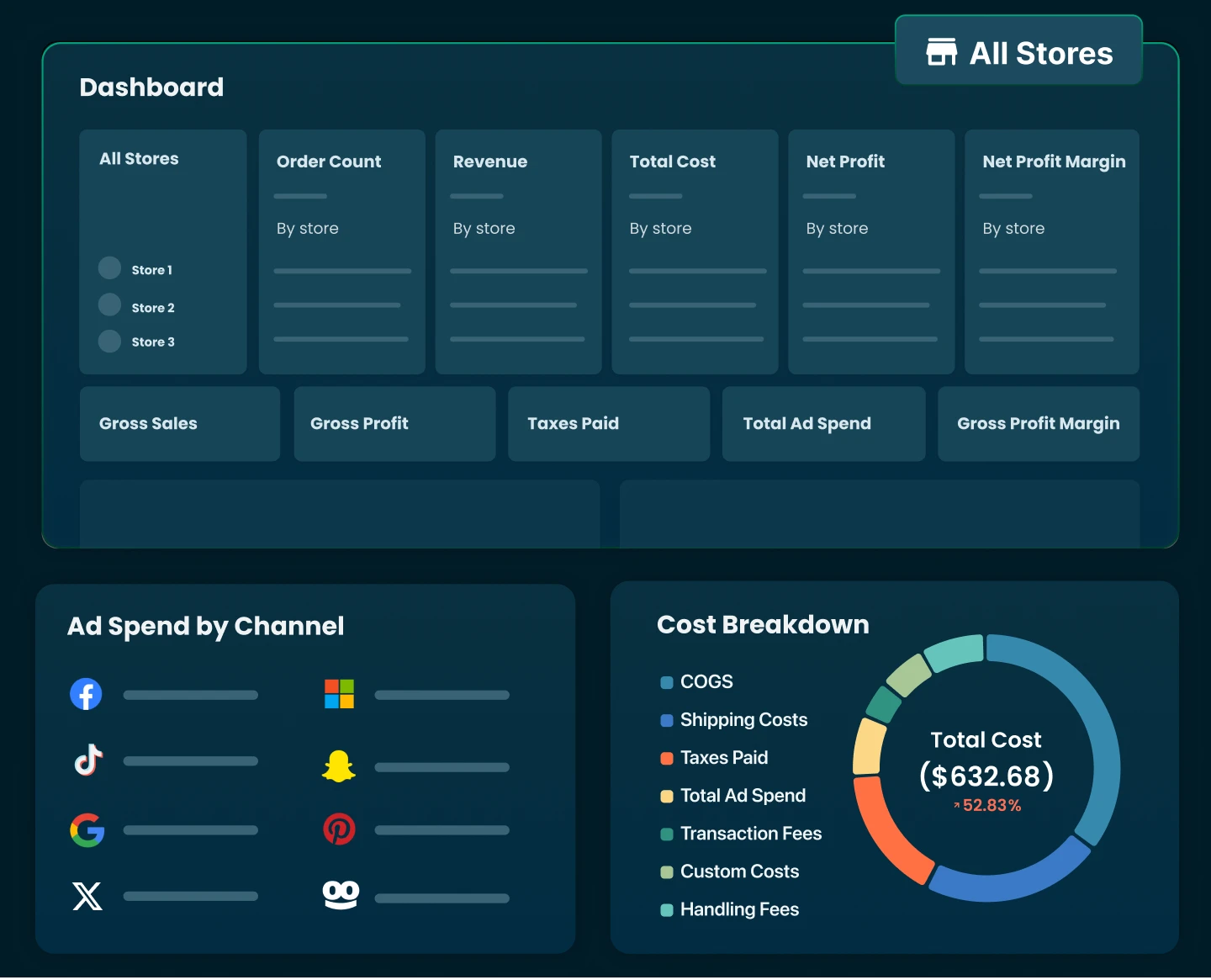
As ecommerce platforms adopt MCP, merchants could move from manually checking dashboards to simply asking questions about profitability, customer acquisition costs, or store performance. Tools like TrueProfit are part of that shift, making business data more accessible to the AI systems merchants already use.
With the TrueProfit MCP server, sellers can:
- Ask AI assistants questions about profit and loss, ad performance, orders, and business costs in plain English, without digging through reports or dashboards
- Gain AI-driven profit intelligence that goes beyond surface-level metrics, helping identify what's impacting profitability across products, ads, and sales channels.
- Understand the root causes of profit changes as AI cross-references revenue, COGS, ad spend, shipping costs, and fees to explain why profit increased or decreased.
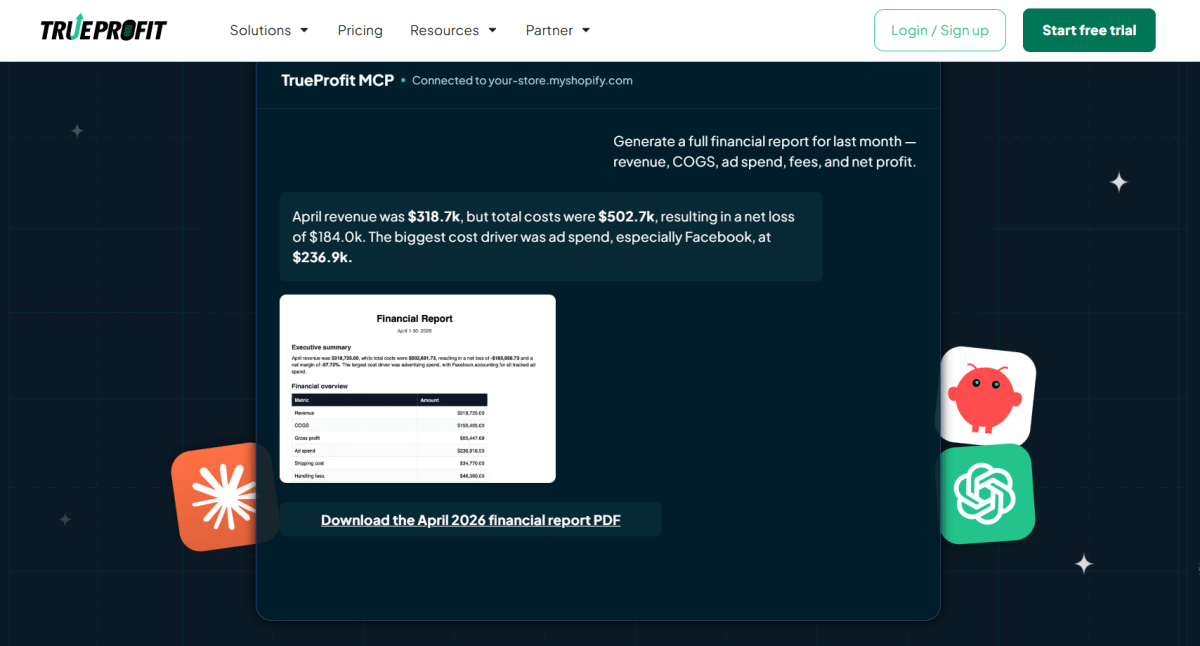
Get instant answers without digging through reports or dashboards with TrueProfit MCP
Lila Le is the Marketing Manager at TrueProfit, with a deep understanding of the Shopify ecosystem and a proven track record in dropshipping. She combines hands-on selling experience with marketing expertise to help Shopify merchants scale smarter, through clear positioning, profit-first strategies, and high-converting campaigns.