
How to Scale Your Dropshipping Store 3X This Black Friday (2026 Guide)


Table of Contents
For ecommerce, Black Friday is the sweetest slice of the year, and dropshipping gets a seat at the feast too. 3x, even 5x your normal sales is genuinely within reach.
Give me 5 minutes, and I’ll show you how to prepare, budget, sell, and scale your dropshipping store for BFCM, without letting your profit disappear along the way. Let’s get started!
In this blog:
When Should You Start Preparing for Black Friday?
Here’s the first thing I want you to get right: the sooner you start preparing for BFCM, the better.
By then, you should be executing, not figuring out what to sell, which offer to run, or which ad creative actually works.
The simplest way to plan it is to work backward from BFCM.
When | What to Focus On | What to Do |
|---|---|---|
8-12 weeks before | Products & numbers | Identify proven products, check product-level profitability, evaluate supplier capacity, set your BFCM offer, and define your ad budget. |
4-8 weeks before | Testing & validation | Test products, creatives, audiences, and offers. Find what converts before competition drives up ad costs. |
1-2 weeks before | Store & conversion | Optimize product pages, test discounts and bundles, check checkout, confirm shipping information, and remove conversion friction. |
8-12 Weeks Before: Get the Basics Right
Start with your products and your numbers.
Look at what's already selling, which products actually make money, and whether your suppliers can handle more volume. This is also the moment to lock in your BFCM offer and set a realistic ad budget.
You don't need to reinvent your store for Black Friday. Double down on what already has proof behind it.
4-8 Weeks Before: Test Before You Scale
This is your testing window.
Test your products, creatives, audiences, and offers while you still have time to learn from the results. The goal is to know what deserves more budget before competition pushes ad costs up.
Because if an offer or creative doesn't work now, Black Friday traffic won't magically fix it.
1-2 Weeks Before: Remove Every Bit of Friction
Now, stop experimenting and start polishing.
Make sure your product pages are convincing, your discounts and bundles actually work, checkout is smooth, and shipping information is impossible to miss.
You want customers spending their time deciding whether they want the product, not wondering how much shipping costs or when it will arrive.

How Much Budget Should You Prepare for 2026 Black Friday?
Let’s get one thing straight first: your Black Friday budget isn’t just your ad budget.
If you’re expecting a big sales spike, you also need enough cash to pay suppliers, cover fulfillment, absorb discounts, handle returns, and survive any gap between customer payments and your actual payouts.
Start With Your Main BFCM Costs
A practical starting point is to work backward from your target BFCM revenue.
For paid advertising, you can plan around 15%-25% of your target BFCM revenue across Meta, Google, TikTok, and other channels.
But don’t assume your normal acquisition costs will stay the same. During BFCM, competition for shoppers gets much more aggressive, so CAC and CPMs can increase by around 30%-60%.
For example, if you normally spend $5,000 a month on ads, you may need around $10,000-$15,000 in November to maintain a similar level of reach.
Then you have product and fulfillment costs. For ecommerce and retail businesses, inventory can account for around 30%-50% of projected gross BFCM sales.
For dropshipping, though, this doesn’t mean you need to purchase that amount of inventory upfront. Think of it as the product and fulfillment capital your order volume will consume. Your actual cash requirement depends on supplier pricing, payment terms, and how quickly you need to pay for orders.
And then there’s the discount.
A BFCM promotion can reduce your gross margin by 20%-40%, depending on how aggressive the offer is. So before you decide to run 20%, 30%, or 40% off, calculate what that discount does to your unit economics.
A useful guardrail is to aim to retain at least 50% of your baseline gross and net profit margin after the discount.
Don’t Spend Your Entire Ad Budget on BFCM Week
Here’s another thing I’d plan for: the warm-up.
You don’t want your first serious ad test to happen when everyone else is already fighting for Black Friday traffic.
A practical starting split is:
- 25% of your marketing budget: October to early November
- 75%: BFCM week
Use the first 25% to build email and SMS audiences, test creatives, and warm up potential buyers while CPMs are generally lower.
And don’t panic if the warm-up numbers look weaker than usual.
CTR can be strong because people are actively browsing and comparing deals, while conversion can soften because shoppers know Black Friday is coming and are waiting for the better offer.
The goal of this stage isn’t necessarily to maximize immediate ROAS.
You’re paying to build an audience and find what works before the expensive days arrive.
Then, when BFCM hits, you can put more of your budget behind the products, creatives, and audiences that have already shown traction.
Leave Room for Returns, Refunds & Chargebacks
I’d also keep a post-sale buffer.
The 5% buffer we mentioned earlier is a reasonable starting point for shipping surcharges, temporary fulfillment labor, returns, and other unexpected post-sale costs.
But don’t treat 5% as your final number.
Your product category matters.
If you’re selling apparel, footwear, or other products with a higher return risk, you may need a much larger buffer. Some fashion businesses can see return rates reach 15%-20%, so using the same 5% assumption as a low-return product category could leave you underfunded.
The better approach is to start with your own historical return and refund rate, then increase the buffer if you expect BFCM volume or discounting to change customer behavior.
What Could Your That Budget Look Like?
Here’s a simple example across different business sizes:
Expense Category | Micro Store ($20K Goal) | Mid-Market ($100K Goal) | Growth Brand ($500K Goal) |
|---|---|---|---|
Paid Ads (BFCM Campaign) | $5,000–$7,000 | $25,000–$35,000 | $125,000–$175,000 |
Creative & Content Testing | $200–$500 | $1,000–$2,500 | $5,000–$10,000 |
COGS / Supplier Payments | $6,000–$8,000 | $30,000–$40,000 | $150,000–$200,000 |
Email/SMS Marketing | $150–$400 | $800–$1,500 | $4,000–$8,000 |
Tech, Apps & Platform Fees | $150–$300 | $500–$1,000 | $2,500–$5,000 |
Customer Support / WISMO Staffing | $300–$600 | $1,500–$3,000 | $8,000–$15,000 |
Returns/Refunds/Chargeback Buffer | $400–$800 | $2,000–$4,000 | $10,000–$20,000 |
Payment Processor Reserve | $500–$1,000 | $3,000–$5,000 | $15,000–$25,000 |
Total Recommended Cash Outlay | $12,700–$18,600 | $63,800–$92,000 | $319,500–$458,000 |
Again, treat this as a planning example, not a universal formula.
For a dropshipping store, your actual cash requirement can look very different, because you're not necessarily buying inventory upfront. Your supplier payment terms, product costs, payout schedule, and order volume all change how much working capital you really need.
Recommended Strategies to Win BFCM For Dropshippers
Now that you have your budget in mind, let's get into the part that actually decides whether that budget makes money: how you structure your Black Friday strategy.
And this is where I'd avoid the most common approach of all, which is simply putting every product on sale.
Black Friday gives you more traffic, but it also gives customers more reasons to compare prices. If your only edge is a bigger discount, you can easily end up selling more while keeping less.
Instead, build your strategy around four things: the right products, the right offer, a friction-free store, and enough margin to make the extra volume worthwhile.
1. How to Price Black Friday Dropshipping Products Profitably
The easiest mistake here is choosing the discount first.
"Let's do 30% off."
Then you check the numbers afterward.
Do it the other way around.
Start with your normal selling price and work out how much margin you actually have to give. Then test different offers and see how each one affects your profit per order.
And remember, a bigger discount isn't always a better offer.
A bundle can lift AOV without forcing you to slash the price of a single product. A tiered offer can nudge customers to spend more. Even a smaller discount can work if the perceived value is strong enough.
The goal isn't to win the discount war. It's to build an offer that feels compelling while still leaving enough profit to scale.
2. How to Prepare Your Store for Black Friday
Before you send more traffic to your store, make sure the store can actually convert it.
Start with your product pages. Make the value proposition obvious, show the product in use, highlight reviews or social proof, and make your Black Friday offer easy to understand.
Then check the less exciting stuff that can still quietly kill a conversion:
- Is checkout working smoothly on mobile?
- Are shipping times clearly displayed?
- Are your return and refund policies easy to find?
- Are discount codes working correctly?
- Do bundles and upsells work as expected?
You don't want to discover a broken checkout or a confusing shipping policy after you've already spent thousands on traffic.
3. How to Market Your Black Friday Dropshipping Store
Don't think of Black Friday marketing as one giant campaign that starts on Friday.
You have a pre-sale phase, a conversion phase, and a follow-up phase.
Before BFCM, focus on building awareness and collecting email or SMS subscribers. As the sale gets closer, start creating urgency and warming up your audiences.
During BFCM, put more budget behind the creatives and products that have already proven themselves. Retarget shoppers who visited your store, viewed products, or added items to their cart but didn't buy.
And after the sale, don't disappear.
Those customers have already paid the hardest part of the acquisition cost: you've convinced them to buy from you once. Follow up with relevant products, post-purchase offers, and retention campaigns to grow their long-term value.
4. How to Manage Orders During Black Friday
Here's where a great sales campaign can quickly turn into an operational headache.
Before scaling, confirm that your suppliers can handle the expected order volume and that their shipping timelines are realistic.
Then watch your orders closely during the sale.
If a product suddenly takes off, don't assume your supplier can automatically absorb 5x or 10x the usual volume. Check stock availability, processing times, and shipping capacity before pushing even more traffic.
And be transparent with customers.
If BFCM orders are going to take longer to arrive, say so upfront. Clear expectations are far easier to manage than hundreds of "Where is my order?" messages after the sale.
5. How to Track Profit Closely During the Peak Days
This is probably the one I'd keep the closest eye on during BFCM.
Because when your sales suddenly jump 2x or 3x, it's very easy to glance at the dashboard and think, "Okay, we're killing it."
But here's the catch: more sales also mean more costs moving around at the same time.
Your ad spend goes up. Discounts eat into your margin. COGS and shipping add up with every order. Then transaction fees, refunds, and chargebacks pile on top of that.
So when BFCM gets messy, these are the numbers I'd want right in front of me:
- Net profit: how much money you actually keep after all costs
- Net profit margin: what percentage of your revenue turns into profit
- Net profit per order: how much profit each order generates
- Profit by product: which products are actually worth scaling
- Profit by advertising channel: which channels bring in profitable sales
- Ad spend and CAC: how much you’re spending to acquire each customer
- Refunds and chargebacks: how much revenue is being lost after the sale
The App Stacks You Should Definitely Install Before BFCM
Here are a few worth looking at.
1. Discount & Promotion Apps
If you're going beyond a basic "20% OFF" sitewide discount, these can help you build more flexible offers:
- Kaching Bundle Quantity Breaks - bundles and quantity discounts
- BOGO+ - BOGO and promotional offers
- Discounty - bulk and tiered discounts
- Essential Free Shipping Upsell - free-shipping incentives and cart offers
And here's the thing: don't compete on discount percentage alone. A bundle or volume offer can lift AOV without forcing you to hand the same discount to every customer.
2. Email & SMS Marketing Apps
Before spending more money to acquire another customer, look at the customers and subscribers you already have.
Some popular options are:
- Klaviyo - email, SMS, segmentation, and automation
- Omnisend - ecommerce email and SMS
- Shopify Email - straightforward email campaigns within Shopify
- Postscript - SMS marketing
Use these before BFCM to build your list, then during the sale to announce offers, recover abandoned carts, and bring previous customers back.
Your email list becomes especially valuable when paid traffic gets more expensive.
Upsell & Cross-Sell Apps
You've already paid to get the customer into your store. Now see if you can make that order worth more.
A few options:
- ReConvert - post-purchase upsells
- AfterSell - post-purchase and checkout upsells
- Frequently Bought Together - product recommendations and bundles
- UpCart - cart upsells and cross-sells
The goal isn't to throw another offer at every customer. Recommend something that genuinely makes sense with what they're already buying.
Inventory & Order Management Apps
This is the category you'll appreciate the moment orders start coming in faster than usual.
Depending on your sourcing and fulfillment setup, you could look at:
- DSers - AliExpress order processing and supplier management
- AutoDS - sourcing, inventory monitoring, and order automation
- Syncee - supplier and inventory management
- Shopify Flow - workflow automation
Just make sure the tool fits your actual supplier workflow. There's no point automating a process your supplier doesn't support.
Profit Tracking & Analytics Apps
And personally, this is the one I wouldn't overlook during BFCM.
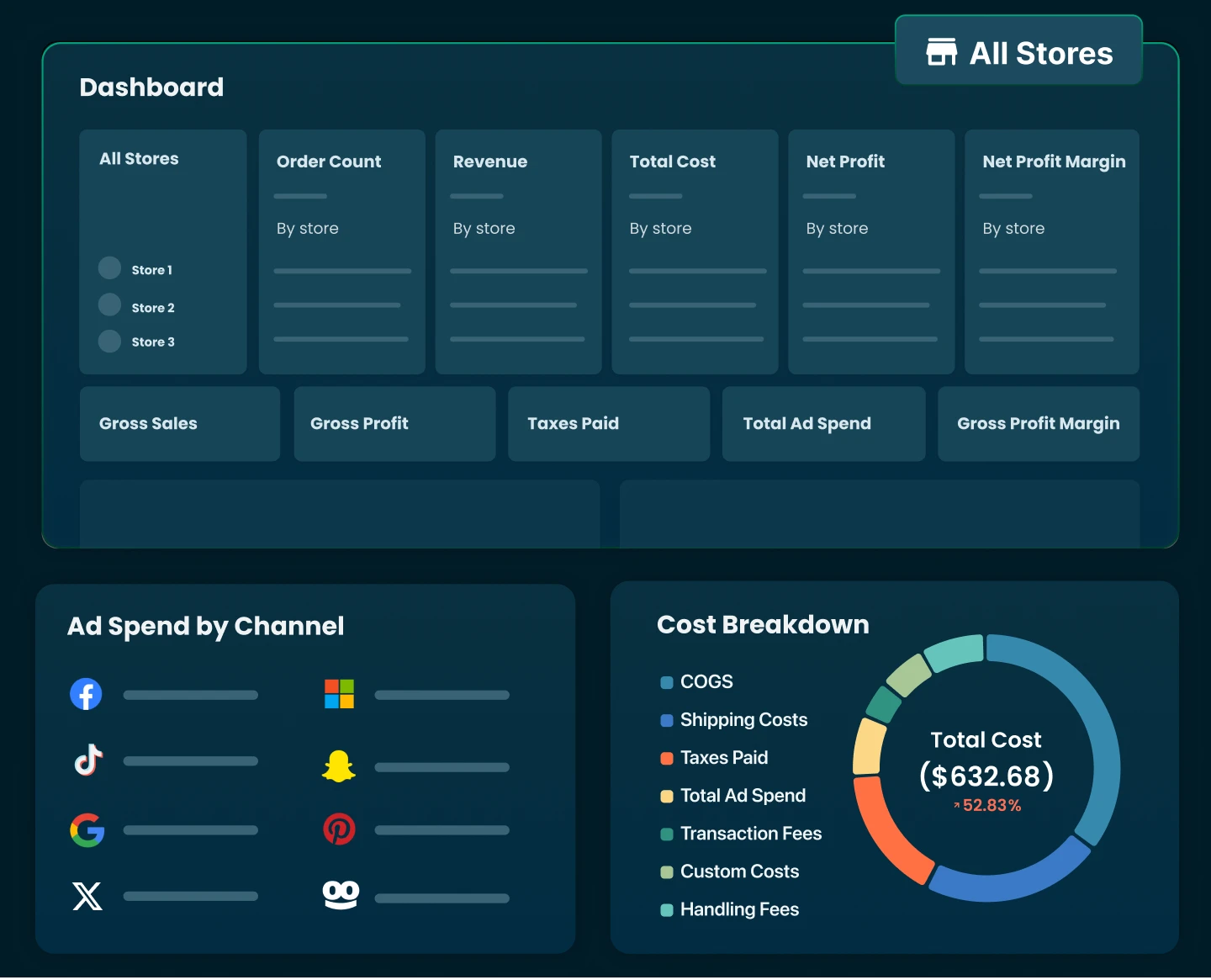
As I mentioned earlier, you need to track more than revenue and ROAS. Net profit, profit per order, product-level profit, channel profitability, CAC, refunds, and chargebacks are what tell you what's actually happening to your bottom line.
The problem is, BFCM is probably the worst possible time to track all of that by hand.
Your store is busy. Orders are flying in. Ad spend is changing by the hour. And your costs are scattered across Shopify, Meta, Google, TikTok, suppliers, shipping providers, and payment platforms.
So yes, you can throw everything into a spreadsheet.
But by the time you've pulled the data, cleaned it up, and updated the formulas, the decision you needed to make may already be yesterday's decision.
And there's a bigger risk hiding underneath: bad data leads to bad scaling.
A campaign can look profitable because COGS hasn't been updated. A product can look like a winner because refunds haven't hit the numbers yet. A strong ROAS can quietly turn into a weak profit margin once discounts, shipping, and transaction fees are counted in.
That's why I'd automate this part.
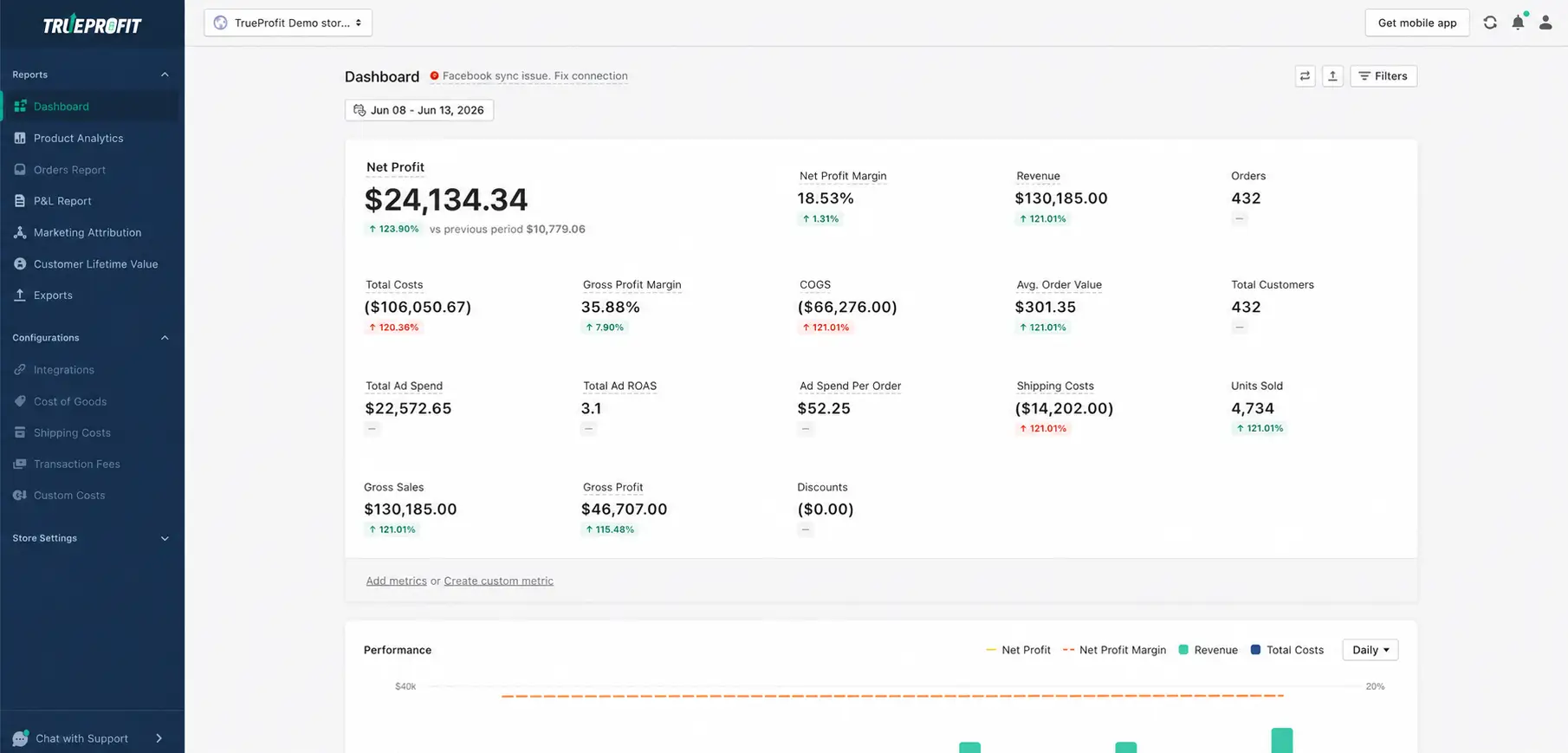
A profit-tracking tool pulls your revenue and costs into one place automatically, and TrueProfit does exactly that, including COGS, ad spend, shipping fees, transaction fees, refunds, and chargebacks.
So instead of asking, "How much did we sell?", you can see "How much did we actually make?" in real time.
You can track net profit, net profit margin, profit per order, product profitability, and channel performance without manually stitching the data together.
And that changes how you scale during BFCM.
If a product is generating revenue but losing margin, you'll see it. If one campaign is producing less revenue but stronger profit, you'll see that too.


4 Tips to Get More Out of BFCM
1. Don't Treat Every Visitor the Same
Not everyone landing on your store is equally close to buying.
Someone who added a product to their cart is very different from someone seeing your brand for the first time. The same goes for an existing customer versus a completely new visitor.
During BFCM, prioritize your highest-intent audiences first. Give past customers, email subscribers, cart abandoners, and repeat visitors a reason to come back before spending more to acquire colder traffic.
The cheapest conversion opportunity is often already sitting in your audience.
2. Use Urgency to Recover Hesitation, Not Create Pressure
A lot of BFCM shoppers don't say no. They just wait.
They compare prices, check other stores, or tell themselves they'll come back later.
That's where clear deadlines can help. Instead of filling every page with countdown timers, use urgency at the moments when customers are most likely to hesitate: abandoned carts, products they've viewed multiple times, or offers that are genuinely about to end.
The goal isn't to make the whole store feel urgent.
It's to give hesitant shoppers a specific reason to stop waiting.
3. Pay Attention to What Happens After the Click
A campaign can generate plenty of traffic and still leave money on the table.
If people are clicking but not buying, the problem may not be the ad or the product. It could be that shoppers are getting stuck at a specific point in the journey.
During BFCM, watch where customers drop off:
Ad → product page → add to cart → checkout → purchase
A sudden drop at one stage can tell you where to look instead of randomly changing your entire campaign.
Sometimes, fixing one point of friction is more valuable than launching another ad.
4. Think About What a BFCM Customer Is Worth After November
BFCM often brings in customers at a higher acquisition cost and sometimes at a lower margin.
That doesn't automatically make them bad customers.
The mistake is evaluating the entire campaign based only on the first order.
Pay attention to which BFCM customers come back, what products they buy next, and how much additional profit they generate over time. You may find that some campaigns that look less impressive on day one bring in more valuable customers in the long run.
Final Thoughts
So, if I had to boil this whole BFCM strategy down, I’d say this:
Don’t wait for Black Friday to figure things out.
Know your winners. Know your numbers. Know how much cash you can put behind the campaign. And make sure your supplier, store, and fulfillment process can handle the volume before you start pushing harder.
Then when the sales spike, don’t let the excitement make your decisions for you.
If something is profitable, scale it. If it’s only generating revenue, look closer.
That’s how you make BFCM work for your business, instead of just making your dashboard look good.
Harry Chu is the Founder of TrueProfit, a net profit tracking solution designed to help Shopify merchants gain real-time insights into their actual profits. With 11+ years of experience in eCommerce and technology, his expertise in profit analytics, cost tracking, and data-driven decision-making has made him a trusted voice for thousands of Shopify merchants.