

11 Best Dropshipping Pricing Strategies $M Ecom Stores Apply (2026 Guide)


Table of Contents
Pricing a dropshipping product isn't as simple as taking your supplier's price and slapping on a markup.
You have to account for shipping, payment fees, ad spend, refunds, discounts, and a handful of other costs that quietly eat into your margin. A product that looks profitable on day one can end up barely breaking even once everything is added up.
The good news? You don't need a complicated model to get started. You just need to know your costs, pick a target margin, and make sure the final price still makes sense to the person buying it.
In this blog:
Step 1: Identify Your Costs Before Pricing a Dropshipping Product
Before you decide what customers pay, you need to know what a sale actually costs you.
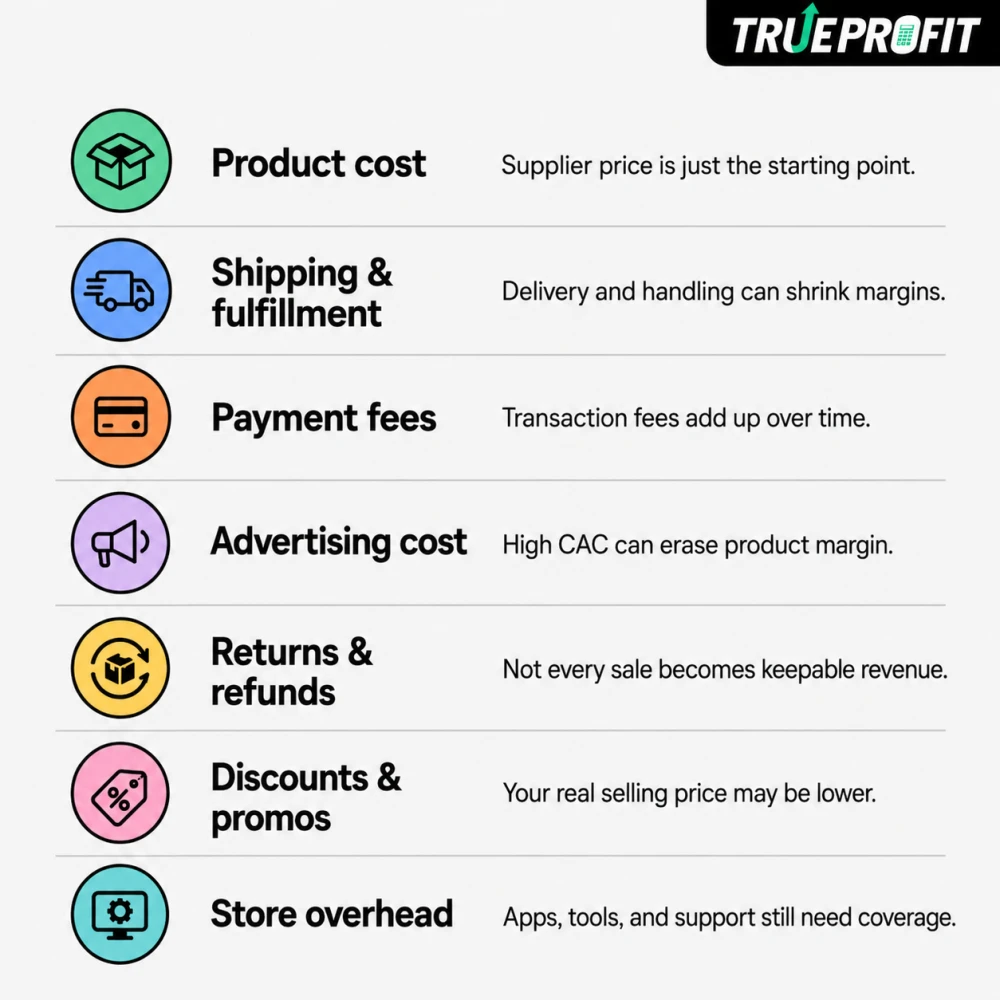
The supplier's price is only the starting point. Depending on how you run things, several other expenses will chip away at what you keep from each sale.

1. Product Cost (or Cost of Goods Sold)
This is the obvious one: what your supplier charges you for the product.
For example, if you source an item for $12 and sell it for $35, your product cost is $12 per unit. This is the amount you pay your supplier for each item before considering other dropshipping expenses.
Check whether your supplier also charges for packaging, customization, minimum order requirements, or other product-related fees.
2. Shipping and Fulfillment
Shipping can hit your margins harder than you'd expect, especially when you're selling internationally.
Include whatever it costs to get the product from your supplier or fulfillment partner to the customer. And if you advertise free shipping, remember it's never actually free for your business.
Depending on your setup, you may also need to cover expedited shipping, reshipments, lost packages, or fulfillment fees.
3. Payment Processing Fees
Payment providers usually take a percentage of each transaction, sometimes plus a fixed fee. For example, Stripe charges 2.9% + $0.30 per successful domestic card transaction in the U.S., while PayPal Checkout charges 2.99% + $0.49 for domestic credit and debit card payments.
One order barely registers, but these fees pile up fast as your volume grows. Your pricing should have room to absorb them, not treat them as an afterthought.
4. Advertising Costs
Advertising costs include everything you spend to attract customers and promote your products. This can cover paid ads on platforms like Meta, Google, and TikTok, as well as influencer fees, sponsored content, and the cost of creating ad creatives such as product videos, UGC, and images.
If you use retargeting campaigns or work with creators on a commission basis, those expenses should also be counted as part of your advertising costs.
5. Returns, Refunds, and Chargebacks
Some customers will ask for refunds, return products, or file chargebacks. Depending on your policies and fulfillment setup, you might also eat the cost of return shipping or reshipping.
This is especially important for products with higher return rates, such as apparel and shoes, where sizing and fit can lead to more returns, as well as electronics, beauty products, and other items where customers may change their minds or find the product different from their expectations.
You don't need to predict the exact cost of every order. But your pricing should leave enough room to cover these losses over time.
6. Discounts and Promotions
Your advertised price usually isn't your real selling price.
If your product is listed at $39.99 but you regularly run 15% off, customers are effectively paying around $34. That's the price your economics actually need to support.
So when you set your initial price, factor in the discounts, seasonal promos, free-shipping offers, and bundles you actually plan to run.
7. Store and Operating Costs
Store and operating costs are the ongoing expenses required to run your dropshipping business. These can include your Shopify subscription, ecommerce apps, domain and hosting fees, email marketing software, customer support tools, accounting software, and other business overhead.
While these costs aren't directly tied to a specific order, they should still be included in your overall dropshipping cost calculation.

Step 2: Calculate Your Break-Even Price
Next, find the lowest price you can sell at without losing money.
At its simplest:
So if your total costs to deliver an order is $28.70, anything below $28.70 means you're selling at a loss.
In practice it gets a little messier, because some costs like payment processing are a percentage of your selling price.
For example, your order has:
- Product and fulfillment cost: $16
- Advertising cost: $10
- Other costs: $1
- Payment fee: 3% of selling price
That gives you a base total cost of $27 per order, before payment processing fees.
Next, factor in any costs that depend on your selling price. If your payment processor charges a 3% transaction fee, your break-even price can be calculated as:
In this example:
$27 ÷ (1 − 0.03) = $27.84
So, you'd need to charge approximately $27.84 to break even.
From there, you can test different selling prices to see how much profit each order could generate. At a $40 selling price, for example, the payment fee would be $1.20, leaving:
$40 − $16 − $10 − $1 − $1.20 = $11.80 profit per order
This gives you a clearer picture of your actual cost structure before setting your final selling price or launching campaigns.
Step 3: Set Your Target Profit Margin
Now that you know your costs and break-even point, decide how much gross profit you want the product to generate.
A simple formula:
Say your total cost is $20 and you're targeting a 60% gross margin:
Then your selling price should be: $20 ÷ (1 − 0.60) = $50
At $50, you'd have $30 in gross profit before advertising and other operating expenses.
But don't pick a target margin just because you saw a certain percentage floating around online.
Factor in your product category, acquisition costs, competition, AOV, expected discounts, and how hard you plan to scale.
A product that leans heavily on paid ads, for instance, needs more room to absorb acquisition costs than one that pulls most of its customers organically.
Then, estimate your target net profit.
Unlike gross profit, net profit is much harder to control because it depends on costs across the entire business, including advertising, refunds, transaction fees, apps, payroll, and other operating expenses.
Still, having a target gives you a benchmark for deciding whether your pricing leaves enough room to run the store sustainably.
For a new dropshipping store, I suggest aiming for a 10% net margin initially. Once operations are efficient and consistent, work toward increasing it to 15-20%.
Step 4: Choose a Markup That Fits Your Product
Markup gives you a quick way to turn your costs into a selling price.
A common starting range for dropshipping is around 2x–3x the landed cost, but no single markup works for every product.
For example, if your landed cost is $10:
Markup | Selling Price | Gross Profit |
|---|---|---|
2x | $20 | $10 |
2.5x | $25 | $15 |
3x | $30 | $20 |
4x | $40 | $30 |
A higher markup gives you more breathing room for advertising, discounts, refunds, and other expenses. But it only works if customers are actually willing to pay that price.
A $10 product priced at $30 can work great if it solves a clear problem and has strong perceived value. But if comparable products sell for $20, pushing yours to $40 makes conversion a lot harder.
Also, don't confuse markup with margin. A 3x markup means you added 200% to your cost. It doesn't mean you keep 200% as profit, or that your net margin is 66.7%.
Treat markup as a starting point, then check it against the market and your real store economics.

Step 5: Check Competitor Pricing
Once you have a price that works on paper, see how it stacks up against the market.
Look at several stores selling genuinely comparable products. Pay attention to more than price: quality, features, branding, shipping, reviews, guarantees, and the overall offer.
For example:
Competitor | Price | Positioning |
|---|---|---|
Store A | $24.99 | Budget |
Store B | $29.99 | Mid-range |
Store C | $34.99 | Premium |
Store D | $39.99 | Branded |
If your product is closest to Store B in quality and positioning, $28.99–$31.99 is a reasonable starting range.
But don't automatically try to be the cheapest.
A lower price can lift conversion, but it also leaves you less room for advertising and other costs. If you offer better branding, faster shipping, stronger presentation, or a better guarantee, you have a real reason to charge more.
What If Your Profitable Price Is Higher Than Competitors?
This is where competitor research can surface a deeper problem.
Say similar products sell for $29.99, but your economics need $39.99. Don't rush to cut your margin just to match them.
Look at what's driving the gap. Maybe your supplier is pricier, your shipping costs more, your conversion rate is lower, or your acquisition costs are swallowing too much of the margin. You might need to fix your sourcing, shipping, conversion rate, AOV, or positioning before you touch the price.
Sometimes a pricing problem is really a cost or product problem in disguise.
Step 6: Choose a Pricing Strategy That Fits Your Product
There's more than one way to land on a price. The right approach depends on what you're trying to optimize.
Cost-Plus Pricing
Cost-plus is the simplest method: total up your product cost and add a markup.
Selling Price = Total Product Cost × (1 + Markup)
If your product and fulfillment costs come to $15 and you apply a 150% markup:
$15 × 2.5 = $37.50
Your starting price is $37.50.
This works well when you're testing a new product or need a quick price before you have customer data.
The catch is that it only tells you what you need to charge. It says nothing about what customers are willing to pay.
That's why cost-plus is best treated as a starting point, not the final answer.
Value-Based Pricing
Value-based pricing shifts the question from "What does this product cost?" to "What is it worth to the customer?"
A product that costs $8 from a supplier doesn't automatically have to sell for $16.
If it solves a frustrating problem, saves customers time, or is positioned as a premium solution, people may happily pay a lot more.
The catch is that perceived value has to be earned. Better branding, presentation, customer experience, proof, and positioning all help support a higher price.
Bundle Pricing
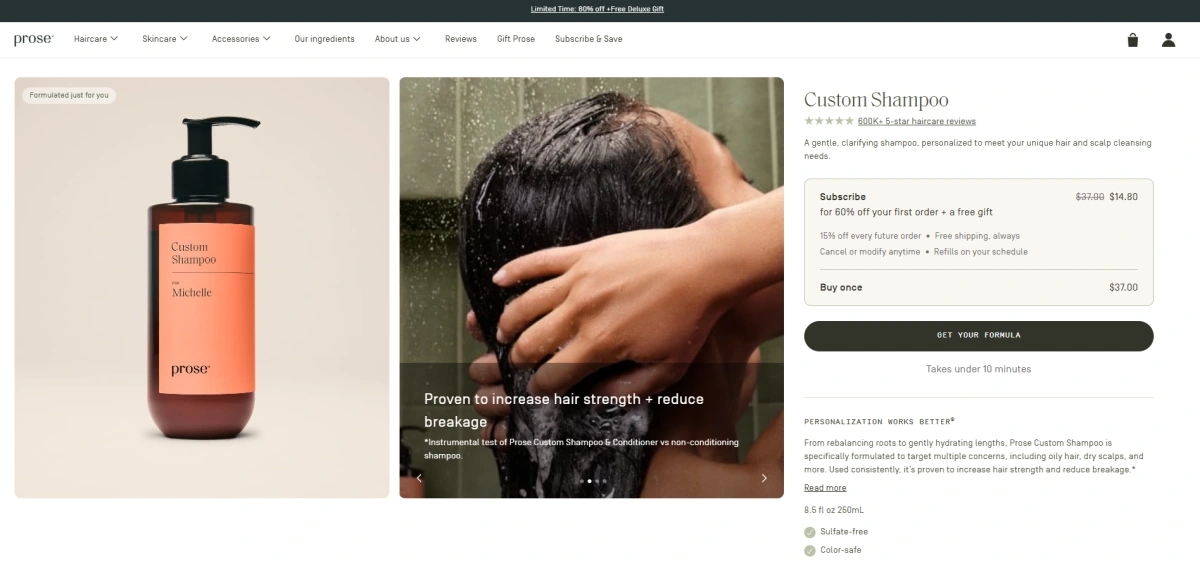
Sometimes the easiest way to fix your economics isn't raising the single-product price. It's giving customers a reason to buy more.
For example:
Offer | Price |
|---|---|
1 item | $29.99 |
2 items | $49.99 |
3 items | $64.99 |
The customer gets a better per-unit price, and you lift AOV.
This works especially well when customers naturally want multiple units and the extra units don't add much to your fulfillment cost.
Step 7: Use Psychological Pricing Carefully
Once you've got a price that actually holds up financially, you can work on how you present it.
That's where psychological pricing comes in.
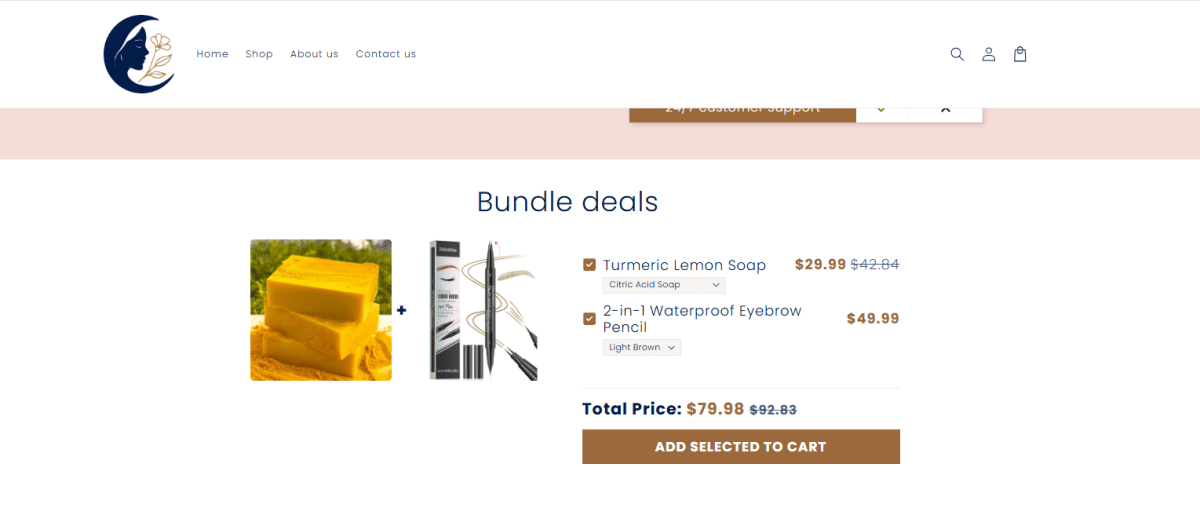
A price of $29.99 instead of $30 can feel a bit more attractive, and a bundle labeled "Best Value" makes the higher-ticket option easier to say yes to.
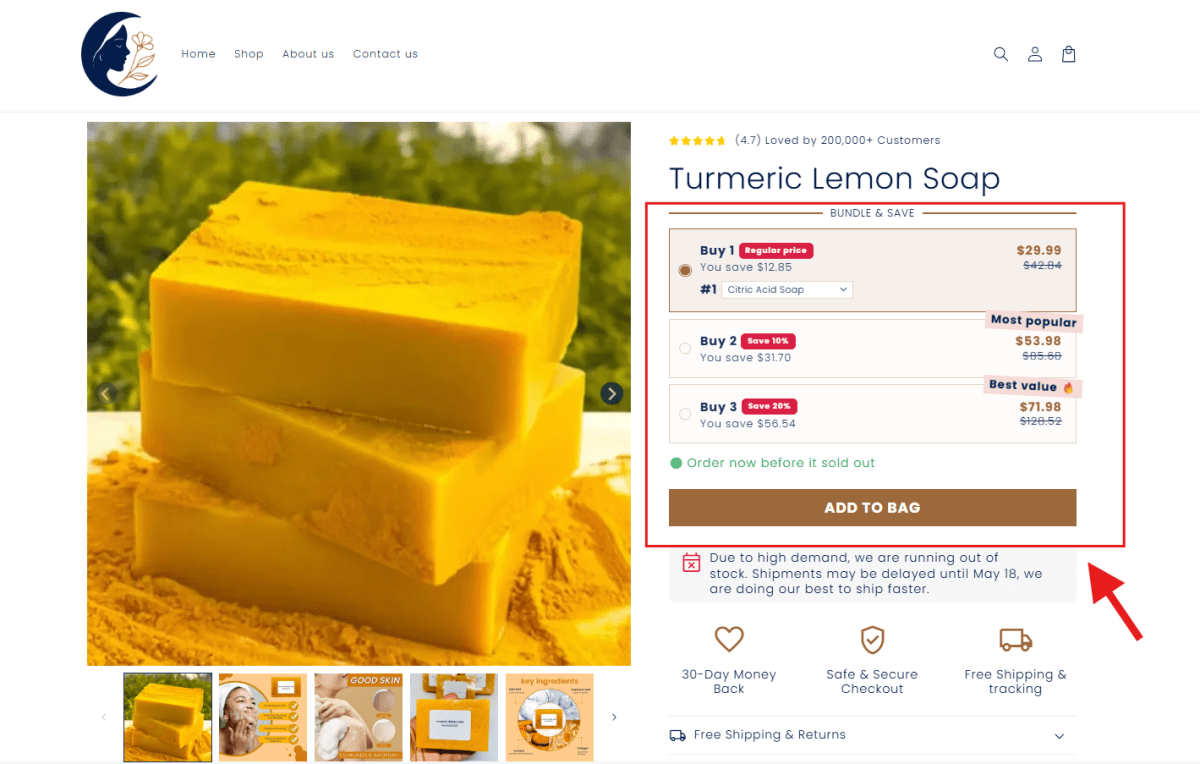
Charm pricing tends to help most with lower- and mid-priced products where customers are weighing several similar offers.
Just don't expect a .99 ending to save a weak offer. The gap between $29.99 and $30 won't matter if customers don't understand why they should buy in the first place.
Go easy on constant discounting, too. If customers always see a product marked down from $49.99 to $29.99, the "sale" eventually stops feeling like one.
Step 8: Match Your Price to Your Customer Acquisition Model
Your acquisition strategy should shape your pricing, because two stores selling the same product can have wildly different customer acquisition costs.
Take a $40 product with $18 in product, shipping, and payment-related costs. If it costs another $12 to acquire the customer, you're left with $10 before other overhead.
If CAC climbs to $18, that same order leaves you just $4.
That's why paid acquisition usually needs more pricing room.
Paid Ads
If you're running Meta, Google, or TikTok Ads, your expected CAC has to fit comfortably inside your product economics.
You don't want a price that only works when your ads perform at their absolute best. Leave room for CAC swings, creative testing, and scaling.
Organic and TikTok Traffic
Organic traffic gives you more flexibility since you're not paying a platform for every customer.
You can keep the same price and pocket more profit, or use that edge to offer a more competitive price.
The right call depends on whether you're chasing margin or using price as a growth lever.
High-Intent Search
Customers coming through high-intent searches are often comparing several products before they buy.
If comparable products sit around $30 and yours costs $45, you'll need to make the difference obvious through quality, features, branding, or the overall offer.
Here, competitive positioning matters as much as markup.
Influencer and Creator Traffic
Creator campaigns add another acquisition cost, usually through commissions.
If a creator takes 15% of a $40 sale, that's $6 of acquisition cost before your other expenses.
So your price needs enough contribution margin to absorb the commission without wrecking the order economics.
A useful way to think about it:
If that number is too small, you've got three levers: raise your price, cut acquisition costs, or cut product costs.
Step 9: Calculate Your Break-Even ROAS
If paid ads are part of your plan, your pricing also has to make sense against your break-even ROAS.
A simplified formula:
With a 50% gross margin:
1 ÷ 0.50 = 2.0
Your break-even ROAS is 2.0.
With a 70% gross margin:
1 ÷ 0.70 = 1.43
Your break-even ROAS is roughly 1.43.
Keep in mind this is a simplified benchmark. Real profitability also depends on payment fees, shipping, refunds, discounts, and other variable costs.
More importantly, break-even ROAS isn't your target ROAS. Breaking even on ad spend doesn't mean the business is turning a healthy profit.
Your pricing needs enough margin to support your acquisition strategy and still leave something for the business after all the relevant costs are paid.
Step 10: Test Different Product Prices
Your first price is a hypothesis, not a permanent decision.
Once you have enough traffic and orders, test whether a different price improves your overall economics.
You might test $29.99 vs. $34.99, or pit a single-product offer against a bundle offer.
Don't judge the result by conversion rate alone.
A lower price can lift conversion while shrinking profit per order. A higher price can nudge conversion down slightly but generate a lot more profit from the customers who do buy.
That's why a pricing test should look at the relationship between conversion, profit per order, CAC, and total net profit.
Say your $29.99 price converts at 4%, while $34.99 converts at 3.5%. The higher price isn't automatically worse. If the extra margin more than makes up for the conversion drop, it can produce better overall profit.
Test one pricing variable at a time, and give the experiment enough traffic to produce useful data.
Step 11: Monitor Profit at the Product and Order Level
Once your product is live, let your pricing be guided by what's actually happening in your store, not just what looked profitable before launch.
This is where metrics like net profit per order, net profit margin, CAC, refund rate, and AOV earn their keep.
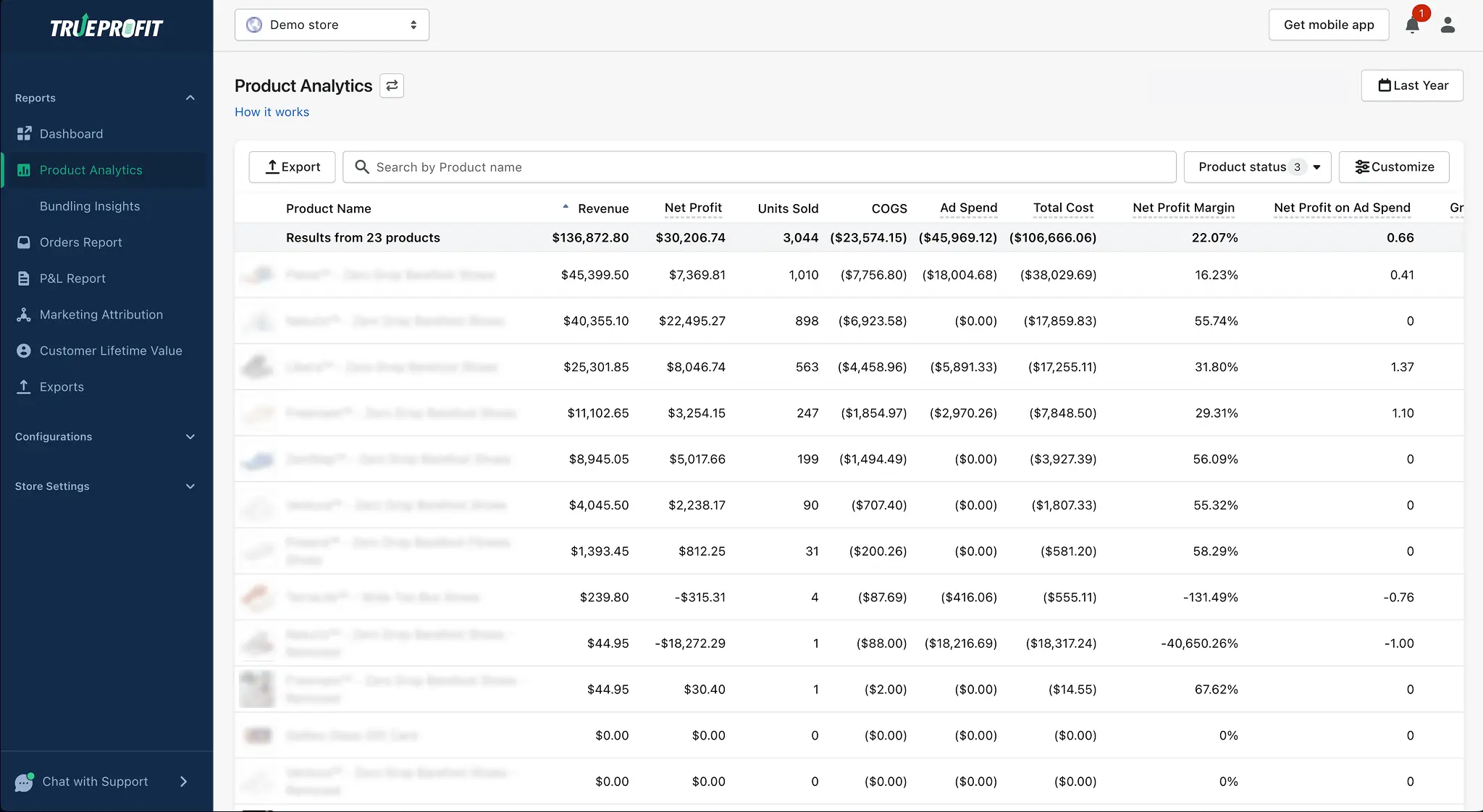
A product pulling in $20,000 in revenue sounds like a clear winner. But if advertising, shipping, payment fees, refunds, and other expenses leave you with only $1,500, the revenue number tells just part of the story.
Looking at profit at the product and order level shows you what's really working.
If net profit per order keeps coming in lower than expected, you can revisit your price, cut costs, improve your offer, or lift AOV. If the product holds healthy margins while converting well, you've got a much stronger case for scaling it.
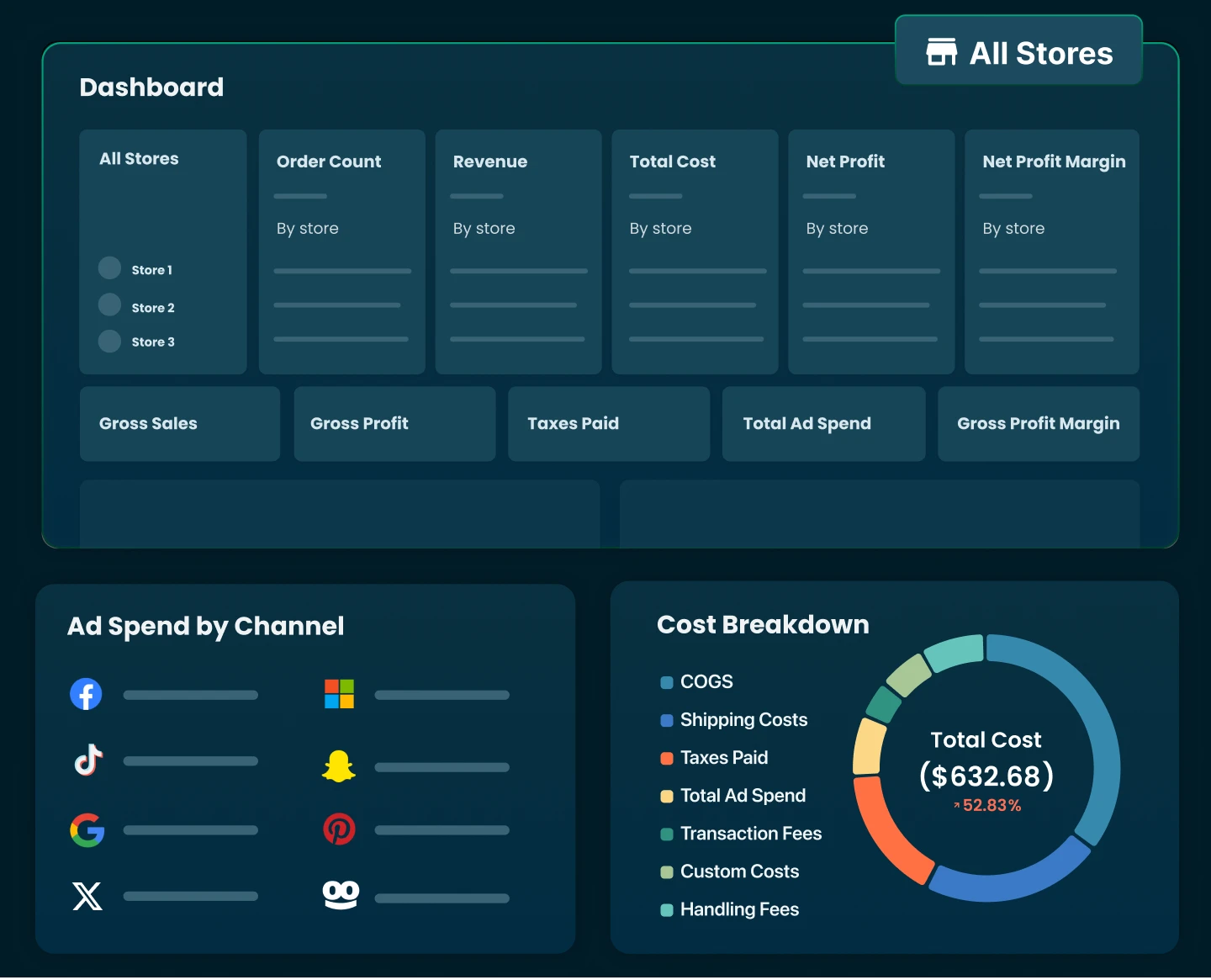
You can track all of this in a spreadsheet, but it's hard to be sure you've captured every cost that goes into an accurate net profit figure. It's also slow, and by the time the numbers are done, they're already out of date.
TrueProfit makes this simpler. As the number 1 net profit tracking tool for Shopify merchants, it pulls in every cost and every metric automatically and in real time, so you always know exactly what each product and order is really keeping, not just what your spreadsheet caught last week.
When to Raise or Lower Your Dropshipping Product Price
As your costs, competition, conversion rate, customer behavior, or acquisition strategy shift, your pricing may need to shift with them.
When to Raise Your Price
A price increase makes sense when your product keeps converting well but the profit you keep from each order is too thin.
It's also worth testing when supplier or advertising costs have gone up, or when your product has built stronger branding, quality, or positioning than comparable offers.
Instead of making a big jump, test a 5-10% increase first. For example, if your product sells for $37, try 38.99 - 39.99 and monitor your conversion rate, AOV, and profit per order.
If conversion remains stable and your profit improves, you can test another 5-10% increase. This step-by-step approach helps you find a higher price point without making a sudden change that could hurt demand.
When to Lower Your Price
A lower price makes sense when you're sitting well above comparable products without enough perceived value to justify the gap.
It's also worth testing if a previous price hike dropped conversion enough to hurt overall profit.
But don't assume more orders automatically make a lower price better. If you double your order volume while halving your profit per order, your total profit might not budge.
Look at conversion rate, profit per order, AOV, CAC, and total net profit before and after the change.
Your best price is a moving target. The goal isn't to keep tweaking it. It's to make sure your price keeps supporting both customer demand and profitable growth.
Final Thoughts
Learning how to price dropshipping products is really about finding the balance between what customers are willing to pay and what your business needs to make the sale worthwhile.
Start with your real costs. Build in enough margin for acquisition and other expenses. Check the market to make sure your price makes sense competitively, then test and refine it once you have real customer data.
Most importantly, don't let revenue or order volume become your only measure of success. A product can sell extremely well and still contribute little to your bottom line.
The strongest pricing strategy is one that gives customers a compelling reason to buy while leaving your store with enough net profit to keep acquiring customers, reinvesting, and scaling.

Harry Chu is the Founder of TrueProfit, a net profit tracking solution designed to help Shopify merchants gain real-time insights into their actual profits. With 11+ years of experience in eCommerce and technology, his expertise in profit analytics, cost tracking, and data-driven decision-making has made him a trusted voice for thousands of Shopify merchants.